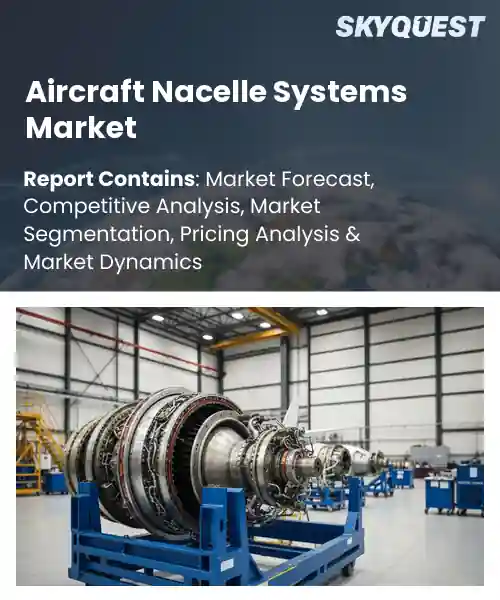
Aircraft Nacelle Systems Market
Report ID: SQMIG20A2648
Report ID: SQMIG20A2648
[email protected]
USA +1 351-333-4748
Report ID:
SQMIG20A2648 |
Region:
Global |
Published Date: June, 2026
Pages:
157
|Tables:
147
|Figures:
78


Global Aircraft Nacelle Systems Market size was valued at USD 9.6 Billion in 2024 and is poised to grow from USD 9.95 Billion in 2025 to USD 13.2 Billion by 2033, growing at a CAGR of 3.6% during the forecast period (2026-2033).
The aircraft nacelle systems market covers the making of engine cowling, thrust reverser bits, acoustic treatment panels ,and accessory compartments, mostly for both commercial and military jets. It matters a lot because the nacelle basically shapes aerodynamic efficiency, reduces noise, and even affects fuel consumption, so it can steer airline operating costs plus how well they meet regulatory rules.
Moreover, engine efficiency regulations are the main factors driving the global aircraft nacelle systems market growth, since stricter carbon-intensity limits force airlines to look for lower-drag, quieter options, which later convert into measurable cost savings. Due to that, manufacturers are pouring money into advanced composite materials and active noise-control approaches, and this can be seen in Safran’s work on a nacelle that’s about 30 percent lighter for the Airbus A321neo, which is said to cut fuel burn by 1.5 percent per flight. This push also creates openings for Tier-2 suppliers doing high-temperature sealants and additive-manufactured brackets, and it supports retrofit programs for older fleets, too, so market activity grows across both new-build and aftermarket streams.
AI-driven automation is reshaping nacelle production by smoothing out design, manufacturing, and inspection, like it all less stop-and-go. Sophisticated algorithms generate optimized nacelle shapes that can reduce material waste and shrink engineering time. Then robots tied to machine learning vision systems handle high precision assembly and surface finishing, which lowers manual labor and improves consistency, even when batches vary a little. Predictive maintenance tools look at sensor signals from test rigs, which helps spot potential defects earlier, and that in turn cuts rework expenses. Also, this whole change gives manufacturers more speed in reacting to new regulations and airline specs, and that boosts overall efficiency plus competitiveness as the sector keeps expanding.
Market snapshot - (2026-2033)
Global Market Size
USD 9.6 Billion
Largest Segment
Inlet Cowls
Fastest Growth
Thrust Reversers
Growth Rate
3.6% CAGR
To get more insights on this market click here to Request a Free Sample Report
The global aircraft nacelle systems market is segmented by component system focus, aircraft fleet application, engine configuration typology, structural material substrate, end-user procurement channel, and region. Based on component system focus, the market is categorized into Inlet Cowls, Fan Cowls, Thrust Reversers, Exhaust Systems, Engine Build-Up Units, and Others. By aircraft fleet application, the market is segmented into Commercial Aviation, Military Aviation, and General Aviation. Based on engine configuration typology, the market is divided into Turbofan Engines, Turboprop Engines, and Turboshaft Engines. By structural material substrate, the market is segmented into Advanced Carbon Fiber Composites, Lightweight Aluminum Alloys, High-Temperature Stainless Steel, and Titanium Alloys. Based on end-user procurement channel, the market is categorized into Original Equipment Manufacturer (OEM) Integration and Aftermarket Maintenance and Overhaul Services. Regionally, the market is analyzed across North America, Europe, Asia Pacific, Latin America, and the Middle East & Africa.
As per the aircraft nacelle systems market analysis, the Inlet cowls segment dominates a bit too much because they are the primary aerodynamic interface, the thing that governs airflow into the engine, which then directly affects fuel efficiency and thrust capability. Their design complexity is not small at all, so manufacturers end up pushing advanced shaping plus material integration, which makes them a must-have when trying to satisfy strict certification requirements. So naturally, OEMs sink a lot of engineering effort into inlet cowls, and that basically locks in their centrality inside nacelle architecture and system reliability.
Meanwhile, fan cowls are gaining the strongest growth momentum. That’s because newer high bypass engines want bigger fan diameters, and also tighter control over noise and acoustics. Lightweight composites and integrated noise reduction approaches are showing up faster, enabling quicker adoption, and that opens performance gains and regulatory alignment, which means market opportunities widen for manufacturers and their suppliers.
According to the aircraft nacelle systems market forecast, the turbofan engines segment dominates, mostly because it’s the common powerplant setup for commercial use and for a lot of military aircraft too. That means nacelles need refined designs to deal with high airflow quantities and major thermal loads. The efficiency story pushes OEMs to channel investments into optimized inlet, fan, and exhaust integration, so turbofan-compatible nacelles become a main development target. As a result, the market gets heavy R&D attention, more supplier coordination, and greater component standardization, all reinforcing dominance.
On the other hand, turboprop engines are showing the fastest expansion within nacelle systems. Short-haul aircraft are chasing better fuel economy and reduced operating expenses, and that drives demand. With newer nacelle concepts plus lighter material solutions, adoption becomes easier, which stimulates demand for exhaust configurations that are tailored as well as vibration damping measures, so overall market growth keeps moving upward.
To get detailed segments analysis, Request a Free Sample Report
As per the aircraft nacelle systems market regional forecast, North America is leading the market not just because of one thing, but also because there’s advanced engineering capabilities, a deep aerospace supply chain that actually works together , and they keep putting money into research and development. The whole region wins from having lots of big aircraft manufacturers and tier one suppliers in close range, so they cooperate on new propulsion ideas and acoustic technologies. On top of that, regulatory frameworks are robust , and commercial and defense operators push demand enough to keep the ecosystem moving. There’s also a skilled workforce, and that helps with lighter materials and digital manufacturing. all of this creates a loop, virtuous , and it keeps attracting partnerships from around the globe. Plus, there are world class testing facilities and a mature certification process, which means manufacturers can roll products out faster and adjust quickly to changing performance targets and environmental requirements. And don’t forget the connected network of universities, research institutes, and industry clusters, because that stuff feeds talent development and tech transfer, so the region stays like an innovation hub for high efficiency nacelle design.
United States Aircraft Nacelle Systems Market
In the United States, the aircraft nacelle systems sector thrives, on a dense set of original equipment manufacturers and a lively supplier network made up of Tier one specialists focusing on advanced aerostructures. The strong focus on aerospace research at top universities supports rapid prototyping and testing of new acoustic liners, plus thermal management solutions. There’s close alignment with defense programs and commercial airline initiatives, and that leads to continual refinement of weight-saving materials and integrated health monitoring technologies.
Canada Aircraft Nacelle Systems Market
The Canadian aircraft nacelle systems industry benefits from a well-established aerospace manufacturing base, plus government incentives that nudge green technology development. Collaborative programs between national research agencies and industry teams speed up adoption of lightweight composite materials and low emission propulsion integration. Also, being near to major North American airlines gives steady needs for retrofit solutions, while a capable engineering workforce maintains high standards in acoustic performance and thermal efficiency, including design and reliability.
The European aircraft nacelle systems market penetration is driven quickly because of a mix of strict environmental regulations, ambitious carbon reduction targets, and a history of collaborative engineering across multiple countries. Major aerospace centers help create tight links between aircraft makers, specialized supplier groups, and research organizations, so low noise and fuel efficient nacelle concepts get built quicker. Policy moves that support sustainable aviation fuels and greener propulsion technologies also force manufacturers to bring in advanced acoustic liners and aerodynamic shaping. At the same time, the European Union pushes circular economy ideas, which encourages recyclable composites and modular designs, and that shortens development timelines. This blend, regulatory pressure plus technical know how and cross border cooperation, makes Europe a fast moving engine for next generation nacelle innovation. Defense aviation programs also add extra demand,so suppliers can tailor solutions for both commercial and military platforms. Finally, more emphasis on digital twins and predictive maintenance tools improves reliability and lifecycle outcomes, and that increases trust with airline customers.
Germany Aircraft Nacelle Systems Market
In Germany, the aircraft nacelle systems market growth is supported by a solid web of engineering companies that specialize in high precision aerodynamic testing and composite material fabrication. Close work with leading aircraft manufacturers helps integrate noise reduction technologies with lightweight structures. Government backed research programs support the creation of next generation thermal management solutions, while a skilled workforce keeps quality steady and helps the sector adapt fast to shifting regulatory standards.
United Kingdom Aircraft Nacelle Systems Market
In the United Kingdom, the aircraft nacelle systems market outlook is seeing the fastest changes due to a cluster of innovative aerospace startups, plus strong university industry collaborations. A big emphasis on digital engineering and additive manufacturing helps validate prototypes faster, and reduces the time to market for advanced acoustic liners. Supportive government policies encourage investment in low emission propulsion integration, and there’s also a legacy of defense aerospace knowledge that deepens the supply chain, giving more resilience and quick technology diffusion across Europe.
France Aircraft Nacelle Systems Market
In France, the aircraft nacelle systems market remains dominant because of a heritage of aerospace strength ,and because there’s a concentration of tier one suppliers. Close ties with major aircraft manufacturers enable co development of integrated nacelle solutions focused on fuel efficiency and acoustic performance. National research programs highlight sustainable material science, which pushes adoption of recyclable composites. Strong after sales support and lifecycle services also strengthen customer confidence, helping the region maintain a competitive edge across commercial and regional jet segments.
Asia Pacific is reinforcing its stance in the aircraft nacelle systems market, mainly because of fast industrialization and also the strategic government push, plus there’s this noticeable increase in locally made aircraft programs. In many nations across the region, they invest heavily to modernize aerospace supply chains, and they keep building partnerships between local makers and global tier-one specialists so the technology transfer goes faster. There’s also a strong focus on lightweight composite fabrication , and then advanced acoustic treatments too, and it matches what regional airlines ask for, higher fuel efficiency and lower noise footprints. Meanwhile, aerospace clusters in major economies are growing, which pulls in a skilled talent pool, and it even helps research move along in thermal‑management and integrated health-monitoring systems. Taken together with the rising defense aviation needs, the whole picture turns into a fertile ground for scaling production capacity, plus advancing next‑generation nacelle designs across the Pacific basin. And the push toward digitalization—like AI‑driven design optimization, is further speeding up development cycles and improving performance predictability.
Japan Aircraft Nacelle Systems Market
In Japan, the Aircraft Nacelle Systems Market is supported by know-how in precision engineering, with a clear focus on high‑reliability parts for both commercial and defense platforms. There’s also collaborative research between top universities and large manufacturers, which helps with the integration of ultra‑lightweight materials, along with inventive acoustic liners. Government actions that prioritize sustainable aviation fuel compatibility nudge companies toward thermally efficient nacelle architectures, and this culture of continual improvement keeps their name tied to exceptional quality, and good performance.
South Korea Aircraft Nacelle Systems Market
The South Korean Aircraft Nacelle Systems Market is benefiting from the expansion of domestic aircraft manufacturing capabilities, and it also rides on strong governmental support for aerostructures. Partnerships between large conglomerates and specialized suppliers help speed up the uptake of high‑temperature resistant materials, and noise‑control know-how. There’s emphasis on digital twins, plus simulation tools, and that helps improve design accuracy while trimming the development timelines. With growing demand from regional carriers for fuel‑efficient jets, innovation keeps moving, and it positions South Korea as an emerging center for more sophisticated nacelle solutions.
To know more about the market opportunities by region and country, click here to
Buy The Complete Report
Increasing Demand for Fuel Efficiency
Regulatory Pressure for Emission Reduction
High Development Cost Burden
Supply Chain Vulnerabilities
Request Free Customization of this report to help us to meet your business objectives.
The global aircraft nacelle systems market gets shaped by intense competition between OEMs and specialist suppliers, with demand pulled along by the need for lighter, quieter and better fuel-efficient nacelles. Most players are trying to push tech upgrades, like advanced acoustic liners and high-temperature composite structures, while some recent M&A is basically merging know-how, and strategic partnerships speed up certification processes and supply-chain integration , a bit faster than before, in practice.
Top Player’s Company Profile
Recent Developments in the Aircraft Nacelle Systems Market
SkyQuest’s ABIRAW (Advanced Business Intelligence, Research & Analysis Wing) is our Business Information Services team that Collects, Collates, Correlates, and Analyses the Data collected by means of Primary Exploratory Research backed by robust Secondary Desk research.
As per SkyQuest analysis, the global aircraft nacelle systems market is being driven primarily by the rising demand for fuel efficiency, which pushes airlines and manufacturers toward lighter, aerodynamically optimized nacelles. As a second catalyst, stringent emission reduction regulations are nudging adoption of advanced acoustic liners and composite materials, even faster. Still, there’s a constraint, the high development cost burden from extensive CFD simulations, material testing and certification, which can discourage smaller players. North America keeps leading due to its strong aerospace supply chain with major OEMs and research institutions. In the overall product mix, the inlet cowl segment holds the largest share, since it directly controls airflow and drag, so it stays central to performance improvements.
| Report Metric | Details |
|---|---|
| Market size value in 2024 | USD 9.6 Billion |
| Market size value in 2033 | USD 13.2 Billion |
| Growth Rate | 3.6% |
| Base year | 2024 |
| Forecast period | (2026-2033) |
| Forecast Unit (Value) | USD Billion |
| Segments covered |
|
| Regions covered | North America (US, Canada), Europe (Germany, France, United Kingdom, Italy, Spain, Rest of Europe), Asia Pacific (China, India, Japan, Rest of Asia-Pacific), Latin America (Brazil, Rest of Latin America), Middle East & Africa (South Africa, GCC Countries, Rest of MEA) |
| Companies covered |
|
| Customization scope | Free report customization with purchase. Customization includes:-
|
To get a free trial access to our platform which is a one stop solution for all your data requirements for quicker decision making. This platform allows you to compare markets, competitors who are prominent in the market, and mega trends that are influencing the dynamics in the market. Also, get access to detailed SkyQuest exclusive matrix.
Table Of Content
Executive Summary
Market overview
Parent Market Analysis
Market overview
Market size
KEY MARKET INSIGHTS
COVID IMPACT
MARKET DYNAMICS & OUTLOOK
Market Size by Region
KEY COMPANY PROFILES
Methodology
For the Aircraft Nacelle Systems Market, our research methodology involved a mixture of primary and secondary data sources. Key steps involved in the research process are listed below:
1. Information Procurement: This stage involved the procurement of Market data or related information via primary and secondary sources. The various secondary sources used included various company websites, annual reports, trade databases, and paid databases such as Hoover's, Bloomberg Business, Factiva, and Avention. Our team did 45 primary interactions Globally which included several stakeholders such as manufacturers, customers, key opinion leaders, etc. Overall, information procurement was one of the most extensive stages in our research process.
2. Information Analysis: This step involved triangulation of data through bottom-up and top-down approaches to estimate and validate the total size and future estimate of the Aircraft Nacelle Systems Market.
3. Report Formulation: The final step entailed the placement of data points in appropriate Market spaces in an attempt to deduce viable conclusions.
4. Validation & Publishing: Validation is the most important step in the process. Validation & re-validation via an intricately designed process helped us finalize data points to be used for final calculations. The final Market estimates and forecasts were then aligned and sent to our panel of industry experts for validation of data. Once the validation was done the report was sent to our Quality Assurance team to ensure adherence to style guides, consistency & design.
Analyst Support
Customization Options
With the given market data, our dedicated team of analysts can offer you the following customization options are available for the Aircraft Nacelle Systems Market:
Product Analysis: Product matrix, which offers a detailed comparison of the product portfolio of companies.
Regional Analysis: Further analysis of the Aircraft Nacelle Systems Market for additional countries.
Competitive Analysis: Detailed analysis and profiling of additional Market players & comparative analysis of competitive products.
Go to Market Strategy: Find the high-growth channels to invest your marketing efforts and increase your customer base.
Innovation Mapping: Identify racial solutions and innovation, connected to deep ecosystems of innovators, start-ups, academics, and strategic partners.
Category Intelligence: Customized intelligence that is relevant to their supply Markets will enable them to make smarter sourcing decisions and improve their category management.
Public Company Transcript Analysis: To improve the investment performance by generating new alpha and making better-informed decisions.
Social Media Listening: To analyze the conversations and trends happening not just around your brand, but around your industry as a whole, and use those insights to make better Marketing decisions.
REQUEST FOR SAMPLE
 REQUEST FREE CUSTOMIZATION
Global Aircraft Nacelle Systems Market size was valued at USD 9.6 Billion in 2024 and is poised to grow from USD 9.95 Billion in 2025 to USD 13.2 Billion by 2033, growing at a CAGR of 3.6% during the forecast period (2026-2033).
The global aircraft nacelle systems market is shaped by intense competition among OEMs and specialist suppliers, with demand driven by the need for lighter, quieter and more fuel‑efficient nacelles. Companies are pursuing technology innovation such as advanced acoustic liners and high‑temperature composite structures, while recent M&A activity consolidates capabilities and strategic partnerships accelerate certification and supply‑chain integration. 'Safran', 'Spirit AeroSystems Inc.', 'RTX Corporation', 'GKN Aerospace', 'FACC AG', 'Leonardo S.p.A.', 'The NORDAM Group LLC', 'Aernnova Aerospace S.A.', 'Magellan Aerospace Corporation', 'Barnes Group Inc.', 'Woodward Inc.', 'Sonaca Group', 'Bombardier Inc.', 'Triumph Group Inc.', 'MHI Aero Engines Ltd.', 'Boeing Aerostructures Australia', 'Aero Vodochody AEROSPACE a.s.', 'Sicamb S.p.A.', 'Middle River Aerostructure Systems', 'Lisi Aerospace'
Growing emphasis on reducing operational costs drives airlines to prioritize aircraft designs that minimize fuel consumption, prompting manufacturers to develop advanced nacelle systems that improve aerodynamic performance, lower drag, and integrate lightweight materials, thereby supporting market expansion as airlines seek to meet sustainability targets while maintaining profitability, and encouraging OEMs to invest in research collaborations with engine suppliers to align propulsion and nacelle efficiencies for next‑generation solutions across both commercial and business aircraft fleets, reinforcing the strategic importance of innovative nacelle technologies.
Advanced Acoustic Optimization: Manufacturers are integrating sophisticated acoustic lining and active noise control technologies into nacelle designs to meet stricter cabin comfort standards and community noise regulations. By leveraging lightweight composite materials and signal processing, engineers achieve reductions in fan and turbine noise without compromising aerodynamic efficiency. This shift is driving collaborations with acoustic specialists and prompting redesigns of inlet and outlet geometries, positioning quieter nacelles as a differentiator in commercial aircraft procurement and enhancing brand perception among airlines focused on passenger experience.
Why does North America Dominate the Global Aircraft Nacelle Systems Market? |@12


Want to customize this report? This report can be personalized according to your needs. Our analysts and industry experts will work directly with you to understand your requirements and provide you with customized data in a short amount of time. We offer $1000 worth of FREE customization at the time of purchase.
Feedback From Our Clients


 USA (+1) 351-333-4748

