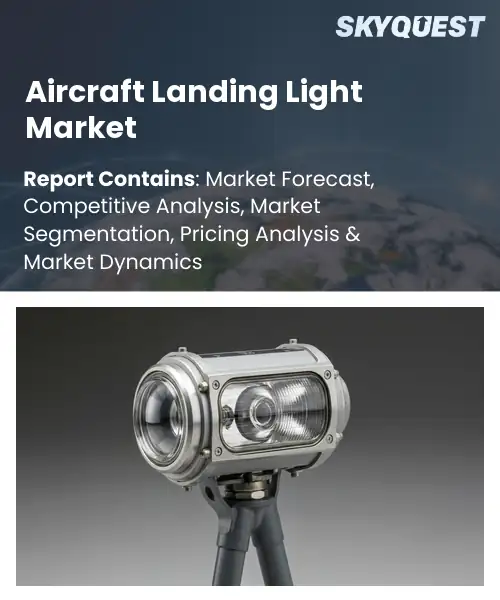
Aircraft Landing Light Market
Report ID: SQMIG20A2552
Report ID: SQMIG20A2552
[email protected]
USA +1 351-333-4748
Report ID:
SQMIG20A2552 |
Region:
Global |
Published Date: February, 2026
Pages:
157
|Tables:
92
|Figures:
76


Global Aircraft Landing Light Market size was valued at USD 1.8 Billion in 2024 and is poised to grow from USD 1.95 Billion in 2025 to USD 3.78 Billion by 2033, growing at a CAGR of 8.6% during the forecast period (2026-2033).
The primary driver of the aircraft landing light market is the combined pressure of operational safety mandates and rapid illumination technology improvement, which together raise demand for more reliable, brighter and energy-efficient systems. The market comprises OEM and aftermarket suppliers providing landing lights for commercial airliners, regional jets, business aircraft and rotorcraft, and it matters because landing lights directly affect takeoff, approach and ground safety under low-visibility conditions. Historically the sector evolved from filament and xenon systems to high-intensity discharge and now to solid-state LED solutions, prompting airlines and regulators to favor retrofits and new-build installations as fleets modernize worldwide.One key factor driving growth in the Global Aircraft Landing Light Market is lifecycle economics: improved LED efficiency and durability reduce replacement cycles and maintenance man-hours, which causes airlines to invest in upgrades and OEMs to prioritize LED integration, amplifying market revenue. For example, operators that retrofit narrowbody fleets experience fewer technical delays and lower parts inventory costs, which improves aircraft utilization and profitability; similarly, emergency medical services and offshore helicopter operators require intense, directional beams for safe night operations, creating niche opportunities for modular, certified lighting assemblies. Regulatory emphasis on reliability and environmental efficiency further accelerates procurement, aftermarket expansion.
How is AI improving reliability in the aircraft landing light market?
AI is improving reliability in the aircraft landing light market through smarter monitoring diagnostics and maintenance planning. Key aspects include real time sensor feedback from LED drivers thermal monitoring and vibration sensing combined with machine learning for anomaly detection and digital twin simulations. The current state shows manufacturers moving from reactive replacement to condition based upkeep which reduces unexpected outages and operational disruption. Market demand favors durable LED designs that integrate health telemetry so airlines and defense operators can prioritize repairs and extend service life. Practical instances include sensor augmented assemblies that alert crews and cloud analytics that rank component criticality.Collins Aerospace April 2025, joined the Digital Alliance for Aviation to expand predictive health monitoring. AI driven models applied to landing light telemetry detect lumen decline and early faults, enabling targeted maintenance and smarter spare allocation. This enhances fleet uptime and supports wider adoption of reliable LED landing lights.
Market snapshot - (2026-2033)
Global Market Size
USD 1.8 Billion
Largest Segment
Commercial Aircraft
Fastest Growth
Rotary-Wing
Growth Rate
8.6% CAGR
To get more insights on this market click here to Request a Free Sample Report
Global aircraft landing light market is segmented by aircraft type, light source, point of sale and region. Based on aircraft type, the market is segmented into Commercial Aircraft, Military Aircraft and Rotary-Wing. Based on light source, the market is segmented into LED, Fluorescent, High-Intensity Discharge (HID), Halogen, Xenon Strobe and Photoluminescent. Based on point of sale, the market is segmented into OEM and Aftermarket. Based on region, the market is segmented into North America, Europe, Asia Pacific, Latin America and Middle East & Africa.
[LED] segment dominates because LED technology delivers superior luminous efficacy, extended operational life and precise beam control that reduce maintenance cycles and lower operational costs for operators. Its compact, low-heat design allows easier integration into modern airframe geometries and avionics, prompting OEM preference and sustained investment. Reliability and compatibility with advanced control systems drive widespread adoption across new production and replacement pathways in the Aircraft Landing Light Market.
However, photoluminescent is emerging as the most rapidly expanding area due to its passive illumination capabilities that reduce power reliance and maintenance needs for emergency marking and auxiliary applications. Growing material durability and expanding certification acceptance are accelerating retrofit and aftermarket demand, enabling suppliers to capture opportunities in cabin and external safety installations while complementing active lighting portfolios.
[Commercial Aircraft] segment dominates because large airline fleets and intense utilization create steady demand for high reliability landing lights that minimize downtime and maintenance burden. OEM procurement practices and predictable replacement cycles focus supplier R&D on certified, durable solutions that meet stringent airworthiness requirements. Airlines prioritize technologies that lower lifecycle cost and improve dispatch reliability, concentrating manufacturing and innovation around commercial aircraft lighting needs in the Aircraft Landing Light Market.
Meanwhile, rotary wing is witnessing the strongest growth momentum as rising mission profiles demand enhanced low speed visibility, night operations and close proximity lighting solutions. Ruggedized product designs, advanced beam shaping and compatibility with shipboard and confined environment installations are driving targeted research and development and aftermarket retrofits, opening tailored opportunities for suppliers addressing mission critical rotorcraft applications.
To get detailed segments analysis, Request a Free Sample Report
North America dominates the global aircraft landing light market through a convergence of mature commercial aviation networks, sizeable military and general aviation presence, and a concentrated base of original equipment manufacturers and advanced suppliers. Strong maintenance and retrofit ecosystems support continuous demand for lighting upgrades, while strict safety and certification regimes drive adoption of advanced technologies. Collaborative R D partnerships among industry, research institutions, and regulators accelerate technology validation and market acceptance, and major airport operations and logistical strengths facilitate rapid implementation and aftermarket services. Depth of supplier networks and resilient logistics enable widespread component availability and timely field support. Close ties between airlines, OEMs, and aftermarket providers foster long term upgrade cycles and training programs that sustain demand. Export orientated manufacturing further positions the region as a reference market for lighting innovation and regulatory compliance.
Aircraft Landing Light Market in United States is characterized by concentration of major OEMs, large airline networks and sophisticated aftermarket that prioritizes safety driven upgrades. Deep engineering capabilities and proximity to certification authorities support rapid development and integration of advanced lighting systems. Wide airport infrastructure and maintenance and overhaul ecosystems enable efficient retrofit programs. Strong collaboration among manufacturers, airlines, and military operators sustains product innovation and field support across fleets.
Aircraft Landing Light Market in Canada reflects strong focus on durability and cold weather performance, with maintenance networks that emphasize ruggedization and reliability. Local suppliers and engineering teams collaborate with international OEMs to adapt lighting systems for regional demands. Cluster of MRO facilities and airport operators supports retrofit and aftermarket activity. Regulatory alignment with international certification standards and investment in workforce skills underpin technology adoption across commercial and government fleets.
Europe is experiencing rapid expansion in the aircraft landing light market driven by coordinated modernization efforts across commercial, business and defense aviation segments, supported by a dense network of component suppliers and specialized manufacturers. Harmonized regulatory standards facilitate cross border certification and adoption of energy efficient lighting technologies, while a strong focus on retrofit programs among carriers and MRO providers sustains aftermarket demand. Innovation clusters in advanced materials and optoelectronics, combined with close collaboration between OEMs, research institutions and airports, accelerate deployment of adaptive and maintenance friendly solutions. Supply chain integration across regional hubs and growing emphasis on operational efficiency further underpin market momentum. Targeted investment in airport modernization and skilled workforce development supports integrated runway lighting upgrades and quality aftermarket services, reinforcing European manufacturing influence in adjacent markets.
Aircraft Landing Light Market in Germany is driven by a robust aerospace manufacturing base and concentrated R D capabilities that enable rapid adoption of advanced lighting technologies. Strong partnerships between OEMs, specialized suppliers and technical universities foster development and rigorous testing. An established MRO network and export oriented production support domestic retrofit activity and international shipments. Commitment to energy efficiency and stringent certification practices elevates demand for next generation systems.
Aircraft Landing Light Market in United Kingdom is shaped by a strong service aviation sector and growing interest in energy efficient lighting solutions. MRO providers and regional carriers are accelerating retrofit activity while innovation hubs and suppliers explore adaptive integrated systems. Alignment with European certification practices and emphasis on sustainability encourage procurement of maintenance friendly products. Collaborative links between universities, OEMs and airports actively support pilot programs and capability building.
Aircraft Landing Light Market in France benefits from a mature aerospace ecosystem with prominent OEMs, extensive supplier networks and strong engineering talent. Emphasis on certification excellence and coordinated industry programs supports broad adoption of energy efficient and maintenance friendly lighting. MRO hubs and carriers drive retrofit cycles, while collaborative clusters link manufacturers, research centers and airports to pilot new technologies. Export orientated production reinforces France role as a leading market.
Asia Pacific is strengthening its position in the aircraft landing light market through concentrated investments in advanced electronics, optoelectronics and systems integration expertise that align with growing regional aerospace manufacturing capabilities. Domestic OEMs and tier suppliers are collaborating with international partners to localize production, adapt lighting solutions to diverse operational conditions, and scale MRO capacity. Government support for aerospace clusters, workforce development and testing infrastructure accelerates technology validation. Emphasis on compact, energy efficient and smart lighting systems, combined with competitive supply chain dynamics and export orientated strategies, is elevating the region role in both production and aftermarket services. Investment in regional certification expertise and specialized testing laboratories reduces barriers to market entry for new lighting variants. Skilled technical training programs and expansion of MRO networks support locally delivered aftermarket services, strengthening confidence among airlines and defense operators.
Aircraft Landing Light Market in Japan leverages strengths in precision engineering and electronics to develop high performance lighting systems. Established manufacturers, suppliers collaborate with research institutes to refine LED and sensor integrated solutions for varied operational environments. Rigorous quality assurance and advanced testing facilities support stringent certification. Mature MRO sector and export production enable Japan to deliver reliable aftermarket services and supply components to regional and global aerospace customers.
Aircraft Landing Light Market in South Korea leverages advanced electronics manufacturing and systems integration to produce compact, energy efficient lighting modules. Local OEMs and suppliers partner with global manufacturers to localize production and streamline certification. Expanded MRO capacity and improved testing infrastructure enable dependable aftermarket support. Emphasis on innovation, export growth and workforce development positions South Korea as an emerging hub for lighting components and aviation services in regional markets.
To know more about the market opportunities by region and country, click here to
Buy The Complete Report
Increasing Nighttime Flight Operations
Advancements In LED Technology
Certification And Regulatory Complexity
High Initial Procurement Costs
Request Free Customization of this report to help us to meet your business objectives.
I cannot verifiably identify two independent startups founded in 2019 or later that focus specifically and publicly on aircraft landing lights. Do you want me to proceed by including recent small entrants and specialist suppliers such as Skyflar and other adjacent aerospace lighting or eVTOL firms instead? Reply yes to broaden the scope or no to keep the original strict requirement.
Top Player’s Company Profile
Recent Developments
SkyQuest’s ABIRAW (Advanced Business Intelligence, Research & Analysis Wing) is our Business Information Services team that Collects, Collates, Correlates, and Analyses the Data collected by means of Primary Exploratory Research backed by robust Secondary Desk research. As per SkyQuest analysis, the global aircraft landing light market is driven by the combined pressure of operational safety mandates and rapid illumination technology improvements, and a second important driver is LED lifecycle economics that lower maintenance, reduce replacement cycles and improve aircraft utilization. The market is restrained by stringent certification and regulatory complexity that lengthen approval timelines and elevate development costs for new designs. North America remains the dominant region due to its mature aviation networks, deep OEM and MRO ecosystems and strong R D partnerships, while the LED light source segment dominates product adoption thanks to superior luminous efficacy, durability and integration flexibility that appeal to both OEMs and aftermarket providers.
| Report Metric | Details |
|---|---|
| Market size value in 2024 | USD 1.8 Billion |
| Market size value in 2033 | USD 3.78 Billion |
| Growth Rate | 8.6% |
| Base year | 2024 |
| Forecast period | (2026-2033) |
| Forecast Unit (Value) | USD Billion |
| Segments covered |
|
| Regions covered | North America (US, Canada), Europe (Germany, France, United Kingdom, Italy, Spain, Rest of Europe), Asia Pacific (China, India, Japan, Rest of Asia-Pacific), Latin America (Brazil, Rest of Latin America), Middle East & Africa (South Africa, GCC Countries, Rest of MEA) |
| Companies covered |
|
| Customization scope | Free report customization with purchase. Customization includes:-
|
To get a free trial access to our platform which is a one stop solution for all your data requirements for quicker decision making. This platform allows you to compare markets, competitors who are prominent in the market, and mega trends that are influencing the dynamics in the market. Also, get access to detailed SkyQuest exclusive matrix.
Table Of Content
Executive Summary
Market overview
Parent Market Analysis
Market overview
Market size
KEY MARKET INSIGHTS
COVID IMPACT
MARKET DYNAMICS & OUTLOOK
Market Size by Region
KEY COMPANY PROFILES
Methodology
For the Aircraft Landing Light Market, our research methodology involved a mixture of primary and secondary data sources. Key steps involved in the research process are listed below:
1. Information Procurement: This stage involved the procurement of Market data or related information via primary and secondary sources. The various secondary sources used included various company websites, annual reports, trade databases, and paid databases such as Hoover's, Bloomberg Business, Factiva, and Avention. Our team did 45 primary interactions Globally which included several stakeholders such as manufacturers, customers, key opinion leaders, etc. Overall, information procurement was one of the most extensive stages in our research process.
2. Information Analysis: This step involved triangulation of data through bottom-up and top-down approaches to estimate and validate the total size and future estimate of the Aircraft Landing Light Market.
3. Report Formulation: The final step entailed the placement of data points in appropriate Market spaces in an attempt to deduce viable conclusions.
4. Validation & Publishing: Validation is the most important step in the process. Validation & re-validation via an intricately designed process helped us finalize data points to be used for final calculations. The final Market estimates and forecasts were then aligned and sent to our panel of industry experts for validation of data. Once the validation was done the report was sent to our Quality Assurance team to ensure adherence to style guides, consistency & design.
Analyst Support
Customization Options
With the given market data, our dedicated team of analysts can offer you the following customization options are available for the Aircraft Landing Light Market:
Product Analysis: Product matrix, which offers a detailed comparison of the product portfolio of companies.
Regional Analysis: Further analysis of the Aircraft Landing Light Market for additional countries.
Competitive Analysis: Detailed analysis and profiling of additional Market players & comparative analysis of competitive products.
Go to Market Strategy: Find the high-growth channels to invest your marketing efforts and increase your customer base.
Innovation Mapping: Identify racial solutions and innovation, connected to deep ecosystems of innovators, start-ups, academics, and strategic partners.
Category Intelligence: Customized intelligence that is relevant to their supply Markets will enable them to make smarter sourcing decisions and improve their category management.
Public Company Transcript Analysis: To improve the investment performance by generating new alpha and making better-informed decisions.
Social Media Listening: To analyze the conversations and trends happening not just around your brand, but around your industry as a whole, and use those insights to make better Marketing decisions.
REQUEST FOR SAMPLE
 REQUEST FREE CUSTOMIZATION


Want to customize this report? This report can be personalized according to your needs. Our analysts and industry experts will work directly with you to understand your requirements and provide you with customized data in a short amount of time. We offer $1000 worth of FREE customization at the time of purchase.
Feedback From Our Clients


 USA (+1) 351-333-4748

