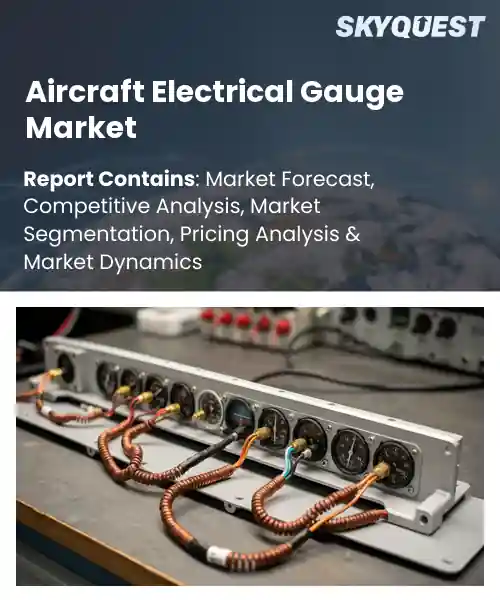
Aircraft Electrical Gauge Market
Report ID: SQMIG20A2802
Report ID: SQMIG20A2802
[email protected]
USA +1 351-333-4748
Report ID:
SQMIG20A2802 |
Region:
Global |
Published Date: July, 2026
Pages:
157
|Tables:
118
|Figures:
73


Global Aircraft Electrical Gauge Market size was valued at USD 97.16 Billion in 2024 and is poised to grow from USD 100.37 Billion in 2025 to USD 130.13 Billion by 2033, growing at a CAGR of 3.3% during the forecast period (2026-2033).
The global aircraft electrical gauge market comprises instruments that convert electrical signals into visual indicators of altitude, speed, engine performance, and system health, essential for pilot awareness. Its importance grew as airlines demanded reliability and avionics replaced analog panels. A primary driver has been the shift toward integrated cockpit architectures, notably the adoption of glass‑cockpit displays that require gauges for redundancy. Over the past two decades firms such as Honeywell and Collins have moved from mechanical dial gauges to sensors, reducing weight and maintenance while boosting diagnostic accuracy. This evolution expanded the market’s scope from legacy retrofits to narrow‑body programs.
Regulatory pressure for enhanced safety monitoring drives the aircraft electrical gauge market because agencies such as EASA and FAA now require health reporting on airframes. Airlines meet this by retrofitting fleets with gauges that stream data to predictive‑maintenance platforms, enabling detection of component failure and cutting downtime. The resulting demand spurs investment in gauge modules that merge wireless telemetry with displays, offering suppliers a chance to provide integrated solutions rather than separate instruments. Lufthansa’s adoption of cloud‑based gauge analytics on its A320neo fleet, which lowered engine‑related delays by 12 %, demonstrates how data‑driven upgrades generate cost savings and improve dispatch reliability.
How Is AI-Driven Automation Influencing the Accuracy and Reliability of Aircraft Electrical Gauge Systems?
AI‑driven automation is reshaping aircraft electrical gauge systems by embedding intelligent diagnostics directly into the hardware. Sensors now feed real‑time data to machine‑learning models that detect drift, predict failure and auto‑adjust calibration, which reduces manual checks and improves consistency. The technology also enables self‑healing algorithms that correct minor anomalies before they affect pilot displays, raising overall reliability. The electrification of aircraft has led manufacturers to incorporate these capabilities to keep up with improved safety regulations and to optimize maintenance cycles. Consequently, there is an enhanced communication between operations and maintenance, making the data collected more reliable and reducing the downtime of the aircraft.
In January 2025, Honeywell expanded its partnership with NXP Semiconductors to develop AI-driven aviation technologies by integrating Honeywell Anthem avionics with NXP’s autonomy computing platform. The collaboration enhances intelligent flight management, predictive cockpit systems, and aircraft monitoring, supporting next-generation electrical gauges and engine indication systems with improved situational awareness and operational safety.
Market snapshot - (2026-2033)
Global Market Size
USD 97.16 Billion
Largest Segment
Multifunction Indicators
Fastest Growth
Multifunction Indicators
Growth Rate
3.3% CAGR
To get more insights on this market click here to Request a Free Sample Report
Global aircraft electrical gauge market is segmented by gauge type, technology class, aircraft fleet, sales channel and region. Based on gauge type, the market is segmented into ammeters, voltmeters, frequency meters, loadmeters and multifunction indicators. Based on technology class, the market is segmented into analog gauges, digital displays and glass integrated. Based on aircraft fleet, the market is segmented into fixed wing, rotary wing and advanced mobility. Based on sales channel, the market is segmented into aerospace OEMs and aftermarket MRO. Based on region, the market is segmented into North America, Europe, Asia Pacific, Latin America and Middle East & Africa.
Analog gauges segment dominates because aircraft manufacturers value the proven reliability and immediate readability of needle type instruments, which align with stringent safety standards and low maintenance requirements. The tactile feedback and shielding from electromagnetic interference create a feeling of confidence in both pilots and maintenance crews, therefore encouraging the use of analog approaches in both old and new systems. Consequently, this segment remains the cornerstone of gauge selection for most commercial and military fleets.
However, digital displays segment is witnessing the strongest growth momentum as avionics integration moves toward glass cockpits and advanced data visualization.Showing many parameters on configurable screens helps reduce panel clutter and enables predictive maintenance algorithms, encouraging more companies to adopt the technology in future aircraft and creating opportunities for system providers.
Multifunction indicators segment leads because they consolidate several measurement functions into a single display, simplifying cockpit architecture and reducing weight penalties. The use of integrated indicators contributes to improved situational awareness for users. Moreover, its manufacturers are able to take more advantage of simpler cabling and improved certification processes as a result of this approach. It is due to the combination of efficiency and functionality that the multifunction display is one of the most commonly used devices in aeronautics.
Meanwhile, glass integrated segment emerges as the key highgrowth area as manufacturers adopt full color, high resolution panels that can fuse navigation, engine data, and health monitoring. The seamless integration with digital networks enhances real time diagnostics and supports advanced flight management functions, prompting rapid uptake in both new builds and retrofits, and opening lucrative pathways for sensor and software providers.
To get detailed segments analysis, Request a Free Sample Report
North America leads the market through a combination of advanced aerospace engineering capabilities, strong defense procurement frameworks, and a robust ecosystem of original equipment manufacturers and specialized component suppliers. The region has deep ties between research institutions and various industries, which ensures quick implementation of modern sensor technologies and top-quality pressure measure solutions. The legal framework prioritizes safety and quality of performance and therefore has created a demand for innovative electrical measurement technologies. Collaboration of airlines, manufacturers, and MRO providers creates feedback loops that promote product improvements and help the companies to maintain comparative advantages globally.
Aircraft electrical gauge market in the United States is propelled by a high concentration of major aircraft manufacturers and a strong tradition of aerospace innovation. The presence of leading research universities and a vibrant supplier network accelerates the development of next‑generation gauge technologies. Both the extensive military contracts and the large fleets of commercial airlines have resulted in a consistent need for dependable instruments, thus establishing the U.S.A. as a standard that others aim to meet.
Aircraft electrical gauge market in Canada benefits from a supportive governmental policy environment that encourages aerospace research and export growth. Collaborative arrangements among local industries and global partners encourage the transfer of technology and improve product availability. Both the concern on safety standards and the escalating demand from actors in the region demonstrate Canada’s capabilities as a trustworthy provider of quality gauge solutions in North America.
Europe’s expansion is driven by a convergence of stringent regulatory standards, a strong emphasis on sustainability, and deep engineering expertise across its aerospace sector. The commitment to lightweight and energy-efficient aircraft designs in the region enhances the use of advanced electric measurement systems which allow for accurate monitoring and diagnostics. Joint research programs of top universities and aircraft manufacturers speed up innovations in aviation while developed commercial aviation network ensures demand for the needed instrumentation. Moreover, developed supply chain system across different countries facilitates the fast introduction of the leading measurement technologies making Europe the place for market expansion.
Aircraft electrical gauge market in Germany showcases dominant capabilities rooted in a long history of precision engineering and strong automotive‑aerospace cross‑pollination. Industry clusters centered around major aerospace hubs nurture close cooperation between OEMs and component specialists, fostering high‑quality gauge solutions. Germany emphasizes its excellence in the field of advanced instrumentation for both military and commercial aviation thanks to its extreme reliability and performance as well as tough certification requirements.
Aircraft electrical gauge market in the United Kingdom experiences rapid growth fueled by innovative research programs and a vibrant start‑up ecosystem focused on aerospace technologies. Strategic government initiatives promote cooperation between academic institutions and manufacturers, driving innovation in the development of smart gauge systems. The UK’s active participation in international aerospace projects as well as the growing fleet of modern aircraft significantly increases the demand for advanced electrical monitoring solutions, making the market one of the most dynamic segments in Europe.
Aircraft electrical gauge market in France is emerging through a combination of strong governmental support for aerospace projects and a network of specialized suppliers. The development of advanced instruments emphasizing safety and efficiency results from collaboration between the best aircraft companies and research centers. Increasing adoption by regional airlines and a focus on integration with digital cockpit architectures underline France’s rising influence in the continental market landscape.
Asia Pacific advances its position through aggressive investment in aerospace infrastructure, a burgeoning commercial airline base, and a strategic focus on technology transfer from established market leaders. Manufacturers in the region are adopting cutting-edge technologies like digitalization as well as sensor integration to cater to the increasing demand for precise systems for electrical measurement. Partnerships with global companies along with the focus on solutions that are both cost-effective and reliable are making it easy to boost production capacity. As a result, rapidly developing human resources along with supportive government policies make the region a significant player in the global market for systems for electrical measurement in aircrafts.
Aircraft electrical gauge market in Japan benefits from a well‑established aerospace tradition and a commitment to high‑precision manufacturing. Close ties between major aircraft producers and specialized gauge suppliers facilitate the development of reliable, high‑performance instrumentation. The importance of the highest safety requirements, as well as constant developments in the sphere of innovation, leads to the growing weight of the advanced electrical monitoring solutions in civil and military aviation industries.
Aircraft electrical gauge market in South Korea is propelled by a dynamic mix of innovative engineering and strong governmental initiatives supporting aerospace growth. Collaboration among major electronic companies and aircraft manufacturers drives the development of innovative measuring technologies based on reliability and efficiency. The expansion of the commercial fleet and rising exports help strengthen South Korea's growing status in the regional aircraft electrical measuring technology.
To know more about the market opportunities by region and country, click here to
Buy The Complete Report
Increasing Adoption Of Advanced Avionics
Shift Toward Digital Instrumentation
Stringent Certification Requirements
High Cost Of Advanced Materials
Request Free Customization of this report to help us to meet your business objectives.
The competitive landscape in the global aircrafts electrical gauge market outlook is shaped by emerging electric‑propulsion innovators and traditional aerospace manufacturers racing to integrate advanced gauge technologies. Companies such as Natilus, Boom Supersonic, Otto Aviation and Transcend Air are showcasing new aircraft concepts, prompting strategic partnerships and technology‑focused collaborations that accelerate product differentiation and market entry.
Top Player’s Company Profile
Recent Developments
SkyQuest’s ABIRAW (Advanced Business Intelligence, Research & Analysis Wing) is our Business Information Services team that Collects, Collates, Correlates, and Analyses the Data collected by means of Primary Exploratory Research backed by robust Secondary Desk research.
As per SkyQuest analysis, the global aircraft electrical gauge industry is being propelled primarily by the increasing adoption of advanced avionics that demand precise, reliable instrumentation, while a second strong catalyst is the shift toward digital cockpit integration which enables lighter panels and real‑time data visualization. However, stringent certification requirements pose a notable restraint by extending development timelines and raising costs. North America remains the dominant region, benefiting from a robust aerospace ecosystem and leading OEM presence. The market dominance of the segment of analog gauges remains due to proven reliability and low maintenance requirements despite being pushed aside by the multifunction digital solutions.
| Report Metric | Details |
|---|---|
| Market size value in 2024 | USD 97.16 Billion |
| Market size value in 2033 | USD 130.13 Billion |
| Growth Rate | 3.3% |
| Base year | 2024 |
| Forecast period | (2026-2033) |
| Forecast Unit (Value) | USD Billion |
| Segments covered |
|
| Regions covered | North America (US, Canada), Europe (Germany, France, United Kingdom, Italy, Spain, Rest of Europe), Asia Pacific (China, India, Japan, Rest of Asia-Pacific), Latin America (Brazil, Rest of Latin America), Middle East & Africa (South Africa, GCC Countries, Rest of MEA) |
| Companies covered |
|
| Customization scope | Free report customization with purchase. Customization includes:-
|
To get a free trial access to our platform which is a one stop solution for all your data requirements for quicker decision making. This platform allows you to compare markets, competitors who are prominent in the market, and mega trends that are influencing the dynamics in the market. Also, get access to detailed SkyQuest exclusive matrix.
Table Of Content
Executive Summary
Market overview
Parent Market Analysis
Market overview
Market size
KEY MARKET INSIGHTS
COVID IMPACT
MARKET DYNAMICS & OUTLOOK
Market Size by Region
KEY COMPANY PROFILES
Methodology
For the Aircraft Electrical Gauge Market, our research methodology involved a mixture of primary and secondary data sources. Key steps involved in the research process are listed below:
1. Information Procurement: This stage involved the procurement of Market data or related information via primary and secondary sources. The various secondary sources used included various company websites, annual reports, trade databases, and paid databases such as Hoover's, Bloomberg Business, Factiva, and Avention. Our team did 45 primary interactions Globally which included several stakeholders such as manufacturers, customers, key opinion leaders, etc. Overall, information procurement was one of the most extensive stages in our research process.
2. Information Analysis: This step involved triangulation of data through bottom-up and top-down approaches to estimate and validate the total size and future estimate of the Aircraft Electrical Gauge Market.
3. Report Formulation: The final step entailed the placement of data points in appropriate Market spaces in an attempt to deduce viable conclusions.
4. Validation & Publishing: Validation is the most important step in the process. Validation & re-validation via an intricately designed process helped us finalize data points to be used for final calculations. The final Market estimates and forecasts were then aligned and sent to our panel of industry experts for validation of data. Once the validation was done the report was sent to our Quality Assurance team to ensure adherence to style guides, consistency & design.
Analyst Support
Customization Options
With the given market data, our dedicated team of analysts can offer you the following customization options are available for the Aircraft Electrical Gauge Market:
Product Analysis: Product matrix, which offers a detailed comparison of the product portfolio of companies.
Regional Analysis: Further analysis of the Aircraft Electrical Gauge Market for additional countries.
Competitive Analysis: Detailed analysis and profiling of additional Market players & comparative analysis of competitive products.
Go to Market Strategy: Find the high-growth channels to invest your marketing efforts and increase your customer base.
Innovation Mapping: Identify racial solutions and innovation, connected to deep ecosystems of innovators, start-ups, academics, and strategic partners.
Category Intelligence: Customized intelligence that is relevant to their supply Markets will enable them to make smarter sourcing decisions and improve their category management.
Public Company Transcript Analysis: To improve the investment performance by generating new alpha and making better-informed decisions.
Social Media Listening: To analyze the conversations and trends happening not just around your brand, but around your industry as a whole, and use those insights to make better Marketing decisions.
REQUEST FOR SAMPLE
 REQUEST FREE CUSTOMIZATION
Global Aircraft Electrical Gauge Market size was valued at USD 97.16 Billion in 2024 and is poised to grow from USD 100.37 Billion in 2025 to USD 130.13 Billion by 2033, growing at a CAGR of 3.3% during the forecast period (2026-2033).
The competitive landscape is shaped by emerging electric‑propulsion innovators and traditional aerospace manufacturers racing to integrate advanced gauge technologies. Companies such as Natilus, Boom Supersonic, Otto Aviation and Transcend Air are showcasing new aircraft concepts, prompting strategic partnerships and technology‑focused collaborations that accelerate product differentiation and market entry. 'Honeywell International Inc', 'Ametek Inc', 'Garmin Ltd', 'Safran SA', 'Thales Group', 'RTX Corporation', 'Curtiss-Wright Corporation', 'Meggitt plc', 'Astronautics Corporation of America', 'Innovative Solutions and Support Inc', 'Davtron Inc', 'Mid-Continent Instrument Co Inc', 'UMA Instruments', 'Electronics International Inc', 'J P Instruments Inc', 'Avionics Instruments LLC'
Airlines and aircraft manufacturers are increasingly integrating advanced avionics suites that rely on precise electrical gauges for monitoring critical parameters, thereby driving demand for more sophisticated and reliable gauge solutions. This adoption is fueled by the need to enhance flight safety, improve operational efficiency, and meet stringent regulatory standards, prompting manufacturers to innovate with digital displays, higher accuracy sensors, and ruggedized designs. Consequently, the market experiences sustained growth as suppliers align product development with these evolving performance expectations and certification requirements.
Digital Cockpit Integration: Aircraft manufacturers are consolidating analog displays into fully digital cockpits, driving demand for multifunctional electrical gauges that combine navigation, engine monitoring, and flight data visualization on unified screens. This shift enables lighter instrument panels, reduces wiring complexity, and supports seamless software updates throughout an aircraft’s lifecycle. Airlines benefit from enhanced situational awareness and operational flexibility, while suppliers invest in high‑resolution display technologies and open‑architecture software frameworks to meet evolving OEM specifications under strict aerospace standards, ensuring long‑term compatibility across new aircraft generations.
Why does North America Dominate the Global Aircraft Electrical Gauge Market? |@12


Want to customize this report? This report can be personalized according to your needs. Our analysts and industry experts will work directly with you to understand your requirements and provide you with customized data in a short amount of time. We offer $1000 worth of FREE customization at the time of purchase.
Feedback From Our Clients


 USA (+1) 351-333-4748

