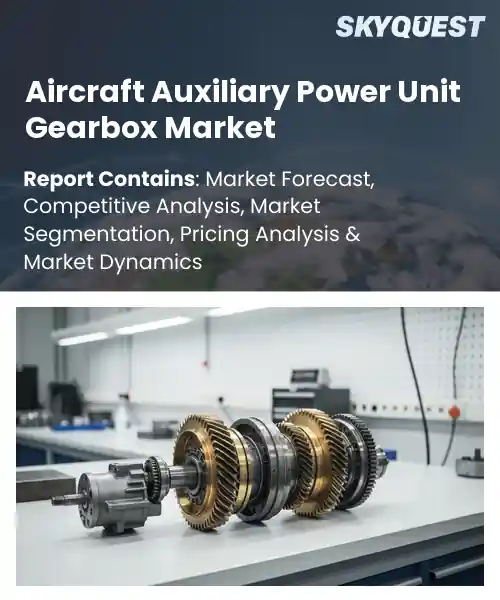
Aircraft Auxiliary Power Unit Gearbox Market
Report ID: SQMIG45J2611
Report ID: SQMIG45J2611
[email protected]
USA +1 351-333-4748
Report ID:
SQMIG45J2611 |
Region:
Global |
Published Date: July, 2026
Pages:
157
|Tables:
174
|Figures:
78


Global Aircraft Auxiliary Power Unit Gearbox Market size was valued at USD 685.5 Million in 2024 and is poised to grow from USD 725.94 Million in 2025 to USD 1148.34 Million by 2033, growing at a CAGR of 5.9% during the forecast period (2026-2033).
The global aircraft auxiliary power unit (APU) gearbox market supplies the mechanical heart that transfers turbine output to electricity, pneumatic, and hydraulic systems on commercial and military jets. Its significance stems from the need for reliable on‑board power during ground operations and in‑flight emergencies, a requirement that has intensified as airlines pursue higher dispatch reliability. Historically, the market evolved from simple spur‑gear designs in the 1970s to high‑efficiency planetary gearsets with advanced materials such as titanium alloys. For example, Pratt & Whitney’s GTF‑powered APU incorporates a lightweight gearbox that reduces fuel burn by roughly 4 %, demonstrating the sector’s shift toward performance‑centric solutions.
Rising demand for fuel‑efficient narrow‑body aircraft creates the key trend driving the global aircraft auxiliary power unit gearbox sector, because lighter gearsets directly lower auxiliary power consumption and therefore overall block fuel usage. Operators such as Southwest Airlines have begun retrofitting existing 737‑MAX fleets with low‑weight gearboxes, reporting up to 2% operational cost savings per flight. This cost advantage encourages OEMs to invest in hybrid‑electric APU concepts, where the gearbox must accommodate torque peaks from electric motors while maintaining compactness. Consequently, suppliers that can integrate additive‑manufactured titanium gears with health‑monitoring sensors are positioned to capture new contracts from both commercial and defense programs.
How is AI-Driven Automation Influencing the Aircraft APU Gearbox Market?
AI driven automation is reshaping the aircraft APU gearbox sector by embedding intelligence into design, production and service phases. In design it enables rapid simulation of gear configurations that meet weight and durability goals. During manufacturing AI powered CNC tools adjust cutting paths in real time, reducing waste and cycle time. On the operational side predictive analytics monitor vibration and temperature, alerting crews before wear becomes critical. This continuous feedback loop shortens downtime, extends component life and lowers maintenance costs. As airlines seek greener and more reliable power units the market is responding with higher demand for smarter gearboxes.
In March 2025, BAE Systems plc introduced an AI enabled gearbox assembly line that synchronizes machining and quality checks, cutting production lead time and boosting reliability, thereby reinforcing market growth through greater efficiency. The system also streams real time performance data to service teams, enabling condition based maintenance and reducing aircraft on ground time.
Market snapshot - (2026-2033)
Global Market Size
USD 685.5 Million
Largest Segment
Integrated APU Gearbox Assemblies
Fastest Growth
Integrated APU Gearbox Assemblies
Growth Rate
5.9% CAGR
To get more insights on this market click here to Request a Free Sample Report
Global aircraft auxiliary power unit gearbox market is segmented by gearbox type, aircraft type, APU type, application, fit type, end user and region. Based on gearbox type, the market is segmented into accessory gearboxes, reduction gearboxes, integrated apu gearbox assemblies and others. Based on aircraft type, the market is segmented into commercial aircraft, military aircraft, business jets and helicopters. Based on APU type, the market is segmented into fixed-wing aircraft APUs and rotary-wing aircraft APUs. Based on application, the market is segmented into power generation drive systems, pneumatic system drive applications, engine starting applications and auxiliary aircraft systems applications. Based on fit type, the market is segmented into line fit and retrofit. Based on end user, the market is segmented into aircraft OEMs, MRO service providers, defense aviation operators, commercial aviation operators and others. Based on region, the market is segmented into North America, Europe, Asia Pacific, Latin America and Middle East & Africa.
Accessory gearboxes segment dominates because it offers the most flexible power transmission solution for a wide range of auxiliary functions, allowing manufacturers to integrate multiple accessories without redesigning the core APU architecture. Its modular nature simplifies installation and maintenance, which reduces aircraft downtime and operating costs. Moreover, its adaptability to different aircraft families makes it a preferred choice for OEMs seeking scalable solutions throughout the product lifecycle and service phases.
Meanwhile, integrated APU gearbox assemblies segment emerges as the most rapidly expanding because aircraft manufacturers are consolidating components to reduce weight and improve reliability. This integration enables tighter packaging and streamlined certification, encouraging new aircraft programs to adopt the combined solution, thereby driving demand and fostering innovation in gearbox design.
Commercial aircraft segment dominates because airlines prioritize reliable auxiliary power to support extensive onboard systems, and larger fleets drive volume purchasing of standardized gearboxes. The high utilization rates of commercial jets demand robust gearboxes that can endure frequent cycles, prompting OEMs to focus on proven designs that ensure operational efficiency and lower lifecycle costs. This market pressure reinforces the prevalence of commercial aircraft applications in the gearbox market.
On the other hand, helicopters segment is witnessing growth momentum because emerging rotorcraft designs require compact and lightweight gearboxes to meet performance and fuel efficiency goals. The rise of air mobility concepts and increased demand for offshore transport are prompting manufacturers to integrate specialized gearboxes, thereby expanding market opportunities and stimulating technical advancements.
To get detailed segments analysis, Request a Free Sample Report
As per the global aircraft auxiliary power unit gearbox market share, North America maintains a pre‑eminent position through a combination of deep aerospace engineering expertise, a concentration of original equipment manufacturers, and a mature supply chain that spans design, testing and after‑sales support. The region benefits from strong collaboration between industry and research institutions, fostering continuous innovation in lightweight materials and precision gear technology. Robust regulatory frameworks ensure high reliability standards, while extensive maintenance, repair and overhaul networks provide rapid service turnaround. Strategic investments in advanced manufacturing capabilities and a skilled workforce further reinforce the ability to meet evolving airline performance requirements, cementing the region’s leadership in the global market.
Aircraft auxiliary power unit gearbox market in the United States is shaped by the presence of leading aerospace manufacturers and a highly integrated supply ecosystem. Investment in cutting‑edge research drives the development of high‑efficiency gear designs, and a strong emphasis on reliability supports extensive aftermarket services. Collaborative programs with defense and commercial sectors enhance technology transfer, while a large base of certified service providers ensures rapid deployment and maintenance support for airline operators.
Aircraft auxiliary power unit gearbox market in Canada leverages a reputation for precision engineering and a supportive innovation environment. Close ties between manufacturers and academic research centers promote advancements in lightweight and durable gear solutions. A well‑established maintenance infrastructure provides comprehensive support across the domestic airline network, and government incentives encourage continued investment in sustainable manufacturing practices, reinforcing Canada’s role as a key contributor within the North American landscape.
Based on global aircraft auxiliary power unit gearbox regional forecast, Europe’s expansion is propelled by a strong emphasis on environmental performance, advanced engineering talent, and a collaborative regulatory landscape that encourages standardisation and innovation. The region’s leading manufacturers invest heavily in next‑generation gear designs that enhance fuel efficiency and reduce emissions, aligning with strict environmental directives. A network of specialised suppliers and extensive certification bodies facilitates rapid adoption of new technologies. Moreover, integrated research initiatives across borders foster shared knowledge, while a well‑developed aftermarket service sector ensures high availability and support, positioning Europe as a dynamic growth engine in the market.
Aircraft auxiliary power unit gearbox market in Germany is anchored by world‑renowned engineering firms and a resilient supply chain focused on precision gear manufacturing. Strong emphasis on research collaborations with technical universities drives continuous improvement in material durability and gearbox efficiency. An established network of certification agencies supports swift market entry for innovative solutions, while a dense maintenance and overhaul infrastructure provides reliable after‑sales support, reinforcing Germany’s dominant status in the European arena.
Aircraft auxiliary power unit gearbox market in the United Kingdom is characterized by a flourishing ecosystem of niche suppliers and a proactive approach to technology adoption. Collaborative projects between aerospace firms and research institutions accelerate the development of lightweight, high‑performance gear assemblies. A responsive maintenance sector ensures rapid service delivery, and regulatory alignment with European standards facilitates cross‑border trade, positioning the United Kingdom as an emerging hub within the continent’s expanding market.
Aircraft auxiliary power unit gearbox market in France benefits from a strong tradition of aerospace excellence and a strategic focus on sustainable solutions. Investments in advanced materials and digital design tools enable the creation of gearboxes that meet stringent efficiency goals. Close partnerships between manufacturers and governmental research agencies foster innovation, while a robust repair and overhaul network provides comprehensive support to airline operators, driving the fastest growth trajectory among European markets.
As per global aircraft auxiliary power unit gearbox regional outlook, Asia Pacific is enhancing its role through accelerated industrialisation, rising air travel demand, and a concerted push towards domestic technology capabilities. The region’s manufacturers are adopting sophisticated design methodologies and integrating smart manufacturing processes to improve gearbox reliability and performance. Governmental policies encourage local production and skill development, reducing reliance on external sources. A growing network of certification bodies and service centres ensures compliance with international standards, while strategic partnerships with global OEMs facilitate technology transfer, collectively reinforcing Asia Pacific’s emerging prominence in the market.
Aircraft auxiliary power unit gearbox market in Japan is driven by a legacy of high‑precision engineering and a commitment to continuous improvement. Collaborative initiatives between leading manufacturers and research institutes advance the development of compact, high‑efficiency gear systems. A well‑structured maintenance ecosystem provides timely support to the extensive domestic airline fleet, and adherence to rigorous quality standards ensures the reliability expected by operators, strengthening Japan’s competitive edge in the region.
Aircraft auxiliary power unit gearbox market in South Korea is marked by rapid technological adoption and strong government backing for aerospace development. Investment in advanced manufacturing techniques and material science enhances gear durability and performance. Strategic collaborations with global partners accelerate knowledge transfer, while an expanding maintenance and overhaul network offers comprehensive service coverage. These factors combine to elevate South Korea’s standing as a dynamic contributor to the Asia Pacific market.
To know more about the market opportunities by region and country, click here to
Buy The Complete Report
Increasing Demand For Efficient Power
Regulatory Push For Emission Standards
High Certification Complexity
Limited Availability Of Skilled Labor
Request Free Customization of this report to help us to meet your business objectives.
The global aircraft auxiliary power unit gearbox market is moderately consolidated, with leading players including Safran, RTX (through Collins Aerospace), Liebherr, The Timken Company, and SKF. Companies compete through lightweight gearbox designs, advanced materials, and aftermarket support. Safran emphasizes fuel-efficient aerospace transmission technologies, while Collins Aerospace focuses on integrated APU systems, and Liebherr strengthens its position through continuous engineering innovation and OEM collaborations.
Top Player’s Company Profile
Recent Developments
SkyQuest’s ABIRAW (Advanced Business Intelligence, Research & Analysis Wing) is our Business Information Services team that Collects, Collates, Correlates, and Analyses the Data collected by means of Primary Exploratory Research backed by robust Secondary Desk research.
As per SkyQuest analysis, the global aircraft auxiliary power unit gearbox industry is being pulled forward by the growing demand for efficient power that lets airlines cut fuel use and emissions, while a second strong catalyst is the tightening of global emission standards that force OEMs to adopt lighter, low‑friction gearboxes. A major brake on growth is the high certification complexity that lengthens development cycles and limits new entrants. North America remains the dominant region thanks to its deep engineering base, mature supply chain and extensive MRO network. Within the product mix, accessory gearboxes lead the market because of their modular flexibility and widespread use across commercial fleets, reinforcing overall market momentum.
| Report Metric | Details |
|---|---|
| Market size value in 2024 | USD 685.5 Million |
| Market size value in 2033 | USD 1148.34 Million |
| Growth Rate | 5.9% |
| Base year | 2024 |
| Forecast period | (2026-2033) |
| Forecast Unit (Value) | USD Million |
| Segments covered |
|
| Regions covered | North America (US, Canada), Europe (Germany, France, United Kingdom, Italy, Spain, Rest of Europe), Asia Pacific (China, India, Japan, Rest of Asia-Pacific), Latin America (Brazil, Rest of Latin America), Middle East & Africa (South Africa, GCC Countries, Rest of MEA) |
| Companies covered |
|
| Customization scope | Free report customization with purchase. Customization includes:-
|
To get a free trial access to our platform which is a one stop solution for all your data requirements for quicker decision making. This platform allows you to compare markets, competitors who are prominent in the market, and mega trends that are influencing the dynamics in the market. Also, get access to detailed SkyQuest exclusive matrix.
Table Of Content
Executive Summary
Market overview
Parent Market Analysis
Market overview
Market size
KEY MARKET INSIGHTS
COVID IMPACT
MARKET DYNAMICS & OUTLOOK
Market Size by Region
KEY COMPANY PROFILES
Methodology
For the Aircraft Auxiliary Power Unit Gearbox Market, our research methodology involved a mixture of primary and secondary data sources. Key steps involved in the research process are listed below:
1. Information Procurement: This stage involved the procurement of Market data or related information via primary and secondary sources. The various secondary sources used included various company websites, annual reports, trade databases, and paid databases such as Hoover's, Bloomberg Business, Factiva, and Avention. Our team did 45 primary interactions Globally which included several stakeholders such as manufacturers, customers, key opinion leaders, etc. Overall, information procurement was one of the most extensive stages in our research process.
2. Information Analysis: This step involved triangulation of data through bottom-up and top-down approaches to estimate and validate the total size and future estimate of the Aircraft Auxiliary Power Unit Gearbox Market.
3. Report Formulation: The final step entailed the placement of data points in appropriate Market spaces in an attempt to deduce viable conclusions.
4. Validation & Publishing: Validation is the most important step in the process. Validation & re-validation via an intricately designed process helped us finalize data points to be used for final calculations. The final Market estimates and forecasts were then aligned and sent to our panel of industry experts for validation of data. Once the validation was done the report was sent to our Quality Assurance team to ensure adherence to style guides, consistency & design.
Analyst Support
Customization Options
With the given market data, our dedicated team of analysts can offer you the following customization options are available for the Aircraft Auxiliary Power Unit Gearbox Market:
Product Analysis: Product matrix, which offers a detailed comparison of the product portfolio of companies.
Regional Analysis: Further analysis of the Aircraft Auxiliary Power Unit Gearbox Market for additional countries.
Competitive Analysis: Detailed analysis and profiling of additional Market players & comparative analysis of competitive products.
Go to Market Strategy: Find the high-growth channels to invest your marketing efforts and increase your customer base.
Innovation Mapping: Identify racial solutions and innovation, connected to deep ecosystems of innovators, start-ups, academics, and strategic partners.
Category Intelligence: Customized intelligence that is relevant to their supply Markets will enable them to make smarter sourcing decisions and improve their category management.
Public Company Transcript Analysis: To improve the investment performance by generating new alpha and making better-informed decisions.
Social Media Listening: To analyze the conversations and trends happening not just around your brand, but around your industry as a whole, and use those insights to make better Marketing decisions.
REQUEST FOR SAMPLE
 REQUEST FREE CUSTOMIZATION
Global Aircraft Auxiliary Power Unit Gearbox Market size was valued at USD 685.5 Million in 2024 and is poised to grow from USD 725.94 Million in 2025 to USD 1148.34 Million by 2033, growing at a CAGR of 5.9% during the forecast period (2026-2033).
Top Player’s Company Profile 'Safran Transmission Systems', 'RTX Corporation', 'Honeywell International Inc.', 'Parker Hannifin Corporation', 'Liebherr-Aerospace', 'The Timken Company', 'SKF AB', 'Triumph Group, Inc.', 'Aero Gear, Inc.', 'PBS Group, a.s.', 'Aviadvigatel JSC', 'MTU Aero Engines AG', 'Rolls-Royce Holdings plc', 'GE Aerospace', 'Kawasaki Heavy Industries, Ltd.', 'Mitsubishi Heavy Industries, Ltd.', 'GKN Aerospace', 'Woodward, Inc.', 'Kamatics Corporation'
The aviation industry is prioritizing fuel efficiency and lower emissions, prompting airlines to select aircraft equipped with advanced auxiliary power units that deliver reliable power while minimizing consumption; manufacturers respond by developing gearboxes optimized for lightweight construction and reduced friction, which directly supports market expansion as operators replace legacy systems to achieve operational cost savings and meet environmental objectives. The shift also encourages OEMs to integrate digital monitoring features that enhance maintenance planning, thereby increasing overall system attractiveness and reinforcing demand across commercial and business jet segments.
Sustainable Materials Integration: The industry is increasingly prioritizing the use of lightweight, high‑strength composite materials and eco‑friendly alloys in APU gearbox design. Manufacturers are redesigning components to reduce overall weight, lower fuel consumption, and meet stricter emissions standards. This shift drives collaboration with advanced material suppliers and stimulates R&D investment to certify new composites for aviation use, ultimately delivering longer service intervals, improved reliability, and a greener operational footprint across commercial and defense fleets through optimized thermal management and predictive maintenance strategies globally.
Why does North America Dominate the Global Aircraft Auxiliary Power Unit Gearbox Market? |@12


Want to customize this report? This report can be personalized according to your needs. Our analysts and industry experts will work directly with you to understand your requirements and provide you with customized data in a short amount of time. We offer $1000 worth of FREE customization at the time of purchase.
Feedback From Our Clients


 USA (+1) 351-333-4748

