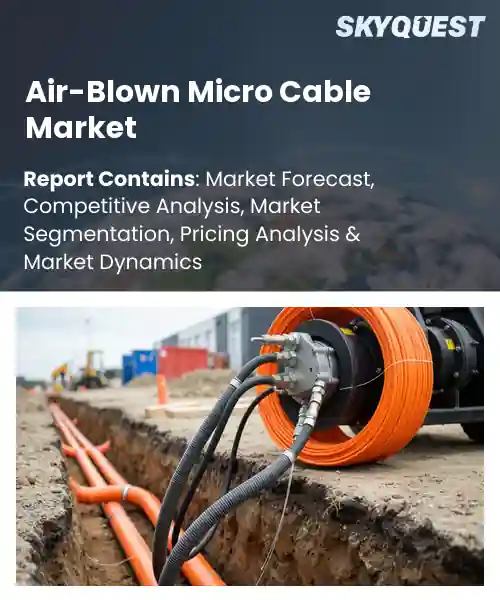
Air-Blown Micro Cable Market
Report ID: SQMIG45H2264
Report ID: SQMIG45H2264
[email protected]
USA +1 351-333-4748
Report ID:
SQMIG45H2264 |
Region:
Global |
Published Date: July, 2026
Pages:
157
|Tables:
144
|Figures:
78


Global Air-Blown Micro Cable Market size was valued at USD 486.7 Million in 2024 and is poised to grow from USD 526.61 Million in 2025 to USD 989.25 Million by 2033, growing at a CAGR of 8.2% during the forecast period (2026-2033).
The global air‑blown micro‑cable market supplies lightweight, high‑capacity fiber bundles installed by blowing them through ducts, eliminating trenching. This approach matters because telecom operators can quickly expand broadband in urban cores while preserving street aesthetics and lowering environmental impact. Originating in the 2000s for metro networks, the technology matured as manufacturers introduced thin fibers with higher tensile strength, enabling longer runs without repeaters. For example, a European carrier upgraded 30 km of legacy conduit in Paris using air‑blown micro‑cables, cutting deployment from months to weeks and reducing CAPEX by roughly 35 percent. The market’s evolution reflects a shift toward agile, cost‑effective infrastructure.The surge in data traffic driven by 5G rollouts and cloud‑intensive services forces operators to densify networks while avoiding costly civil works. Air‑blown micro‑cables address this need because their low insertion force enables upgrades of conduit bundles, turning higher capacity into shorter time‑to‑market. Cities such as Singapore have launched smart‑city projects that require fiber‑to‑the‑building deployments, prompting utilities to adopt air‑blown solutions to meet timelines and budgets. Regulatory incentives for greener infrastructure reward low‑emission installation methods, encouraging investment. Consequently, manufacturers are expanding production of light fibers and blowing equipment, creating a cycle that expands adoption across residential, enterprise, and industrial segments.
How is AI influencing design optimization in the air‑blown micro cable market?
AI is reshaping design optimization for air‑blown micro cables by automating geometry generation, airflow simulation, and material selection. Machine‑learning models evaluate thousands of duct configurations in seconds, identifying layouts that maximize fiber density while minimizing pressure loss. These tools also predict long‑term performance, allowing engineers to reduce physical prototyping and accelerate time‑to‑market. As network operators seek faster, lighter installations, AI‑driven analytics help manufacturers balance flexibility with strength, improving installation speed and reducing waste. The approach creates a feedback loop where field data continuously refines algorithms, ensuring each new cable generation is more efficient than the last.In November 2025 Sirocco was highlighted for its microduct cables, a development that aligns with broader AI‑driven design trends improving performance and deployment efficiency.
Market snapshot - (2026-2033)
Global Market Size
USD 486.7 Million
Largest Segment
Single Micro Cables
Fastest Growth
Ribbon Micro Cables
Growth Rate
8.2% CAGR
To get more insights on this market click here to Request a Free Sample Report
Global air-blown micro cable market is segmented by cable type, fiber type, installation, application, end user and region. Based on cable type, the market is segmented into Single Micro Cables, Bundled Micro Cables and Ribbon Micro Cables. Based on fiber type, the market is segmented into Single-Mode Fiber and Multi-Mode Fiber. Based on installation, the market is segmented into Direct Buried, Duct Installation and Aerial Installation. Based on application, the market is segmented into FTTH, Data Centers, Telecommunications and Enterprise Networks. Based on end user, the market is segmented into Telecom Operators, Internet Service Providers and Enterprises. Based on region, the market is segmented into North America, Europe, Asia Pacific, Latin America and Middle East & Africa.
FTTH segment dominates because it directly benefits from the lightweight, high‑density capabilities of air‑blown micro cables, enabling service providers to reach residential customers with minimal trenching. The technology’s ability to deliver gigabit speeds over existing ducts accelerates broadband rollouts, satisfies escalating consumer demand, and positions FTTH as the primary growth engine for fiber access networks. Its scalability also aligns with municipal objectives for universal connectivity, reinforcing its market leadership.
On the other hand, data centers segment is witnessing the strongest growth momentum as cloud providers and enterprises demand higher bandwidth and lower latency within their facilities. Air‑blown micro cables provide dense fiber paths with reduced floor space, supporting rapid scaling of inter‑rack and inter‑pod connections, thereby propelling rapid market expansion in high‑performance computing environments.
Direct Buried segment dominates because it aligns with the core advantage of air‑blown micro cable technology—minimal soil disturbance and rapid rollout. By allowing cables to be blown through pre‑installed ducts directly into the ground, the approach reduces civil engineering effort, shortens construction timelines, and lowers disruption to existing infrastructure. This simplicity resonates with network builders seeking cost‑effective, low‑maintenance solutions, reinforcing its leadership in deployment strategies across diverse urban and suburban projects.
Meanwhile, aerial installation segment emerges as the most rapidly expanding area as operators capitalize on its flexibility for dense urban environments where existing pole infrastructure can be leveraged. The ability to bypass underground constraints, combined with growing demand for quick capacity upgrades, fuels accelerated adoption and creates new market opportunities.
To get detailed segments analysis, Request a Free Sample Report
The Asia Pacific region commands leadership through a combination of advanced telecommunications infrastructure, aggressive network densification, and robust manufacturing ecosystems. Enterprises and service providers in the region prioritize high‑capacity, flexible fiber solutions to support rapid urbanization and burgeoning data consumption. Strong collaboration between equipment manufacturers and local operators accelerates technology adoption, while government initiatives encourage continuous upgrade of broadband networks. Moreover, the presence of world‑class research institutions fuels innovation in cable design and deployment methods, reinforcing the region’s reputation as a hub for cutting‑edge fiber solutions.
Japan Air-Blown Micro Cable Market
Air-Blown Micro Cable Market in Japan benefits from a mature broadband backbone and a national emphasis on resilient disaster‑recovery communications. Operators leverage the technology to retrofit existing ducts, reducing civil works and accelerating rollout in densely populated corridors. Japanese manufacturers contribute expertise in low‑loss fiber and precision blowing equipment, fostering a seamless supply chain that supports rapid market uptake.
South Korea Air-Blown Micro Cable Market
Air-Blown Micro Cable Market in South Korea is propelled by a proactive stance on next‑generation connectivity and a high concentration of smart‑city projects. The country’s focus on minimizing underground disruption aligns with the non‑invasive nature of air‑blown deployment, encouraging swift integration into legacy conduit networks. Collaborative efforts between local telecom giants and equipment providers enhance technical proficiency, reinforcing the market’s expansion across both urban and suburban zones.
North America experiences accelerated growth as service providers seek cost‑effective strategies to meet escalating bandwidth demand. The technology’s ability to leverage existing conduit infrastructure reduces capital expenditures and shortens project timelines, appealing to operators focused on agility. Strong emphasis on sustainability drives adoption of low‑impact installation methods, while a competitive landscape encourages continual innovation in blowing equipment and fiber quality. Additionally, close collaboration between manufacturers, integrators, and regulatory bodies creates a supportive environment for rapid market penetration across diverse geographic areas.
United States Air-Blown Micro Cable Market
Air-Blown Micro Cable Market in the United States gains traction through expansive suburban expansion and the modernization of legacy duct systems. Providers prioritize the technique to avoid disruptive trenching, aligning with regulatory preferences for minimally invasive upgrades. The presence of leading equipment manufacturers supplies advanced blowing solutions that enhance installation efficiency, fostering widespread acceptance among regional carriers and large‑scale internet service operators.
Canada Air-Blown Micro Cable Market
Air-Blown Micro Cable Market in Canada reflects a strategic focus on extending high‑speed connectivity to remote and northern communities. The technology’s capacity to navigate long conduit runs without extensive civil works supports national objectives for digital inclusion. Partnerships between telecom firms and local infrastructure owners streamline deployment, while a regulatory climate that values environmental stewardship further encourages adoption of air‑blown solutions.
Europe reinforces its market standing by integrating air‑blown fiber into comprehensive broadband upgrade programs driven by policy targets for universal high‑speed access. The region’s dense urban fabric and legacy conduit networks create an ideal environment for non‑intrusive deployment, enabling rapid capacity enhancements without extensive street works. Collaborative frameworks among governments, standards bodies, and industry consortia promote consistent technical specifications, fostering cross‑border interoperability. Innovation hubs across the continent contribute to refined blowing techniques and fiber designs, supporting continuous improvement and broader market acceptance.
Germany Air-Blown Micro Cable Market
Air-Blown Micro Cable Market in Germany benefits from stringent engineering standards and a strong emphasis on infrastructure efficiency. Operators exploit the method to upgrade extensive duct systems within industrial corridors, reducing disruption to densely populated areas. German manufacturers provide precision blowing equipment that aligns with the market’s demand for high reliability and low attenuation, reinforcing confidence among service providers.
United Kingdom Air-Blown Micro Cable Market
Air-Blown Micro Cable Market in the United Kingdom is shaped by national broadband initiatives that prioritize rapid rollout in both metropolitan and regional zones. The technique’s ability to reuse existing ducts aligns with policy goals to minimize construction impact and expedite delivery. Collaboration between telecom operators and specialist installers enhances skill development, driving broader acceptance across the market.
France Air-Blown Micro Cable Market
Air-Blown Micro Cable Market in France is propelled by government‑backed programs focused on digital cohesion and the modernization of aging conduit networks. Operators favor the technology to achieve swift capacity upgrades while preserving historic urban landscapes. French equipment suppliers contribute tailored blowing solutions that address the diverse topographies of the country, supporting sustained market growth.
To know more about the market opportunities by region and country, click here to
Buy The Complete Report
Energy Efficiency Enhancing Product Appeal
Regulatory Support Accelerating Adoption
High Installation Cost Limiting Uptake
Complex Maintenance Requirements Reducing Confidence
Request Free Customization of this report to help us to meet your business objectives.
The competitive landscape of the global air‑blown micro cable market is shaped by established fiber‑optic leaders such as Corning, CommScope and Clearfield, which are expanding product lines and forming strategic alliances to integrate air‑blown technology into existing infrastructure. Recent M&A activity includes Clearfield’s acquisition of niche air‑blown cable assets to broaden its portfolio, while partnerships between CommScope and AI‑data‑center providers are accelerating the rollout of high‑density, lightweight cable solutions that address bandwidth demand and installation cost pressures.
Top Player’s Company Profile
Recent Developments
SkyQuest’s ABIRAW (Advanced Business Intelligence, Research & Analysis Wing) is our Business Information Services team that Collects, Collates, Correlates, and Analyses the Data collected by means of Primary Exploratory Research backed by robust Secondary Desk research. As per SkyQuest analysis, the global air‑blown micro‑cable market is being propelled primarily by energy‑efficiency appeal, as manufacturers deliver lightweight, low‑power solutions that meet sustainability goals, while regulatory support further accelerates adoption by simplifying certification and encouraging green infrastructure. The FTTH segment leads growth because its need for high‑density, trench‑free deployment aligns perfectly with the technology’s strengths. Asia Pacific dominates the market, driven by rapid urbanization, strong manufacturing bases and proactive government programs. However, the high upfront cost of specialized blowing equipment remains a notable restraint, tempering uptake among smaller operators. Together, these forces shape a dynamic yet cost‑sensitive market landscape.
| Report Metric | Details |
|---|---|
| Market size value in 2024 | USD 486.7 Million |
| Market size value in 2033 | USD 989.25 Million |
| Growth Rate | 8.2% |
| Base year | 2024 |
| Forecast period | (2026-2033) |
| Forecast Unit (Value) | USD Million |
| Segments covered |
|
| Regions covered | North America (US, Canada), Europe (Germany, France, United Kingdom, Italy, Spain, Rest of Europe), Asia Pacific (China, India, Japan, Rest of Asia-Pacific), Latin America (Brazil, Rest of Latin America), Middle East & Africa (South Africa, GCC Countries, Rest of MEA) |
| Companies covered |
|
| Customization scope | Free report customization with purchase. Customization includes:-
|
To get a free trial access to our platform which is a one stop solution for all your data requirements for quicker decision making. This platform allows you to compare markets, competitors who are prominent in the market, and mega trends that are influencing the dynamics in the market. Also, get access to detailed SkyQuest exclusive matrix.
Table Of Content
Executive Summary
Market overview
Parent Market Analysis
Market overview
Market size
KEY MARKET INSIGHTS
COVID IMPACT
MARKET DYNAMICS & OUTLOOK
Market Size by Region
KEY COMPANY PROFILES
Methodology
For the Air-Blown Micro Cable Market, our research methodology involved a mixture of primary and secondary data sources. Key steps involved in the research process are listed below:
1. Information Procurement: This stage involved the procurement of Market data or related information via primary and secondary sources. The various secondary sources used included various company websites, annual reports, trade databases, and paid databases such as Hoover's, Bloomberg Business, Factiva, and Avention. Our team did 45 primary interactions Globally which included several stakeholders such as manufacturers, customers, key opinion leaders, etc. Overall, information procurement was one of the most extensive stages in our research process.
2. Information Analysis: This step involved triangulation of data through bottom-up and top-down approaches to estimate and validate the total size and future estimate of the Air-Blown Micro Cable Market.
3. Report Formulation: The final step entailed the placement of data points in appropriate Market spaces in an attempt to deduce viable conclusions.
4. Validation & Publishing: Validation is the most important step in the process. Validation & re-validation via an intricately designed process helped us finalize data points to be used for final calculations. The final Market estimates and forecasts were then aligned and sent to our panel of industry experts for validation of data. Once the validation was done the report was sent to our Quality Assurance team to ensure adherence to style guides, consistency & design.
Analyst Support
Customization Options
With the given market data, our dedicated team of analysts can offer you the following customization options are available for the Air-Blown Micro Cable Market:
Product Analysis: Product matrix, which offers a detailed comparison of the product portfolio of companies.
Regional Analysis: Further analysis of the Air-Blown Micro Cable Market for additional countries.
Competitive Analysis: Detailed analysis and profiling of additional Market players & comparative analysis of competitive products.
Go to Market Strategy: Find the high-growth channels to invest your marketing efforts and increase your customer base.
Innovation Mapping: Identify racial solutions and innovation, connected to deep ecosystems of innovators, start-ups, academics, and strategic partners.
Category Intelligence: Customized intelligence that is relevant to their supply Markets will enable them to make smarter sourcing decisions and improve their category management.
Public Company Transcript Analysis: To improve the investment performance by generating new alpha and making better-informed decisions.
Social Media Listening: To analyze the conversations and trends happening not just around your brand, but around your industry as a whole, and use those insights to make better Marketing decisions.
REQUEST FOR SAMPLE
 REQUEST FREE CUSTOMIZATION


Want to customize this report? This report can be personalized according to your needs. Our analysts and industry experts will work directly with you to understand your requirements and provide you with customized data in a short amount of time. We offer $1000 worth of FREE customization at the time of purchase.
Feedback From Our Clients


 USA (+1) 351-333-4748

