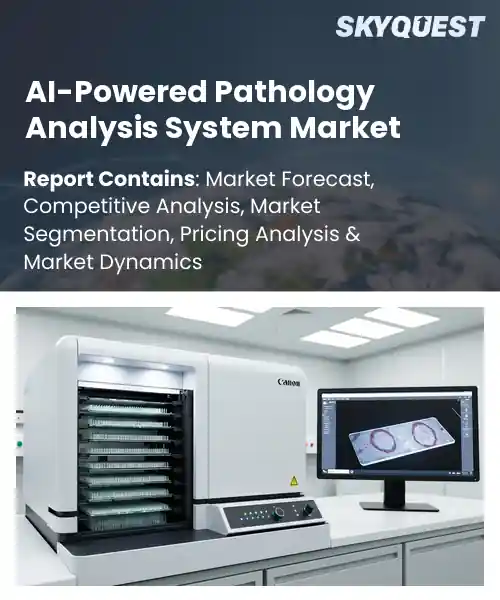
AI-Powered Pathology Analysis System Market
Report ID: SQMIG35G2377
Report ID: SQMIG35G2377
[email protected]
USA +1 351-333-4748
Report ID:
SQMIG35G2377 |
Region:
Global |
Published Date: February, 2026
Pages:
157
|Tables:
145
|Figures:
78


Global AI-Powered Pathology Analysis System Market size was valued at USD 107.5 Billion in 2024 and is poised to grow from USD 125.99 Billion in 2025 to USD 448.49 Billion by 2033, growing at a CAGR of 17.2% during the forecast period (2026-2033).
The primary factor driving the AI-powered pathology analysis system market is the integration of digital imaging, machine learning, and clinical demand for quicker and more consistent diagnostic results. This sector covers software and platforms, which turn pathology slides into digital images, extract features with algorithms, and produce results for pathologists and oncologists. Speed in diagnostics and reproducibility affects treatment processes significantly, particularly in the oncology field where the interpretation of biopsy slides is used to make decisions regarding treatment methods.
The last decade has seen considerable growth in this type of technology because the costs associated with whole slide imaging have decreased, new regulatory approvals have come for algorithms used with the system, and pilot testing at the academic centers showed a reduction in turnaround times and improved concordance.
Continuing through the expected growth period, integration into clinical settings (driven by the shortage of personnel, higher incidence of cancer being diagnosed and reimbursement models rewarding precision) is the primary driver of the future growth of this market. Since there aren't enough pathologists available to read the number of cases they're handling, many labs are beginning to use AI-based technologies to triage the slides and quantify the biomarkers so they can reduce their backlog and arrive at their tumor therapy decisions faster.
The continued reduction in barriers to implementation, due to regulation and enhanced partnerships between vendors and hospitals, will facilitate the movement of real-world use cases such as automated HER2 scoring and estimating the tumor mutational burden from clinical trials into day-to-day practice.
How is AI-enabled Automation Impacting Adoption and Accuracy in the Pathology Analysis Systems Market?Machine learning and digital slide imaging combined with machine learning to assist pathologists with image analysis case prioritization and quantitative reporting. This type of technology has become popular because it automates detection of suspicious regions; provides standardized interpretations of stains; and provides a smoother integration into laboratory software. The increased vendor supply of validated products combined with clinical partners conducting diagnostics with greater consistency and faster turnaround times have accelerated the rate of adoption. Real-world deployments of AI-enabled technologies assist pathologists in focusing their efforts on complex cases while routine task assignments are prioritized. Some current examples of AI-enabled applications for pathologists include tumor detection assistance, automated biomarker assessment, and tools that streamline the workflow of pathologists’ review of high-priority examinations.
Market snapshot - (2026-2033)
Global Market Size
USD 107.5 Billion
Largest Segment
Software
Fastest Growth
Software
Growth Rate
17.2% CAGR
To get more insights on this market click here to Request a Free Sample Report
Global AI-powered pathology analysis system market into segmented by components, technology, deployment mode, use cases, end use and region. Based on components, the market is segmented into software, hardware and services. Based on technology, the market is segmented into machine learning, computer vision and natural language processing. Based on deployment mode, the market is segmented into cloud and on-premise. Based on use cases, the market is segmented into drug discovery, disease diagnosis & prognosis, clinical workflow and training & education. Based on end use, the market is segmented into hospitals & labs, life sciences companies, research institutesand other end use. Based on region, the market is segmented into North America, Europe, Asia Pacific, Latin America and Middle East & Africa.
As per AI-powered pathology analysis system market outlook, the software segment continues to lead the way due to the provision of the analytical core tied to the acquisition of images and the interconnectivity between AI models and laboratory information systems, creating usable workflows. Vendors are investing heavily into developing algorithms, validation pipelines, and user interfaces that facilitate their usage across both diagnostic and research settings. Through software scalability, interoperability, and rapid model updates, it will shape the purchase decisions made by institutions while generating value via the automation of workflows, standardization of reporting, ease of meeting regulatory compliance requirements, and the ability to monitor performance continuously.
As per AI-powered pathology analysis system market forecast, services are emerging as the fastest-growing segment of usage related to the implementation, customization, and validation of complex deployments. By providing support for integration, regulatory advice, training on usage, and managed analytics, providers help accelerate the adoption process for institutions with limited internal expertise in AI, generating recurring revenue models and facilitating an expanded clinical adoption of solutions while enabling an ongoing evolution of their platform.
Machine learning segment dominates with high AI-powered pathology analysis system market share because machine learning provides the core predictive engines that translate histopathology data into diagnostic and prognostic insights. Extensive research focus and model improvements drive robustness across varied staining and imaging protocols, enabling reliable feature extraction and risk stratification. Its centrality to algorithmic innovation, continuous learning pipelines, and interoperability with digital scanners and data platforms establishes it as the foundational technology powering clinical grade solutions and vendor collaborations.
As per AI-powered pathology analysis system market analysis, computer vision is growing rapidly as imaging algorithms and slide digitization expand automated morphology tasks. Improvements in segmentation, feature localization, and stain normalization accelerate deployment for tumor detection, biomarker quantification, and quality control, attracting investment and creating new application pathways that broaden market opportunity and clinical integration.
To get detailed segments analysis, Request a Free Sample Report
As per AI-powered pathology analysis system market regional outlook, the North America region dominates the market for a variety of reasons. The collaboration of the diverse participants across multiple sectors creates an integrated innovation ecosystem that facilitates the rapid translation of research into clinical practice. Academic medical centers, specialty pathology laboratories, and established technology companies partner with one another to strengthen the development and validation of algorithms. Furthermore, regulatory engagement and proactive dialogue with payers minimize barriers to implementation, while there is ample funding to support the iterative improvement and scaling of products.
The AI-powered pathology analysis system market in the United States benefits from a concentrated network of academic medical centers, technology companies, and specialty pathology laboratories that collaborate on the development and validation of algorithms. The integration of algorithms into clinical practice has been aided through progressive regulatory engagement, payer dialog, and an early-adopting culture among the leading hospitals. There is strong venture capital activity, and there are highly experienced data scientists in the country that accelerate the translation of research into commercialized systems and pilot implementations at specialty centers.
As per AI-powered pathology analysis system industry analysis, Canada is characterized by the close collaboration between regional health authorities, academic research institutions, and public hospitals with an emphasis on interoperability and population-based validation (PBV). The supportive policy environment and cooperative procurement models support technology assessment and pilot deployment.
As per AI-powered pathology analysis system market regional forecast, the market in Europe is experiencing rapid growth due to coordinated efforts by healthcare providers, research networks, and industry partners that have made it a priority to establish standards and ensure that their products have clinical relevance. National and regional health systems encourage interoperability and the sharing of information about patients, which facilitates multi-site validation and comparative evaluations of new technologies. Policy frameworks and regulatory engagement emphasize safety and measurable clinical benefit; thus, they encourage the establishment of structured pilots and pathways for integrating new technologies into routine clinical practice. The public funding mechanisms, as well as the collaborative consortia, are supporting the maturation of technology, while the combination of existing vendors and innovative early-stage companies is speeding up the localization and adaptation of the technologies to various clinical contexts.
In Germany, the AI-powered pathology analysis system market is being driven by a strong network of university hospitals, specialized diagnostic centers and establishedmedical technology companies that are making a commitment to clinically validate their products and ensure their quality. The commitment of the health systems to establishand adhere to standards and rigorously evaluate new technologies is supporting the integration of AI-Powered Pathology Analysis Systems into laboratory work.
The AI-powered pathology analysis system market is an innovative professional ecosystem in the UK that connects academic institutions, national health services and startups together to speed up the translation of clinical findings into proven treatments. Digital transformation initiatives and centralized healthcare data policies support pilot studies and wide implementation across all areas of the National Health Service. Through partnerships between technology companies and clinical networks, there are clear pathways to integrating AI-powered pathology analysis systems. Furthermore, clinical training and evaluation of clinical diagnosis support the adoption of these systems across all diagnostic specialties.
In France, the AI-powered pathology analysis system market is evolving through the collective work of translational research, leading cancer centres and regional innovation hubs aimed at developing and evaluating new technologies. Collaboration between hospitals, research institutions, and technology companies provides the foundation for targeted pilot studies in specific diagnostic areas. The current phase of regulatory dialogue and structured evaluation frameworks is maturing, while public sector procurement of innovation is transitioning into new processes. The focus on integration with laboratory processes and clinician engagement provides a strong foundation for adoption in all areas of healthcare delivery.
As per AI-powered pathology analysis system industry analysis, the growth of strategic investment into digital diagnostic infrastructures and the development of expertise in computational pathology has strengthened Asia Pacific's position in the market for AI-enabled pathology analysis systems. The region continues to develop new methods for digitizing slide samples and curating data, while also validating algorithms for use in clinical settings so that they can help to address regional healthcare needs. As the region develops regulations and certification processes for the use of AI in healthcare, pilots and clinical evaluations will be initiated to determine the operational feasibility of AI-enabled technologies.
As per AI-powered pathology analysis system market regional outlook, Japan is well established due to the country’s strength in the medical imaging sector, its considerable number of well-established diagnostic companies, and its many clinical research organizations that focus on validating new technologies. These organizations have developed an established culture of performing scientific evaluations in a methodical manner and collaborating with technology vendors to facilitate the integration of AI-powered pathology analysis systems into laboratory workflows.
As per AI-powered pathology analysis system market regional forecast, South Korea is also developing through the efforts of advanced technology companies, new venture startups, and hospitals that test and deploy digital solutions. Collaborations between the government and academia facilitate the practice and infrastructure needed for clinical research on image acquisition and data management. Strong ties exist between industry, academic institutions, and clinical settings; thus, enabling successful pilot programs, allowing for localization of algorithms to meet regional pathology workflow requirements, and supporting efforts to integrate clinical systems and vendors more broadly.
To know more about the market opportunities by region and country, click here to
Buy The Complete Report
Integration with Clinical Workflows
The integration of AI-powered pathology systems within existing clinical workflows provides shorter diagnostic turn-around times and promote enhanced teamwork between the pathologists and the clinical providers, supporting the opportunity for wider adoption of these systems. The alignment with regular laboratory information systems and reporting processes supports seamless workflows through: Streamlining of case reviews; availability of a second opinion; and support for multidisciplinary decision making; thus, enhancing their perceived utility and operational value. Interoperability improvements directly affect hospital acquisition decisions and promote more widespread implementation, as all parties recognize the more direct connection to efficiency gains and improved management of their patient population through real, workflows to achieve the outcome of reducing diagnostic turn-around times, with better outcomes/efficiency.
Advances in Deep Learning
Continued advancements in deep learning architectures and training methods are continuously improving the accuracy and reliability of automated tools used to analyze and characterize images by enabling accurate and reliable detection and characterization of complex histopathological patterns that previously could not be accomplishedby automated tools. As automated systems are better able to provide clinically relevant and accurate results, clinicians are increasingly placing their trust in algorithm-generated results and incorporating these algorithms into diagnostic pathways. This will drive ongoing purchasing decisions and investment into the infrastructure and support systems that are required to successfully implement automated systems. These advances will also decrease the number of cases that are manually reviewed on a regular basis, thereby freeing the time of highly experienced professionals to conduct complex analyses, while increasing the number of practitioners who acquire experience in using automated systems in their practices.
High Regulatory Uncertainty
The slow growth of the market for AI-based diagnostics is due to the complexity and uncertainty of the regulatory process. This has made it difficult to get new products approved and released, which in turn has reduced vendors' ability to expand their offerings. The differences between the regulatory requirements in each region also createadditional obstacles that require manufacturers to invest substantial time and money in compliance rather than developing and marketing new products. These additionalcosts will further delay how long it takes for new products to manufacture and sell as well as limit how far into the world they can be sold.
Data Privacy and Sharing
Confidentiality of data and the inability to share data from different institutions create additional barriers to the development and validation of AI models. Lack of access to a wide variety of training data limits the developer's ability to improve the performance of algorithms for different clinical situations and consequently hinders generalizability and clinician confidence. In addition, complicated consent processes and reluctance from institutions to share proprietary collections of clinical cases creates excessive operational costs to conduct collaborative research that further delays the development of models and therefore slows down the overall adoption of these products across the healthcare delivery systems.
Request Free Customization of this report to help us to meet your business objectives.
The competitive environment of AI-powered pathology labs is changing significantly. M&A and strategic partnerships will continue to reshape the landscape of traditional laboratory workflows and vendor moats due to M&A, strategic partnerships, and innovation in edge computing technology. Moreover, large companies such as Evident are acquiring companies that have functional integrations to develop their complete, integrated products, as illustrated by Evident's acquisition of Pramana and the establishment of an extensive relationship with Siemens Healthineers. Additionally, small companies like Picture Health use multimodal pathomics and radiomics platforms to differentiate themselves from large players to establish biopharma validation and deployment contracts.
Clinical Workflow Integration: AI-based pathology platforms are now embedded into the regular workflow of laboratories, allowing for smooth image review, triaging of cases, and reporting as well as working alongside laboratory information systems. Integration of AI tools into pathology has allowed for improved collaboration between pathologists and AI tools, standardization of diagnostic protocols, and reduction of manual steps that used to disrupt the workflow.
Expansion of Decentralized Care: AI-based pathology solutions are moving from being contained only in centralized lab locations to include community hospitals, regional clinics, and remote diagnostics hubs using cloud-based solutions with simplified scanning workflows. With this decentralization, people now have greater access to expert interpretation of finds, and telepathology can be used to support local patients acting more quickly on available information identified through telepathology consultations. Vendors and healthcare systems are also creating unique deployment strategies, training methods, and service models to ensure the reliability, quality control, and clinical integration of deployments to enhance widespread screening, increase capacity, and achieve health equity throughout geography.
SkyQuest’s ABIRAW (Advanced Business Intelligence, Research & Analysis Wing) is our Business Information Services team that Collects, Collates, Correlates, and Analyses the Data collected by means of Primary Exploratory Research backed by robust Secondary Desk research.
As per SkyQuest analysis, the global AI-powered pathology analysis system industry, which is driven by a combination of clinical demand for faster and more consistent diagnoses, is primarily driven by the combination of the convergence of digital imaging, machine learning, and clinical demand for faster, more consistent diagnoses, while the software segment will lead as the dominant product category and North America will continue to be the dominant geography to a well-established ecosystem of innovation and early clinical adoption. Another major factor driving growth in this area is continued improvements in deep learning technology, which results in greater accuracy and reliability of the model. However, growth will be stymied by a significant lack of regulatory clarity that slows the approval and deployment both within and across borders. Vendors that are focused on developing interoperable software, validated workflow, and managed services are well-positioned to take advantage of emerging clinical and research use cases. The AI-Powered Pathology Analysis System Market is currently dominated by established digital pathology & AI diagnostic solution companies (PathAI, Tempus, Ibex Medical Analytics, Proscia, & Aiforia Technologies) who continue to maintain their strong market share with advanced AI algorithms & digital pathology platforms in addition to strategic alliances/collaborations with hospitals, laboratories & research institutions. The AI-powered pathology analysis system market trends within the market are being driven by overall growth in the digital pathology automation/AI diagnostic markets; the increasing need for automated assistance in diagnosis; and the integration of newer AI technology (deep learning and computer vision) to help improve slide analysis accuracy.
| Report Metric | Details |
|---|---|
| Market size value in 2024 | USD 107.5 Billion |
| Market size value in 2033 | USD 448.49 Billion |
| Growth Rate | 17.2% |
| Base year | 2024 |
| Forecast period | (2026-2033) |
| Forecast Unit (Value) | USD Billion |
| Segments covered |
|
| Regions covered | North America (US, Canada), Europe (Germany, France, United Kingdom, Italy, Spain, Rest of Europe), Asia Pacific (China, India, Japan, Rest of Asia-Pacific), Latin America (Brazil, Rest of Latin America), Middle East & Africa (South Africa, GCC Countries, Rest of MEA) |
| Companies covered |
|
| Customization scope | Free report customization with purchase. Customization includes:-
|
To get a free trial access to our platform which is a one stop solution for all your data requirements for quicker decision making. This platform allows you to compare markets, competitors who are prominent in the market, and mega trends that are influencing the dynamics in the market. Also, get access to detailed SkyQuest exclusive matrix.
Table Of Content
Executive Summary
Market overview
Parent Market Analysis
Market overview
Market size
KEY MARKET INSIGHTS
COVID IMPACT
MARKET DYNAMICS & OUTLOOK
Market Size by Region
KEY COMPANY PROFILES
Methodology
For the AI-Powered Pathology Analysis System Market, our research methodology involved a mixture of primary and secondary data sources. Key steps involved in the research process are listed below:
1. Information Procurement: This stage involved the procurement of Market data or related information via primary and secondary sources. The various secondary sources used included various company websites, annual reports, trade databases, and paid databases such as Hoover's, Bloomberg Business, Factiva, and Avention. Our team did 45 primary interactions Globally which included several stakeholders such as manufacturers, customers, key opinion leaders, etc. Overall, information procurement was one of the most extensive stages in our research process.
2. Information Analysis: This step involved triangulation of data through bottom-up and top-down approaches to estimate and validate the total size and future estimate of the AI-Powered Pathology Analysis System Market.
3. Report Formulation: The final step entailed the placement of data points in appropriate Market spaces in an attempt to deduce viable conclusions.
4. Validation & Publishing: Validation is the most important step in the process. Validation & re-validation via an intricately designed process helped us finalize data points to be used for final calculations. The final Market estimates and forecasts were then aligned and sent to our panel of industry experts for validation of data. Once the validation was done the report was sent to our Quality Assurance team to ensure adherence to style guides, consistency & design.
Analyst Support
Customization Options
With the given market data, our dedicated team of analysts can offer you the following customization options are available for the AI-Powered Pathology Analysis System Market:
Product Analysis: Product matrix, which offers a detailed comparison of the product portfolio of companies.
Regional Analysis: Further analysis of the AI-Powered Pathology Analysis System Market for additional countries.
Competitive Analysis: Detailed analysis and profiling of additional Market players & comparative analysis of competitive products.
Go to Market Strategy: Find the high-growth channels to invest your marketing efforts and increase your customer base.
Innovation Mapping: Identify racial solutions and innovation, connected to deep ecosystems of innovators, start-ups, academics, and strategic partners.
Category Intelligence: Customized intelligence that is relevant to their supply Markets will enable them to make smarter sourcing decisions and improve their category management.
Public Company Transcript Analysis: To improve the investment performance by generating new alpha and making better-informed decisions.
Social Media Listening: To analyze the conversations and trends happening not just around your brand, but around your industry as a whole, and use those insights to make better Marketing decisions.
REQUEST FOR SAMPLE
 REQUEST FREE CUSTOMIZATION
Global Ai-Powered Pathology Analysis System Market size was valued at USD 107.5 Billion in 2024 and is poised to grow from USD 125.99 Billion in 2025 to USD 448.49 Billion by 2033, growing at a CAGR of 17.2% during the forecast period (2026-2033).
Competitive landscape in AI-powered pathology is defined by targeted M&A, strategic partnerships, and edge computing innovation that reshape laboratory workflows and vendor moats. Evident’s acquisition of Pramana and its collaboration with Siemens Healthineers show incumbents buying integrated scanning and inline AI capabilities. Meanwhile startups such as Picture Health differentiate via multimodal pathomics and radiomics platforms to secure biopharma validation and deployment deals. 'aetherAI', 'aiforia', 'IBEX', 'HOLOGIC', 'Proscia', 'Tempus', 'Roche', 'Quest Diagnostics', 'Indica Labs', 'KFBIO', 'mindpeak', 'VISIOPHARM', 'PathAI', 'deepbio', 'Aiosyn', 'QRITIVE', 'tribun HEALTH', 'Pathline', '3DHealth', 'BioSkryb'
The seamless integration of AI-powered pathology systems into existing clinical workflows reduces diagnostic turnaround and enhances collaboration between pathologists and clinicians, thereby encouraging adoption. By fitting into routine laboratory information systems and reporting processes, these solutions streamline case review, enable second opinions, and support multidisciplinary decision-making, which increases perceived utility and operational value. Improved interoperability directly influences hospital procurement decisions and fosters wider implementation, as stakeholders recognize clearer pathways to efficiency gains and improved patient management through practical, workflow-aligned deployment.
Clinical Workflow Integration: AI-powered pathology platforms are increasingly embedded into routine laboratory workflows, enabling seamless image review, case triage, and reporting alongside laboratory information systems. This integration drives collaborative decision-making between pathologists and AI tools, standardizes diagnostic protocols, and reduces manual steps that previously fragmented workflows. Vendors and health systems prioritize interoperability, user-centered design, and scalable deployment models to facilitate adoption, foster clinician trust, and translate algorithm outputs into actionable insights that fit existing clinical practices and quality pathways and support continuous improvement.
Why does North America Dominate the Global AI-Powered Pathology Analysis System Market?


Want to customize this report? This report can be personalized according to your needs. Our analysts and industry experts will work directly with you to understand your requirements and provide you with customized data in a short amount of time. We offer $1000 worth of FREE customization at the time of purchase.
Feedback From Our Clients


 USA (+1) 351-333-4748

