
AI In Asset Management Market
Report ID: SQMIG40K2001
Report ID: SQMIG40K2001
[email protected]
USA +1 351-333-4748
Report ID:
SQMIG40K2001 |
Region:
Global |
Published Date: June, 2025
Pages:
195
|Tables:
94
|Figures:
71


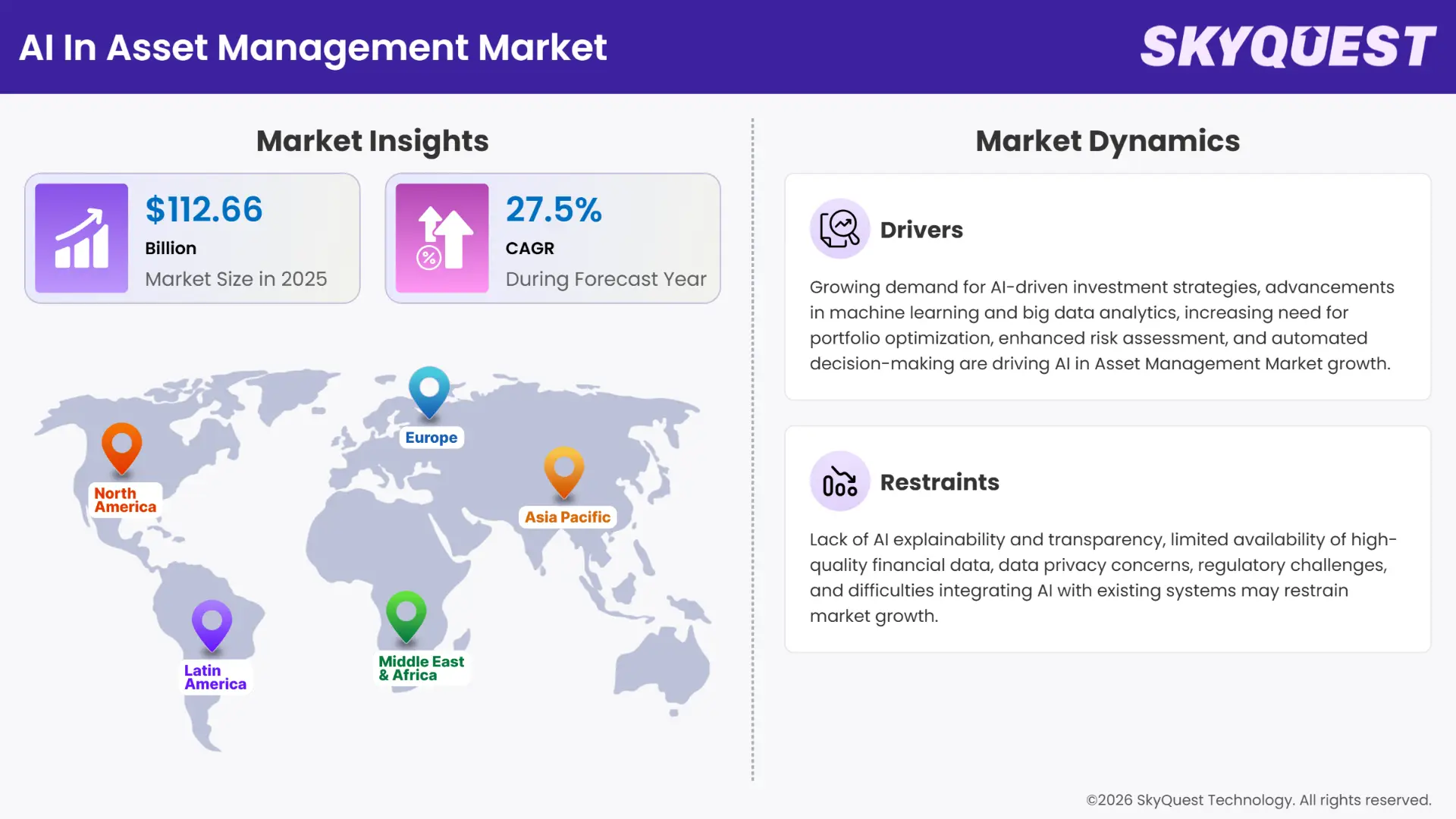
Global AI In Asset Management Market size was valued at USD 88.36 Billion in 2024 and is poised to grow from USD 112.66 Billion in 2025 to USD 786.75 Billion by 2033, growing at a CAGR of 27.5% during the forecast period (2026–2033).
Key Takeaways: Market Trends & Insights
The primary driver of the global AI in asset management market is the increasing demand for predictive analytics to enhanced investment decision-making. Traditional asset management relies heavily on historical data and human expertise, often struggling with market volatility and large-scale data interpretation. AI-powered predictive analytics transforms this by utilizing machine learning algorithms to process vast datasets, identify patterns, and generate data-driven insights. This causes a shift from reactive to proactive decision-making, allowing asset managers to anticipate market movements, optimize portfolio allocations, and mitigate risks.
Additionally, AI-driven forecasting models enhance quantitative trading strategies by detecting market anomalies and uncovering hidden opportunities. As financial institutions prioritize efficiency and precision, AI’s predictive capabilities drive widespread adoption, fueling market growth.
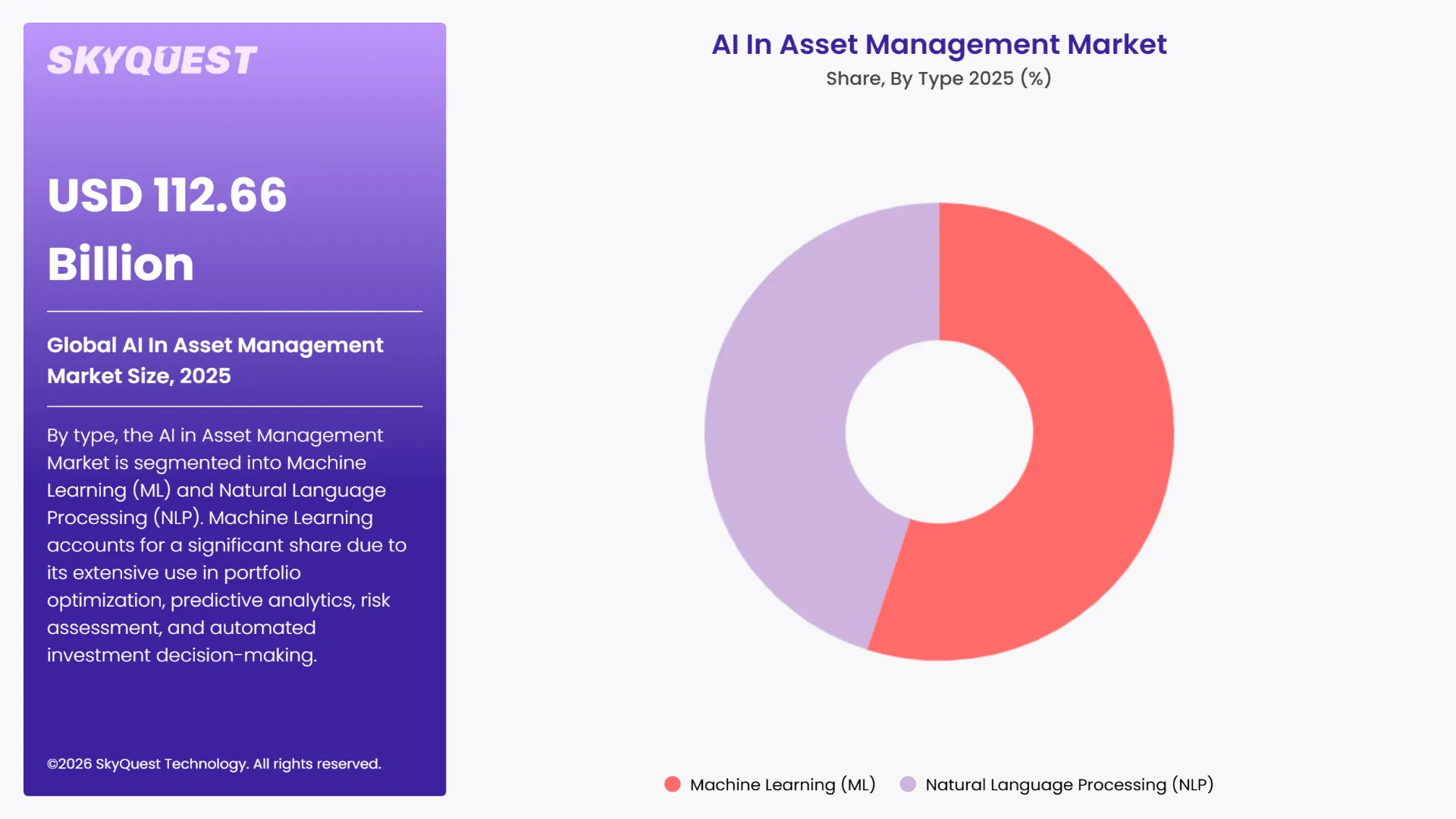
A key factor influencing the market is the integration of Natural Language Processing (NLP) for sentiment analysis in financial decision-making. Financial markets are highly sensitive to news, social media trends, and global economic events. NLP enables asset managers to extract actionable insights from unstructured data sources, such as earnings reports, regulatory filings, and social media sentiment. This leads to a significant advantage, as AI can assess investor sentiment, detect early signals of market shifts, and refine trading strategies accordingly. The ability to process qualitative data into quantifiable metrics enhances risk assessment and strengthens decision-making. As AI-driven sentiment analysis gains traction, firms leveraging NLP benefit from improved agility, directly impacting portfolio performance and investor confidence.
In What Ways does AI Reduce Reliance on Human Intuition in Asset Management?
AI is transforming global AI in asset management market by automating complex decision-making processes and enhancing investment strategies. AI-driven algorithms analyze vast datasets in real time, enabling asset managers to detect patterns, predict market trends, and optimize portfolios with unprecedented accuracy. This shift reduces reliance on human intuition, improving efficiency and reducing risk exposure. Additionally, AI-powered robo-advisors are democratizing asset management, making financial services more accessible. A related development is BlackRock’s AI-driven platform, Aladdin, which integrates predictive analytics and risk assessment tools, allowing fund managers to make data-driven decisions, ultimately driving the global AI in asset management market.
To get more insights on this market click here to Request a Free Sample Report
Global AI In Asset Management Market is segmented by Technology, Deployment Model, Application, End Use and region. Based on Technology, the market is segmented into Machine Learning (ML) and Natural Language Processing (NLP). Based on Deployment Model, the market is segmented into On-premises and Cloud-based. Based on Application, the market is segmented into Portfolio optimization, Conversational platform, Risk & compliance, Data analysis, Process automation and Others. Based on End Use, the market is segmented into BFSI, Retail and e-commerce, Healthcare, Energy and utilities, Manufacturing, Transportation & logistics, Media & Entertainment and Others. Based on region, the market is segmented into North America, Europe, Asia Pacific, Latin America and Middle East & Africa.
The global AI in asset management market startup landscape is rapidly expanding, with numerous innovative firms leveraging artificial intelligence to revolutionize investment strategies and portfolio management. These startups are developing advanced AI-driven tools to enhance decision-making, optimize asset allocation, and democratize access to sophisticated financial services. By integrating machine learning, big data analytics, and automation, they are reshaping the financial industry, improving efficiency, mitigating risks, and providing investors with real-time insights for better portfolio performance.
Established in 2018, 3AI is a UK-based fintech startup founded by Hassan Salamony, Jacob Ayres-Thomson, and Simon Judd. The company specializes in integrating artificial intelligence into asset management, aiming to empower investors with data-driven insights and enhance investment decision-making processes. ALBA is a self-learning equity prediction intelligence system that leverages AI to provide reliable and accurate global equity forecasts. By analyzing vast datasets, ALBA identifies patterns and trends, enabling investors to make informed decisions.
Its top picks have consistently outperformed the S&P 500 index since the 1980s, demonstrating its effectiveness in navigating financial markets. By combining machine learning algorithms with big data analytics, 3AI's R&D efforts have led to the development of ALBA's predictive capabilities. This integration allows for the processing of extensive financial data, resulting in precise investment strategies and the identification of profitable opportunities. Consequently, investors benefit from enhanced returns and reduced risks.
Established in 2017, Upside AI is an India-based investment management startup founded by Nikhil Hooda, Kanika Agarrwal, and Atanuu Agarrwal. The firm focuses on utilizing technology to drive investment decisions, believing that machines, being unbiased and unemotional, can make better long-term choices. Upside AI's platform employs proprietary machine learning algorithms to analyze fundamental business data and identify companies with strong growth potential.
This systematic approach ensures a rules-based investment strategy, minimizing human biases and emotions in decision-making. Upside AI is building an end-to-end digital platform that integrates client onboarding, sophisticated investment technology, and live tracking/reporting through a seamless user interface. This innovation streamlines operations, enhances client experience, and allows for scalable asset management solutions, positioning the firm to attract a broader client base and increase assets under management.
Established in 2023, FinChat is a Toronto-based AI fintech startup that provides an AI-powered investment software platform. The company focuses on enhancing the efficiency of investment professionals by automating the creation of research reports, presentations, and data analysis. FinChat's platform allows users to generate equities research, create documents, charts, and presentations by simply typing questions, similar to the ChatGPT interface. This tool significantly reduces the time analysts spend on manual tasks, converting processes that previously took 30 hours into just 30 minutes, thereby improving productivity and allowing professionals to focus on higher-value activities.
By leveraging models from AI providers like Anthropic and OpenAI, FinChat's R&D team has developed a platform capable of understanding and processing complex financial queries. This innovation enables real-time analysis and accurate responses, enhancing the quality and speed of investment research. As a result, financial firms can make quicker, more informed decisions, gaining a competitive edge in the market.
Fixed Income is dominating the global AI in asset management market due to its complexity, data-driven nature, and demand for risk mitigation. AI innovations in this sector focus on predictive analytics, algorithmic bond trading, and real-time risk assessment. Machine learning models analyze macroeconomic indicators, credit spreads, and yield curves to optimize portfolio allocation and enhance returns. AI-driven bond rating models improve credit risk evaluation, reducing default exposure. The rise of robo-advisors and AI-powered trading platforms further accelerates adoption. Fixed Income’s dominance stems from institutional investors' reliance on AI for precision, automation, and efficiency in navigating volatile debt markets.
Real Estate is poised to be the fastest-growing segment in the global AI in asset management market due to increasing adoption of AI-powered property valuation, risk assessment, and investment analytics. AI enhances market forecasting, automates asset monitoring, and optimizes portfolio diversification, attracting institutional investors seeking data-driven decision-making and efficiency in real estate asset management.
Portfolio optimization is dominating in the global AI in asset management market due to its ability to maximize returns while minimizing risk through advanced data analytics and automation. AI-driven portfolio optimization leverages machine learning, predictive analytics, and real-time market data to create dynamic, risk-adjusted investment strategies. Innovations include AI-powered asset allocation models, sentiment analysis for market trends, and deep learning algorithms that adapt to market fluctuations. AI enhances diversification by identifying optimal asset mixes, reducing volatility, and automating rebalancing. Institutional investors increasingly rely on AI for precision and efficiency, making portfolio optimization the leading application in AI-driven asset management.
Risk management is set to be the fastest-growing in the global AI in asset management market due to increasing market volatility and regulatory demands. AI-driven risk models enhance fraud detection, stress testing, and predictive risk analytics. Machine learning algorithms identify hidden risks, automate compliance, and improve decision-making, making AI indispensable for financial institutions.
To get detailed segments analysis, Request a Free Sample Report
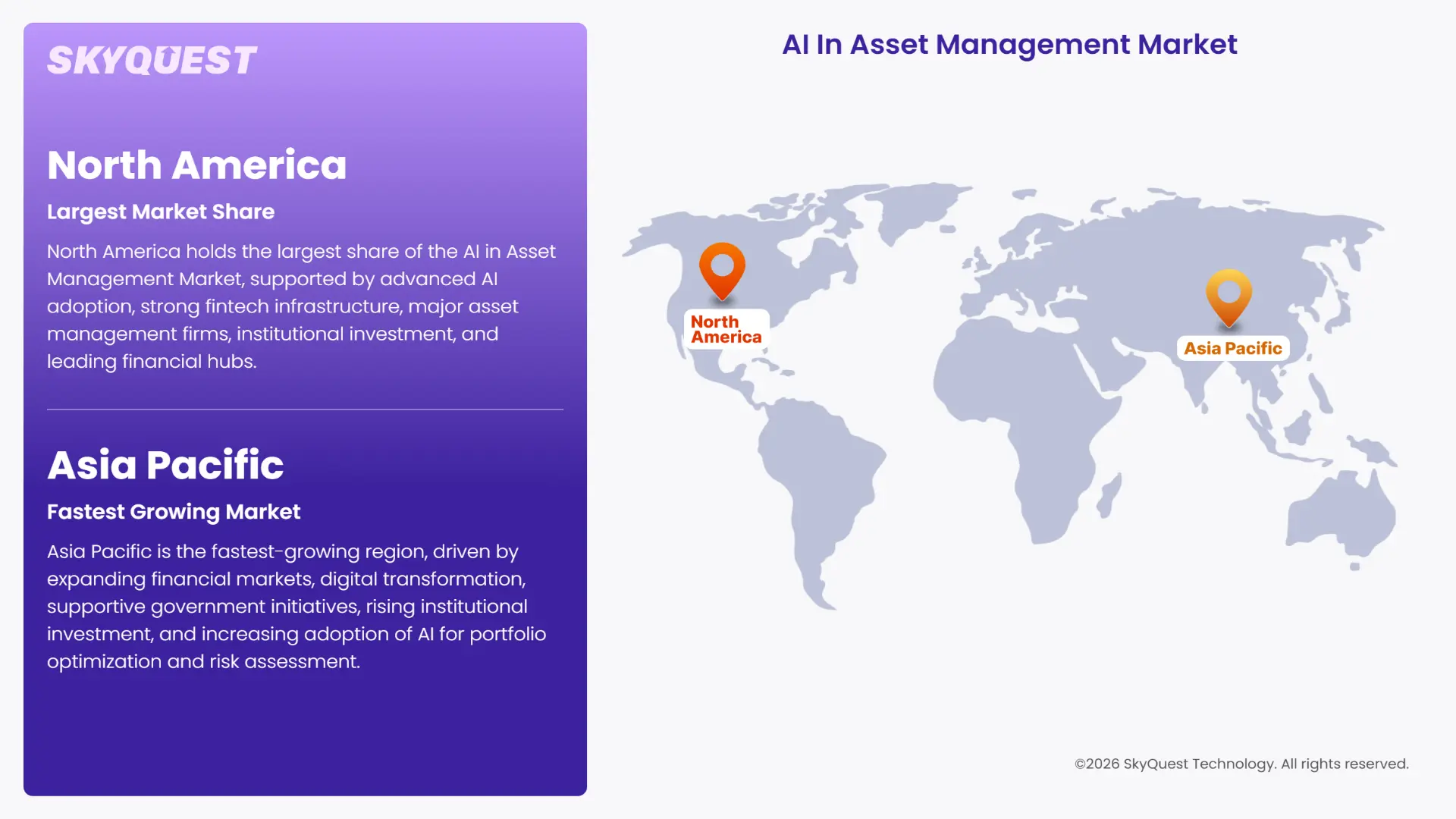
North America leads the global AI in asset management market, driven by advanced AI adoption, strong fintech infrastructure, and a high concentration of asset management firms. The region benefits from major financial hubs like New York and Toronto, where AI-driven investment strategies are rapidly evolving. Regulatory support, increasing institutional investments in AI-powered analytics, and the presence of tech giants fueling innovation further strengthen North America’s dominance, making it a key driver of AI integration in asset management.
Asia-Pacific is witnessing rapid growth in the global AI in asset management market, fueled by expanding financial markets, digital transformation, and government initiatives supporting AI adoption. Key financial hubs like Hong Kong, Singapore, and Tokyo are leading AI integration in investment strategies. The region’s strong fintech ecosystem, rising institutional investments, and demand for automated wealth management solutions drive market expansion. Additionally, increased adoption of AI in risk assessment and portfolio optimization positions Asia-Pacific as a key growth region.
Europe is a key player in global AI in asset management, driven by strong financial markets, regulatory advancements, and AI innovation. The European Union’s AI Act promotes ethical AI adoption, enhancing trust in AI-powered investment solutions. Major financial hubs like London, Frankfurt, and Paris are leading in AI-driven portfolio management, risk assessment, and algorithmic trading. Additionally, European fintech startups are pioneering AI-based wealth management platforms, making asset management more efficient and accessible across institutional and retail markets.
To know more about the market opportunities by region and country, click here to
Buy The Complete Report
Growing Demand for AI-Driven Investment Strategies
Advancements in Machine Learning and Big Data Analytics
Lack of Explainability and Transparency
Limited Availability of Quality Data
Request Free Customization of this report to help us to meet your business objectives.
The global AI in asset management market is highly competitive, with key players integrating AI to enhance investment strategies and portfolio management. Leading companies include BlackRock, JPMorgan Chase, Morgan Stanley, UBS, and Goldman Sachs, alongside AI-driven fintech firms like SigTech and Kensho Technologies. BlackRock’s Aladdin platform leverages predictive analytics for risk management, while JPMorgan Chase’s LOXM AI enhances trade execution. Morgan Stanley’s AI-powered WealthDesk personalizes investment solutions, optimizing client portfolios. Additionally, UBS employs AI for fraud detection and algorithmic trading. These firms continuously invest in AI-driven innovation to improve efficiency, minimize risk, and maintain a competitive edge.
AI-Powered Personalization in Wealth Management
Integration of Generative AI in Portfolio Analysis
SkyQuest’s ABIRAW (Advanced Business Intelligence, Research & Analysis Wing) is our Business Information Services team that Collects, Collates, Correlates, and Analyses the Data collected by means of Primary Exploratory Research backed by robust Secondary Desk research.
As per SkyQuest analysis, the global AI in asset management industry is enhancing investment strategies, optimizing portfolio allocations, and improving risk assessment. The integration of machine learning, predictive analytics, and NLP-driven sentiment analysis allows asset managers to make data-driven decisions with greater precision. The rise of AI-powered startups underscores the market’s evolution, offering innovative solutions that democratize financial services and increase efficiency.
As financial hubs like New York, Toronto, and key Asia-Pacific markets drive AI adoption, institutional investors increasingly rely on AI to navigate market complexities. With portfolio optimization and risk management at the forefront, AI’s role in asset management will continue to expand, shaping a more intelligent, automated, and data-driven financial landscape in the years ahead.
| Report Metric | Details |
|---|---|
| Market size value in 2024 | USD 88.36 Billion |
| Market size value in 2033 | USD 786.75 Billion |
| Growth Rate | 27.5% |
| Base year | 2024 |
| Forecast period | 2026–2033 |
| Forecast Unit (Value) | USD Billion |
| Segments covered |
|
| Regions covered | North America (US, Canada), Europe (Germany, France, United Kingdom, Italy, Spain, Rest of Europe), Asia Pacific (China, India, Japan, Rest of Asia-Pacific), Latin America (Brazil, Rest of Latin America), Middle East & Africa (South Africa, GCC Countries, Rest of MEA) |
| Companies covered |
|
| Customization scope | Free report customization with purchase. Customization includes:-
|
To get a free trial access to our platform which is a one stop solution for all your data requirements for quicker decision making. This platform allows you to compare markets, competitors who are prominent in the market, and mega trends that are influencing the dynamics in the market. Also, get access to detailed SkyQuest exclusive matrix.
Table Of Content
Executive Summary
Market overview
Parent Market Analysis
Market overview
Market size
KEY MARKET INSIGHTS
COVID IMPACT
MARKET DYNAMICS & OUTLOOK
Market Size by Region
KEY COMPANY PROFILES
Methodology
For the AI In Asset Management Market, our research methodology involved a mixture of primary and secondary data sources. Key steps involved in the research process are listed below:
1. Information Procurement: This stage involved the procurement of Market data or related information via primary and secondary sources. The various secondary sources used included various company websites, annual reports, trade databases, and paid databases such as Hoover's, Bloomberg Business, Factiva, and Avention. Our team did 45 primary interactions Globally which included several stakeholders such as manufacturers, customers, key opinion leaders, etc. Overall, information procurement was one of the most extensive stages in our research process.
2. Information Analysis: This step involved triangulation of data through bottom-up and top-down approaches to estimate and validate the total size and future estimate of the AI In Asset Management Market.
3. Report Formulation: The final step entailed the placement of data points in appropriate Market spaces in an attempt to deduce viable conclusions.
4. Validation & Publishing: Validation is the most important step in the process. Validation & re-validation via an intricately designed process helped us finalize data points to be used for final calculations. The final Market estimates and forecasts were then aligned and sent to our panel of industry experts for validation of data. Once the validation was done the report was sent to our Quality Assurance team to ensure adherence to style guides, consistency & design.
Analyst Support
Customization Options
With the given market data, our dedicated team of analysts can offer you the following customization options are available for the AI In Asset Management Market:
Product Analysis: Product matrix, which offers a detailed comparison of the product portfolio of companies.
Regional Analysis: Further analysis of the AI In Asset Management Market for additional countries.
Competitive Analysis: Detailed analysis and profiling of additional Market players & comparative analysis of competitive products.
Go to Market Strategy: Find the high-growth channels to invest your marketing efforts and increase your customer base.
Innovation Mapping: Identify racial solutions and innovation, connected to deep ecosystems of innovators, start-ups, academics, and strategic partners.
Category Intelligence: Customized intelligence that is relevant to their supply Markets will enable them to make smarter sourcing decisions and improve their category management.
Public Company Transcript Analysis: To improve the investment performance by generating new alpha and making better-informed decisions.
Social Media Listening: To analyze the conversations and trends happening not just around your brand, but around your industry as a whole, and use those insights to make better Marketing decisions.
REQUEST FOR SAMPLE
 REQUEST FREE CUSTOMIZATION
Global AI In Asset Management Market size was valued at USD 88.36 Billion in 2024 and is poised to grow from USD 112.66 Billion in 2025 to USD 786.75 Billion by 2033, growing at a CAGR of 27.5% during the forecast period (2026–2033).
Key vendors include BlackRock, JPMorgan Chase & Co., Morgan Stanley, Goldman Sachs, Charles Schwab, Vanguard, Fidelity Investments, Russell Investments, State Street Corporation, UBS Group AG, Salesforce, IBM, Microsoft, S&P Global, and Wipro Limited.
The key driver of the AI in Asset Management Market is rising demand for predictive analytics to enhance investment decisions. AI enables asset managers to process vast datasets, identify market patterns, optimize portfolios, improve risk assessment, and generate actionable investment insights.
A key trend is AI-powered personalization in wealth management, with machine learning and generative AI enabling tailored portfolios, real-time insights, sentiment analysis, automated reporting, and more data-driven investment strategies.
North America accounted for the largest share of the AI in Asset Management Market, driven by advanced AI adoption, strong fintech infrastructure, major asset management firms, institutional investment, and leading financial hubs such as New York and Toronto.


Want to customize this report? This report can be personalized according to your needs. Our analysts and industry experts will work directly with you to understand your requirements and provide you with customized data in a short amount of time. We offer $1000 worth of FREE customization at the time of purchase.
Feedback From Our Clients


 USA (+1) 351-333-4748

