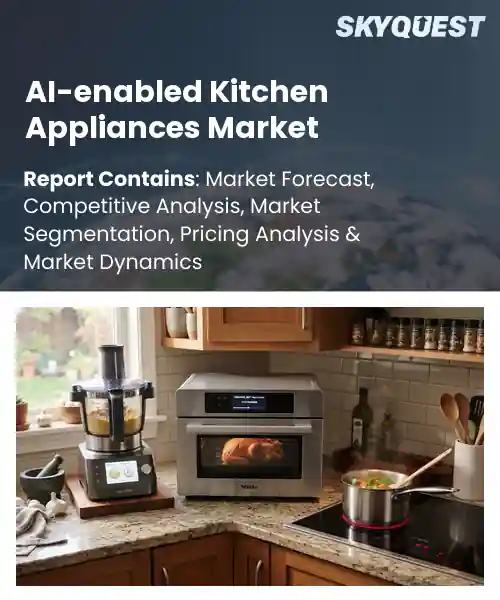
AI-enabled Kitchen Appliances Market
Report ID: SQMIG25H2180
Report ID: SQMIG25H2180
[email protected]
USA +1 351-333-4748
Report ID:
SQMIG25H2180 |
Region:
Global |
Published Date: August, 2026
Pages:
157
|Tables:
147
|Figures:
78


Global Ai-Enabled Kitchen Appliances Market size was valued at USD 8.64 Billion in 2024 and is poised to grow from USD 10.21 Billion in 2025 to USD 38.92 Billion by 2033, growing at a CAGR of 18.2% during the forecast period (2026-2033).
The AI‑enabled kitchen appliances market comprises devices such as refrigerators, ovens, coffee makers and dishwashers that embed machine‑learning algorithms to anticipate user needs, optimize energy use and integrate with voice assistants. Its significance stems from the convergence of smart‑home adoption and rising consumer expectations for personalized cooking experiences. The sector emerged in the 2010s when manufacturers introduced Wi‑Fi‑enabled coffee machines, but accelerated after 2018 as cloud computing, affordable sensors and data platforms lowered development costs. Today, brands like Samsung’s Family Hub refrigerator and June’s AI oven illustrate how inventory management and automated cooking programs have become mainstream, driving market acceptance. Building on that foundation, the growth factor is the integration of AI with data‑driven nutrition and energy‑efficiency services, creating a loop that reliance. When a smart refrigerator records expiration dates, it can suggest recipes that reduce waste, prompting users to purchase complementary ingredients added to grocery‑list apps. This behavior not only boosts appliance usage but also opens revenue streams for manufacturers through meal‑planning platforms. Utility companies partner with AI ovens to shift cooking loads to off‑peak hours, lowering grid strain and offering rebates that incentivize adoption. These incentives accelerate market penetration and attract venture capital, positioning the sector for expansion.
How is AI and IoT integration driving innovation in the kitchen appliances market?
AI and IoT are reshaping kitchen appliances by embedding sensors, cloud connectivity and machine learning into everyday tools. Manufacturers now embed voice assistants that recognize recipes, ovens that adjust heat based on food moisture, and refrigerators that track inventory and suggest meals. These capabilities turn appliances into proactive partners, reducing manual steps and improving energy use. Consumers benefit from personalized experiences while brands gather data to refine product cycles. The market is seeing a shift from isolated gadgets to integrated ecosystems that communicate across the home, creating new value streams and driving demand for smarter, connected solutions.Samsung March 2024, introduced an AI powered refrigerator that learns usage patterns, automatically adjusts temperature and syncs with ovens and dishwashers to coordinate cooking cycles, reducing waste and simplifying meal planning. This launch showcases how real time data and cloud analytics accelerate efficiency and fuel market growth.
Market snapshot - (2026-2033)
Global Market Size
USD 8.64 Billion
Largest Segment
Smart Refrigerators
Fastest Growth
Smart Air Fryers
Growth Rate
18.2% CAGR
To get more insights on this market click here to Request a Free Sample Report
Global ai-enabled kitchen appliances market is segmented by appliance type, ai technology, connectivity, application, end user and region. Based on appliance type, the market is segmented into Smart Refrigerators, Smart Ovens, Smart Cooktops, Smart Coffee Makers, Smart Dishwashers and Smart Air Fryers. Based on ai technology, the market is segmented into Machine Learning, Computer Vision and Natural Language Processing. Based on connectivity, the market is segmented into Wi-Fi, Bluetooth and Zigbee. Based on application, the market is segmented into Cooking Automation, Food Monitoring, Energy Management and Appliance Diagnostics. Based on end user, the market is segmented into Residential and Commercial. Based on region, the market is segmented into North America, Europe, Asia Pacific, Latin America and Middle East & Africa.
Machine Learning segment dominates because it provides the foundational intelligence that enables predictive temperature control, inventory forecasting, and personalized recipe suggestions in smart kitchen appliances. By continuously analyzing usage patterns, it refines operational algorithms, creating seamless interaction between hardware and user preferences. This adaptability drives consumer confidence and manufacturers’ commitment, making machine learning the core engine that sustains market relevance and product differentiation across various product lines globally continuously.
Conversely, Computer Vision segment emerges as the fastest growing area because it enables real time food recognition, cooking progress monitoring, and safety alerts within appliances. Enhanced camera integration and edge processing spark consumer interest, prompting OEMs to embed vision systems that unlock new use cases and expand the market’s functional horizon.
Wi Fi segment dominates because it offers ubiquitous high bandwidth connectivity that supports seamless firmware updates, voice command integration, and real time data streaming for smart kitchen appliances. Its compatibility with home routers ensures reliable communication, encouraging manufacturers to prioritize Wi Fi in design, which in turn enhances user convenience and accelerates adoption across diverse household environments. It also enables coordinated scheduling with other home devices, boosting overall efficiency.
Meanwhile, Zigbee segment is witnessing the strongest growth momentum because its low power consumption and mesh networking capabilities suit multi appliance ecosystems in kitchens. Developers are leveraging Zigbee to create cost effective, reliable links between devices, driving broader deployment in compact appliances and encouraging innovative features that expand market appeal.
To get detailed segments analysis, Request a Free Sample Report
Asia Pacific leads the AI‑enabled kitchen appliances market due to a confluence of advanced manufacturing capabilities, strong consumer appetite for smart home solutions, and supportive innovation ecosystems. The region benefits from deep R&D investment in electronics and robotics, which translates into sophisticated appliance designs that integrate voice control, predictive cooking algorithms, and energy‑efficient operation. Urbanization trends and rising disposable income drive demand for convenience‑focused products, while government initiatives encourage digital transformation across household sectors. Collaborative partnerships between appliance manufacturers and technology firms accelerate the rollout of connected ecosystems, reinforcing the region’s reputation as a hub for cutting‑edge kitchen solutions. These combined factors create a self‑reinforcing cycle of adoption, product refinement, and market leadership that sustains Asia Pacific’s dominant position. These ongoing efforts also emphasize sustainability, aligning with consumer expectations and further cementing the region’s appeal.
AI-enabled Kitchen Appliances Market in Japan is shaped by a culture that values precision, efficiency, and technological elegance. Consumers embrace appliances that offer seamless integration with mobile platforms and advanced cooking assistance, reflecting high digital literacy. Domestic manufacturers leverage strong engineering expertise to embed sophisticated sensors and AI-driven personalization, while collaborations with global tech firms expand functionality. This synergy fuels a steady stream of innovative products that cater to space‑constrained urban kitchens and a growing preference for health‑focused cooking.
AI-enabled Kitchen Appliances Market in South Korea thrives on a rapid adoption cycle driven by tech‑savvy consumers and a robust ecosystem of startups and established manufacturers. The market emphasizes connectivity, with appliances frequently linked to smart home hubs and voice assistants, delivering personalized cooking experiences. Local firms capitalize on advanced semiconductor capabilities to embed AI processors directly into devices, enhancing real‑time decision making. Government support for smart living initiatives further accelerates product development, positioning South Korea as a leader in next‑generation kitchen technology.
North America experiences rapid expansion of AI‑enabled kitchen appliances as consumers prioritize convenience, health, and connected living. A strong culture of early technology adoption fuels demand for appliances that integrate voice control, predictive cooking algorithms, and remote monitoring through mobile applications. Growing awareness of nutrition and desire for personalized meal preparation encourage manufacturers to embed AI that adjusts cooking parameters to individual preferences. The presence of major technology firms and a mature e‑commerce infrastructure accelerates product rollout and seamless software updates. Collaborative ecosystems between appliance makers, cloud service providers, and data analytics companies enhance functionality and create value‑added services such as recipe recommendations and energy‑usage insights. These dynamics, combined with a focus on sustainability and smart‑home interoperability, reinforce the region’s momentum in embracing intelligent kitchen solutions.
AI-enabled Kitchen Appliances Market in United States reflects a high degree of consumer willingness to invest in smart home ecosystems and a competitive landscape of both legacy brands and innovative startups. Integration with widely adopted voice assistants and extensive app ecosystems enables seamless control and data-driven personalization. Manufacturers leverage advanced analytics to offer features such as automated grocery replenishment and adaptive cooking programs. This convergence of technology, lifestyle trends, and robust distribution channels sustains a dynamic market environment.
AI-enabled Kitchen Appliances Market in Canada benefits from a consumer base that values energy efficiency, sustainability, and seamless integration with home automation platforms. Canadian households adopt appliances that provide AI‑driven cooking guidance and remote monitoring, aligning with a growing emphasis on healthy lifestyles. Local manufacturers collaborate with technology partners to embed multilingual voice interfaces and climate‑aware cooking algorithms. Government incentives for smart‑home adoption further encourage market penetration, fostering an ecosystem where innovative kitchen solutions thrive.
Europe strengthens its position in the AI‑enabled kitchen appliances market through a blend of design excellence, regulatory leadership, and a focus on sustainability. Manufacturers prioritize sleek, ergonomic designs that integrate AI for intuitive user experiences while adhering to stringent energy‑efficiency standards. Collaborative research initiatives across the continent foster advancements in machine‑learning algorithms that enable adaptive cooking and waste reduction. Strong consumer demand for health‑oriented features drives the incorporation of nutrition‑focused AI that suggests balanced recipes and portion sizes. The region’s mature supply chain and emphasis on data privacy create a trusted environment for connected appliances. Additionally, policy incentives encouraging smart‑home adoption and circular‑economy practices accelerate market growth, positioning Europe as a hub for innovative, responsible kitchen technology. These combined efforts not only enhance consumer confidence but also attract global partnerships seeking to leverage Europe’s expertise in sustainable smart appliances.
AI-enabled Kitchen Appliances Market in Germany is characterized by a strong engineering tradition and a consumer preference for precision and reliability. German manufacturers embed AI to deliver highly accurate temperature control, predictive maintenance alerts, and integration with energy‑management systems. The market benefits from close collaboration between appliance producers and automotive‑grade sensor suppliers, resulting in robust, data‑driven cooking solutions. Sustainability is a core driver, with AI optimizing resource usage and supporting circular‑economy initiatives. This combination of technical rigor and eco‑conscious design reinforces Germany’s reputation as a leader in premium smart kitchen technology.
AI-enabled Kitchen Appliances Market in United Kingdom reflects a consumer focus on convenience, culinary creativity, and data privacy. British households adopt appliances that offer AI‑driven recipe personalization, voice‑activated controls, and seamless integration with popular smart‑home hubs. Local manufacturers prioritize secure data handling and compliance with stringent privacy regulations, building trust in connected kitchen devices. Collaborative projects with research institutions drive innovations such as adaptive cooking modes that respond to ingredient availability and user skill level. The emphasis on sustainable design, including energy‑saving AI algorithms, aligns with the UK’s broader environmental objectives, strengthening the market’s growth trajectory.
AI-enabled Kitchen Appliances Market in France is driven by a cultural appreciation for gastronomy combined with a growing appetite for smart home convenience. French consumers seek appliances that can intelligently suggest recipes, adjust cooking parameters to preserve flavor, and integrate with voice assistants in multiple languages. Domestic manufacturers collaborate with culinary institutes to embed AI that respects traditional cooking techniques while offering modern efficiency. Energy‑efficiency standards and government incentives for digital home upgrades further stimulate adoption. This blend of culinary heritage, technological innovation, and sustainability focus positions France as a vibrant contributor to Europe’s smart kitchen landscape.
To know more about the market opportunities by region and country, click here to
Buy The Complete Report
Connected Appliances Enhancing Convenience
Data Analytics Driving Product Innovation
High Initial Cost Limits Adoption
Data Privacy Concerns Restrict Market Growth
Request Free Customization of this report to help us to meet your business objectives.
The competitive landscape is shaped by intense rivalry as major appliance manufacturers partner with AI specialists and pursue technology‑driven innovations such as smart cooking algorithms, voice‑controlled interfaces, and integrated IoT ecosystems; recent M&A activity and joint ventures aim to accelerate product rollouts and capture emerging consumer demand for personalized, data‑rich kitchen experiences.
Top Player’s Company Profile
Recent Developments
SkyQuest’s ABIRAW (Advanced Business Intelligence, Research & Analysis Wing) is our Business Information Services team that Collects, Collates, Correlates, and Analyses the Data collected by means of Primary Exploratory Research backed by robust Secondary Desk research. As per SkyQuest analysis, the global AI‑enabled kitchen appliances market is being propelled primarily by the convenience offered by connected appliances that automate cooking, inventory and energy use, while a second strong catalyst is the wealth of data analytics that fuels continuous product innovation and personalized experiences. The market is led by the Asia Pacific region, where advanced manufacturing and strong consumer demand drive rapid adoption. Machine learning remains the dominant AI technology segment, underpinning predictive temperature control and recipe suggestions across smart refrigerators, ovens and other devices. However, the high initial cost of these sophisticated appliances poses a significant restraint, slowing uptake in price‑sensitive segments.
| Report Metric | Details |
|---|---|
| Market size value in 2024 | USD 8.64 Billion |
| Market size value in 2033 | USD 38.92 Billion |
| Growth Rate | 18.2% |
| Base year | 2024 |
| Forecast period | (2026-2033) |
| Forecast Unit (Value) | USD Billion |
| Segments covered |
|
| Regions covered | North America (US, Canada), Europe (Germany, France, United Kingdom, Italy, Spain, Rest of Europe), Asia Pacific (China, India, Japan, Rest of Asia-Pacific), Latin America (Brazil, Rest of Latin America), Middle East & Africa (South Africa, GCC Countries, Rest of MEA) |
| Companies covered |
|
| Customization scope | Free report customization with purchase. Customization includes:-
|
To get a free trial access to our platform which is a one stop solution for all your data requirements for quicker decision making. This platform allows you to compare markets, competitors who are prominent in the market, and mega trends that are influencing the dynamics in the market. Also, get access to detailed SkyQuest exclusive matrix.
Table Of Content
Executive Summary
Market overview
Parent Market Analysis
Market overview
Market size
KEY MARKET INSIGHTS
COVID IMPACT
MARKET DYNAMICS & OUTLOOK
Market Size by Region
KEY COMPANY PROFILES
Methodology
For the AI-enabled Kitchen Appliances Market, our research methodology involved a mixture of primary and secondary data sources. Key steps involved in the research process are listed below:
1. Information Procurement: This stage involved the procurement of Market data or related information via primary and secondary sources. The various secondary sources used included various company websites, annual reports, trade databases, and paid databases such as Hoover's, Bloomberg Business, Factiva, and Avention. Our team did 45 primary interactions Globally which included several stakeholders such as manufacturers, customers, key opinion leaders, etc. Overall, information procurement was one of the most extensive stages in our research process.
2. Information Analysis: This step involved triangulation of data through bottom-up and top-down approaches to estimate and validate the total size and future estimate of the AI-enabled Kitchen Appliances Market.
3. Report Formulation: The final step entailed the placement of data points in appropriate Market spaces in an attempt to deduce viable conclusions.
4. Validation & Publishing: Validation is the most important step in the process. Validation & re-validation via an intricately designed process helped us finalize data points to be used for final calculations. The final Market estimates and forecasts were then aligned and sent to our panel of industry experts for validation of data. Once the validation was done the report was sent to our Quality Assurance team to ensure adherence to style guides, consistency & design.
Analyst Support
Customization Options
With the given market data, our dedicated team of analysts can offer you the following customization options are available for the AI-enabled Kitchen Appliances Market:
Product Analysis: Product matrix, which offers a detailed comparison of the product portfolio of companies.
Regional Analysis: Further analysis of the AI-enabled Kitchen Appliances Market for additional countries.
Competitive Analysis: Detailed analysis and profiling of additional Market players & comparative analysis of competitive products.
Go to Market Strategy: Find the high-growth channels to invest your marketing efforts and increase your customer base.
Innovation Mapping: Identify racial solutions and innovation, connected to deep ecosystems of innovators, start-ups, academics, and strategic partners.
Category Intelligence: Customized intelligence that is relevant to their supply Markets will enable them to make smarter sourcing decisions and improve their category management.
Public Company Transcript Analysis: To improve the investment performance by generating new alpha and making better-informed decisions.
Social Media Listening: To analyze the conversations and trends happening not just around your brand, but around your industry as a whole, and use those insights to make better Marketing decisions.
REQUEST FOR SAMPLE
 REQUEST FREE CUSTOMIZATION


Want to customize this report? This report can be personalized according to your needs. Our analysts and industry experts will work directly with you to understand your requirements and provide you with customized data in a short amount of time. We offer $1000 worth of FREE customization at the time of purchase.
Feedback From Our Clients


 USA (+1) 351-333-4748

