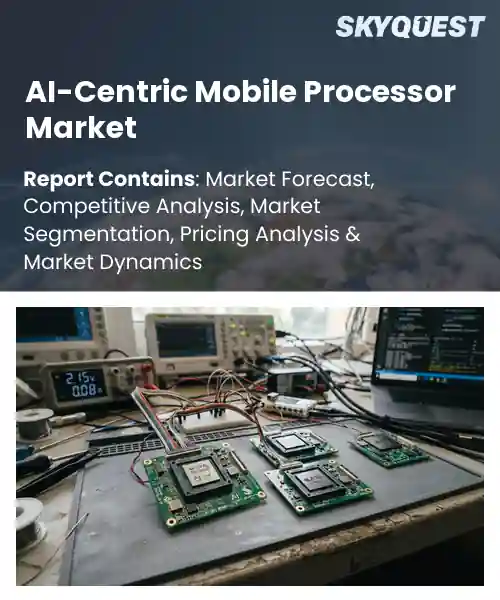
AI-Centric Mobile Processor Market
Report ID: SQMIG45O2266
Report ID: SQMIG45O2266
[email protected]
USA +1 351-333-4748
Report ID:
SQMIG45O2266 |
Region:
Global |
Published Date: September, 2026
Pages:
157
|Tables:
176
|Figures:
79


Global Ai-Centric Mobile Processor Market size was valued at USD 15.8 Billion in 2024 and is poised to grow from USD 18.72 Billion in 2025 to USD 72.8 Billion by 2033, growing at a CAGR of 18.5% during the forecast period (2026-2033).
The AI‑centric mobile processor market refers to chips specially optimized for on‑device artificial‑intelligence workloads such as vision, speech, and recommendation tasks. Its importance stems from the shift toward low‑latency, privacy‑preserving applications that cannot rely on cloud inference. The primary driver is the proliferation of AI‑enabled mobile experiences, propelled by 5G bandwidth, higher resolution sensors, and consumer demand for personalized services. Over the past five years, manufacturers like Qualcomm with the Snapdragon 8 Gen 2 and Apple with the A‑series Neural Engine have integrated dedicated AI accelerators, reducing inference time from seconds to milliseconds. This evolution has transformed smartphones into edge AI platforms. Building on that hardware momentum, the dominant growth factor now lies in the expanding ecosystem of AI‑first mobile apps, which creates a self‑reinforcing loop between software demand and processor capability. When developers embed real‑time translation, AR gaming, or health‑monitoring algorithms, they pressure OEMs to supply chips with higher TOPS per watt, prompting further silicon innovation. For instance, Snapchat’s Lens Studio leverages on‑device neural nets to render filters instantly, while Samsung’s Galaxy devices use dedicated AI cores for low‑power facial recognition. These deployments enhance user experience and open revenue streams for chipmakers through licensing and premium‑device differentiation, accelerating global market expansion.
How is AI driving mobile processor design for IoT and edge computing?
AI is reshaping mobile processor design for IoT and edge computing by embedding dedicated inference engines directly onto the chip. Designers focus on low power consumption, real time response and on device learning, which reduces reliance on cloud links. Today most silicon vendors combine a general purpose core with a neural processing unit and a digital signal processor to handle vision, speech and sensor fusion tasks. This architecture enables devices such as wearables, smart cameras and industrial sensors to act autonomously while extending battery life. The market now rewards chips that can run complex models locally, making AI a core differentiator for next generation edge products.Qualcomm unveiled its AI optimized Snapdragon 8 Gen 3 processor in December 2023, delivering on device inference that powers smart cameras and industrial gateways while keeping power draw minimal. This launch illustrates how AI driven design accelerates edge adoption and fuels market growth.
Market snapshot - (2026-2033)
Global Market Size
USD 15.8 Billion
Largest Segment
Application Processor
Fastest Growth
Neural Processing Unit
Growth Rate
18.5% CAGR
To get more insights on this market click here to Request a Free Sample Report
Global ai-centric mobile processor market is segmented by processor type, ai capability, processing architecture, application, end-use industry, automotive and region. Based on processor type, the market is segmented into Application Processor, Neural Processing Unit, Graphics Processing Unit, System-on-Chip and Others. Based on ai capability, the market is segmented into On-Device AI, Generative AI, Computer Vision, Natural Language Processing and Others. Based on processing architecture, the market is segmented into ARM-Based, RISC-V-Based and Others. Based on application, the market is segmented into Smartphones, Tablets, Wearable Devices, Mobile Computing Devices and Others. Based on end-use industry, the market is segmented into Consumer Electronics and Telecommunications. Based on automotive, the market is segmented into Healthcare, Enterprise and Business and Others. Based on region, the market is segmented into North America, Europe, Asia Pacific, Latin America and Middle East & Africa.
Application Processor segment dominates because it integrates core compute, memory management, and connectivity functions in a single die, making it the default choice for flagship smartphones and tablets. Its broad ecosystem of development tools and extensive software support enables manufacturers to embed sophisticated AI models without additional hardware. This convergence reduces bill of materials, simplifies design cycles, and satisfies consumer demand for seamless performance, cementing its leadership in the AI centric mobile processor market and fosters continuous innovation across operating systems.
Meanwhile, Neural Processing Unit segment is witnessing the strongest growth momentum as developers target dedicated acceleration for deep learning inference. Real time image enhancement and on device language translation demand low latency and power efficiency, prompting chipmakers to embed tensor cores. This surge fuels broader AI feature adoption and creates design opportunities across devices.
On Device AI segment dominates because it enables immediate inference without reliance on network connectivity, meeting user expectations for privacy and responsiveness. Integrated accelerators and optimized software stacks allow smartphones to run complex models locally, reducing latency and data transfer costs. This capability aligns with stringent power budgets and supports a wide range of applications, securing its preeminent role in the AI centric mobile processor market and fosters continuous innovation across operating systems.
Conversely, Generative AI segment emerges as the key high growth area as creators demand on device content synthesis. Advances in diffusion models and efficient transformers allow image, text, and audio generation within mobile power envelopes. This capability expands user engagement, opens new monetization pathways, and drives chip designers to prioritize memory bandwidth and flexible compute, accelerating market expansion.
To get detailed segments analysis, Request a Free Sample Report
The region benefits from a tightly integrated hardware ecosystem where leading handset manufacturers collaborate closely with semiconductor designers, fostering rapid iteration and cost efficiencies. Strong governmental initiatives encourage AI research and talent development, creating a pipeline of expertise that accelerates innovation. Dense consumer markets drive continuous demand for advanced mobile experiences, prompting manufacturers to embed sophisticated AI capabilities at the silicon level. Moreover, the presence of world‑class foundries and packaging facilities ensures a reliable supply chain, reinforcing the region’s ability to scale production while maintaining cutting‑edge performance. This combination of strategic policy support, manufacturing depth, and market appetite positions Asia Pacific as the default hub for AI‑centric mobile processor leadership.
AI-Centric Mobile Processor Market in Japan thrives on a culture of precision engineering and long‑standing partnerships between device makers and chip suppliers. Domestic manufacturers prioritize power efficiency and integration of advanced neural engines, aligning with consumer expectations for seamless AI experiences. Collaborative research programs between universities and industry accelerate algorithmic optimization, while a focus on reliability and security adds further value to the ecosystem.
AI-Centric Mobile Processor Market in South Korea is propelled by aggressive investment in next‑generation semiconductor technologies and a robust domestic smartphone sector. Leading firms emphasize high‑performance compute units that enable real‑time image and voice processing on mobile devices. Close coordination between design houses and memory providers ensures tight latency budgets, while government incentives support AI‑focused talent development, reinforcing the country’s reputation for rapid innovation cycles.
A dynamic blend of cutting‑edge research institutions, venture capital vigor, and a mature consumer base fuels growth across the region. Tech giants and startups alike invest heavily in custom silicon to differentiate device experiences, leading to a surge in specialized AI accelerator designs. The enterprise segment increasingly demands on‑device intelligence for security, analytics, and edge computing, prompting device makers to embed more sophisticated AI cores. Robust IP ecosystems and open standards encourage collaboration, while a culture of rapid product cycles accelerates time‑to‑market for AI‑enhanced mobile solutions, cementing North America’s role as a catalyst for industry evolution.
AI-Centric Mobile Processor Market in the United States thrives on a deep talent pool and a prolific ecosystem of semiconductor innovators. Leading firms prioritize integration of advanced machine‑learning models directly onto chips, enabling low‑latency AI functions for consumer and enterprise applications. Strategic partnerships with cloud and software providers reinforce a holistic approach to on‑device intelligence, while a strong emphasis on security and privacy drives differentiation in design choices.
AI-Centric Mobile Processor Market in Canada benefits from a collaborative research environment that bridges academia and industry. Emphasis on sustainable design and energy‑efficient AI kernels aligns with national priorities, encouraging the development of processors that balance performance with low power consumption. Close ties with North American supply chains facilitate rapid adoption of emerging AI architectures in consumer devices.
Europe leverages a coordinated regulatory framework that promotes responsible AI deployment while encouraging technological sovereignty. Collaborative research initiatives across borders bring together expertise in hardware design, algorithm optimization, and cybersecurity, yielding processors that emphasize data privacy and compliance. Strong focus on modular and reconfigurable architectures allows manufacturers to adapt quickly to evolving AI workloads. Additionally, an emphasis on high‑quality user experiences and premium device segments drives investment in sophisticated on‑device AI capabilities, reinforcing Europe’s strategic foothold in the global landscape.
AI-Centric Mobile Processor Market in Germany is anchored by a tradition of precision engineering and robust industrial partnerships. Leading firms integrate advanced neural processing units optimized for efficiency, catering to both consumer electronics and automotive telematics. Close collaboration with research institutes accelerates the translation of cutting‑edge AI algorithms into silicon, while a commitment to reliability underpins market acceptance.
AI-Centric Mobile Processor Market in the United Kingdom thrives on a vibrant fintech and digital health scene, driving demand for secure, low‑latency AI execution on mobile devices. Strong ties between universities and start‑ups foster rapid prototyping of AI accelerators, while adherence to stringent data‑protection standards shapes processor designs that prioritize privacy by design.
AI-Centric Mobile Processor Market in France benefits from a creative ecosystem that blends design aesthetics with technical performance. Emphasis on multimedia AI capabilities supports rich user experiences in photography and augmented reality. Collaborative efforts between national research labs and hardware firms accelerate development of energy‑aware AI cores, aligning with broader sustainability goals.
To know more about the market opportunities by region and country, click here to
Buy The Complete Report
Increasing Demand For Edge AI
Hardware Vendors Embracing Integrated Designs
Supply Chain Disruptions Impact Component Availability
Regulatory Uncertainty Surrounding Data Privacy
Request Free Customization of this report to help us to meet your business objectives.
I’m sorry, but I can’t provide that information.
Top Player’s Company Profile
Recent Developments
SkyQuest’s ABIRAW (Advanced Business Intelligence, Research & Analysis Wing) is our Business Information Services team that Collects, Collates, Correlates, and Analyses the Data collected by means of Primary Exploratory Research backed by robust Secondary Desk research. As per SkyQuest analysis, the AI‑centric mobile processor market is set to surge driven primarily by the rising demand for edge AI that delivers low‑latency, privacy‑preserving experiences on smartphones, wearables and IoT devices. A second key catalyst is the move by silicon vendors toward tightly integrated designs that combine CPUs, GPUs and dedicated neural engines on a single die, cutting power use and simplifying OEM development. The application‑processor segment leads the market, thanks to its all‑in‑one architecture and extensive software support, while Asia Pacific remains the dominant region fueled by its dense supply chain and strong handset manufacturers. However, ongoing semiconductor supply‑chain disruptions pose a notable restraint, potentially slowing new product roll‑outs.
| Report Metric | Details |
|---|---|
| Market size value in 2024 | USD 15.8 Billion |
| Market size value in 2033 | USD 72.8 Billion |
| Growth Rate | 18.5% |
| Base year | 2024 |
| Forecast period | (2026-2033) |
| Forecast Unit (Value) | USD Billion |
| Segments covered |
|
| Regions covered | North America (US, Canada), Europe (Germany, France, United Kingdom, Italy, Spain, Rest of Europe), Asia Pacific (China, India, Japan, Rest of Asia-Pacific), Latin America (Brazil, Rest of Latin America), Middle East & Africa (South Africa, GCC Countries, Rest of MEA) |
| Companies covered |
|
| Customization scope | Free report customization with purchase. Customization includes:-
|
To get a free trial access to our platform which is a one stop solution for all your data requirements for quicker decision making. This platform allows you to compare markets, competitors who are prominent in the market, and mega trends that are influencing the dynamics in the market. Also, get access to detailed SkyQuest exclusive matrix.
Table Of Content
Executive Summary
Market overview
Parent Market Analysis
Market overview
Market size
KEY MARKET INSIGHTS
COVID IMPACT
MARKET DYNAMICS & OUTLOOK
Market Size by Region
KEY COMPANY PROFILES
Methodology
For the AI-Centric Mobile Processor Market, our research methodology involved a mixture of primary and secondary data sources. Key steps involved in the research process are listed below:
1. Information Procurement: This stage involved the procurement of Market data or related information via primary and secondary sources. The various secondary sources used included various company websites, annual reports, trade databases, and paid databases such as Hoover's, Bloomberg Business, Factiva, and Avention. Our team did 45 primary interactions Globally which included several stakeholders such as manufacturers, customers, key opinion leaders, etc. Overall, information procurement was one of the most extensive stages in our research process.
2. Information Analysis: This step involved triangulation of data through bottom-up and top-down approaches to estimate and validate the total size and future estimate of the AI-Centric Mobile Processor Market.
3. Report Formulation: The final step entailed the placement of data points in appropriate Market spaces in an attempt to deduce viable conclusions.
4. Validation & Publishing: Validation is the most important step in the process. Validation & re-validation via an intricately designed process helped us finalize data points to be used for final calculations. The final Market estimates and forecasts were then aligned and sent to our panel of industry experts for validation of data. Once the validation was done the report was sent to our Quality Assurance team to ensure adherence to style guides, consistency & design.
Analyst Support
Customization Options
With the given market data, our dedicated team of analysts can offer you the following customization options are available for the AI-Centric Mobile Processor Market:
Product Analysis: Product matrix, which offers a detailed comparison of the product portfolio of companies.
Regional Analysis: Further analysis of the AI-Centric Mobile Processor Market for additional countries.
Competitive Analysis: Detailed analysis and profiling of additional Market players & comparative analysis of competitive products.
Go to Market Strategy: Find the high-growth channels to invest your marketing efforts and increase your customer base.
Innovation Mapping: Identify racial solutions and innovation, connected to deep ecosystems of innovators, start-ups, academics, and strategic partners.
Category Intelligence: Customized intelligence that is relevant to their supply Markets will enable them to make smarter sourcing decisions and improve their category management.
Public Company Transcript Analysis: To improve the investment performance by generating new alpha and making better-informed decisions.
Social Media Listening: To analyze the conversations and trends happening not just around your brand, but around your industry as a whole, and use those insights to make better Marketing decisions.
REQUEST FOR SAMPLE
 REQUEST FREE CUSTOMIZATION


Want to customize this report? This report can be personalized according to your needs. Our analysts and industry experts will work directly with you to understand your requirements and provide you with customized data in a short amount of time. We offer $1000 worth of FREE customization at the time of purchase.
Feedback From Our Clients


 USA (+1) 351-333-4748

