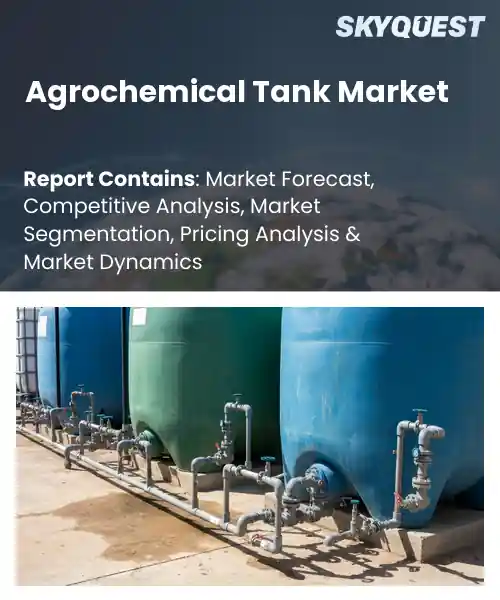
Agrochemical Tank Market
Report ID: SQMIG15C2223
Report ID: SQMIG15C2223
[email protected]
USA +1 351-333-4748
Report ID:
SQMIG15C2223 |
Region:
Global |
Published Date: July, 2026
Pages:
157
|Tables:
99
|Figures:
76


Global Agrochemical Tank Market size was valued at USD 1.5 Billion in 2024 and is poised to grow from USD 1.57 Billion in 2025 to USD 2.23 Billion by 2033, growing at a CAGR of 4.5% during the forecast period (2026-2033).
High adoption of precision agriculture, increasing mechanization of farming operations, rising demand for corrosion-resistant agrochemical storage solutions, expanding use of GPS-enabled spraying systems, and growing emphasis on sustainable farming practices are driving demand for agrochemical tanks.
Growing requirements for the secure storage, transport, and application of fertilizers, herbicides, insecticides, and fungicides are also contributing to the growing popularity of high-end agrochemical tanks. Continuous innovations in terms of corrosion-resistant polyethylene, composite tank design, and precision metering technology are adding to their durability, chemical resistance, and accuracy of application. Increasing use of GPS-spraying equipment, Internet of Things-based monitoring devices, and modular tanks is further helping farmers in saving chemicals, improving crop yield, and adopting sustainable agriculture. Increased spending on climate-smart agriculture and precise application system is likely to generate new opportunities for the agrochemical tank industry in the coming years. Growing adoption of precision agriculture around the world coupled with increasing mechanization of farming operations is expected to primarily drive agrochemical tank market growth.
On the contrary, fluctuating raw material prices, stringent environmental and chemical storage regulations, high initial costs of advanced tank systems, and limited adoption of precision farming technologies in developing regions are anticipated to slow down agrochemical tank market penetration across the study period and beyond.
How is IoT-enabled Monitoring Influencing Efficiency of Agrochemical Tank?
IoT is revolutionizing the agrochemical tank industry with its capabilities of providing real-time updates regarding tank levels, temperature, flow rates, and chemical utilization. Sensors fitted in the tanks enable communication of information to cloud-based platforms in real time, thus allowing farmers to track the status of the tanks via mobile phones from anywhere. The technology enables farmers to get immediate warnings whenever there is a lack of chemicals in the tanks or when there are leaks or problems with the machinery.
Market snapshot - (2026-2033)
Global Market Size
USD 1.5 Billion
Largest Segment
Vertical Tanks
Fastest Growth
Horizontal Tanks
Growth Rate
4.5% CAGR
To get more insights on this market click here to Request a Free Sample Report
Global agrochemical tank market is segmented by type, application, capacity (size), and region. Based on type, the market is segmented into vertical tanks, horizontal tanks, and conical tanks. Based on application, the market is segmented into water storage, fertilizer storage, chemical storage, and others. Based on capacity (size), the market is segmented into 200 500 litres, 500 1,000 liters, 1,000 15,000 liters, 15,000 30,000 liters, and above 30,000 liters. Based on region, the market is segmented into North America, Europe, Asia Pacific, Latin America, and Middle East & Africa.
The vertical tanks segment is forecasted to lead the global agrochemical tank market revenue generation across the study period. Their vertical shape ensures optimal use of floor space as well as easy filling and discharge of the chemicals in bulk quantities. This design suits the available land on the farms as it can be installed among other machines. These vessels are rigid and thus have higher tolerance for pressure changes, which is important for handling sensitive chemicals. They are chosen by many due to their ease of maintenance and automated dispensing.
Meanwhile, horizontal tanks emerge as the most rapidly expanding segment as per this agrochemical tank market forecast, owing to the trend towards the use of low-profile storage systems which can easily fit into the process of mechanized spreading. The development of protective linings and modular constructions makes it easier for farmers to utilize this method.
The fertilizer storage segment is anticipated to account for the highest global agrochemical tank market share in the future. It clearly meets the fundamental requirement of maintaining nutrient stability without any contamination. The interior of these tanks is designed to create a moist environment to increase the shelf life of the products as well as to perform uniformly in the field. Frequent turnover of fertilizers encourages the use of tanks, which become very important due to stringent safety requirements. Besides, they work seamlessly with precision dispensing equipment.
On the other hand, chemical storage segment is witnessing the strongest growth as manufacturers develop different formulations for their agrochemical products that need containment. Innovations in protective coatings and leak detection make people feel safe in dealing with hazardous materials, leading to increased usage. This trend opens up opportunities in the market due to the safe usage of actives.
To get detailed segments analysis, Request a Free Sample Report
The Asia Pacific region dominates the agrochemical tank market because of a blend of intensive farming methods, fast uptake of modern agricultural technology, and a competent manufacturing infrastructure in the area. Large-scale production of crops, including staples and high-value crops, increases the need for reliable storage and dispensing facilities. The availability of large agrochemical manufacturers and an enabling regulatory framework ensures continuous improvement in tank technology, material science, and automation. In addition, the availability of competent engineers and efficient supply chain networks in the region enhances the development and deployment of tanks in the area.
Agrochemical tank market in Japan is characterized by a focus on high‑precision equipment and stringent quality standards. Domestic manufacturers prioritize durability and corrosion resistance to meet the exacting requirements of the country’s diversified crop portfolio. Collaboration between research institutions and industry players fuels ongoing innovation in tank materials and safety features, supporting Japan’s reputation for technologically advanced agricultural solutions.
Agrochemical tank demand in South Korea benefits from a strong emphasis on smart farming and integration of digital monitoring systems. Local producers leverage advanced sensor technology and connectivity to offer tanks that provide real‑time data on chemical levels and tank integrity. This alignment with the nation’s broader push toward agricultural digitization enhances efficiency and safety across Korean farming operations.
North American demand for agrochemical tanks is growing at a fast pace because of the demand for increased productivity and environmental compliance from the farmers. The increasing cultivation of specialty crops and use of precision agriculture techniques lead to the increased demand for tanks that are efficient and reliable. A collaboration of equipment companies and agrochemicals increases the availability of tanks that are equipped with safety measures, ergonomics, and monitoring systems. In addition, the presence of an effective R&D infrastructure and sustainability-oriented regulatory framework ensures continual growth of the market in USA and Canada.
Agrochemical tank market in United States reflects a strong orientation toward large‑scale operations and mechanization. Manufacturers prioritize scalability, corrosion‑resistant alloys, and advanced sealing technologies to accommodate the extensive range of chemicals used in American agriculture. Close collaboration with agribusiness firms drives the incorporation of automated dispensing and real‑time tracking capabilities, aligning with the country’s emphasis on operational efficiency and regulatory adherence.
Agrochemical tank market in Canada is shaped by the country’s diverse climatic zones and emphasis on sustainable farming practices. Suppliers focus on robust tank designs capable of withstanding extreme temperature variations while maintaining chemical integrity. Integration of environmentally conscious materials and spill‑prevention systems is prevalent, supporting Canada’s commitment to reducing agricultural runoff and enhancing overall farm safety.
Europe controls its agrochemical tank demand through a unified approach to protecting the environment, following regulations, and innovating technologically. Europe has very tough safety and emission regulations that encourage the creation of tanks with better leak-proof designs, materials that can be recycled, and better monitoring facilities. Cooperative efforts between research centers, manufacturers, and policy makers create breakthroughs in lightweight composite tanks and modular tanks that are deployable in different agricultural contexts. Consistent funding for green chemistry and precision applications reinforces Europe’s dominance in developing tank systems.
Agrochemical tank market in Germany emphasizes engineering excellence and high‑performance materials. German producers integrate advanced corrosion‑resistant alloys and precision manufacturing processes to meet the rigorous demands of the country’s intensive crop management. Strong collaboration with chemical manufacturers ensures tanks are optimized for safety, efficiency, and compliance with strict European standards.
Agrochemical Tank Market in United Kingdom is driven by a blend of tradition and innovation in farming practices. British firms focus on modular tank designs that facilitate easy adaptation to diverse farm sizes and crop types. Emphasis on smart sensors and data connectivity aligns with the UK’s push toward digital agriculture, enhancing monitoring and reducing environmental impact.
Agrochemical Tank Market in France benefits from a deep integration with the nation’s renowned agronomy sector. French manufacturers prioritize elegantly designed tanks that combine durability with aesthetic considerations, catering to both large estates and family farms. Commitment to eco‑friendly materials and compliance with EU directives reinforces France’s role in promoting sustainable agrochemical handling.
To know more about the market opportunities by region and country, click here to
Buy The Complete Report
Rising Global Food Production
Adoption Of Sustainable Practices
Stringent Environmental Regulations
High Capital Investment Requirements
Request Free Customization of this report to help us to meet your business objectives.
The agrochemical tank market is intensely competitive, with major chemical giants leveraging strategic M&A, joint ventures, and advanced coating technologies to protect market share. Bayer’s acquisition of a specialty tank liner business in 2022 and BASF’s partnership with a nanocoating firm to launch corrosion‑resistant tanks illustrate how firms are using concrete moves to differentiate. These actions intensify pressure on rivals to innovate and expand distribution networks, driving the market’s evolution.
SkyQuest’s ABIRAW (Advanced Business Intelligence, Research & Analysis Wing) is our Business Information Services team that Collects, Collates, Correlates, and Analyses the Data collected by means of Primary Exploratory Research backed by robust Secondary Desk research.
As per SkyQuest analysis, increasing mechanization of farming operations, and rising demand for corrosion-resistant agrochemical storage solutions are anticipated to drive the demand for agrochemical tanks going forward. However, fluctuating raw material prices, stringent environmental and chemical storage regulations, and high initial costs of advanced tank systems are slated to slow down the adoption of agrochemical tanks in the future. Asia Pacific is slated to spearhead the demand for agrochemical tanks owing to widespread adoption of precision farming technologies, high farm mechanization rates, and strong investments in smart agricultural equipment. Development of IoT-enabled tank monitoring systems, integration of GPS-guided precision spraying technologies, and advancements in modular corrosion-resistant tank designs are anticipated to be key trends driving the agrochemical tank industry over the coming years.
| Report Metric | Details |
|---|---|
| Market size value in 2024 | USD 1.5 Billion |
| Market size value in 2033 | USD 2.23 Billion |
| Growth Rate | 4.5% |
| Base year | 2024 |
| Forecast period | (2026-2033) |
| Forecast Unit (Value) | USD Billion |
| Segments covered |
|
| Regions covered | North America (US, Canada), Europe (Germany, France, United Kingdom, Italy, Spain, Rest of Europe), Asia Pacific (China, India, Japan, Rest of Asia-Pacific), Latin America (Brazil, Rest of Latin America), Middle East & Africa (South Africa, GCC Countries, Rest of MEA) |
| Companies covered |
|
| Customization scope | Free report customization with purchase. Customization includes:-
|
To get a free trial access to our platform which is a one stop solution for all your data requirements for quicker decision making. This platform allows you to compare markets, competitors who are prominent in the market, and mega trends that are influencing the dynamics in the market. Also, get access to detailed SkyQuest exclusive matrix.
Table Of Content
Executive Summary
Market overview
Parent Market Analysis
Market overview
Market size
KEY MARKET INSIGHTS
COVID IMPACT
MARKET DYNAMICS & OUTLOOK
Market Size by Region
KEY COMPANY PROFILES
Methodology
For the Agrochemical Tank Market, our research methodology involved a mixture of primary and secondary data sources. Key steps involved in the research process are listed below:
1. Information Procurement: This stage involved the procurement of Market data or related information via primary and secondary sources. The various secondary sources used included various company websites, annual reports, trade databases, and paid databases such as Hoover's, Bloomberg Business, Factiva, and Avention. Our team did 45 primary interactions Globally which included several stakeholders such as manufacturers, customers, key opinion leaders, etc. Overall, information procurement was one of the most extensive stages in our research process.
2. Information Analysis: This step involved triangulation of data through bottom-up and top-down approaches to estimate and validate the total size and future estimate of the Agrochemical Tank Market.
3. Report Formulation: The final step entailed the placement of data points in appropriate Market spaces in an attempt to deduce viable conclusions.
4. Validation & Publishing: Validation is the most important step in the process. Validation & re-validation via an intricately designed process helped us finalize data points to be used for final calculations. The final Market estimates and forecasts were then aligned and sent to our panel of industry experts for validation of data. Once the validation was done the report was sent to our Quality Assurance team to ensure adherence to style guides, consistency & design.
Analyst Support
Customization Options
With the given market data, our dedicated team of analysts can offer you the following customization options are available for the Agrochemical Tank Market:
Product Analysis: Product matrix, which offers a detailed comparison of the product portfolio of companies.
Regional Analysis: Further analysis of the Agrochemical Tank Market for additional countries.
Competitive Analysis: Detailed analysis and profiling of additional Market players & comparative analysis of competitive products.
Go to Market Strategy: Find the high-growth channels to invest your marketing efforts and increase your customer base.
Innovation Mapping: Identify racial solutions and innovation, connected to deep ecosystems of innovators, start-ups, academics, and strategic partners.
Category Intelligence: Customized intelligence that is relevant to their supply Markets will enable them to make smarter sourcing decisions and improve their category management.
Public Company Transcript Analysis: To improve the investment performance by generating new alpha and making better-informed decisions.
Social Media Listening: To analyze the conversations and trends happening not just around your brand, but around your industry as a whole, and use those insights to make better Marketing decisions.
REQUEST FOR SAMPLE
 REQUEST FREE CUSTOMIZATION
Global Agrochemical Tank Market size was valued at USD 1.5 Billion in 2024 and is poised to grow from USD 1.57 Billion in 2025 to USD 2.23 Billion by 2033, growing at a CAGR of 4.5% during the forecast period (2026-2033).
The agrochemical tank market is intensely competitive, with major chemical giants leveraging strategic M&A, joint ventures, and advanced coating technologies to protect market share. Bayer’s acquisition of a specialty tank liner business in 2022 and BASF’s partnership with a nanocoating firm to launch corrosion‑resistant tanks illustrate how firms are using concrete moves to differentiate. These actions intensify pressure on rivals to innovate and expand distribution networks, driving the market’s evolution. 'Snyder Industries, LLC', 'Norwesco, Inc.', 'L.F. Manufacturing, Inc.', 'Assmann Corporation of America', 'Chemical Containers, Inc.', 'Enduramaxx Limited', 'ProMinent GmbH', 'Tank Holding Corporation', 'Poly Processing Company, LLC', 'Grupo Rotoplas, S.A.B. de C.V.', 'Polymaster Group', 'Sintex Industries Limited', 'Sherman Roto Tank LLC', 'Meridian Manufacturing Inc.', 'Balmoral Tanks Limited', 'Balson Polyplast Pvt. Ltd.', 'NEL Tanks Pty Ltd', 'Forti Technology Group', 'Prettech Machinery Making Co., Ltd.', 'Stafco Inc.'
The growing requirement for higher crop yields across diverse regions fuels demand for reliable storage solutions, and agrochemical tanks provide essential containment for fertilizers, pesticides, and growth regulators. As producers expand cultivation areas and adopt intensive practices, the need for safe, corrosion‑resistant vessels that prevent product degradation and environmental contamination becomes critical. Consequently, manufacturers of these tanks experience heightened interest, prompting investments in advanced materials and modular designs that align with evolving agronomic strategies and regulatory expectations throughout globally increasingly.
Sustainable Formulations: The agrochemical tank sector is shifting toward environmentally friendly product designs that minimize residual soil impact and enhance biodegradability. Manufacturers are reformulating active ingredients and carrier liquids to meet growing farmer demand for low‑toxicity solutions, while aligning with corporate sustainability pledges. This transition drives collaboration with research institutes, encourages the adoption of green chemistry principles, and influences packaging innovations that reduce waste, ultimately reshaping value chains and opening new market segments focused on ecological stewardship.
Why does Asia Pacific Dominate the Global Agrochemical Tank Market? |@12


Want to customize this report? This report can be personalized according to your needs. Our analysts and industry experts will work directly with you to understand your requirements and provide you with customized data in a short amount of time. We offer $1000 worth of FREE customization at the time of purchase.
Feedback From Our Clients


 USA (+1) 351-333-4748

