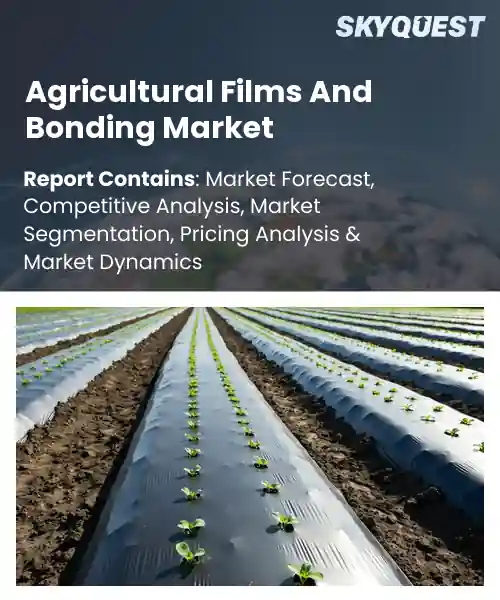
Agricultural Films And Bonding Market
Report ID: SQMIG15E3586
Report ID: SQMIG15E3586
[email protected]
USA +1 351-333-4748
Report ID:
SQMIG15E3586 |
Region:
Global |
Published Date: June, 2026
Pages:
157
|Tables:
120
|Figures:
77


Global Agricultural Films And Bonding Market size was valued at USD 14.52 Billion in 2024 and is poised to grow from USD 15.28 Billion in 2025 to USD 22.85 Billion by 2033, growing at a CAGR of 5.22% during the forecast period (2026-2033).
The primary driver of the agricultural films and bonding market is the intensifying need to increase crop yields while conserving scarce resources, which has transformed polymer covers into multifunctional agricultural systems. Agricultural films encompass greenhouse covers, mulch, silage and irrigation tapes. Bonding solutions enable durable seams, laminations and assemblies. The importance of the market is reflected in how film technologies have extended harvest seasons, improved water and chemical input efficiencies, and increased postharvest quality. Examples include using polyethylene greenhouse film covering to produce tomatoes year-round and using biodegradable mulch for reduced plastic residue in Europe. Over decades the sector evolved from LDPE sheets to co-extruded, UV-stabilized, and performance-tuned films demanded by farming.
Building on that evolution, material innovation driven by sustainability requirements is the key trend driving the global agricultural films and bonding sector, because stricter regulations and farmer concern over plastic residues force a shift from conventional polymers to biodegradable and co-extruded multilayer films. When producers commercialize compostable mulch and UV-resistant greenhouse laminates growers face lower disposal costs and better field performance, increasing adoption of higher-value films. In response suppliers of bonding and seam technologies formulate compatible adhesives and ultrasonic welders to join hybrid structures, enabling laminated drip tape and durable silage wraps. This cause-and-effect sequence creates opportunities in recycling infrastructure, certification and sensor-enabled films for optimization.
How is IoT Improving Performance in the Agricultural Films and Bonding Market?
The agricultural films and bonding market covers mulch films, silage and bale wraps, laminates and the adhesives that join multilayer constructions. IoT improves performance by turning passive materials into connected assets that feed real time soil moisture and temperature data into farm management systems. This enables targeted irrigation and fertilization, adaptive film selection and predictive maintenance that extends service life and reduces waste. Manufacturers and service providers are pairing sensor ready films with automated laying machines and cloud analytics so growers can match film properties to microclimates and bonding processes can be monitored during production for consistent quality, making the market more responsive and value driven.
In February 2026, Bumigro introduced a microbe based edible mulch film that attracted industry attention, and when combined with IoT soil sensors it supports efficient deployment and timely degradation by informing irrigation and removal schedules, improving crop outcomes and supply chain efficiency.
Market snapshot - (2026-2033)
Global Market Size
USD 14.52 Billion
Largest Segment
Mulch Films
Fastest Growth
Greenhouse Films
Growth Rate
5.22% CAGR
To get more insights on this market click here to Request a Free Sample Report
Global agricultural films and bonding market is segmented by film type, material, application, distribution and region. Based on film type, the market is segmented into mulch films, greenhouse films, silage films and fumigation films. Based on material, the market is segmented into LDPE (low-density polyethylene), LLDPE, biodegradable (PLA, PBAT) and EVA. Based on application, the market is segmented into fruit & vegetable farming, grain crops and horticulture. Based on distribution, the market is segmented into direct to farms, agricultural dealers and online. Based on region, the market is segmented into North America, Europe, Asia Pacific, Latin America and Middle East & Africa.
Based on the global agricultural films and bonding market growth, mulch Films segment dominates because growers depend on these films to regulate soil moisture, suppress weeds, and moderate soil temperature, which together improve crop uniformity and reduce input requirements. Their cross-application suitability for fruit, vegetable and horticulture production increases routine procurement, while compatibility with established bonding and sealing methods simplifies deployment and reinforces preference among buyers and specifiers in the agricultural films and bonding market.
However, greenhouse films are the most rapidly expanding area due to rising adoption of protected cultivation and demand for films that provide light diffusion and thermal control. Innovations in the way multilayer films are constructed and bonded to form large structures, as well as how they are integrated with climate control technologies, are opening the door for new applications for multilayer agricultural films and bonding solutions.
Biodegradable (PLA, PBAT) segment leads because sustainability mandates, brand commitments, and buyer preferences push procurement toward materials with lower end of life impact. Because of their ability to be composted, compostable plastics are not only reducing disposal pressure but also enabling improved mechanical performance and processing compatibility for replacing traditional plastic materials. To support the shift towards using compostable plastics and polymers, suppliers and adhesive manufacturers continue to advance bonding technologies to work with compostable-based polymers to drive integrated products that will ultimately reshape the specification and buying practice in the agriculture films and bonding industry.
Meanwhile, LLDPE is witnessing rapid growth as manufacturers and growers favor its tensile strength, puncture resistance, and stretchability for durable mulch and silage films. Advances in coextrusion and thin gauge manufacturing reduce material intensity while bonding systems evolve to ensure reliable seals, enabling expanded use cases and commercial opportunities within the agricultural films and bonding market.
To get detailed segments analysis, Request a Free Sample Report
As per the global agricultural films and bonding market share, Asia Pacific dominates due to a confluence of expansive agricultural activity, high adoption of protected cultivation techniques and a concentrated manufacturing ecosystem that supplies tailored films and bonding solutions. Strong resources in the area of the material science make up for regional producers of the area, and strong amounts of investment into research produces long- lasting and UV protective films and advanced adhesive solutions. Because of still existing demand for mulching, greenhouse covering and silage, due to the numerous adapted cropping systems and the great volume of horticultural production, and with an integrated supply chain across the production locations, the lead time to be able to produce almost anything with customization, is minimal. The high degree of cooperation between equipment manufacturers, polymer suppliers and agricultural technology innovators will result in a much faster rate of diffusion of technology, and with evolving environmental issues. The suppliers of these materials are responding by putting more emphasis on recyclability and life cycle performance, which will further reinforce the ability to be a leader in the area long term.
Agricultural films and bonding market in Japan features high technical sophistication, with manufacturers focusing on advanced polymer formulations, precision bonding technologies and durable products for intensive horticulture. The relationship between industrial and research development helps to create prototypes and modify/estimate the final products designed to create films for better climate resilience. In addition, the market supports premium quality products through various aspects including their regional market of specialty crops and the requirement of quality to generate and develop specialty crops.
Agricultural films and bonding market in South Korea is driven by a combination of advanced materials research, compact land use practices and strong integration between polymer producers and agricultural technology firms. The market emphasizes tailored films that address intensive greenhouse cultivation and urban farming needs, alongside bonding solutions that improve installation efficiency. Strategic focus on export markets and collaborations with machinery makers supports adaptation of products to varied regional requirements.
Based on global agricultural films and bonding regional forecast, North America expansion is driven by a combination of modern farming practices, large scale commercial agriculture and strong emphasis on productivity and resource efficiency. Agricultural mechanization and precision systems are leading to an increased demand for high-performance films that extend the crop cycle, reduce inputs, and simplify the installation and maintenance of large-scale agribusinesses. Suppliers use product portfolios to differentiate themselves by creating films that are durable, UV-stable, and compatible with recycling. Distribution channels and service networks allow farmers to easily access products and provide technical support. Ag-Tech companies, polymer manufacturers, and installers collaborate to speed up innovation and product adoption. New sustainability priorities are driving the development of films and adhesives in a way that balances performance, end of life, and overall market momentum across multiple types of agricultural production.
Agricultural films and bonding market in United States is shaped by large scale commercial farms, extensive distribution networks and adoption of precision agriculture. The ongoing focus of suppliers on the service, combined with their ability to provide localized technical support and their ability to incorporate recycled materials into products, guide the procurement of these products. In addition, the relationships between suppliers and equipment manufacturers and agronomy advisors help promote the integration of films into crop management systems.
Agricultural films and bonding market in Canada reflects a balance between commodity production and diversified specialty cropping. The emphasis placed by participants on how film products will perform within various types of climate will influence product development priorities with regards to storage, silage and protected growing applications, as well as affecting the availability, quality and price of film products. Product reliability and logistics efficiency are also important elements influencing film products that suppliers produce.
As per global agricultural films and bonding regional outlook, Europe is strengthening its position through a pronounced emphasis on sustainability, material innovation and regulatory compliance that elevates product standards. While developing bonded chemistries, suppliers are investing in both bio-based and recyclable formulations for all aspects of their manufacturing operations due to the increased requirements of end-of-life products as well as environmentally-friendly options which require minimal resource inputs during production. As a result, suppliers are developing products specifically designed to support highly productive cultivation industries, particularly in the cases of vegetable and flower production. Collaborative efforts between manufacturers, research organizations, testing labs and government agencies provide certifications and facilitate the development/commercialization of next-generation products. In addition, the focus on circular economies will drive suppliers to develop and produce product materials that are both high performing and environmentally responsible, further solidifying the strategic position of those particular regions.
Agricultural films and bonding market in Germany benefits from strong industrial capabilities, rigorous testing infrastructure and a focus on quality. The demand for new high performance solutions is driven by increased protected crop production and the use of intensive horticulture. The pilot programs developed through collaboration between research organizations and converters have been instrumental in obtaining these high performance solutions. Circular economy approaches encourage the development of materials that have a balance of durability and recovery at their end of life.
Agricultural films and bonding market in United Kingdom is influenced by a strong research base, diverse horticultural sector and emphasis on sustainability. Firms develop recyclable films, low emission adhesives and solutions for controlled environment agriculture. Distributors provide installation support and trials to aid farmer decision making. Working together with technology companies creates customized solutions for specialty crops, while government regulations and customers’ demands have fostered increased use of sustainable materials and methods.
Agricultural films and bonding market in France blends a tradition of high value horticulture with targeted innovation in protective films and adhesives. Research collaborations are being established with the goal of developing films that will provide a balance between controlling the microclimate, as well as performance/strength and recyclability. Retailers that focus on specialty products and cooperative organizations also assist in trialing and providing technical support, so that growers may adopt new film-based products and/or technologies.
To know more about the market opportunities by region and country, click here to
Buy The Complete Report
Increasing Demand For Crop Protection
Adoption Of Sustainable Packaging
Regulatory Complexity And Compliance Costs
Limited Recycling Infrastructure Development
Request Free Customization of this report to help us to meet your business objectives.
Competitive landscape in the global agricultural films and bonding market outlook is increasingly polarized between legacy chemical and film producers and deep tech entrants that compete on soil-biodegradability and cost-effective integration into existing film lines; regulatory bans on residual plastics and farm labor cost pressure are primary market drivers that shape competition and accelerate M&A, licensing and partnerships such as BASF expanding ecovio mulch offerings and Xampla partnering with Croda, while startups scale via public funding and pilots.
Top Player’s Company Profile
Recent Developments
SkyQuest’s ABIRAW (Advanced Business Intelligence, Research & Analysis Wing) is our Business Information Services team that Collects, Collates, Correlates, and Analyses the Data collected by means of Primary Exploratory Research backed by robust Secondary Desk research.
As per SkyQuest analysis, the global agricultural films and bonding industry is chiefly driven by the intensifying need to raise crop yields while conserving water and inputs, and a second driver is the rising adoption of biodegradable and bio-based films driven by sustainability mandates. A key restraint is complex and evolving regulatory compliance and associated costs that slow product roll-outs. Asia Pacific emerges as the dominating region due to expansive agriculture, protected cultivation and local manufacturing scale, while mulch films remain the dominating segment because of broad applicability for moisture control, weed suppression and input reduction. The market is poised for innovation in smart films, recycling and bonding solutions.
| Report Metric | Details |
|---|---|
| Market size value in 2024 | USD 14.52 Billion |
| Market size value in 2033 | USD 22.85 Billion |
| Growth Rate | 5.22% |
| Base year | 2024 |
| Forecast period | (2026-2033) |
| Forecast Unit (Value) | USD Billion |
| Segments covered |
|
| Regions covered | North America (US, Canada), Europe (Germany, France, United Kingdom, Italy, Spain, Rest of Europe), Asia Pacific (China, India, Japan, Rest of Asia-Pacific), Latin America (Brazil, Rest of Latin America), Middle East & Africa (South Africa, GCC Countries, Rest of MEA) |
| Companies covered |
|
| Customization scope | Free report customization with purchase. Customization includes:-
|
To get a free trial access to our platform which is a one stop solution for all your data requirements for quicker decision making. This platform allows you to compare markets, competitors who are prominent in the market, and mega trends that are influencing the dynamics in the market. Also, get access to detailed SkyQuest exclusive matrix.
Table Of Content
Executive Summary
Market overview
Parent Market Analysis
Market overview
Market size
KEY MARKET INSIGHTS
COVID IMPACT
MARKET DYNAMICS & OUTLOOK
Market Size by Region
KEY COMPANY PROFILES
Methodology
For the Agricultural Films And Bonding Market, our research methodology involved a mixture of primary and secondary data sources. Key steps involved in the research process are listed below:
1. Information Procurement: This stage involved the procurement of Market data or related information via primary and secondary sources. The various secondary sources used included various company websites, annual reports, trade databases, and paid databases such as Hoover's, Bloomberg Business, Factiva, and Avention. Our team did 45 primary interactions Globally which included several stakeholders such as manufacturers, customers, key opinion leaders, etc. Overall, information procurement was one of the most extensive stages in our research process.
2. Information Analysis: This step involved triangulation of data through bottom-up and top-down approaches to estimate and validate the total size and future estimate of the Agricultural Films And Bonding Market.
3. Report Formulation: The final step entailed the placement of data points in appropriate Market spaces in an attempt to deduce viable conclusions.
4. Validation & Publishing: Validation is the most important step in the process. Validation & re-validation via an intricately designed process helped us finalize data points to be used for final calculations. The final Market estimates and forecasts were then aligned and sent to our panel of industry experts for validation of data. Once the validation was done the report was sent to our Quality Assurance team to ensure adherence to style guides, consistency & design.
Analyst Support
Customization Options
With the given market data, our dedicated team of analysts can offer you the following customization options are available for the Agricultural Films And Bonding Market:
Product Analysis: Product matrix, which offers a detailed comparison of the product portfolio of companies.
Regional Analysis: Further analysis of the Agricultural Films And Bonding Market for additional countries.
Competitive Analysis: Detailed analysis and profiling of additional Market players & comparative analysis of competitive products.
Go to Market Strategy: Find the high-growth channels to invest your marketing efforts and increase your customer base.
Innovation Mapping: Identify racial solutions and innovation, connected to deep ecosystems of innovators, start-ups, academics, and strategic partners.
Category Intelligence: Customized intelligence that is relevant to their supply Markets will enable them to make smarter sourcing decisions and improve their category management.
Public Company Transcript Analysis: To improve the investment performance by generating new alpha and making better-informed decisions.
Social Media Listening: To analyze the conversations and trends happening not just around your brand, but around your industry as a whole, and use those insights to make better Marketing decisions.
REQUEST FOR SAMPLE
 REQUEST FREE CUSTOMIZATION
Global Agricultural Films And Bonding Market size was valued at USD 14.52 Billion in 2024 and is poised to grow from USD 15.28 Billion in 2025 to USD 22.85 Billion by 2033, growing at a CAGR of 5.22% during the forecast period (2026-2033).
Competitive landscape is increasingly polarized between legacy chemical and film producers and deep tech entrants that compete on soil-biodegradability and cost-effective integration into existing film lines; regulatory bans on residual plastics and farm labor cost pressure are primary market drivers that shape competition and accelerate M&A, licensing and partnerships such as BASF expanding ecovio mulch offerings and Xampla partnering with Croda, while startups scale via public funding and pilots. 'Berry Global Group', 'Silon sro', 'RKW Group', 'Plastika Kritis SA', 'Ginegar Plastic Products', 'POLIFILM GmbH', 'Armando Alvarez Group', 'Ab Rani Plast Oy', 'Novamont SpA', 'BASF SE (Ecovio biodegradable)', 'Barbier Group', 'British Polythene Industries (BPI)', 'Agri-Cover Inc.', 'Coveris Holdings', 'Stek BV (Hoogendoorn)', 'AEP Industries', 'Trioplast AB', 'Politiv (Kfar Ata)', 'Britton Group', 'Pregis LLC'
The growing emphasis on crop protection and yield stability encourages wider adoption of agricultural films and bonding solutions because these materials provide controlled environments that reduce pest exposure and mitigate weather variability. Farmers and agribusinesses perceive films as practical tools to extend growing seasons, protect young plants, and improve fertilizer and water use efficiency. This perceived value leads stakeholders to prioritize investments in durable, compatible films and adhesives, stimulating product development, supply chain expansion, and increased procurement across diverse production systems.
Biobased Material Adoption: Growing customer and regulatory emphasis on sustainable inputs is driving demand for films and adhesives derived from renewable sources and biodegradable polymers. Producers are reformulating products to maintain mechanical performance while reducing environmental footprint, collaborating with material innovators and suppliers. Marketing highlights cradle to field benefits, and end users prioritize reduced soil impact and disposal ease. Adoption encourages investments in testing and certifications, fostering differentiation through clear sustainability claims and expanded appeal among environmentally conscious growers worldwide.
Why does Asia Pacific Dominate the Global Agricultural Films And Bonding Market? |@12


Want to customize this report? This report can be personalized according to your needs. Our analysts and industry experts will work directly with you to understand your requirements and provide you with customized data in a short amount of time. We offer $1000 worth of FREE customization at the time of purchase.
Feedback From Our Clients


 USA (+1) 351-333-4748

