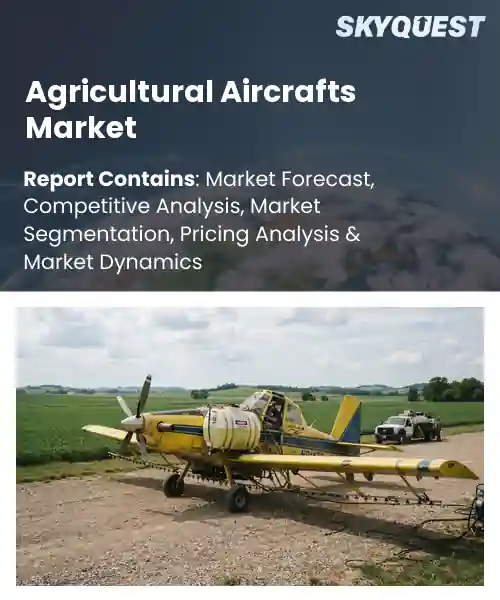
Agricultural Aircrafts Market
Report ID: SQMIG20A2923
Report ID: SQMIG20A2923
[email protected]
USA +1 351-333-4748
Report ID:
SQMIG20A2923 |
Region:
Global |
Published Date: September, 2026
Pages:
157
|Tables:
151
|Figures:
78


Global Agricultural Aircrafts Market size was valued at USD 5.12 Billion in 2024 and is poised to grow from USD 5.5 Billion in 2025 to USD 9.82 Billion by 2033, growing at a CAGR of 7.5% during the forecast period (2026-2033).
The agricultural aircraft market centres on specialised fixed‑wing and rotary‑wing platforms that disperse seeds, fertilizers, and pesticides over farmland. Its primary driver is the escalating demand for higher crop yields as global populations approach ten billion, prompting farmers to adopt precision aerial application to maximise resource efficiency. Historically, the sector began in the 1940s with surplus military trainers converted for dusting, as exemplified by the Grumman Ag Cat, and expanded through the 1970s when jet‑powered models such as the Piper PA‑25 enabled larger coverage. Today, the market underpins food‑security strategies by reducing ground‑equipment constraints and cutting application time significantly economically. Regulatory incentives for reduced chemical runoff now serve as the market’s secondary catalyst, because stricter environmental standards compel growers to switch from broad‑field spreaders to low‑altitude, variable‑rate spraying performed by aircraft. This shift creates demand for next‑generation airframes equipped with GPS‑guided tanks and real‑time telemetry, exemplified by the adoption of the Air Tractor AT‑802 in Brazil’s soybean belt, where yield improvements of 12 % have been recorded. The cause‑effect loop pressure driving technology investment, which in turn lowers input costs opens opportunities for manufacturers to expand service‑fleets, partner with agritech firms, and capture markets in Saharan Africa where fragmented landholdings limit ground‑based operations.
How is AI-driven automation impacting efficiency in the agricultural aircraft market?
AI-driven automation is reshaping the agricultural aircraft market by turning traditional spray missions into data rich operations. Sensors mounted on the airframe collect real time weather and crop health information while machine learning algorithms translate that data into precise spray patterns. Pilots now rely on automated flight paths that adjust altitude and speed to match field conditions reducing overlap and missed spots. The technology also lowers fuel consumption because the aircraft follows the most efficient route. As a result operators experience faster turnarounds higher payload utilization and safer flights all of which make aerial application more attractive to growers.John Deere, August 2023, introduced an AI powered autonomous spray drone that plans routes, monitors canopy health and adjusts spray volume without pilot input. This innovation demonstrates how AI automation can boost precision, cut operating costs and accelerate adoption of aerial solutions across the agricultural aircraft market.
Market snapshot - (2026-2033)
Global Market Size
USD 5.12 Billion
Largest Segment
Fixed-Wing Agricultural Aircraft
Fastest Growth
Unmanned Agricultural Aircraft
Growth Rate
7.5% CAGR
To get more insights on this market click here to Request a Free Sample Report
Global agricultural aircrafts market is segmented by aircraft type, propulsion, application, farm size, end user and region. Based on aircraft type, the market is segmented into Fixed-Wing Agricultural Aircraft, Agricultural Helicopters, Unmanned Agricultural Aircraft and Others. Based on propulsion, the market is segmented into Piston Engine, Turboprop, Electric and Hybrid-Electric. Based on application, the market is segmented into Crop Spraying, Fertilizer Application, Seeding, Crop Monitoring, Pest Control and Others. Based on farm size, the market is segmented into Small Farms, Medium Farms and Large Farms. Based on end user, the market is segmented into Commercial Farmers, Agricultural Service Providers, Government Agencies, Research Institutions and Others. Based on region, the market is segmented into North America, Europe, Asia Pacific, Latin America and Middle East & Africa.
Piston engine segment dominates because it offers proven reliability, lower acquisition costs, and an extensive support network that farmers and service providers trust. Its simplicity aligns with the operational practices of many agricultural operators, allowing easy maintenance and quick turn‑around between missions. The entrenched supply chain and familiarity among pilots and technicians reinforce its preferred status, making it the go‑to choice for most crop‑spraying and seeding operations throughout the season.
However, electric propulsion is witnessing the strongest growth momentum as advances in battery density and charging infrastructure reduce operational constraints. Environmental regulations and farmer demand for lower emissions drive adoption, while quieter operation expands usage windows. This emerging technology is unlocking new market opportunities and reshaping future fleet composition globally.
Crop spraying segment dominates because it directly addresses the core revenue‑generating activity for most agricultural aviation operators. The high demand for timely pest and disease control makes aerial application the most cost‑effective solution for large acreage, reinforcing frequent flight cycles. Established aircraft designs and proven chemical delivery systems create a low‑risk environment, encouraging both owners and service providers to prioritize spraying missions over ancillary tasks throughout the planting season.
Meanwhile, crop monitoring emerges as the key high‑growth area because integration of high‑resolution sensors and real‑time data analytics enables farmers to make proactive decisions. The shift toward data‑driven management, combined with decreasing sensor costs, expands aircraft utilization beyond spraying, creating significantly new revenue streams and stimulating broader market adoption.
To get detailed segments analysis, Request a Free Sample Report
North America enjoys a combination of expansive arable land, a long history of technology adoption, and a highly coordinated supply chain that together create a fertile environment for agricultural aviation. The region benefits from robust research institutions and leading manufacturers that continuously refine aircraft performance and safety features. Strong financial mechanisms and supportive regulatory frameworks encourage investment in modern fleets, while a deep pool of experienced pilots and maintenance specialists ensures operational reliability. Integration with precision farming technologies enhances the value proposition of aerial application, allowing producers to achieve higher efficiency and environmental stewardship. These synergistic strengths reinforce a market position that remains difficult for other regions to replicate, sustaining North America’s leadership in the sector.
Agricultural Aircrafts Market in the United States is driven by extensive large‑scale farming operations that demand rapid and uniform coverage of crops. A mature ecosystem of original equipment manufacturers, aftermarket service providers, and training institutions underpins a reliable supply chain. Continuous innovation in avionics and spray systems aligns with the country’s emphasis on precision agriculture, while strong financing options and favorable tax treatments support fleet renewal. The convergence of these factors creates a resilient demand environment that sustains the United States as a cornerstone of the global market.
Agricultural Aircrafts Market in Canada is shaped by vast grain belts and diversified climatic zones that require adaptable aerial solutions. Collaborative government programs and research partnerships promote the development of dual‑purpose aircraft suited for both spraying and transport tasks. A well‑established network of service centers ensures high aircraft availability across remote regions. Emphasis on environmental responsibility drives the adoption of efficient spray technologies, while the country’s reputation for safety and reliability attracts operators seeking dependable aerial services. These elements collectively reinforce Canada’s significant role within the North American landscape.
Europe’s agricultural aircraft sector is energized by a strong commitment to sustainable farming practices and a tightly integrated agri‑technology ecosystem. Stringent environmental regulations encourage the use of precise aerial application to minimize chemical use and protect biodiversity. Collaborative research hubs across the continent foster innovations in low‑emission propulsion, advanced spray systems, and digital flight planning, enhancing both efficiency and compliance. Financial incentives and targeted subsidies lower barriers to adoption for medium‑sized farms, while well‑developed logistical networks ensure rapid deployment of services. Together, these drivers create a fertile environment for rapid market expansion and position Europe as a hub of progressive agricultural aviation.
Agricultural Aircrafts Market in Germany is characterized by a high level of engineering excellence and a proactive approach to sustainability. The country’s strong industrial base supports the development of cutting‑edge aircraft designs that prioritize fuel efficiency and reduced emissions. Close collaboration between manufacturers, research institutes, and farming cooperatives accelerates the adoption of precision aerial solutions. Robust support mechanisms, including training programs and financial incentives, facilitate fleet modernization among growers. This dynamic environment positions Germany as the fastest growing market within Europe’s agricultural aviation sector.
Agricultural Aircrafts Market in the United Kingdom is emerging through a blend of innovative technology adoption and supportive policy frameworks. The sector benefits from a network of specialized service providers that offer tailored solutions for a variety of crop types. Government initiatives aimed at enhancing food security and reducing environmental impact encourage the integration of aerial application with digital farm management tools. Growing awareness of efficiency gains among growers drives incremental uptake, while partnerships with research institutions foster continuous improvement. These factors contribute to the United Kingdom’s status as an emerging market within Europe.
Agricultural Aircrafts Market in France holds a dominant position owing to its extensive agricultural heritage and strong domestic manufacturing capabilities. French operators benefit from a well‑established infrastructure that includes dedicated training centers, maintenance hubs, and a dense network of service providers. The nation’s emphasis on high‑quality crop production aligns with the precision offered by modern aerial application, reinforcing demand across diverse farming regions. Collaborative efforts between industry and research bodies drive ongoing enhancements in aircraft performance and environmental compliance. This confluence of factors sustains France’s leadership in the European agricultural aviation arena.
The Asia Pacific region is rapidly advancing its agricultural aircraft footprint through a combination of rising agribusiness activity and targeted government support. Nations are increasingly recognizing the efficiency gains provided by aerial spraying, especially in regions with labor constraints and fragmented land holdings. Investment in research and development accelerates the introduction of newer, more versatile aircraft that can operate in varied climatic conditions. Integration with emerging drone technologies creates hybrid solutions that expand operational flexibility. Additionally, regional trade agreements facilitate cross‑border collaboration, enabling knowledge transfer and supply chain resilience. These collective efforts are elevating the Asia Pacific’s role as a burgeoning hub for agricultural aviation.
Agricultural Aircrafts Market in Japan is propelled by a focus on high‑value specialty crops and the need for precise application techniques in limited arable land. The country’s advanced aerospace industry contributes sophisticated aircraft platforms equipped with state‑of‑the‑art navigation and spray systems. Government incentives aimed at modernizing agricultural practices encourage growers to adopt aerial solutions that enhance yield and reduce labor intensity. Close coordination between manufacturers, research institutes, and farming associations streamlines technology transfer, reinforcing Japan’s growing presence in the regional market.
Agricultural Aircrafts Market in South Korea benefits from strong government initiatives that prioritize agricultural modernization and environmental stewardship. The sector leverages the nation’s expertise in electronics and automation to equip aircraft with intelligent flight control and monitoring systems. Collaborative programs between universities, manufacturers, and large‑scale farms foster the development of customized aerial solutions suited to diverse crop cycles. Efforts to improve operational safety and reduce chemical usage further drive acceptance among producers. These dynamics collectively strengthen South Korea’s position within the Asia Pacific agricultural aviation landscape.
To know more about the market opportunities by region and country, click here to
Buy The Complete Report
Using Advanced Sensors
Growing Demand For Sustainable Farming
Regulatory Restrictions on Emissions
High Acquisition Cost For Operators
Request Free Customization of this report to help us to meet your business objectives.
The competitive landscape of the global agricultural aircraft market is shaped by strategic M&A, partnerships and technology innovation, with incumbents leveraging acquisitions such as AGCO’s purchase of Precision Planting to integrate advanced spraying systems, while CNH Industrial’s collaboration with DJI enhances drone‑based crop monitoring, and Boeing’s Aurora Flight Sciences advances autonomous aircraft concepts for precision agriculture.
Top Player’s Company Profile
Recent Developments
SkyQuest’s ABIRAW (Advanced Business Intelligence, Research & Analysis Wing) is our Business Information Services team that Collects, Collates, Correlates, and Analyses the Data collected by means of Primary Exploratory Research backed by robust Secondary Desk research. As per SkyQuest analysis the global agricultural aircraft market is being propelled primarily by the integration of high‑resolution sensors that enable precise, variable‑rate spraying while a second strong catalyst is AI‑driven automation that optimizes flight paths and reduces fuel use. The piston‑engine propulsion segment continues to dominate because of its proven reliability and low acquisition cost and North America remains the leading region thanks to its expansive farms, mature supply chain and supportive policies. However, stricter emissions regulations pose a restraint by increasing development costs and limiting the adoption of traditional powerplants, encouraging a shift toward electrified solutions. This dynamic is prompting manufacturers to invest in hybrid‑electric powertrains to meet both market demand and regulatory pressure.
| Report Metric | Details |
|---|---|
| Market size value in 2024 | USD 5.12 Billion |
| Market size value in 2033 | USD 9.82 Billion |
| Growth Rate | 7.5% |
| Base year | 2024 |
| Forecast period | (2026-2033) |
| Forecast Unit (Value) | USD Billion |
| Segments covered |
|
| Regions covered | North America (US, Canada), Europe (Germany, France, United Kingdom, Italy, Spain, Rest of Europe), Asia Pacific (China, India, Japan, Rest of Asia-Pacific), Latin America (Brazil, Rest of Latin America), Middle East & Africa (South Africa, GCC Countries, Rest of MEA) |
| Companies covered |
|
| Customization scope | Free report customization with purchase. Customization includes:-
|
To get a free trial access to our platform which is a one stop solution for all your data requirements for quicker decision making. This platform allows you to compare markets, competitors who are prominent in the market, and mega trends that are influencing the dynamics in the market. Also, get access to detailed SkyQuest exclusive matrix.
Table Of Content
Executive Summary
Market overview
Parent Market Analysis
Market overview
Market size
KEY MARKET INSIGHTS
COVID IMPACT
MARKET DYNAMICS & OUTLOOK
Market Size by Region
KEY COMPANY PROFILES
Methodology
For the Agricultural Aircrafts Market, our research methodology involved a mixture of primary and secondary data sources. Key steps involved in the research process are listed below:
1. Information Procurement: This stage involved the procurement of Market data or related information via primary and secondary sources. The various secondary sources used included various company websites, annual reports, trade databases, and paid databases such as Hoover's, Bloomberg Business, Factiva, and Avention. Our team did 45 primary interactions Globally which included several stakeholders such as manufacturers, customers, key opinion leaders, etc. Overall, information procurement was one of the most extensive stages in our research process.
2. Information Analysis: This step involved triangulation of data through bottom-up and top-down approaches to estimate and validate the total size and future estimate of the Agricultural Aircrafts Market.
3. Report Formulation: The final step entailed the placement of data points in appropriate Market spaces in an attempt to deduce viable conclusions.
4. Validation & Publishing: Validation is the most important step in the process. Validation & re-validation via an intricately designed process helped us finalize data points to be used for final calculations. The final Market estimates and forecasts were then aligned and sent to our panel of industry experts for validation of data. Once the validation was done the report was sent to our Quality Assurance team to ensure adherence to style guides, consistency & design.
Analyst Support
Customization Options
With the given market data, our dedicated team of analysts can offer you the following customization options are available for the Agricultural Aircrafts Market:
Product Analysis: Product matrix, which offers a detailed comparison of the product portfolio of companies.
Regional Analysis: Further analysis of the Agricultural Aircrafts Market for additional countries.
Competitive Analysis: Detailed analysis and profiling of additional Market players & comparative analysis of competitive products.
Go to Market Strategy: Find the high-growth channels to invest your marketing efforts and increase your customer base.
Innovation Mapping: Identify racial solutions and innovation, connected to deep ecosystems of innovators, start-ups, academics, and strategic partners.
Category Intelligence: Customized intelligence that is relevant to their supply Markets will enable them to make smarter sourcing decisions and improve their category management.
Public Company Transcript Analysis: To improve the investment performance by generating new alpha and making better-informed decisions.
Social Media Listening: To analyze the conversations and trends happening not just around your brand, but around your industry as a whole, and use those insights to make better Marketing decisions.
REQUEST FOR SAMPLE
 REQUEST FREE CUSTOMIZATION


Want to customize this report? This report can be personalized according to your needs. Our analysts and industry experts will work directly with you to understand your requirements and provide you with customized data in a short amount of time. We offer $1000 worth of FREE customization at the time of purchase.
Feedback From Our Clients


 USA (+1) 351-333-4748

