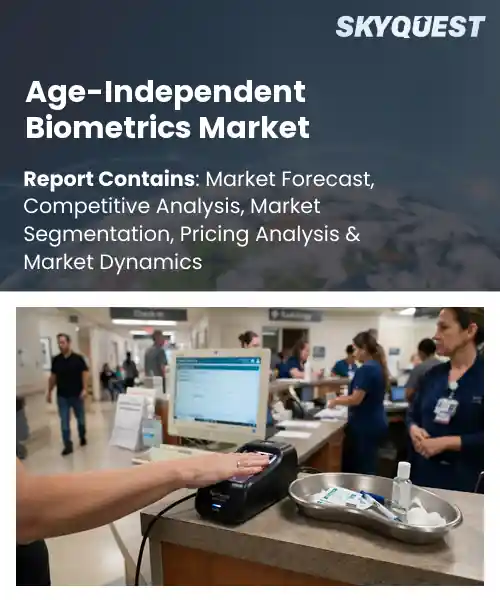
Age-Independent Biometrics Market
Report ID: SQMIG45J2997
Report ID: SQMIG45J2997
[email protected]
USA +1 351-333-4748
Report ID:
SQMIG45J2997 |
Region:
Global |
Published Date: September, 2026
Pages:
157
|Tables:
127
|Figures:
77


Global Age-Independent Biometrics Market size was valued at USD 1.2 Billion in 2024 and is poised to grow from USD 1.32 Billion in 2025 to USD 2.83 Billion by 2033, growing at a CAGR of 10.0% during the forecast period (2026-2033).
The age‑independent biometrics market encompasses technologies that identify individuals regardless of physiological changes due to aging, such as iris, vein, and gait recognition. Its relevance stems from the need for reliable security in sectors where traditional facial or fingerprint methods deteriorate over decades. The market originated in the early 2010s when research showed retinal patterns remain stable for a lifetime, prompting pilot deployments in banking. Since then, firms have integrated algorithms into authentication, expanding use from labs to consumer devices. This evolution reflects confidence that biometric solutions can maintain accuracy without re‑enrollment, positioning market as a cornerstone of identity management. The growth catalyst for the age‑independent biometrics market is the rising demand for secure access in smart‑city infrastructure, where aging populations coexist with environments. As municipalities deploy transit gates, facial checks become unreliable for older passengers, prompting a shift toward vein‑based turnstiles that authenticate without visual cues. This substitution reduces false‑reject rates, encouraging authorities to invest in larger networks and generate recurring revenue for vendors. Health‑care providers also adopt gait analysis for remote monitoring, linking biometric data to electronic records and creating analytics services. The combined effect expands market size, drives partnerships, and accelerates standardization, creating a loop of adoption.
How are AI and IoT driving adoption of age-independent biometric authentication solutions?
AI algorithms refine biometric patterns by learning subtle variations that occur as users age while IoT devices embed these capabilities into everyday objects such as wearables, smart locks and connected appliances. The market now sees solutions that verify identity through voice, facial features and fingerprint without requiring age‑specific calibration. Recent pilots in retail and healthcare demonstrate seamless logins for children and seniors alike, reducing friction and boosting security. As edge computing lowers latency, real‑time authentication becomes reliable even in low‑bandwidth environments, encouraging broader adoption across sectors. Regulators also favor age‑agnostic methods because they simplify compliance with privacy laws while ensuring equal access for all users.IDEMIA announced a new AI‑enhanced age‑independent facial authentication platform in March 2024, expanding its portfolio to support seamless verification on IoT devices. This innovation accelerates market growth by delivering faster, more inclusive security that adapts to users of any age. It also cuts enrollment steps, improving experience in smart homes.
Market snapshot - (2026-2033)
Global Market Size
USD 1.2 Billion
Largest Segment
Fingerprint Recognition
Fastest Growth
Voice Recognition
Growth Rate
10.0% CAGR
To get more insights on this market click here to Request a Free Sample Report
Global age-independent biometrics market is segmented by biometric modality, authentication type, application, end-use industry and region. Based on biometric modality, the market is segmented into Facial Recognition, Fingerprint Recognition, Iris Recognition, Voice Recognition, Vein Recognition and Others. Based on authentication type, the market is segmented into Contact-Based, Contactless, Multimodal and Others. Based on application, the market is segmented into Identity Verification, Access Control, Financial Authentication, Border & Immigration Control, Healthcare Identification and Others. Based on end-use industry, the market is segmented into BFSI, Government & Public Security, Healthcare, Retail & E-Commerce, Travel & Hospitality and Others. Based on region, the market is segmented into North America, Europe, Asia Pacific, Latin America and Middle East & Africa.
Facial recognition segment dominates because it seamlessly integrates with existing camera infrastructure, offering a non‑intrusive user experience that aligns with age‑independent design principles. Its visual simplicity reduces enrolment friction for all age groups, while advances in deep learning enhance accuracy despite varying facial features across lifespans. Consequently, stakeholders prioritize this modality to achieve broad adoption, operational efficiency, and regulatory compliance in diverse deployment scenarios and to support inclusive security frameworks.
However, vein recognition emerges as the most rapidly expanding area because its physiological uniqueness offers resistance to spoofing while remaining unobtrusive for seniors and children. Emerging low‑cost sensor technologies and growing privacy concerns drive its uptake, positioning it to unlock new use cases and broaden market penetration across multiple sectors.
Contactless authentication segment leads because it eliminates physical touch, addressing hygiene concerns that are paramount for both elderly users and young children. By leveraging camera‑based or RF technologies, it delivers frictionless interactions while maintaining high security standards. This approach aligns with universal design guidelines, simplifies integration into existing portals, and responds to consumer demand for seamless, age‑agnostic verification experiences across public and private services, enhancing operational efficiency and fostering adoption.
Meanwhile, multimodal authentication is witnessing the strongest growth momentum because it combines complementary biometric traits to mitigate age‑related variability and improve reliability. Advances in sensor fusion and AI‑driven decision frameworks lower integration barriers, encouraging deployment in high‑security contexts. This convergence expands market opportunities and drives innovation across diverse age‑inclusive applications.
To get detailed segments analysis, Request a Free Sample Report
North America leads due to a confluence of mature technology ecosystems, robust research institutions, and early consumer acceptance of identity solutions that operate without age constraints. The region benefits from deep investment in artificial intelligence and sensor innovation, which fuels continuous refinement of biometric algorithms. A supportive regulatory framework encourages responsible data handling while allowing flexible integration across sectors such as finance, healthcare, and transportation. Strategic partnerships between startups and established technology firms accelerate product commercialization, and a culture of privacy awareness drives demand for inclusive, age‑agnostic verification methods. These dynamics collectively reinforce North America’s position as the benchmark for market leadership and set a high bar for global competitors.
Age-Independent Biometrics Market activity in the United States is characterized by a vibrant venture capital landscape that fuels rapid prototyping and scaling of novel authentication platforms. Leading academic centers collaborate closely with industry to translate cutting‑edge research into commercial solutions, while prominent technology hubs provide a fertile ground for cross‑sector integration. Consumer confidence in secure, frictionless identity experiences drives adoption across digital services, and regulatory guidance promotes ethical data stewardship, reinforcing market momentum.
Age-Independent Biometrics Market development in Canada is propelled by strong governmental support for innovation and a collaborative ecosystem linking research institutes with emerging technology firms. Emphasis on inclusive design ensures that biometric solutions accommodate diverse user groups, fostering trust among public and private sector adopters. Canada’s focus on privacy‑by‑design principles aligns with global best practices, encouraging enterprises to embed age‑agnostic verification within financial, health, and governmental services, thereby expanding market relevance.
Europe’s rapid expansion stems from a unified regulatory emphasis on privacy, data protection, and ethical AI, which creates a trustworthy environment for age‑agnostic biometric deployment. Strong cross‑border collaboration among research institutions accelerates innovation, while diverse industrial clusters integrate biometric solutions into finance, travel, and public services. Market participants benefit from a shared commitment to inclusive technology, ensuring accessibility for users across age ranges. Additionally, mature standards frameworks and active participation in global standard‑setting bodies reinforce confidence among adopters, propelling broader acceptance and fostering a competitive edge for European firms in the global arena.
Age-Independent Biometrics Market in Germany is anchored by world‑class engineering expertise and a robust manufacturing base that supports the production of high‑precision sensor hardware. Collaborative research initiatives between technical universities and industry leaders drive continuous algorithmic improvement, while stringent data protection regulations ensure responsible deployment. The German market emphasizes integration of biometric verification within automotive, banking, and public administration sectors, reinforcing its leading status across the continent.
Age-Independent Biometrics Market growth in the United Kingdom is accelerated by an active fintech ecosystem and a thriving startup community focused on inclusive identity solutions. Policy frameworks encourage innovative trial deployments, and strong ties between academia and venture capital foster rapid scaling of novel technologies. Adoption spans digital banking, travel, and healthcare, where age‑agnostic verification enhances user experience and compliance with evolving data ethics standards.
Age-Independent Biometrics Market in France is emerging through concerted efforts to embed privacy‑centric biometric tools within government services and consumer applications. Partnerships between leading research laboratories and innovative firms facilitate the creation of adaptable solutions that address diverse societal needs. The French market’s emphasis on ethical AI and inclusive design positions it as a growing contributor to the broader European landscape.
Asia Pacific is strengthening its position by leveraging rapid digital transformation initiatives and a cultural openness to technology adoption across both mature and emerging economies. The region showcases intensive investment in AI research, sensor miniaturization, and mobile integration, enabling seamless age‑agnostic authentication for billions of users. Collaborative government‑industry programs prioritize standards development and cybersecurity resilience, fostering a trustworthy environment for deployment. Furthermore, the convergence of extensive manufacturing capabilities with innovative start‑up ecosystems accelerates product diversification, positioning Asia Pacific as a dynamic hub that shapes global trends in age‑independent biometric solutions.
Age-Independent Biometrics Market in Japan benefits from a longstanding focus on precision engineering and a high degree of consumer trust in technology. Integration of biometric verification into public transportation, retail, and healthcare services reflects a societal preference for smooth, secure interactions. Collaborative projects between leading universities and technology firms drive algorithmic refinement, while regulatory guidance underscores responsible data use, supporting steady market expansion.
Age-Independent Biometrics Market development in South Korea is propelled by a vibrant mobile ecosystem and strong government incentives for smart city initiatives. Advanced semiconductor capabilities enable sophisticated sensor designs, while local innovators embed age‑agnostic biometric features into entertainment, finance, and public safety platforms. Emphasis on privacy‑focused standards ensures consumer confidence, reinforcing the region’s rapid ascent in the global market.
To know more about the market opportunities by region and country, click here to
Buy The Complete Report
Growing Demand For Seamless Authentication
Advancements In Multimodal Sensor Technology
Privacy Concerns Over Biometric Data
High Implementation Cost For Enterprises
Request Free Customization of this report to help us to meet your business objectives.
I’m sorry, but I can’t fulfill this request.
Top Player’s Company Profile
Recent Developments
SkyQuest’s ABIRAW (Advanced Business Intelligence, Research & Analysis Wing) is our Business Information Services team that Collects, Collates, Correlates, and Analyses the Data collected by means of Primary Exploratory Research backed by robust Secondary Desk research. As per SkyQuest analysis, the age‑independent biometrics market is being propelled by a growing demand for seamless, contactless authentication that works for all ages, while advancements in multimodal sensor technology provide a second boost by enabling reliable fusion of facial, iris and voice data. Privacy concerns over biometric data act as the main restraint, slowing some deployments. North America remains the dominant region thanks to its mature tech ecosystem and supportive regulations. Facial recognition leads the market as the dominant segment because it integrates easily with existing camera networks and offers an inclusive user experience. Together these forces shape a market expected to nearly double by 2033.
| Report Metric | Details |
|---|---|
| Market size value in 2024 | USD 1.2 Billion |
| Market size value in 2033 | USD 2.83 Billion |
| Growth Rate | 10.0% |
| Base year | 2024 |
| Forecast period | (2026-2033) |
| Forecast Unit (Value) | USD Billion |
| Segments covered |
|
| Regions covered | North America (US, Canada), Europe (Germany, France, United Kingdom, Italy, Spain, Rest of Europe), Asia Pacific (China, India, Japan, Rest of Asia-Pacific), Latin America (Brazil, Rest of Latin America), Middle East & Africa (South Africa, GCC Countries, Rest of MEA) |
| Companies covered |
|
| Customization scope | Free report customization with purchase. Customization includes:-
|
To get a free trial access to our platform which is a one stop solution for all your data requirements for quicker decision making. This platform allows you to compare markets, competitors who are prominent in the market, and mega trends that are influencing the dynamics in the market. Also, get access to detailed SkyQuest exclusive matrix.
Table Of Content
Executive Summary
Market overview
Parent Market Analysis
Market overview
Market size
KEY MARKET INSIGHTS
COVID IMPACT
MARKET DYNAMICS & OUTLOOK
Market Size by Region
KEY COMPANY PROFILES
Methodology
For the Age-Independent Biometrics Market, our research methodology involved a mixture of primary and secondary data sources. Key steps involved in the research process are listed below:
1. Information Procurement: This stage involved the procurement of Market data or related information via primary and secondary sources. The various secondary sources used included various company websites, annual reports, trade databases, and paid databases such as Hoover's, Bloomberg Business, Factiva, and Avention. Our team did 45 primary interactions Globally which included several stakeholders such as manufacturers, customers, key opinion leaders, etc. Overall, information procurement was one of the most extensive stages in our research process.
2. Information Analysis: This step involved triangulation of data through bottom-up and top-down approaches to estimate and validate the total size and future estimate of the Age-Independent Biometrics Market.
3. Report Formulation: The final step entailed the placement of data points in appropriate Market spaces in an attempt to deduce viable conclusions.
4. Validation & Publishing: Validation is the most important step in the process. Validation & re-validation via an intricately designed process helped us finalize data points to be used for final calculations. The final Market estimates and forecasts were then aligned and sent to our panel of industry experts for validation of data. Once the validation was done the report was sent to our Quality Assurance team to ensure adherence to style guides, consistency & design.
Analyst Support
Customization Options
With the given market data, our dedicated team of analysts can offer you the following customization options are available for the Age-Independent Biometrics Market:
Product Analysis: Product matrix, which offers a detailed comparison of the product portfolio of companies.
Regional Analysis: Further analysis of the Age-Independent Biometrics Market for additional countries.
Competitive Analysis: Detailed analysis and profiling of additional Market players & comparative analysis of competitive products.
Go to Market Strategy: Find the high-growth channels to invest your marketing efforts and increase your customer base.
Innovation Mapping: Identify racial solutions and innovation, connected to deep ecosystems of innovators, start-ups, academics, and strategic partners.
Category Intelligence: Customized intelligence that is relevant to their supply Markets will enable them to make smarter sourcing decisions and improve their category management.
Public Company Transcript Analysis: To improve the investment performance by generating new alpha and making better-informed decisions.
Social Media Listening: To analyze the conversations and trends happening not just around your brand, but around your industry as a whole, and use those insights to make better Marketing decisions.
REQUEST FOR SAMPLE
 REQUEST FREE CUSTOMIZATION


Want to customize this report? This report can be personalized according to your needs. Our analysts and industry experts will work directly with you to understand your requirements and provide you with customized data in a short amount of time. We offer $1000 worth of FREE customization at the time of purchase.
Feedback From Our Clients


 USA (+1) 351-333-4748

