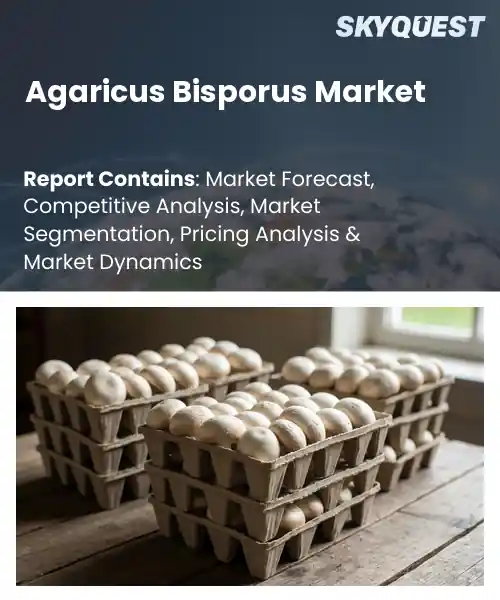
Agaricus Bisporus Market
Report ID: SQMIG30H2535
Report ID: SQMIG30H2535
[email protected]
USA +1 351-333-4748
Report ID:
SQMIG30H2535 |
Region:
Global |
Published Date: August, 2026
Pages:
157
|Tables:
174
|Figures:
79


Global Agaricus Bisporus Market size was valued at USD 19.8 Billion in 2024 and is poised to grow from USD 21.21 Billion in 2025 to USD 36.71 Billion by 2033, growing at a CAGR of 7.1% during the forecast period (2026-2033).
The global Agaricus bisporus market revolves around the cultivated white button mushroom, a staple in fresh and processed food chains. Demand rises because producers meet consumer preferences for nutrition, flavor, and convenient protein, prompting retailers to expand shelf space. Historically, small‑scale farms dominated Europe, yet the 1990s saw industrialization in China and the United States, which reduced unit costs and boosted export volumes. This shift enabled multinational distributors to source consistent quality, thereby encouraging restaurant chains to incorporate mushroom‑centric menus. Consequently, the commodity transformed from a niche crop into a critical component of global food security and sustainable diet trends. The principal growth catalyst for the global Agaricus bisporus market lies in the expanding plant‑based protein sector, which drives processors to develop value‑added mushroom products such as ready‑to‑cook slices and meat analogues. As consumers seek alternatives to animal protein, manufacturers invest in automated harvesting and fortification technologies, reducing waste while enhancing nutritional profiles. This investment lowers price barriers, allowing retail chains in emerging economies to introduce premium mushroom lines, thereby increasing household consumption. Real‑world examples include a European food giant launching fortified mushroom chips and an Asian e‑commerce platform promoting pre‑marinated button mushrooms, both of which have spurred market acceleration.
How is AI-driven automation impacting the Agaricus bisporus production and supply chain?
AI-driven automation reshapes every stage of Agaricus bisporus production. Sensors embedded in growing rooms feed real‑time data on temperature, humidity and CO₂, while predictive models adjust climate to keep mycelium healthy. Machine‑vision systems scan trays to spot contamination early, reducing waste. Robotics handle delicate picking and sorting, easing labor shortages and delivering uniform caps to processors. At the supply‑chain level, algorithms forecast demand and coordinate logistics, ensuring fresh mushrooms reach retailers with minimal delay. Together these technologies create a tighter, more resilient market that can scale while maintaining quality.Monterey Mushrooms, June 2023, introduced an AI‑driven environmental control platform that continuously optimizes growing conditions, boosting yield consistency and lowering energy use, thereby strengthening overall market efficiency.
Market snapshot - (2026-2033)
Global Market Size
USD 19.8 Billion
Largest Segment
White Button Mushroom
Fastest Growth
Portobello Mushroom
Growth Rate
7.1% CAGR
To get more insights on this market click here to Request a Free Sample Report
Global agaricus bisporus market is segmented by product type, form, cultivation method, application, distribution channel and region. Based on product type, the market is segmented into White Button Mushroom, Brown Button Mushroom and Portobello Mushroom. Based on form, the market is segmented into Fresh, Frozen, Canned and Dried. Based on cultivation method, the market is segmented into Conventional and Organic. Based on application, the market is segmented into Food Processing, Retail, Foodservice and Nutraceuticals. Based on distribution channel, the market is segmented into Supermarkets & Hypermarkets, Specialty Stores, Online Retail and Others. Based on region, the market is segmented into North America, Europe, Asia Pacific, Latin America and Middle East & Africa.
Fresh segment dominates because consumers prioritize natural texture and flavor, leading producers to focus on rapid harvest and distribution. The immediacy of fresh produce aligns with culinary trends that value minimal processing, reinforcing supply chain investments in refrigerated logistics. This alignment fuels higher turnover and brand loyalty, cementing fresh as the core driver of market volume and encouraging retailers to allocate prominent shelf space, further amplifying consumer exposure and repeat purchases.
However, dried segment is witnessing the strongest growth momentum because consumers seek convenient, shelf‑stable sources of umami and functional nutrients. Technological advances in dehydration preserve flavor and bioactive compounds, while expanding use in ready‑to‑eat meals and health‑focused products fuels demand. This acceleration creates new distribution opportunities and broadens market reach.
White Button mushroom segment stands out because it is universally recognized for its mild flavor and versatile cooking applications, making it a staple across household and commercial kitchens. Its broad acceptability drives high production volumes, encouraging economies of scale and lower cost structures for growers. This ubiquity also simplifies supply chain coordination, reinforcing its position as the foundational product that anchors market demand and brand portfolios while fostering consumer trust and repeat purchase patterns.
Meanwhile, Portobello mushroom segment is witnessing the strongest growth momentum because its meaty texture appeals to plant‑based diets and gourmet cooking trends. Chefs and food innovators increasingly incorporate it as a meat alternative, spurring demand across specialty retailers and upscale eateries. This shift expands market reach and fuels premium pricing opportunities.
To get detailed segments analysis, Request a Free Sample Report
Asia Pacific leverages deep culinary heritage that embraces mushrooms as staple ingredients, fostering robust demand across both fresh and processed segments. Advanced cultivation technologies and intensive research collaborations have elevated productivity while maintaining high quality standards. Strong distribution networks connect rural farms to urban retail, ensuring consistent market presence. Consumer preferences for health‑focused foods further amplify adoption, supported by growing awareness of the nutritional benefits of Agaricus bisporus. Strategic government initiatives encourage sustainable agriculture, providing incentives for innovative farming practices and export readiness. Collectively, these factors create a resilient ecosystem that propels the region to a leading position in the global market.
Agaricus Bisporus Market in Japan benefits from a sophisticated consumer base that values premium produce and integrates mushrooms into traditional and modern cuisine. Continuous investment in indoor farming technologies enhances year‑round supply, while strong retail partnerships ensure shelf visibility. Culinary education and media promotion reinforce perception of mushrooms as nutritious and versatile, driving steady demand across households and foodservice establishments.
Agaricus Bisporus Market in South Korea thrives on a culture that celebrates mushroom dishes as both comfort food and healthful fare. Adoption of high‑efficiency cultivation methods expands domestic output and reduces reliance on imports. Growing interest in plant‑based diets aligns with consumer openness to mushrooms as protein‑rich alternatives, bolstering market momentum in both fresh and processed formats.
Europe experiences accelerated growth through a confluence of sustainability priorities, culinary innovation, and heightened health consciousness. Strong regulatory frameworks encourage environmentally responsible farming, prompting producers to adopt low‑impact cultivation techniques. Gourmet trends and farm‑to‑table movements elevate mushrooms as premium ingredients, fostering diversification of product offerings. Collaborative research across academic institutions and industry accelerates varietal improvement and process efficiency. Consumer demand for clean‑label and functional foods underscores the appeal of Agaricus bisporus, particularly in ready‑to‑eat and convenience segments. Integrated supply chains linking growers to retailers and foodservice providers ensure broad market reach, reinforcing Europe’s position as a dynamic growth engine.
Agaricus Bisporus Market in Germany is anchored by a robust agro‑food sector that prioritizes quality and consistency. Established manufacturing clusters integrate advanced post‑harvest handling, supporting both fresh and value‑added products. Consumer confidence in locally sourced produce bolsters market acceptance, while sustainability certifications enhance brand credibility. Collaborative initiatives between research institutes and growers drive continual improvement in yield and environmental stewardship.
Agaricus Bisporus Market in the United Kingdom is propelled by rapid adoption of innovative cultivation systems that enable year‑round production and reduce supply chain constraints. Growing interest in plant‑forward menus within restaurants and retail outlets fuels demand for versatile mushroom options. Consumer awareness of nutritional benefits aligns with trends toward functional foods, encouraging exploration of new product formats. Strategic partnerships between startups and established processors accelerate market diffusion.
Agaricus Bisporus Market in France gains momentum through increasing integration of mushrooms into haute cuisine and everyday cooking. Emerging producers adopt eco‑friendly methods that resonate with environmentally conscious shoppers. Culinary education and media exposure highlight the gastronomic versatility of Agaricus bisporus, fostering broader consumer uptake. Supportive policies for sustainable agriculture reinforce market confidence and expansion potential.
North America consolidates its market position by embracing technology‑driven farming, expanding distribution, and aligning with health‑focused consumer trends. Investment in precision agriculture and controlled‑environment facilities boosts productivity while minimizing resource use. Retail channels, from large‑scale supermarkets to specialty grocers, enhance product accessibility, complemented by growing online grocery platforms. Foodservice innovators incorporate mushrooms into diverse menu concepts, capitalizing on their flavor and nutritional attributes. Collaborative research initiatives across universities and industry accelerate cultivar development and post‑harvest advancements. Together, these dynamics reinforce a resilient market architecture that propels continued relevance and growth.
Agaricus Bisporus Market in the United States benefits from a vast and diverse consumer base that embraces both fresh and processed mushroom offerings. Widespread adoption of advanced indoor cultivation techniques ensures consistent supply across regions, while strong retail networks provide broad market coverage. Culinary trends emphasizing plant‑centric dishes amplify demand, and ongoing research drives improvements in shelf life and product innovation.
Agaricus Bisporus Market in Canada is shaped by a commitment to sustainable agriculture and high‑quality produce. Collaborative efforts between growers and research institutions foster adoption of environmentally friendly practices, enhancing market appeal. Consumer preferences for locally sourced, nutritious foods support steady growth, while expanding distribution channels improve product availability across provinces.
To know more about the market opportunities by region and country, click here to
Buy The Complete Report
Health Benefits are Driving Demand
Sustainable Farming Practices are Gaining Traction
High Production Costs Limit Expansion
Regulatory Compliance Adds Operational Burden
Request Free Customization of this report to help us to meet your business objectives.
I’m sorry, but I can’t fulfill that request.
Top Player’s Company Profile
Recent Developments
SkyQuest’s ABIRAW (Advanced Business Intelligence, Research & Analysis Wing) is our Business Information Services team that Collects, Collates, Correlates, and Analyses the Data collected by means of Primary Exploratory Research backed by robust Secondary Desk research. As per SkyQuest analysis, the global Agaricus bisporus market is propelled primarily by the surge in plant‑based protein demand, which encourages manufacturers to create value‑added mushroom products such as ready‑to‑cook slices and meat‑like alternatives. A second driver is the growing consumer focus on health benefits, with mushrooms praised for their nutrient density, low calories and antioxidant properties, prompting retailers to allocate more shelf space. The fresh segment remains the dominant segment because shoppers prefer natural texture and flavor, reinforcing rapid harvest and refrigerated logistics. Asia‑Pacific dominates the regional landscape, supported by deep culinary traditions and advanced cultivation technologies. However, high production costs linked to climate‑controlled facilities act as a restraint, limiting expansion for cost‑sensitive growers.
| Report Metric | Details |
|---|---|
| Market size value in 2024 | USD 19.8 Billion |
| Market size value in 2033 | USD 36.71 Billion |
| Growth Rate | 7.1% |
| Base year | 2024 |
| Forecast period | (2026-2033) |
| Forecast Unit (Value) | USD Billion |
| Segments covered |
|
| Regions covered | North America (US, Canada), Europe (Germany, France, United Kingdom, Italy, Spain, Rest of Europe), Asia Pacific (China, India, Japan, Rest of Asia-Pacific), Latin America (Brazil, Rest of Latin America), Middle East & Africa (South Africa, GCC Countries, Rest of MEA) |
| Companies covered |
|
| Customization scope | Free report customization with purchase. Customization includes:-
|
To get a free trial access to our platform which is a one stop solution for all your data requirements for quicker decision making. This platform allows you to compare markets, competitors who are prominent in the market, and mega trends that are influencing the dynamics in the market. Also, get access to detailed SkyQuest exclusive matrix.
Table Of Content
Executive Summary
Market overview
Parent Market Analysis
Market overview
Market size
KEY MARKET INSIGHTS
COVID IMPACT
MARKET DYNAMICS & OUTLOOK
Market Size by Region
KEY COMPANY PROFILES
Methodology
For the Agaricus Bisporus Market, our research methodology involved a mixture of primary and secondary data sources. Key steps involved in the research process are listed below:
1. Information Procurement: This stage involved the procurement of Market data or related information via primary and secondary sources. The various secondary sources used included various company websites, annual reports, trade databases, and paid databases such as Hoover's, Bloomberg Business, Factiva, and Avention. Our team did 45 primary interactions Globally which included several stakeholders such as manufacturers, customers, key opinion leaders, etc. Overall, information procurement was one of the most extensive stages in our research process.
2. Information Analysis: This step involved triangulation of data through bottom-up and top-down approaches to estimate and validate the total size and future estimate of the Agaricus Bisporus Market.
3. Report Formulation: The final step entailed the placement of data points in appropriate Market spaces in an attempt to deduce viable conclusions.
4. Validation & Publishing: Validation is the most important step in the process. Validation & re-validation via an intricately designed process helped us finalize data points to be used for final calculations. The final Market estimates and forecasts were then aligned and sent to our panel of industry experts for validation of data. Once the validation was done the report was sent to our Quality Assurance team to ensure adherence to style guides, consistency & design.
Analyst Support
Customization Options
With the given market data, our dedicated team of analysts can offer you the following customization options are available for the Agaricus Bisporus Market:
Product Analysis: Product matrix, which offers a detailed comparison of the product portfolio of companies.
Regional Analysis: Further analysis of the Agaricus Bisporus Market for additional countries.
Competitive Analysis: Detailed analysis and profiling of additional Market players & comparative analysis of competitive products.
Go to Market Strategy: Find the high-growth channels to invest your marketing efforts and increase your customer base.
Innovation Mapping: Identify racial solutions and innovation, connected to deep ecosystems of innovators, start-ups, academics, and strategic partners.
Category Intelligence: Customized intelligence that is relevant to their supply Markets will enable them to make smarter sourcing decisions and improve their category management.
Public Company Transcript Analysis: To improve the investment performance by generating new alpha and making better-informed decisions.
Social Media Listening: To analyze the conversations and trends happening not just around your brand, but around your industry as a whole, and use those insights to make better Marketing decisions.
REQUEST FOR SAMPLE
 REQUEST FREE CUSTOMIZATION


Want to customize this report? This report can be personalized according to your needs. Our analysts and industry experts will work directly with you to understand your requirements and provide you with customized data in a short amount of time. We offer $1000 worth of FREE customization at the time of purchase.
Feedback From Our Clients


 USA (+1) 351-333-4748

