

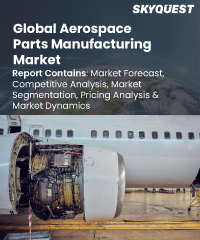
Aerospace Parts Manufacturing Market
Report ID: SQMIG20A2152
Skyquest Technology's expert advisors have carried out comprehensive research and identified these companies as industry leaders in the Aerospace Parts Manufacturing Market. This Analysis is based on comprehensive primary and secondary research on the corporate strategies, financial and operational performance, product portfolio, market share and brand analysis of all the leading Aerospace Parts Manufacturing industry players.


Industry in the Asia-Pacific, Africa, and Middle East sees an ever-growing demand for aerospace parts and manufacturing. Therefore, aerospace parts manufacturing and the demand for aircraft parts are increasing. Says the pattern now indicates efficiency and sustainability are rising in acceptance. This is because aircraft aimed at cutting down GHG emissions should be lighter and fuel-efficient. The expansion of air passenger and freight traffic, fuelled by the growth of commercial aerospace and economic progress in developing nations, is also enhancing the global market. This page outlines key drivers and trends in the global aerospace parts manufacturing market.
According to SkyQuest Technology “Aerospace Parts Manufacturing Market By Product (Engines, Aerostructure, Cabin Interiors, Equipment, Aircraft Manufacturing, System & Support, Avionics, and Insulation Components) By End Use, By Region - Industry Forecast 2025-2032,” demand for aerospace and defense-based weapons is on the increase, which helps in promoting the military sector for the prevention of enemy offensives.
|
Company |
Est. Years |
Headquarters |
Revenue |
Key Services |
|
The Boeing Company |
1916 |
Chicago, Illinois, USA |
USD 66.52 billion (2024) |
Designs, manufactures and services commercial and defence aircraft including airframes, aircraft parts and aftermarket services; supplies major structural components and systems for airlines and armed forces around the world. |
|
Airbus SE |
1970 |
Toulouse, France |
USD 72.6 billion (2024) |
Supplies commercial aircraft, helicopters and defence & space systems; the parts manufacturing arm produces aerostructures, wing-kits, fuselages, landing gear and also offers maintenance and services. |
|
Safran SA |
2005 |
Paris (2 bd Général Martial-Valin), France |
USD 28.84 billion (2024) |
Provides aircraft and helicopter engines & propulsion systems, landing gear, wheels & brakes, avionics and electrical systems; strong in manufacture of complex engine parts and aftermarket spares. |
|
GE Aerospace |
As part of GE (est. 1892) but as standalone unit circa 2024 |
Cincinnati, Ohio, USA |
USD 38.702 billion (2024) |
Designs, manufactures and services large commercial and military aircraft engines, engine components and landing-gear accessories; offers engine aftermarket services and digital diagnostics for parts life-cycle optimisation. |
|
Honeywell International Inc. |
1906 |
Charlotte, North Carolina, USA |
USD 38.498 billion (2024) |
Supplies aerospace & defence products: avionics, auxiliary power units (APUs), environmental control systems, flight-control systems and aircraft parts; manufacturing and aftermarket services for airlines and business aircraft. |
|
Rolls‑Royce Holdings plc |
1904 |
London, England, UK |
NA |
Manufactures aircraft engines (civil & military), propulsion systems and key components; provides parts, maintenance and overhaul services globally. |
|
MTU Aero Engines AG |
1913 |
Munich, Germany |
USD 8.2 Billion (2024) |
Develops and manufactures engines and modules for civil and military aircraft; provides MRO (maintenance, repair & overhaul) services and high-tech parts (turbine blades, compressors) for major OEMs. |
|
GKN Aerospace |
- |
UK (global operations) |
NA |
Tier-1 supplier of aerostructures (wing, fuselage sections), engine systems, electrical wiring interconnection systems (EWIS) and aftermarket repairs for commercial & military aircraft. |
|
Spirit AeroSystems Holdings, Inc. |
2005 (spin-off from Boeing) |
Wichita, Kansas, USA |
USD 6.316 billion (2024) |
Produces fuselages, engine pylons, wing-structures and other large composite/metal assemblies for major aircraft manufacturers; provides component manufacturing and sub-assembly services. |
|
Collins Aerospace (a unit of RTX Corporation) |
Collins Aerospace formed 2018 (merger of Rockwell Collins & UTC Aerospace) |
Charlotte, North Carolina, USA |
USD 1.55 Billion (2024) |
Manufactures aviation systems and components such as avionics, flight controls, landing-gear systems, actuation, wheels & brakes and offer aftermarket & repair services across commercial, regional, business and defence aviation. |
Boeing has not transformed an important factor in the international aerospace parts manufacturing industry with respect to sourcing thousands of global suppliers for producing high-quality wings, control systems, fuselage sections, and airframes. Innovations in composite materials and additive manufacturing solutions from the company's collaborative manufacturing endeavors. It also promotes improvements in its lean manufacturing and supply chain sustainability, which sets the performance standard for top-of-the-line integrators and assemblers of large-scale products in the industry.
With its complete network of component and subsystem manufacturers spread across the globe, Airbus offers large-scale influence by associating itself with some of the essential components in the manufacture of both military and civilian aircraft, such as nacelles, wings, and fuselages. To that end, automation and digital twin technologies are generally encouraged within the company to increase weight and aerodynamic performance. As part of its strategic thrusts to employ lighter composites and more environmentally friendly components, Airbus is at the forefront of several initiatives. This encourages the development of regional supply chains, especially in emerging aerospace hotspots like the Middle East and India.
With most of its attention on propulsion systems, landing gear, braking systems, and interior components, Safran is a significant producer of parts for the aerospace industry. It is responsible for producing important components of the latest designs for high-end aircraft such as the Airbus A320 Neo and Boeing 737 MAX. The engineering skills of the company on titanium and composite parts make the airplane lighter and even better in fuel efficiency. Because of its digital process controls and vertically integrated manufacturing, it is the leader in making engines and systems components that provide all dependability and optimal performance.
GE Aerospace manufactures its modern engine parts for military and commercial aircraft, including combustor modules, fan systems, and turbine blades. Through AI-based predictive maintenance and additive manufacturing, the company increases its longevity and performance. Alliances with OEMs and airlines further substantiate the global supply of high-performance propulsion components. As a result of the company's research on ceramic matrix composites (CMCs), which improve on fuel efficiency and temperature resistance, next-generation jet engines will operate in a different way.
Its aerospace division now manufactures all avionics, flight controls, and environmental systems and includes mechanical systems that are required for flight. Using smart manufacturing, adding sensors to vital aircraft components significantly impacts. Honeywell continues to make strides in developing hybrid-electric and miniaturized technologies aimed at producing lighter, more efficient aircraft. Further, it connects physical components with electronic systems through manufacturing innovations that improve overall dependability and connectivity in the modern aerospace platform.
Rolls-Royce has advanced capability to design and produce cutting-edge parts and subassemblies from jet engines. The performance and efficiency now depend on the exact engineering from which several innovative concepts regarding combustion systems, turbine discs, and blades are coming into existence. Rolls-Royce uses automated, robotic, and digital monitoring systems within its state-of-the-art production facilities to enhance sustainability and quality simultaneously. Through its partnership with aerospace OEMs, it is opening the global supply chain of engine parts, helping both military and commercial aviation.
MTU Aero Engines is an important link to the international value chain of engines for commercial aviation. It manufactures advanced compressor and turbine parts for OEMs and maintenance networks. Thermal coating, precision machining, and additive manufacturing techniques are the areas the company concentrates on to maximize engine life. Essential parts of enhancing the fuel economy and environmental performance of modern airframes are supplied by MTU, together with their great deals with Pratt & Whitney and Safran in important propulsion projects.
As one of the tier-1 suppliers, GKN Aerospace specializes in engine systems, electrical wiring interconnection systems (EWIS), as well as aerostructures. It is of utmost significance in such a leading initiative involving 3D-printed titanium components and lightweight composite materials to reduce aircraft weight and emissions. Company's modern manufacturing infrastructure based in Europe, North America, and Asia will facilitate the business of original equipment manufacturers, including Airbus, Boeing, and Lockheed Martin. GKN is developing hybrid and modular production techniques to provide efficiency and scalability in aerospace components' manufacturing on a global basis.
Spirit AeroSystems, a major independent manufacturer of aerostructures, is one of the world's largest manufacturers of these products, responding to global demand. They produce wing assemblies, nacelles, and fuselages for commercial and military applications. Advanced composite technology with robotic assembly capabilities improves accuracy and reduces assembly time. Spirit plays a major role in various enterprise initiatives fulfilling different goals and deliverables in collaboration with Boeing and Airbus. Sustainability, lightweight design and additive manufacturing are key elements in repositioning modern airframe manufacturing capabilities.
The RTX Corporation went on with Collins Aerospace to assist the aerospace industry in developing modern ideas with various mechanical systems, actuation, landing gear, and avionics components. The company was the first to integrate mechanical and electronic subsystems to provide for more efficient and safer aircraft. High-tech plants make use of flexible production through automation and digital engineering. Collins is also a pioneer in providing modular systems and high-performance materials for future aircraft designs and electrification.
The aerospace parts manufacturing market has all the potential of witnessing massive growth owing to the rise in aviation activities, technology advancements, as well as the desire of consumers-motivated by fuel-efficient and lighter planes. Innovations in digital production, additive manufacturing, and composites today are changing the design and assembly of aircraft parts. With a rise in defense programs and more commercial aircraft being delivered, suppliers globally are making efforts toward strong partnership and economic sustainability. Automation along with its green material and precision engineering, both of which serve the performance and efficiency sine qua non, take their shape as the cornerstone for future developments in the market.
REQUEST FOR SAMPLE
 REQUEST FREE CUSTOMIZATION
Want to customize this report? This report can be personalized according to your needs. Our analysts and industry experts will work directly with you to understand your requirements and provide you with customized data in a short amount of time. We offer $1000 worth of FREE customization at the time of purchase.
Feedback From Our Clients
Report ID: SQMIG20A2152
[email protected]
USA +1 351-333-4748
 USA (+1) 351-333-4748

