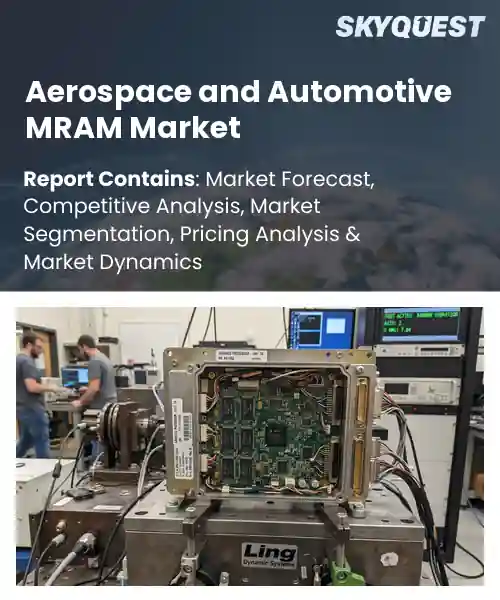
Aerospace and Automotive MRAM Market
Report ID: SQMIG45O2223
Report ID: SQMIG45O2223
[email protected]
USA +1 351-333-4748
Report ID:
SQMIG45O2223 |
Region:
Global |
Published Date: August, 2026
Pages:
157
|Tables:
145
|Figures:
78


Global Aerospace And Automotive Mram Market size was valued at USD 3.18 Billion in 2024 and is poised to grow from USD 3.56 Billion in 2025 to USD 8.68 Billion by 2033, growing at a CAGR of 11.8% during the forecast period (2026-2033).
The magnetic‑ram (MRAM) market for aerospace and automotive systems is a pivotal segment of the non‑volatile memory industry. Its significance stems from the need for radiation‑tolerant storage that retains data without power, a requirement that flash or SRAM cannot reliably meet. Over the past decade, the sector has progressed from laboratory prototypes to flight‑qualified modules, driven initially by satellite navigation payloads and later by electric‑vehicle control units. For example, the European Space Agency certified MRAM chips for the Galileo constellation in 2021, showing that the high reliability technology can survive temperature cycles and ionizing radiation while delivering nanosecond write speeds. One chief catalyst for aerospace and automotive MRAM adoption is need for computing in platforms. As vehicles and spacecraft move processing from clouds to board units, memory must guarantee data preservation despite power loss, temperature extremes, and radiation bursts. MRAM’s endurance and latency enable sensor fusion for cars, allowing systems to retain parameters during voltage drops, which reduces accident risk. In satellite constellations, resilience permits telemetry logging during eclipses, extending mission life and lowering redundancy costs. This drives manufacturers to embed MRAM in control modules, spurring a market surge projected at a growth rate of over 30 percent through 2032.
How is AI-driven automation influencing MRAM adoption in aerospace and automotive sectors?
AI‑driven automation is reshaping MRAM adoption in aerospace and automotive applications by streamlining design verification, reducing firmware complexity, and enabling real‑time error correction. Engineers use machine‑learning models to predict magnetic tunnel junction behavior, which cuts development cycles and improves reliability for safety‑critical systems. The technology also supports adaptive control loops that manage power consumption, making MRAM a preferred non‑volatile memory for next‑generation flight computers and vehicle control units. As manufacturers seek lighter, faster, and more resilient electronics, AI tools provide the insight needed to integrate MRAM without extensive hardware redesign, accelerating its entry into high‑performance platforms.May 2026, MRAM‑Info announced a new SOT‑MRAM design win with an aerospace OEM, illustrating how AI‑driven automation accelerates validation and boosts efficiency, reinforcing market momentum.
Market snapshot - (2026-2033)
Global Market Size
USD 3.18 Billion
Largest Segment
Spin-Transfer Torque MRAM
Fastest Growth
Spin-Orbit Torque MRAM
Growth Rate
11.8% CAGR
To get more insights on this market click here to Request a Free Sample Report
Global aerospace and automotive mram market is segmented by mram type, memory density, application, end-use system, product type and region. Based on mram type, the market is segmented into Toggle MRAM, Spin-Transfer Torque MRAM and Spin-Orbit Torque MRAM. Based on memory density, the market is segmented into Up to 1 Mb, 1–64 Mb and Above 64 Mb. Based on application, the market is segmented into Aerospace Electronics, Automotive Electronics, Avionics and Advanced Driver Assistance Systems. Based on end-use system, the market is segmented into Flight Control Systems, Navigation & Communication Systems, Infotainment Systems and Engine Control Systems. Based on product type, the market is segmented into Discrete MRAM and Embedded MRAM. Based on region, the market is segmented into North America, Europe, Asia Pacific, Latin America and Middle East & Africa.
Embedded MRAM segment dominates because its non‑volatile nature eliminates the need for constant power, aligning with strict weight and energy constraints of aerospace and automotive platforms. The integration directly onto silicon reduces board count, improving fault tolerance and simplifying system architecture. Designers favor this technology for its radiation hardness and fast write cycles, which meet rigorous certification standards while supporting increasingly complex control algorithms and enabling higher levels of redundancy across critical subsystems.
However, Spin‑Orbit Torque MRAM segment is witnessing the strongest growth momentum because its ultra‑low switching energy meets the rising demand for power‑efficient memory in electric propulsion control units. Continuous material breakthroughs and scalable fabrication are unlocking new design windows, accelerating adoption across next‑generation avionics and driver‑assist modules for future systems.
1–64 Mb segment dominates because it strikes a balance between capacity and footprint, fulfilling the high‑speed data buffering needs of advanced driver assistance sensors while fitting within tight PCB real estate. This density range accommodates frequent firmware updates and over‑the‑air patches without incurring latency, essential for safety‑critical perception algorithms. Its moderate endurance aligns with automotive temperature cycles, offering dependable retention that satisfies functional safety standards and enabling seamless integration with redundant sensor suites.
Meanwhile, Above 64 Mb segment emerges as the key high‑growth area because autonomous flight control platforms demand massive map storage and machine‑learning model caches. Continued scaling of MRAM cells reduces power draw while preserving radiation tolerance, prompting system architects to replace SRAM, thereby expanding market scope and fostering design methodologies.
To get detailed segments analysis, Request a Free Sample Report
North America benefits from a mature semiconductor ecosystem that blends deep research capabilities with large‑scale manufacturing capacity. The region’s aerospace sector demands ultra‑reliable memory for mission‑critical systems, while automotive manufacturers pursue advanced driver assistance and electrification, both of which align with MRAM’s endurance and low‑power attributes. Strong collaboration between defense agencies, automotive OEMs, and leading chip designers accelerates technology adoption. Robust intellectual property frameworks and substantial venture capital support further reinforce innovation pipelines, ensuring that North American firms remain at the forefront of MRAM integration across both aerospace and automotive applications.
United States Aerospace and Automotive MRAM Market
Aerospace and Automotive MRAM Market in the United States is propelled by extensive defense contracts and a vibrant automotive innovation hub. Leading aerospace programs prioritize memory solutions that can withstand extreme conditions, while automotive manufacturers focus on integrating MRAM into next‑generation electric and autonomous vehicles. The convergence of research institutions, venture capital, and a well‑established supply chain creates a fertile environment for rapid product development and commercialization.
Canada Aerospace and Automotive MRAM Market
Aerospace and Automotive MRAM Market in Canada leverages its strong aerospace manufacturing base and growing automotive electronics sector. Collaborative research initiatives between universities and industry accelerate the adaptation of MRAM for safety‑critical aerospace components and emerging vehicle platforms. Government incentives aimed at high‑tech manufacturing further encourage domestic firms to adopt MRAM, positioning Canada as a supportive environment for both sectors.
Europe’s expansion is driven by a deep heritage in aerospace engineering combined with world‑leading automotive design expertise. The region’s emphasis on safety, sustainability, and regulatory compliance fuels demand for memory technologies that offer reliability and low power consumption. Coordinated research programs across the European Union foster cross‑border collaboration, enabling rapid prototyping and standardization of MRAM solutions. Strong automotive supply chains, coupled with a focus on electric mobility and autonomous driving, create a fertile market for MRAM integration, while aerospace manufacturers seek resilient memory for next‑generation aircraft systems.
Germany Aerospace and Automotive MRAM Market
Aerospace and Automotive MRAM Market in Germany is anchored by its renowned automotive engineering and precision aerospace manufacturing. German OEMs prioritize MRAM for its durability in electric vehicle powertrains and advanced driver assistance systems. Simultaneously, aerospace firms adopt MRAM to meet stringent reliability standards for avionics, benefiting from a collaborative ecosystem of research institutes and industrial partners.
United Kingdom Aerospace and Automotive MRAM Market
Aerospace and Automotive MRAM Market in the United Kingdom is experiencing swift growth due to its vibrant aerospace sector and aggressive push toward autonomous vehicle technologies. UK research centers focus on integrating MRAM into safety‑critical aerospace applications, while automotive startups leverage its low‑latency characteristics for next‑generation connectivity solutions. Policy support for high‑tech manufacturing amplifies adoption across both domains.
France Aerospace and Automotive MRAM Market
Aerospace and Automotive MRAM Market in France is emerging as a niche yet dynamic segment, driven by strong aerospace heritage and a burgeoning electric vehicle industry. French aerospace programs seek MRAM for its resilience in harsh environments, while automotive manufacturers explore its benefits for energy‑efficient vehicle electronics. Collaborative initiatives between government labs and industry accelerate technology transfer and market entry.
Asia Pacific is advancing its role through strategic investments in high‑performance electronics and a focus on next‑generation mobility. Japan’s long‑standing expertise in automotive engineering and aerospace precision manufacturing creates a natural fit for MRAM’s reliability and power advantages. South Korea’s leadership in semiconductor fabrication and aggressive automotive electrification agenda further fuels demand. Regional governments provide policy incentives that encourage research collaborations and domestic production, while OEMs prioritize MRAM to meet stringent performance targets for autonomous and electric platforms, reinforcing the region’s competitive edge.
Japan Aerospace and Automotive MRAM Market
Aerospace and Automotive MRAM Market in Japan benefits from its deep automotive engineering culture and meticulous aerospace component production. Japanese manufacturers integrate MRAM to enhance vehicle safety systems and improve energy efficiency in electric drivetrains. In aerospace, the technology supports high‑reliability avionics, aligning with Japan’s commitment to precision and durability in critical applications.
South Korea Aerospace and Automotive MRAM Market
Aerospace and Automotive MRAM Market in South Korea is propelled by its world‑class semiconductor manufacturing capabilities and rapid adoption of electric vehicle technologies. Korean automotive firms leverage MRAM for its low power consumption and robustness in autonomous driving sensors. Aerospace developers also incorporate MRAM to meet stringent reliability standards, supported by strong government initiatives that foster domestic innovation and production.
To know more about the market opportunities by region and country, click here to
Buy The Complete Report
Increasing Demand for Low Power
Adoption of Advanced Memory Architectures
High Cost of MRAM Production
Limited Supply Chain Maturity
Request Free Customization of this report to help us to meet your business objectives.
The aerospace and automotive MRAM market is shaped by intense rivalry among established players such as Everspin Technologies, Avalanche Technology, Honeywell, Renesas and Crocus, each pursuing technology‑focused initiatives to lock in supply contracts with OEMs; recent strategic funding for data‑analytics firms like Marple underscores the growing importance of ecosystem partners that enable real‑time memory performance monitoring and drive adoption in safety‑critical vehicle and aircraft systems.
Top Player’s Company Profile
Recent Developments
SkyQuest’s ABIRAW (Advanced Business Intelligence, Research & Analysis Wing) is our Business Information Services team that Collects, Collates, Correlates, and Analyses the Data collected by means of Primary Exploratory Research backed by robust Secondary Desk research. As per SkyQuest analysis the global aerospace and automotive MRAM market is projected to nearly triple by 2033, driven primarily by the urgent need for low‑power, radiation‑hard memory that can preserve data during power loss in aircraft and electric‑vehicle systems. A second catalyst is the surge in autonomous‑vehicle and spacecraft computing, where AI‑enabled design tools accelerate MRAM integration and support massive sensor‑fusion workloads. The embedded MRAM segment leads the market because its non‑volatile integration reduces board count and boosts reliability for critical subsystems. North America dominates both demand and supply thanks to its mature semiconductor ecosystem and strong defense and automotive partnerships. However, high production costs and a still‑maturing supply chain restrain broader adoption across cost‑sensitive automotive tiers.
| Report Metric | Details |
|---|---|
| Market size value in 2024 | USD 3.18 Billion |
| Market size value in 2033 | USD 8.68 Billion |
| Growth Rate | 11.8% |
| Base year | 2024 |
| Forecast period | (2026-2033) |
| Forecast Unit (Value) | USD Billion |
| Segments covered |
|
| Regions covered | North America (US, Canada), Europe (Germany, France, United Kingdom, Italy, Spain, Rest of Europe), Asia Pacific (China, India, Japan, Rest of Asia-Pacific), Latin America (Brazil, Rest of Latin America), Middle East & Africa (South Africa, GCC Countries, Rest of MEA) |
| Companies covered |
|
| Customization scope | Free report customization with purchase. Customization includes:-
|
To get a free trial access to our platform which is a one stop solution for all your data requirements for quicker decision making. This platform allows you to compare markets, competitors who are prominent in the market, and mega trends that are influencing the dynamics in the market. Also, get access to detailed SkyQuest exclusive matrix.
Table Of Content
Executive Summary
Market overview
Parent Market Analysis
Market overview
Market size
KEY MARKET INSIGHTS
COVID IMPACT
MARKET DYNAMICS & OUTLOOK
Market Size by Region
KEY COMPANY PROFILES
Methodology
For the Aerospace and Automotive MRAM Market, our research methodology involved a mixture of primary and secondary data sources. Key steps involved in the research process are listed below:
1. Information Procurement: This stage involved the procurement of Market data or related information via primary and secondary sources. The various secondary sources used included various company websites, annual reports, trade databases, and paid databases such as Hoover's, Bloomberg Business, Factiva, and Avention. Our team did 45 primary interactions Globally which included several stakeholders such as manufacturers, customers, key opinion leaders, etc. Overall, information procurement was one of the most extensive stages in our research process.
2. Information Analysis: This step involved triangulation of data through bottom-up and top-down approaches to estimate and validate the total size and future estimate of the Aerospace and Automotive MRAM Market.
3. Report Formulation: The final step entailed the placement of data points in appropriate Market spaces in an attempt to deduce viable conclusions.
4. Validation & Publishing: Validation is the most important step in the process. Validation & re-validation via an intricately designed process helped us finalize data points to be used for final calculations. The final Market estimates and forecasts were then aligned and sent to our panel of industry experts for validation of data. Once the validation was done the report was sent to our Quality Assurance team to ensure adherence to style guides, consistency & design.
Analyst Support
Customization Options
With the given market data, our dedicated team of analysts can offer you the following customization options are available for the Aerospace and Automotive MRAM Market:
Product Analysis: Product matrix, which offers a detailed comparison of the product portfolio of companies.
Regional Analysis: Further analysis of the Aerospace and Automotive MRAM Market for additional countries.
Competitive Analysis: Detailed analysis and profiling of additional Market players & comparative analysis of competitive products.
Go to Market Strategy: Find the high-growth channels to invest your marketing efforts and increase your customer base.
Innovation Mapping: Identify racial solutions and innovation, connected to deep ecosystems of innovators, start-ups, academics, and strategic partners.
Category Intelligence: Customized intelligence that is relevant to their supply Markets will enable them to make smarter sourcing decisions and improve their category management.
Public Company Transcript Analysis: To improve the investment performance by generating new alpha and making better-informed decisions.
Social Media Listening: To analyze the conversations and trends happening not just around your brand, but around your industry as a whole, and use those insights to make better Marketing decisions.
REQUEST FOR SAMPLE
 REQUEST FREE CUSTOMIZATION


Want to customize this report? This report can be personalized according to your needs. Our analysts and industry experts will work directly with you to understand your requirements and provide you with customized data in a short amount of time. We offer $1000 worth of FREE customization at the time of purchase.
Feedback From Our Clients


 USA (+1) 351-333-4748

