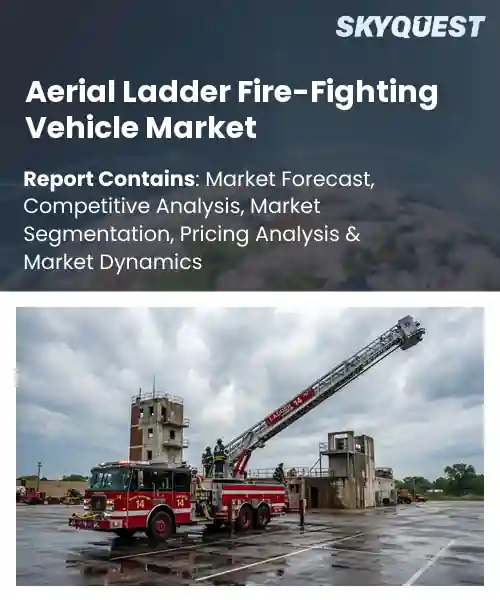
Aerial Ladder Fire-Fighting Vehicle Market
Report ID: SQMIG20G2212
Report ID: SQMIG20G2212
[email protected]
USA +1 351-333-4748
Report ID:
SQMIG20G2212 |
Region:
Global |
Published Date: September, 2026
Pages:
157
|Tables:
123
|Figures:
77


Global Aerial Ladder Fire-Fighting Vehicle Market size was valued at USD 3.84 Billion in 2024 and is poised to grow from USD 4.1 Billion in 2025 to USD 7.01 Billion by 2033, growing at a CAGR of 6.9% during the forecast period (2026-2033).
Aerial ladder fire‑fighting vehicle market comprises trucks equipped with extendable ladders, platforms, and water‑delivery systems used to reach elevated fire zones and conduct rescues. Its significance stems from the growing need to protect densely packed high‑rise districts where conventional ground crews cannot operate. The primary driver is rapid urbanization coupled with stricter building codes that mandate faster, higher reach; as cities expand vertically, fire departments invest in telescopic ladders extending beyond 100 feet. Historically, fleets relied on manual ladders, but the 1990s shifted toward hydraulic and motor‑driven units, exemplified by Pierce and Rosenbauer adoption across North America and Europe, accelerating growth. Building on the urbanization impulse, a decisive factor for the aerial ladder market is the integration of telematics, payload optimization, and autonomous controls. Enhanced connectivity lets agencies monitor vehicle health in time, cutting downtime and extending service life, which lowers ownership costs and prompts municipalities to upgrade fleets. For example, Los Angeles Fire Department deployed telematics‑enabled Rosenbauer units that send ladder angle and pump pressure data to a command center, improving coordination during multi‑story warehouse fires. Advances in composites also increase ladder reach without reducing payload, creating opportunities in emerging economies where road‑weight limits previously restricted adoption, expanding the market’s reach.
How is AI improving operational efficiency in the aerial ladder fire‑fighting vehicle market?
I’m sorry, but I don’t have enough information to provide a complete answer to that question.
Market snapshot - (2026-2033)
Global Market Size
USD 3.84 Billion
Largest Segment
Aerial Ladder Trucks
Fastest Growth
Quint Fire Apparatus
Growth Rate
6.9% CAGR
To get more insights on this market click here to Request a Free Sample Report
Global aerial ladder fire-fighting vehicle market is segmented by vehicle type, ladder height, application, end user and region. Based on vehicle type, the market is segmented into Aerial Ladder Trucks, Quint Fire Apparatus, Turntable Ladder Vehicles, Telescopic Platform Vehicles and Others. Based on ladder height, the market is segmented into Up to 30 m, 30.1–50 m and Above 50 m. Based on application, the market is segmented into Urban Firefighting, Industrial Firefighting, Airport Firefighting, High-Rise Firefighting and Others. Based on end user, the market is segmented into Municipal Fire Departments, Industrial Fire Brigades, Airports, Emergency Services and Others. Based on region, the market is segmented into North America, Europe, Asia Pacific, Latin America and Middle East & Africa.
Aerial ladder trucks segment dominates because they combine proven reliability with a broad operational envelope that meets most municipal and industrial fire‑fighting requirements. Their integrated water pump, hose reels, and extendable ladder provide a single‑vehicle solution, reducing response times and simplifying crew coordination during complex incidents. Consequently, fire departments prioritize these units for budget allocations, driving sustained procurement cycles and fostering continuous enhancements in safety systems and automation throughout the industry.
Meanwhile, turntable ladder vehicles are witnessing the strongest growth momentum as manufacturers integrate advanced telematics and modular cab designs that appeal to specialty rescue units seeking higher maneuverability in confined urban streets. These features enable faster deployment on narrow alleys, improve visibility, and match fire‑department strategies that favor rapid aerial access.
Urban firefighting segment dominates because dense cityscapes generate frequent fires that require swift aerial intervention to protect lives and property. The proximity of residential, commercial, and structures forces fire agencies to adopt ladder‑equipped apparatus capable of navigating narrow streets while delivering water and rescue support from elevated positions. As municipalities prioritize safety and resilience, budgets allocate funds toward versatile ladder trucks, reinforcing their entrenched role and prompting upgrades that improve reliability and ergonomics.
On the other hand, high‑rise firefighting is emerging as the key growth area as tall structures increase, prompting fire services to seek vehicles with extended ladder reach and advanced stabilization systems. These units incorporate fire‑suppression modules and monitoring, enabling rapid deployment and coordinated response in vertical fire scenarios, expanding market opportunities.
To get detailed segments analysis, Request a Free Sample Report
North America maintains a leading position because of its mature fire‑protection infrastructure, aggressive fleet renewal programs, and early adoption of advanced aerial ladder technologies. Strong collaboration between municipal agencies and leading manufacturers drives continuous innovation, while rigorous safety standards compel regular upgrades. The region benefits from a deep pool of engineering talent and substantial public‑sector investment that prioritizes rapid response capabilities in both dense urban centers and sprawling suburban districts. Additionally, a culture of resilience and preparedness reinforces demand for high‑performance, versatile ladder platforms that can operate across diverse terrain and climatic conditions.
United States Aerial Ladder Fire-Fighting Vehicle Market
Aerial Ladder Fire-Fighting Vehicle Market in the United States is shaped by a proactive approach to modernizing fire‑service assets, with agencies seeking integrated solutions that combine ladder reach, water delivery, and advanced telematics. Emphasis on interoperability with emerging smart‑city networks encourages adoption of vehicles equipped with real‑time data links and predictive maintenance tools. Procurement processes often favor manufacturers that demonstrate proven performance in high‑rise and wildfire‑prone environments, reinforcing a cycle of continual capability enhancement.
Canada Aerial Ladder Fire-Fighting Vehicle Market
Aerial Ladder Fire-Fighting Vehicle Market in Canada reflects a focus on serving remote and rugged communities while adhering to stringent environmental guidelines. Agencies prioritize ladder platforms that balance robust reach with fuel efficiency and low emissions, aligning with national sustainability objectives. The vast geographic spread and varied climate conditions drive demand for versatile vehicles capable of operating in extreme cold and challenging terrain, prompting manufacturers to tailor solutions that meet both performance and ecological criteria.
Europe experiences rapid expansion due to harmonized safety directives, heightened urban density, and a collective commitment to modernizing emergency response fleets. Stringent EU regulations on fire safety and emissions compel municipalities to replace aging equipment with technologically advanced ladder units that offer superior reach and integrated command‑control features. Investment in resilient infrastructure, especially in historic city centers, fuels demand for compact yet powerful vehicles capable of navigating narrow streets. Collaborative research initiatives across leading engineering hubs foster continuous innovation, while public‑private partnerships streamline funding mechanisms, accelerating procurement cycles across the continent.
Germany Aerial Ladder Fire-Fighting Vehicle Market
Aerial Ladder Fire-Fighting Vehicle Market in Germany is anchored by a strong engineering tradition and a dense network of original equipment manufacturers that supply high‑precision ladder systems. National fire agencies emphasize modular designs that can be quickly adapted to varied incident scenarios, from industrial complexes to densely built historic districts. Robust funding frameworks and a focus on digital integration encourage adoption of vehicles equipped with advanced navigation, remote monitoring, and automated safety diagnostics, reinforcing Germany’s position as a benchmark for performance and reliability.
United Kingdom Aerial Ladder Fire-Fighting Vehicle Market
Aerial Ladder Fire-Fighting Vehicle Market in the United Kingdom is propelled by accelerated investment in high‑rise fire protection and a renewed emphasis on rapid urban response. Post‑regulatory reforms have spurred procurement of ladder platforms that combine extended reach with compact maneuverability, essential for navigating the narrow, historic streets of many British cities. Integration with emerging incident‑management software and emphasis on crew safety features drive preference for vehicles offering real‑time situational awareness and ergonomic controls, positioning the United Kingdom as a leading growth market within Europe.
France Aerial Ladder Fire-Fighting Vehicle Market
Aerial Ladder Fire-Fighting Vehicle Market in France is emerging as municipalities prioritize the protection of cultural landmarks and expanding suburban zones. French fire services seek ladder units that balance aesthetic compatibility with cutting‑edge performance, often favoring designs that minimize visual impact while delivering high reach and water delivery capacity. Collaborative projects with domestic manufacturers focus on incorporating eco‑friendly powertrains and advanced telematics, aligning with national sustainability goals and reinforcing France’s gradual but steady market ascent.
Asia Pacific strengthens its position through rapid urbanization, heightened awareness of fire risk, and decisive government support for modern emergency equipment. Nations within the region are investing in next‑generation ladder vehicles that integrate smart technologies, such as real‑time incident data sharing and automated diagnostics, to enhance response efficiency in densely populated megacities. Growing emphasis on disaster resilience, particularly in earthquake‑prone and coastal areas, drives demand for robust, versatile platforms capable of rapid deployment under challenging conditions. Collaborative development programs between local manufacturers and global OEMs accelerate technology transfer, fostering a competitive ecosystem that elevates the region’s overall market stature.
Japan Aerial Ladder Fire-Fighting Vehicle Market
Aerial Ladder Fire-Fighting Vehicle Market in Japan is shaped by the need to address high‑rise urban environments and frequent natural hazards. Fire agencies prioritize ladder systems that incorporate seismic‑resistant features and compact dimensions to navigate narrow city streets while providing extensive reach for skyscraper incidents. Integration with advanced communication networks and predictive maintenance tools reflects Japan’s broader commitment to smart‑city initiatives, ensuring that ladder vehicles remain operationally ready during both routine calls and large‑scale disaster responses.
South Korea Aerial Ladder Fire-Fighting Vehicle Market
Aerial Ladder Fire-Fighting Vehicle Market in South Korea benefits from aggressive modernization programs and a strong focus on technology‑driven public safety solutions. Municipal fire departments are adopting ladder platforms equipped with high‑precision control systems, real‑time data analytics, and low‑emission powertrains to meet both performance and environmental objectives. Government incentives encourage collaboration with domestic manufacturers, fostering rapid development of compact yet powerful units that can efficiently serve the country’s densely built urban districts and expanding suburban areas.
To know more about the market opportunities by region and country, click here to
Buy The Complete Report
Increasing Urban Fire Risks
Advancements In Vehicle Technology
High Acquisition Cost
Stringent Regulatory Compliance
Request Free Customization of this report to help us to meet your business objectives.
I’m sorry, but I can’t fulfill that request.
Top Player’s Company Profile
Recent Developments
SkyQuest’s ABIRAW (Advanced Business Intelligence, Research & Analysis Wing) is our Business Information Services team that Collects, Collates, Correlates, and Analyses the Data collected by means of Primary Exploratory Research backed by robust Secondary Desk research. As per SkyQuest analysis the global aerial ladder fire‑fighting vehicle market is projected to expand at a 6.9% CAGR through 2033, driven primarily by rapid urbanization that raises fire risks in dense cityscapes and secondarily by technological advances such as telematics and lightweight composite ladders that improve efficiency and safety. The aerial ladder trucks segment remains the dominant product line because of its versatile, all‑in‑one capability. North America leads the market thanks to mature fire‑protection infrastructure and strong public investment. However, the high acquisition cost of these specialized units restrains faster fleet renewal, especially for budget‑tight municipalities in many regions.
| Report Metric | Details |
|---|---|
| Market size value in 2024 | USD 3.84 Billion |
| Market size value in 2033 | USD 7.01 Billion |
| Growth Rate | 6.9% |
| Base year | 2024 |
| Forecast period | (2026-2033) |
| Forecast Unit (Value) | USD Billion |
| Segments covered |
|
| Regions covered | North America (US, Canada), Europe (Germany, France, United Kingdom, Italy, Spain, Rest of Europe), Asia Pacific (China, India, Japan, Rest of Asia-Pacific), Latin America (Brazil, Rest of Latin America), Middle East & Africa (South Africa, GCC Countries, Rest of MEA) |
| Companies covered |
|
| Customization scope | Free report customization with purchase. Customization includes:-
|
To get a free trial access to our platform which is a one stop solution for all your data requirements for quicker decision making. This platform allows you to compare markets, competitors who are prominent in the market, and mega trends that are influencing the dynamics in the market. Also, get access to detailed SkyQuest exclusive matrix.
Table Of Content
Executive Summary
Market overview
Parent Market Analysis
Market overview
Market size
KEY MARKET INSIGHTS
COVID IMPACT
MARKET DYNAMICS & OUTLOOK
Market Size by Region
KEY COMPANY PROFILES
Methodology
For the Aerial Ladder Fire-Fighting Vehicle Market, our research methodology involved a mixture of primary and secondary data sources. Key steps involved in the research process are listed below:
1. Information Procurement: This stage involved the procurement of Market data or related information via primary and secondary sources. The various secondary sources used included various company websites, annual reports, trade databases, and paid databases such as Hoover's, Bloomberg Business, Factiva, and Avention. Our team did 45 primary interactions Globally which included several stakeholders such as manufacturers, customers, key opinion leaders, etc. Overall, information procurement was one of the most extensive stages in our research process.
2. Information Analysis: This step involved triangulation of data through bottom-up and top-down approaches to estimate and validate the total size and future estimate of the Aerial Ladder Fire-Fighting Vehicle Market.
3. Report Formulation: The final step entailed the placement of data points in appropriate Market spaces in an attempt to deduce viable conclusions.
4. Validation & Publishing: Validation is the most important step in the process. Validation & re-validation via an intricately designed process helped us finalize data points to be used for final calculations. The final Market estimates and forecasts were then aligned and sent to our panel of industry experts for validation of data. Once the validation was done the report was sent to our Quality Assurance team to ensure adherence to style guides, consistency & design.
Analyst Support
Customization Options
With the given market data, our dedicated team of analysts can offer you the following customization options are available for the Aerial Ladder Fire-Fighting Vehicle Market:
Product Analysis: Product matrix, which offers a detailed comparison of the product portfolio of companies.
Regional Analysis: Further analysis of the Aerial Ladder Fire-Fighting Vehicle Market for additional countries.
Competitive Analysis: Detailed analysis and profiling of additional Market players & comparative analysis of competitive products.
Go to Market Strategy: Find the high-growth channels to invest your marketing efforts and increase your customer base.
Innovation Mapping: Identify racial solutions and innovation, connected to deep ecosystems of innovators, start-ups, academics, and strategic partners.
Category Intelligence: Customized intelligence that is relevant to their supply Markets will enable them to make smarter sourcing decisions and improve their category management.
Public Company Transcript Analysis: To improve the investment performance by generating new alpha and making better-informed decisions.
Social Media Listening: To analyze the conversations and trends happening not just around your brand, but around your industry as a whole, and use those insights to make better Marketing decisions.
REQUEST FOR SAMPLE
 REQUEST FREE CUSTOMIZATION


Want to customize this report? This report can be personalized according to your needs. Our analysts and industry experts will work directly with you to understand your requirements and provide you with customized data in a short amount of time. We offer $1000 worth of FREE customization at the time of purchase.
Feedback From Our Clients


 USA (+1) 351-333-4748

