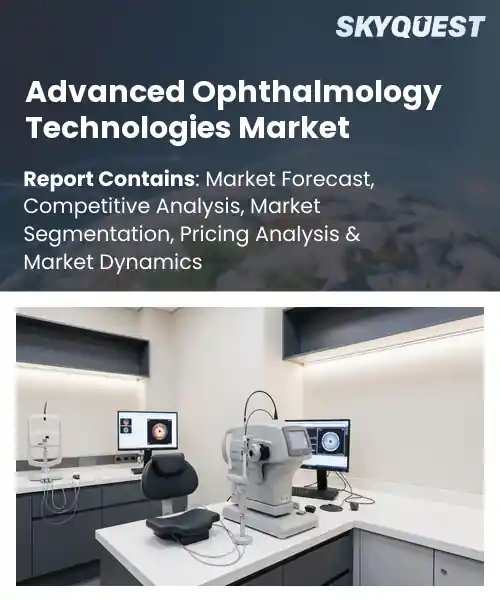
Advanced Ophthalmology Technologies Market
Report ID: SQMIG35A3850
Report ID: SQMIG35A3850
[email protected]
USA +1 351-333-4748
Report ID:
SQMIG35A3850 |
Region:
Global |
Published Date: June, 2026
Pages:
157
|Tables:
120
|Figures:
77


Global Advanced Ophthalmology Technologies Market size was valued at USD 9.0 Billion in 2024 and is poised to grow from USD 9.67 Billion in 2025 to USD 17.26 Billion by 2033, growing at a CAGR of 7.5% during the forecast period (2026-2033).
The main factor behind the advanced ophthalmology technologies market growth is the demographic tilt toward older populations plus those chronic diseases that keep stacking up, so offering more need for sharp diagnosis and treatments that are less invasive.
Moreover, building on both demographic pressure and tech progress, a major growth driver is the integration of artificial intelligence with richer imaging data. The idea is that automated screening and risk stratification can reduce diagnostic pileups, while also making it easier to shift tasks toward primary care settings. For instance, FDA cleared systems for diabetic retinopathy have already been used in clinics to triage patients, this helps shorten referral windows and lets specialists spend more time on treatment rather than on first-pass sorting. At the same time, higher surgical caseloads for cataract and glaucoma raise demand for premium intraocular lenses and minimally invasive devices, which is why companies keep investing in modular platforms and training programs, to expand adoption across both developed and emerging markets.
In practice, AI improves advanced ophthalmology diagnostics by picking up tiny and subtle patterns inside high resolution images, and then combining multimodal inputs, think OCT alongside fundus photography. Core elements usually include automated lesion detection, retinal layer segmentation and risk stratification, all of which are designed to assist clinicians. It’s more like supporting decision-making, not blindly replacing it. What’s happening now is a fusion of imaging hardware and embedded software so AI becomes part of normal workflow, aiming for earlier detection plus more consistent readings.
Market snapshot - (2026-2033)
Global Market Size
USD 9.0 Billion
Largest Segment
Therapeutic Technologies
Fastest Growth
Diagnostic Technologies
Growth Rate
7.5% CAGR
To get more insights on this market click here to Request a Free Sample Report
The Global Advanced Ophthalmology Technologies Market is segmented based on type, product category, application, end-user, and region. Based on type, the market is segmented into diagnostic technologies and therapeutic technologies. Based on product category, the market is segmented into imaging systems, surgical equipment, laser systems, and vision care products. Based on application, the market is segmented into cataract, glaucoma, age-related macular degeneration (AMD), dry eye, refractive surgery, and keratoconus. Based on end-user, the market is segmented into hospitals, ambulatory surgery centers (ASCs), and eye clinics. Based on region, the market is segmented into North America, Europe, Asia Pacific, Latin America, and the Middle East & Africa.
As per the Advanced Ophthalmology Technologies Market analysis, the Imaging Systems segment dominates, they act like the main diagnostic backbone for advanced ophthalmology technologies, so they help with earlier disease detection and, well, better treatment planning. High resolution, multimodal imaging feeds directly into clinical decisions and even surgical workflows, which basically pushes demand for integrated platforms. Then there is the ongoing innovation in optics and software, that boosts diagnostic confidence and also makes clinicians work faster, and that tends to speed up procurement because hospitals and clinics want to lower procedural risk, and at the same time improve patient outcomes
However, Surgical Equipment is showing up as the most rapidly expanding area, mainly because people want minimally invasive instruments, plus robotic assistance, and integrated operating room solutions that give better precision and throughput. There are rapid technology upgrades, and ambulatory surgery environments are adopting these things more and more, also clinicians seem to prefer devices that shorten recovery time, so investment keeps moving, and opportunities open up across providers
According to the Advanced Ophthalmology Technologies Market forecast, the Cataract segment dominates, mostly because cataract care includes a huge share of procedures and it pulls along procurement for both diagnostic and treatment ophthalmic technologies. Innovations in intraocular lenses, phacoemulsification platforms, and preoperative biometry raise clinical expectations, so clinics start feeling like they need to upgrade equipment, and once the procedures become more predictable, providers tend to lean toward tools that reduce operative time and support stronger visual outcomes. That ends up reinforcing cataract-related technology adoption across hospitals, ASCs, and specialized clinics too
Meanwhile, refractive surgery is the fastest growing application space, since demand for long term or permanent vision correction keeps rising, so that drives investment in advanced excimer and femtosecond lasers, plus more customized treatment planning. Ongoing improvements, expanding indications, and clinician preference for minimally invasive approaches are creating new revenue streams, and it also nudges manufacturers to speed up their product pipelines, like keeping the whole market moving forward
To get detailed segments analysis, Request a Free Sample Report
As per the Advanced Ophthalmology Technologies Market regional forecast, North America dominates the market, not just because one thing, but because strong research infrastructure is there, clinical know how is more concentrated than elsewhere, and the healthcare delivery ecosystem is already mature. There is also this rough, fast cycle of collaboration between academic centers, specialty clinics, and industry partners, which helps innovations get translated into clinical practice sooner, and in a more consistent way. Big private and public investment pools keep clinical trials moving and keep device development alive, while high patient awareness plus broad adoption of premium ophthalmic care pushes demand for advanced diagnostics and new therapeutics. Even the regulatory pathways help, because they tend to balance rigor with predictability, so commercialization feels less like a gamble. Then there is a dense web of specialist manufacturers, service providers, plus postmarket support that’s almost like always available, and supply chain efficiency follows. Market consolidation among technology vendors, and solid intellectual property frameworks, also makes global investment and partnerships easier to justify. And patient centric care models, plus payer structures that actually recognize outcomes value, encourage adoption of these premium technologies in different clinical settings, not only in the “best” hospitals.
United States Advanced Ophthalmology Technologies Market
The Advanced Ophthalmology Technologies sector in the United States benefits from a thick concentration of tertiary care centers, pioneering academic research, and active investment from the private sector that accelerates innovation and commercialization. Integrated clinical networks make clinical validation and scaling happen more quickly, while strong working relationships between manufacturers and specialist providers support training, and postmarket services too. High patient awareness, together with the availability of premium ophthalmic care, further sustains uptake of advanced diagnostics and surgical platforms across the country.
Canada Advanced Ophthalmology Technologies Market
The Advanced Ophthalmology Technologies Market in Canada is backed by a collaborative healthcare environment where academic hospitals and regional specialty clinics team up with technology developers to move innovations into clinical use. The focus on equitable access and integrated care pathways helps roll out diagnostic and therapeutic platforms across different kinds of settings, even if the regional constraints vary. Governmental research institutes plus local manufacturing capacity encourage more localized solutions, while clinician engagement and training programs help ensure effective uptake and sustained clinical integration.
Europe is seeing rapid Advanced Ophthalmology Technologies Market penetration in the advanced ophthalmology technologies market, largely due to harmonized regulatory frameworks, strong clinical research networks, and increasing collaboration across national healthcare systems. Well-established specialty centers in key markets nurture clinical expertise while cross-border reimbursement conversations, and policy initiatives, support broader access to innovative diagnostics and therapies. Local manufacturers, contract research organizations, and ophthalmology societies also promote technology adoption by clinician training, plus generation of real world evidence. Demand is also boosted by focused investment in minimally invasive surgical platforms, image guided diagnostics, and digital health integration. Patient advocacy, and local care priorities push modernization of ophthalmic services across varied care environments too. Public private partnerships, and translational funding, speed commercialization of new devices and therapeutics, while regional centers of excellence guide clinical evaluation and help integrate teleophthalmology and digital imaging into routine practice.
Germany Advanced Ophthalmology Technologies Market
The Advanced Ophthalmology Technologies Market in Germany leans on industrial manufacturing strength, specialist clinics, and a supportive regulatory environment to maintain leadership in device innovation. Collaborative networks between research hospitals and manufacturers help refine products, and help keep quality production standards consistent. There’s also a clear emphasis on precision medicine, and image guided diagnostics, which supports clinician adoption. Training programs and professional societies spread best practices, so clinical integration improves, and postmarket feedback loops help continuous improvement, and they keep the industry academic collaboration moving.
United Kingdom Advanced Ophthalmology Technologies Market
The Advanced Ophthalmology Technologies Market in the United Kingdom shows rapid adoption of cutting edge ophthalmic solutions because of active clinical research networks, favorable reimbursement dialogues, and venture activity that backs startups. Streamlined clinical evaluation, and collaborative trials, speed up translation of new diagnostics, and minimally invasive surgical platforms, into everyday practice. National professional bodies and care pathways promote standardized training, and consistent quality assurance, so scalable deployment becomes more realistic across tertiary and community ophthalmology services, without it turning into a patchwork.
France Advanced Ophthalmology Technologies Market
The Advanced Ophthalmology Technologies Market in France is emerging through investments in specialized research centers and clinician engagement that help adoption of novel diagnostics and therapies. There is an emphasis on value based care, and regional networks, which encourages integration of imaging platforms and minimally invasive procedures into standard care pathways. Collaboration between public research institutions and startups generates localized solutions that match national clinical priorities, while professional training initiatives improve clinician confidence and broaden clinical uptake.
Asia Pacific is strengthening its position in the advanced ophthalmology technologies market through a blend of expanding clinical capabilities , targeted domestic manufacturing and strategic international partnerships, that basically make technology transfer easier. At the same time rapid modernization of hospital infrastructure in the biggest city centers, goes along with focused spending on imaging, surgical robotics, and teleophthalmology. This combination lifts regional clinical capacity, and it does so in a practical way. Governments and private stakeholders are also encouraging localized innovation ecosystems, while academic- industry collaboration helps with clinical validation and regulatory alignment, step by step. As digital health platforms get more adoption, and remote diagnostic workflows become more normal, providers can reach community settings faster, and rising clinician expertise helps advanced therapies get adapted to different patient needs across markets where care delivery models vary quite a bit. Regional hubs in major economies are supporting clinical evaluation plus manufacturing scale, so investment keeps showing up. There are also moves toward regulatory harmonization and stronger postmarket surveillance, which builds confidence for multinational companies to localize operations. Finally clinician training programs and telemedicine pilots, push practical adoption across urban as well as rural care pathways.
Japan Advanced Ophthalmology Technologies Market
Japan's Advanced Ophthalmology Technologies Market benefits from deep clinical research abilities, strong hospital infrastructure and a stable domestic manufacturing base that supports high precision ophthalmic devices. There is close coordination among universities, specialty clinics and technology companies, which helps iterative development , plus rigorous clinical validation. The main emphasis stays on miniaturization, imaging quality and the integration of robotics and that makes clinicians more interested. Professional training efforts and established distribution channels also make deployment smoother across tertiary centers, and into specialized ophthalmology practices.
South Korea Advanced Ophthalmology Technologies Market
The Advanced Ophthalmology Technologies Market in South Korea is strengthening through an ecosystem that mixes medical device firms, advanced imaging development, and clinical know how in ophthalmology centers. There is a strong push on prototyping, and collaboration between industry and clinicians, which speeds up development cycles. That same approach supports localization of surgical and diagnostic platforms, without too many delays. Supportive policy moves and partnerships with international firms help with technology transfer, while clinician education programs plus distribution networks encourage broader adoption across hospitals and specialized eye clinic settings.
To know more about the market opportunities by region and country, click here to
Buy The Complete Report
Increasing Prevalence Of Ocular Diseases
Advances In Diagnostic Imaging Technologies
High Cost Of Advanced Devices
Regulatory Complexity And Approval Delays
Request Free Customization of this report to help us to meet your business objectives.
The competitive landscape hinges on M&A , licensing, and clinical partnerships, as incumbents scoop up or consolidate know-how, while startups chase AI and telehealth productization. That competitive pressure to lock in provider integration and somehow get regulatory paths moving more quickly leads to specific M&A moves and collaboration activity. For instance, there’s been a bit of recent consolidation among device manufacturers and also startups like Ophthalmic Sciences raising pre seed funding, and JuneBrain getting federal grants to scale telemonitoring.
Top Player’s Company Profile
Recent Developments in the Advanced Ophthalmology Technologies Market
SkyQuest’s ABIRAW (Advanced Business Intelligence, Research & Analysis Wing) is our Business Information Services team that Collects, Collates, Correlates, and Analyses the Data collected by means of Primary Exploratory Research backed by robust Secondary Desk research.
As per SkyQuest analysis, the global advanced ophthalmology technologies market is set up for steady growth, largely because populations are aging and chronic ocular diseases keep rising, and it’s further accelerated by the integration of artificial intelligence with high resolution imaging , which supports earlier detection and better workflow efficiencies. Still, adoption is slowed down by the high acquisition and maintenance costs , and that makes uptake harder for smaller clinics and for systems with limited resources. North America stays the dominant region , due to research infrastructure, concentrated clinical expertise and relatively favorable commercialization pathways. Imaging systems are the leading segment as well, because they act like the diagnostic backbone , guiding treatment decisions and surgical planning. Manufacturers that focus on modular platforms, training programs and evidence generation are positioned well to capture the expanding demand.
| Report Metric | Details |
|---|---|
| Market size value in 2024 | USD 9.0 Billion |
| Market size value in 2033 | USD 17.26 Billion |
| Growth Rate | 7.5% |
| Base year | 2024 |
| Forecast period | (2026-2033) |
| Forecast Unit (Value) | USD Billion |
| Segments covered |
|
| Regions covered | North America (US, Canada), Europe (Germany, France, United Kingdom, Italy, Spain, Rest of Europe), Asia Pacific (China, India, Japan, Rest of Asia-Pacific), Latin America (Brazil, Rest of Latin America), Middle East & Africa (South Africa, GCC Countries, Rest of MEA) |
| Companies covered |
|
| Customization scope | Free report customization with purchase. Customization includes:-
|
To get a free trial access to our platform which is a one stop solution for all your data requirements for quicker decision making. This platform allows you to compare markets, competitors who are prominent in the market, and mega trends that are influencing the dynamics in the market. Also, get access to detailed SkyQuest exclusive matrix.
Table Of Content
Executive Summary
Market overview
Parent Market Analysis
Market overview
Market size
KEY MARKET INSIGHTS
COVID IMPACT
MARKET DYNAMICS & OUTLOOK
Market Size by Region
KEY COMPANY PROFILES
Methodology
For the Advanced Ophthalmology Technologies Market, our research methodology involved a mixture of primary and secondary data sources. Key steps involved in the research process are listed below:
1. Information Procurement: This stage involved the procurement of Market data or related information via primary and secondary sources. The various secondary sources used included various company websites, annual reports, trade databases, and paid databases such as Hoover's, Bloomberg Business, Factiva, and Avention. Our team did 45 primary interactions Globally which included several stakeholders such as manufacturers, customers, key opinion leaders, etc. Overall, information procurement was one of the most extensive stages in our research process.
2. Information Analysis: This step involved triangulation of data through bottom-up and top-down approaches to estimate and validate the total size and future estimate of the Advanced Ophthalmology Technologies Market.
3. Report Formulation: The final step entailed the placement of data points in appropriate Market spaces in an attempt to deduce viable conclusions.
4. Validation & Publishing: Validation is the most important step in the process. Validation & re-validation via an intricately designed process helped us finalize data points to be used for final calculations. The final Market estimates and forecasts were then aligned and sent to our panel of industry experts for validation of data. Once the validation was done the report was sent to our Quality Assurance team to ensure adherence to style guides, consistency & design.
Analyst Support
Customization Options
With the given market data, our dedicated team of analysts can offer you the following customization options are available for the Advanced Ophthalmology Technologies Market:
Product Analysis: Product matrix, which offers a detailed comparison of the product portfolio of companies.
Regional Analysis: Further analysis of the Advanced Ophthalmology Technologies Market for additional countries.
Competitive Analysis: Detailed analysis and profiling of additional Market players & comparative analysis of competitive products.
Go to Market Strategy: Find the high-growth channels to invest your marketing efforts and increase your customer base.
Innovation Mapping: Identify racial solutions and innovation, connected to deep ecosystems of innovators, start-ups, academics, and strategic partners.
Category Intelligence: Customized intelligence that is relevant to their supply Markets will enable them to make smarter sourcing decisions and improve their category management.
Public Company Transcript Analysis: To improve the investment performance by generating new alpha and making better-informed decisions.
Social Media Listening: To analyze the conversations and trends happening not just around your brand, but around your industry as a whole, and use those insights to make better Marketing decisions.
REQUEST FOR SAMPLE
 REQUEST FREE CUSTOMIZATION
Global Advanced Ophthalmology Technologies Market size was valued at USD 9.0 Billion in 2024 and is poised to grow from USD 9.67 Billion in 2025 to USD 17.26 Billion by 2033, growing at a CAGR of 7.5% during the forecast period (2026-2033).
Competitive landscape is driven by M&A, licensing and clinical partnerships as incumbents acquire or consolidate capabilities while startups pursue AI and telehealth productization. Competitive pressure to secure provider integration and faster regulatory paths drives concrete M&A and collaboration activity. Examples include recent consolidation among device manufacturers and startups such as Ophthalmic Sciences raising pre seed funding and JuneBrain receiving federal grants to scale telemonitoring. 'Carl Zeiss Meditec AG', 'Alcon Inc.', 'Bausch + Lomb', 'Topcon Corporation', 'NIDEK Co., Ltd.', 'EssilorLuxottica', 'CooperVision', 'Teva Pharmaceutical Industries', 'Johnson & Johnson Services', 'Novartis AG', 'Lumenis Ltd.', 'IRIDEX Corporation', 'Glaukos Corporation', 'HOYA Corporation', 'Digital Diagnostics Inc.', 'Ziemer Ophthalmic Systems AG', 'Danaher Corporation', 'Optos Plc', 'Optomed Plc', 'Alimera Sciences'
Increasing prevalence of ocular diseases expands clinical demand for advanced ophthalmology technologies by broadening the patient pool requiring diagnostics, medical devices, and surgical interventions. Healthcare providers respond by integrating sophisticated imaging systems, minimally invasive instruments, and precision lasers to improve outcomes and workflow efficiency, which stimulates procurement and investment. Manufacturers prioritize product development and commercialization to address evolving clinical needs, while hospitals and ambulatory centers upgrade capabilities to maintain standards of care. This sustained clinical necessity underpins market expansion through continual adoption and technology replacement cycles.
Ai-Driven Diagnostic Integration: Clinical workflows are being restructured as artificial intelligence algorithms integrate imaging, electronic records and telehealth platforms to enhance early detection and diagnostic consistency. Adoption fosters collaborative decision making among ophthalmologists, general practitioners and allied technicians, improving referral pathways and patient triage. Vendors and providers prioritize interoperable architectures and explainable models to build clinician trust and facilitate deployment. As implementation matures, emphasis shifts towards clinician training, validated clinical pathways and deployment monitoring to ensure sustained diagnostic quality and seamless care coordination.
Why does North America Dominate the Global Advanced Ophthalmology Technologies Market? |@12


Want to customize this report? This report can be personalized according to your needs. Our analysts and industry experts will work directly with you to understand your requirements and provide you with customized data in a short amount of time. We offer $1000 worth of FREE customization at the time of purchase.
Feedback From Our Clients


 USA (+1) 351-333-4748

