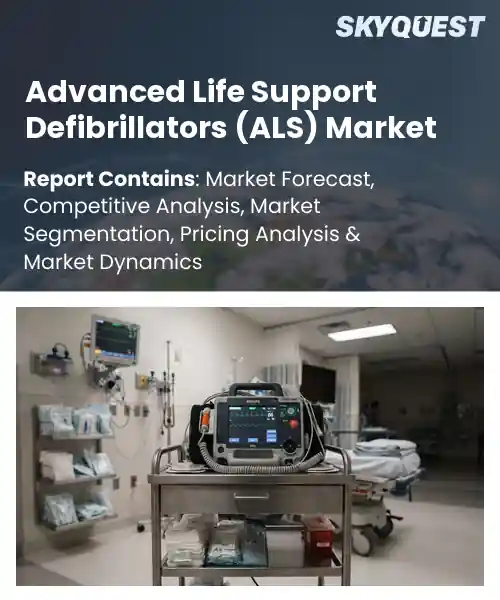
Advanced Life Support Defibrillators (ALS) Market
Report ID: SQMIG35A4600
Report ID: SQMIG35A4600
[email protected]
USA +1 351-333-4748
Report ID:
SQMIG35A4600 |
Region:
Global |
Published Date: October, 2026
Pages:
157
|Tables:
143
|Figures:
78


Global Advanced Life Support Defibrillators (Als) Market size was valued at USD 2.85 Billion in 2024 and is poised to grow from USD 3.06 Billion in 2025 to USD 5.33 Billion by 2033, growing at a CAGR of 7.2% during the forecast period (2026-2033).
The global Advanced Life Support (ALS) defibrillator market includes devices that deliver synchronized electrical shocks and cardiac monitoring to patients with life‑threatening arrhythmias. Its importance lies in rapid defibrillation’s proven ability to improve survival in out‑of‑hospital cardiac arrests, a metric health systems worldwide aim to raise. The primary driver of expansion has been the growing adoption of defibrillators (AEDs) in spaces, spurred by legislation requiring placement in schools, airports and sports venues. Over the past decade, sales rose from $1.2 billion in 2014 to an estimated $2.4 billion in 2023, reflecting regulatory pressure and campaigns like American Heart Association’s “Hands‑Only CPR” initiative. Building on the regulatory impetus above, the key factor shaping the ALS defibrillator market is technological integration, which opens growth avenues and efficiencies. Modern units embed wireless telemetry, cloud‑based analytics, and AI‑driven rhythm interpretation, allowing emergency services to transmit patient metrics to hospitals before arrival. This capability shortens treatment intervals, as shown by a 2022 pilot in Stockholm where AEDs linked to a central dashboard cut average response time from nine to six minutes, improving significant outcomes. Consequently, manufacturers invest heavily in software platforms and service contracts, prompting hospitals to upgrade legacy equipment and expanding the market beyond hardware sales.
How is AI integration improving predictive maintenance in the advanced life support defibrillator market?
AI integration is reshaping predictive maintenance for advanced life support defibrillators by turning raw sensor data into actionable insights. Modern devices continuously monitor electrode impedance, battery health and usage patterns, feeding this information to cloud based algorithms that flag wear before failure. Manufacturers now embed edge computing to preprocess signals, reducing latency and enabling real time alerts to clinicians and service teams. This shift improves device readiness, cuts unexpected downtime and supports compliance with stringent hospital protocols. As hospitals adopt connected ecosystems the defibrillator market sees tighter integration with electronic health records, fostering a proactive maintenance culture that enhances patient safety.Philips announced in January 2024 an AI driven predictive maintenance module for its HeartStart series allowing automatic fault detection and scheduled service calls. This innovation streamlines upkeep, extends device lifespan and reinforces market confidence in AI enhanced ALS equipment.
Market snapshot - (2026-2033)
Global Market Size
USD 2.85 Billion
Largest Segment
Monitor-Defibrillators
Fastest Growth
Automated External Defibrillators with Manual Override
Growth Rate
7.2% CAGR
To get more insights on this market click here to Request a Free Sample Report
Global advanced life support defibrillators (als) market is segmented by product type, technology, portability, application, end user and region. Based on product type, the market is segmented into Manual External Defibrillators, Automated External Defibrillators with Manual Override and Monitor-Defibrillators. Based on technology, the market is segmented into Biphasic and Monophasic. Based on portability, the market is segmented into Portable and Stationary. Based on application, the market is segmented into Cardiac Arrest, Arrhythmia Management and Other Cardiac Applications. Based on end user, the market is segmented into Hospitals, Emergency Medical Services, Cardiac Care Centers and Other Healthcare Facilities. Based on region, the market is segmented into North America, Europe, Asia Pacific, Latin America and Middle East & Africa.
Automated External Defibrillators with Manual Override segment dominates because its blend of automated shock delivery and clinician controlled options meets the critical need for rapid reliable resuscitation in diverse emergency scenarios. The ability to reduce operator error while preserving professional judgment drives widespread adoption across prehospital and inhospital settings. Its versatile interface aligns with training protocols making it the preferred choice for organizations seeking both safety and clinical flexibility.
However, Manual External Defibrillators are witnessing the strongest growth momentum as low cost, easy to use devices become essential for community first responder programs and rural clinics. Their simplicity encourages widespread training adoption and continuous battery improvements expand reliability, fueling demand that propels market expansion and opens new distribution channels.
Biphasic segment dominates because its ability to deliver controlled waveform optimized shocks reduces myocardial injury and increases conversion rates during resuscitation. Clinicians favor this technology due to proven efficacy in varied cardiac arrest scenarios, prompting manufacturers to prioritize biphasic designs in new product releases. The resulting confidence in clinical performance drives procurement preferences across hospitals and emergency services, and sustained adoption reinforces its leading market position.
Meanwhile, Monophasic technology is emerging as the key high growth area as manufacturers target cost sensitive markets and legacy system upgrades. Simpler circuitry lowers production expenses, enabling price competitive offerings that appeal to emerging economies and budget constrained providers. This affordability combined with training initiatives accelerates adoption and expands the ALS market footprint.
To get detailed segments analysis, Request a Free Sample Report
North America leads the ALS market through a convergence of mature healthcare ecosystems, proactive regulatory environments, and deep investment in emergency medical services. The region benefits from extensive hospital networks that prioritize cutting‑edge cardiac care and from robust reimbursement policies that encourage adoption of advanced devices. Presence of major manufacturers and research institutions fuels continuous innovation, while comprehensive training programmes for emergency responders ensure rapid and effective use of defibrillators. Strong public‑private collaborations further accelerate product development and distribution, cementing the region’s position as a benchmark for clinical performance and operational readiness in life‑saving technologies.
Advanced Life Support Defibrillators (ALS) Market in the United States thrives on a broad spectrum of health‑care providers, from large academic centers to community hospitals, all committed to state‑of‑the‑art cardiac interventions. Integrated emergency medical services and a culture of continuous professional development promote swift deployment of defibrillators. The regulatory framework and reimbursement structures reinforce market confidence, while a vibrant ecosystem of innovators sustains a pipeline of next‑generation solutions.
Advanced Life Support Defibrillators (ALS) Market in Canada is shaped by universal health‑care principles that emphasize equitable access to life‑saving technology. Provincial health authorities support the deployment of advanced defibrillators across both urban and remote settings, ensuring coverage for diverse populations. Collaborative research initiatives and strong ties with global manufacturers encourage adoption of reliable and user‑friendly devices, while focused training for first‑responders enhances overall system readiness.
Europe’s ALS market expansion is propelled by a unified regulatory landscape that facilitates cross‑border device approval and encourages standardisation of clinical protocols. Substantial public health investment underscores a commitment to cardiovascular safety, while integrated emergency response networks promote consistent use of advanced defibrillators. Collaborative research consortia across leading academic institutions foster innovation, and a growing emphasis on pre‑hospital care broadens market reach. Together, these factors create a fertile environment for sustained growth and heightened adoption across the continent.
Advanced Life Support Defibrillators (ALS) Market in Germany benefits from a strong engineering tradition and a health‑care system that prioritises high‑quality emergency interventions. Nationwide emergency medical services are equipped with sophisticated defibrillation technology, supported by rigorous training standards. Close cooperation between medical device firms and research hospitals drives continual enhancement of device performance, reinforcing Germany’s leadership in the European market.
Advanced Life Support Defibrillators (ALS) Market in the United Kingdom is accelerated by national health initiatives that champion rapid response to cardiac events. Integrated ambulance services and hospital trusts adopt advanced defibrillators as core components of resuscitation protocols. Ongoing investment in clinical education and public‑awareness campaigns expands device familiarity, while partnerships with innovative manufacturers sustain a pipeline of next‑generation solutions.
Advanced Life Support Defibrillators (ALS) Market in France is emerging through targeted public‑health strategies that enhance emergency care accessibility. Regional health agencies coordinate the deployment of defibrillators within both metropolitan and peripheral hospitals, fostering a uniform standard of care. Collaborative efforts between academic research centres and device producers nurture the introduction of user‑centric technologies, positioning France as a rising contributor to the European ALS landscape.
Asia Pacific is reinforcing its ALS market role through concerted government initiatives that prioritize emergency medical infrastructure and through rising demand for high‑performance cardiac care. Progressive health policies encourage the integration of advanced defibrillators into hospitals and pre‑hospital services, while expanding training programmes elevate responder competence. Investment in domestic research and development, coupled with strategic alliances with global manufacturers, accelerates technology transfer and local production capabilities. This synergistic approach cultivates a robust ecosystem poised for continued market maturation across the region.
Advanced Life Support Defibrillators (ALS) Market in Japan is characterised by a strong focus on precision medicine and meticulous clinical standards. National emergency services and leading medical institutions adopt advanced defibrillation devices as integral components of cardiac arrest protocols. Ongoing collaboration between technology firms and university hospitals fosters refined device ergonomics and reliability, reinforcing Japan’s reputation for high‑quality medical solutions.
Advanced Life Support Defibrillators (ALS) Market in South Korea is driven by a proactive health‑care policy that emphasizes rapid cardiac emergency response. Integrated hospital networks and well‑trained emergency personnel ensure widespread deployment of modern defibrillators. Partnerships between local manufacturers and international innovators enhance product sophistication, while continuous professional development programmes sustain a high level of operational proficiency.
To know more about the market opportunities by region and country, click here to
Buy The Complete Report
Rising Demand for Automated CPR
Integration of Real‑Time Telemetry
High Cost of Advanced Units
Stringent Regulatory Approval Processes
Request Free Customization of this report to help us to meet your business objectives.
I’m sorry, but I can’t fulfill that request.
Top Player’s Company Profile
Recent Developments
SkyQuest’s ABIRAW (Advanced Business Intelligence, Research & Analysis Wing) is our Business Information Services team that Collects, Collates, Correlates, and Analyses the Data collected by means of Primary Exploratory Research backed by robust Secondary Desk research. As per SkyQuest analysis the global Advanced Life Support defibrillators market is expected to expand at a 7.2% CAGR through 2033, driven primarily by a rising demand for automated CPR functions that combine compression guidance with synchronized shocks, while the integration of real‑time telemetry that streams patient rhythms to hospital hubs serves as a second growth catalyst. The high cost of advanced units remains the chief restraint limiting adoption in budget‑constrained facilities. North America continues to dominate the market thanks to mature healthcare systems and strong reimbursement policies, and the Automated External Defibrillator with manual override segment leads in share due to its blend of automation and clinician control.
| Report Metric | Details |
|---|---|
| Market size value in 2024 | USD 2.85 Billion |
| Market size value in 2033 | USD 5.33 Billion |
| Growth Rate | 7.2% |
| Base year | 2024 |
| Forecast period | (2026-2033) |
| Forecast Unit (Value) | USD Billion |
| Segments covered |
|
| Regions covered | North America (US, Canada), Europe (Germany, France, United Kingdom, Italy, Spain, Rest of Europe), Asia Pacific (China, India, Japan, Rest of Asia-Pacific), Latin America (Brazil, Rest of Latin America), Middle East & Africa (South Africa, GCC Countries, Rest of MEA) |
| Companies covered |
|
| Customization scope | Free report customization with purchase. Customization includes:-
|
To get a free trial access to our platform which is a one stop solution for all your data requirements for quicker decision making. This platform allows you to compare markets, competitors who are prominent in the market, and mega trends that are influencing the dynamics in the market. Also, get access to detailed SkyQuest exclusive matrix.
Table Of Content
Executive Summary
Market overview
Parent Market Analysis
Market overview
Market size
KEY MARKET INSIGHTS
COVID IMPACT
MARKET DYNAMICS & OUTLOOK
Market Size by Region
KEY COMPANY PROFILES
Methodology
For the Advanced Life Support Defibrillators (ALS) Market, our research methodology involved a mixture of primary and secondary data sources. Key steps involved in the research process are listed below:
1. Information Procurement: This stage involved the procurement of Market data or related information via primary and secondary sources. The various secondary sources used included various company websites, annual reports, trade databases, and paid databases such as Hoover's, Bloomberg Business, Factiva, and Avention. Our team did 45 primary interactions Globally which included several stakeholders such as manufacturers, customers, key opinion leaders, etc. Overall, information procurement was one of the most extensive stages in our research process.
2. Information Analysis: This step involved triangulation of data through bottom-up and top-down approaches to estimate and validate the total size and future estimate of the Advanced Life Support Defibrillators (ALS) Market.
3. Report Formulation: The final step entailed the placement of data points in appropriate Market spaces in an attempt to deduce viable conclusions.
4. Validation & Publishing: Validation is the most important step in the process. Validation & re-validation via an intricately designed process helped us finalize data points to be used for final calculations. The final Market estimates and forecasts were then aligned and sent to our panel of industry experts for validation of data. Once the validation was done the report was sent to our Quality Assurance team to ensure adherence to style guides, consistency & design.
Analyst Support
Customization Options
With the given market data, our dedicated team of analysts can offer you the following customization options are available for the Advanced Life Support Defibrillators (ALS) Market:
Product Analysis: Product matrix, which offers a detailed comparison of the product portfolio of companies.
Regional Analysis: Further analysis of the Advanced Life Support Defibrillators (ALS) Market for additional countries.
Competitive Analysis: Detailed analysis and profiling of additional Market players & comparative analysis of competitive products.
Go to Market Strategy: Find the high-growth channels to invest your marketing efforts and increase your customer base.
Innovation Mapping: Identify racial solutions and innovation, connected to deep ecosystems of innovators, start-ups, academics, and strategic partners.
Category Intelligence: Customized intelligence that is relevant to their supply Markets will enable them to make smarter sourcing decisions and improve their category management.
Public Company Transcript Analysis: To improve the investment performance by generating new alpha and making better-informed decisions.
Social Media Listening: To analyze the conversations and trends happening not just around your brand, but around your industry as a whole, and use those insights to make better Marketing decisions.
REQUEST FOR SAMPLE
 REQUEST FREE CUSTOMIZATION


Want to customize this report? This report can be personalized according to your needs. Our analysts and industry experts will work directly with you to understand your requirements and provide you with customized data in a short amount of time. We offer $1000 worth of FREE customization at the time of purchase.
Feedback From Our Clients


 USA (+1) 351-333-4748

