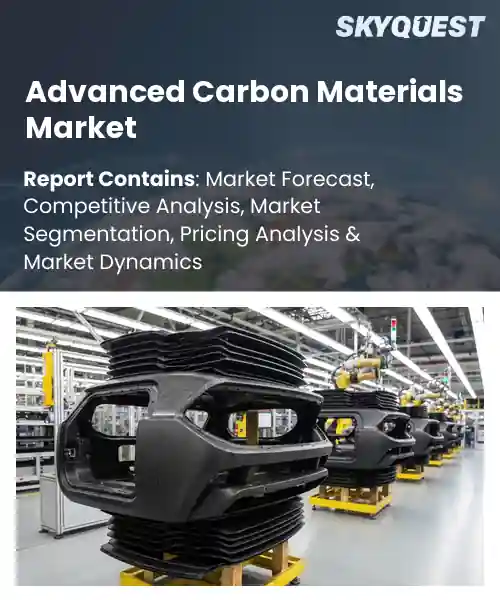
Advanced Carbon Materials Market
Report ID: SQMIG15E3473
Report ID: SQMIG15E3473
[email protected]
USA +1 351-333-4748
Report ID:
SQMIG15E3473 |
Region:
Global |
Published Date: May, 2026
Pages:
157
|Tables:
123
|Figures:
72


Global Advanced Carbon Materials Market size was valued at USD 14.52 Billion in 2024 and is poised to grow from USD 15.9 Billion in 2025 to USD 32.85 Billion by 2033, growing at a CAGR of 9.52% during the forecast period (2026-2033).
The advanced carbon materials market is being fueled by the increasing global demand for lightweight, strong, multi-functional materials across all major sectors such as transportation; energy; and electronics. The market includes many different types of advanced carbon materials that deliver a superior strength-to-weight ratio as well as high electrical conductivity and a very large surface area. The advantages of the advanced carbon materials market are demonstrated through the ability to improve fuel efficiency in commercial aircraft and automobiles improve battery efficiency; and remove pollutants more efficiently. The advanced carbon materials market has matured due to the growth of carbon fiber applications; electric wind turbine blades; and graphene-enabled sensors, with acceptance of these applications growing at a rapid pace.
As the advanced carbon materials industry continues to mature, the most significant factor affecting the growth of the global advanced carbon materials market is scalable manufacturing and cost reductions which enable research to transition to commercial products. Improvements in carbon fiber manufacturing methods using PAN, improvements in graphical CVD processes and cost reductions associated with manufacturing carbon nanotubes will also result in increased unit price reductions allowing suppliers of advanced materials to economically substitute metals for much lighter composites resulting in greater utilization of advanced carbon materials in automotive frames and renewable energy blades.
How is AI accelerating innovation in the advanced carbon materials market?
Advanced carbon materials include graphene carbon fiber carbon black and specialty graphites that enable lighter stronger and more thermally conductive products. AI accelerates innovation by enabling faster materials discovery and by predicting processing conditions that improve quality. Machine learning speeds up simulation of microstructures and guides scale up from lab to factory. In the current market companies use AI to optimize supply chains and to tailor materials for batteries composites and thermal management in data centers so the sector moves from incremental improvements to more radical performance gains and faster time to market.
TOMI Environmental Solutions in April 2026, announced a letter of intent to combine with Carbonium Core to scale domestic production of nuclear grade graphite and support data center infrastructure. AI driven modeling and predictive quality control reduce development time and improve yield which supports market growth and operational efficiency.
Market snapshot - (2026-2033)
Global Market Size
USD 14.52 Billion
Largest Segment
Carbon Black
Fastest Growth
Graphene
Growth Rate
9.52% CAGR
To get more insights on this market click here to Request a Free Sample Report
Global advanced carbon materials market is segmented by type, application, end-use and region. Based on type, the market is segmented into Carbon Nanotubes (CNT), Graphene, Carbon Fibers, Activated Carbon, Carbon Black and Fullerenes. Based on application, the market is segmented into Energy Storage (Batteries, Supercapacitors), Composites, Electronics and Filtration. Based on end-use, the market is segmented into Aerospace, Automotive, Electronics and Medical. Based on region, the market is segmented into North America, Europe, Asia Pacific, Latin America and Middle East & Africa.
Carbon nanotubes segment dominates with large advanced carbon materials market because their exceptional electrical conductivity, mechanical strength and high aspect ratio enable electrode architectures with superior charge transport and structural integrity in advanced batteries. These properties drive adoption as conductive additives, current collectors and active material scaffolds, causing measurable improvements in energy and power behavior and lifecycle stability. Commercial synthesis scaling and integration expertise further reinforce their leadership by reducing barriers to incorporation in battery designs.
As per advanced carbon materials market outlook, graphene is fastest growing segment due to advancements in using two-dimensional electrode coatings and functionalized additives to increase surface area and ion access while maximizing mechanical flexibility. The recent developments in large-scale production, along with the use of graphene in high-rate and hybrid energy storage formats, are increasing its adoption and creating performance-driven opportunities for batteries.
As per advanced carbon materials market forecast, the supercapacitors segment is leading the way because of the increased need for high-power density and rapid charge/discharge cycles and long life. Carbon-based electrode technologies provide superior performance in surface area and conductivity compared to other electrode types. Typically, advanced carbon materials will offer low internal resistance and stable cycling, encouraging the industry to consider using supercapacitors for applications such as power buffering, regenerative braking, and peak shaving. Continuous refinement of material properties, along with continued compatibility with scalable fabrication methods will solidify the supercapacitor segment as the primary application outlet for advanced carbon technologies.
Meanwhile, batteries are the fastest growing application as rising demand for greater energy density and lifecycle drives integration of graphene and nanotube enhanced electrodes and conductive additives. Advances in material functionalization and scalable electrode processing unlock better active material utilization and charging performance, generating new commercialization pathways in energy storage and electrified mobility.
To get detailed segments analysis, Request a Free Sample Report
Asia Pacific is the largest supplier of advanced carbon materials around the world due to its industrial capabilities, supply chains, and electronic and automotive uses. Large investments in material science, collaboration with universities and associations and companies grouped together in a specific area enable quick transitions from research and development to manufacturing.
Advanced carbon materials market in Japan has a significant benefit due to its extensive experience with precision manufacture, integration with electronics, and close relationships between industry and Universities. The semiconductor and automobile industries have a limited domestic and international need for high purity carbon materials and composite materials. Therefore, manufacturers need to ensure the quality of their processes, the ability to miniaturize parts, and the integration of multiple components into either product type. Additionally, cooperation with incubators of innovation and protection of the supplier network enables sustainable high-end material supply for the Japanese market.
As per advanced carbon materials market regional outlook, South Korea has strong electronics manufacturing, battery development, and collaborated technology transfer with universities and industry. These manufacturers put an emphasis on the development of high performance carbon additives, conductive carbon materials, and composite products that are able to meet both consumer electronics and automobile electrification designs. The emphasis on commercialization, clustering, and export-driven production allows manufacturers to scale their production.
North America expansion in advanced carbon materials is fueled by a combination of strong end market demand, a focus on high value applications, and an ecosystem supporting innovation-to-manufacturing pathways. Large research universities and technology companies collaborate with specialized manufacturers to translate laboratory breakthroughs into commercial products, particularly for energy storage, aerospace and industrial filtration applications.
The development of advanced carbon materials in the US involves significant collaboration between research institutions, aerospace/battery OEMs, and specialized manufacturers. Examples include translating laboratory breakthroughs into commercial products for energy storage, aerospace and industrial filtration solutions.
In Canada, the advanced carbon materials market benefits from access to and availability of resources; strong collaboration across research institutions and a commitment to developing clean technology products and processes. Manufacturers develop carbon materials for: energy storage applications, filtration and the manufacture of lightweight composites for use in transportation. Universities, government research centres and industry are creating partnerships to support the development of pilot projects and process efficiencies. Developing differentiated materials that exemplify sustainable sourcing and integration into the upstream supply chain will be important for manufacturers of advanced carbon materials as they continue to satisfy the increasingly sophisticated and demanding needs associated with being environmentally and industrially responsible.
As per advanced carbon materials industry anakysis, to enhance its position within the advanced carbon material sector Europe has established partnerships between industry and academia as well as made investments to support sustainable production processes that exceed current performance requirements. Regional businesses are concentrating efforts on developing low-emission manufactured materials, using methods that will allow recyclability and follow the principles of a circular economy in regards to three primary categories which include transportation, renewable energy and industrial filtration. Partnerships across borders and through consortia enhance cooperation and progress in the innovation of large demonstration projects as well as developing standardization requirements to establish broader acceptance within markets.
As per advanced carbon materials market regional forecast, Germany utilizes Europe's well-known reputation for automotive engineering excellence, precision manufacturing skills and comprehensive supply chain integration to develop carbon fiber that meets or exceeds performance specifications within multiple applications. The commitment to developing high-quality manufactured materials depends heavily upon well-established industrial standards, certification processes and reliability that will lead to applications within lightweight structures and energy systems. Several collaborative research centers and regional manufacturing clusters are currently in place to continue developing pilot processes and refine current processes of carbon fiber manufacture. Through environmentally responsible production and circular development practices, together with Germany's tremendous export-oriented manufacturing capacity and capabilities, Germany will continue to be one of the leaders in producing advanced carbon material solutions for extremely demanding markets.
United Kingdom advanced carbon materials market benefits from a strong university research base, expertise in composites, and a focus on aerospace and defense applications. The existence of ecosystems of innovation provides the basis for creating tailored carbon materials that meet specific structural and thermal management needs. Industry clusters incubate prototyping facilities and testing infrastructure that support certification for these demanding application sectors. There is an emphasis on sustainable manufacturing processes and technology transfer that helps to commercialize and facilitate the emergence of specialized suppliers who serve global markets and contribute to export growth.
Advanced carbon materials market in France is backed by strong research institutions, a solid manufacturing presence and commitment to sustainable material technology. French companies are pursuing customized solutions in carbon for use in renewable energy, transportation applications as well as Industrial Filtration. Collaborative platforms allow for technology validation and pilot production; while engineering expertise is available to support the integration of carbon into more sophisticated assemblies. Financial incentives to support green manufacturing and partnerships with regional clusters help to scale promising technologies while nurturing suppliers that are focused on innovation.
To know more about the market opportunities by region and country, click here to
Buy The Complete Report
Rising Demand In Aerospace
Growth In Energy Storage
High Production Costs Persist
Supply Chain Complexity
Request Free Customization of this report to help us to meet your business objectives.
The competitive landscape is shaped by technology-driven consolidation and targeted commercial alliances as incumbents secure feedstock, proprietary process know-how and downstream channel access. Concrete examples include licensing of carbon nanotube hybrid films to manufacturing partners, strategic investments to scale single-walled carbon nanotube conductive pastes for battery use, and full joint venture buyouts to vertically integrate anode and graphite supply chains for faster commercial qualification.
SkyQuest’s ABIRAW (Advanced Business Intelligence, Research & Analysis Wing) is our Business Information Services team that Collects, Collates, Correlates, and Analyses the Data collected by means of Primary Exploratory Research backed by robust Secondary Desk research.
As per SkyQuest analysis, the global advanced carbon materials market growth is propelled primarily by scalable manufacturing and cost reductions that enable wider commercial adoption, while high production costs remain a significant restraint limiting access for cost-sensitive end users. Carbon nanotubes lead the market as the dominating segment due to their conductivity and mechanical advantages, and Asia Pacific is the dominating region due to concentrated manufacturing, integrated supply chains and strong industrial demand. A second driver accelerating adoption is growth in energy storage applications where advanced carbons improve battery and supercapacitor performance. Overall the market balances rapid innovation and scaling opportunities against persistent cost and supply chain challenges. A key advanced carbon materials market trend is the growing integration of advanced carbon materials into lithium-ion batteries, supercapacitors and semiconductor applications, supported by significant investments in battery innovation and electrification initiatives worldwide.
| Report Metric | Details |
|---|---|
| Market size value in 2024 | USD 14.52 Billion |
| Market size value in 2033 | USD 32.85 Billion |
| Growth Rate | 9.52% |
| Base year | 2024 |
| Forecast period | (2026-2033) |
| Forecast Unit (Value) | USD Billion |
| Segments covered |
|
| Regions covered | North America (US, Canada), Europe (Germany, France, United Kingdom, Italy, Spain, Rest of Europe), Asia Pacific (China, India, Japan, Rest of Asia-Pacific), Latin America (Brazil, Rest of Latin America), Middle East & Africa (South Africa, GCC Countries, Rest of MEA) |
| Companies covered |
|
| Customization scope | Free report customization with purchase. Customization includes:-
|
To get a free trial access to our platform which is a one stop solution for all your data requirements for quicker decision making. This platform allows you to compare markets, competitors who are prominent in the market, and mega trends that are influencing the dynamics in the market. Also, get access to detailed SkyQuest exclusive matrix.
Table Of Content
Executive Summary
Market overview
Parent Market Analysis
Market overview
Market size
KEY MARKET INSIGHTS
COVID IMPACT
MARKET DYNAMICS & OUTLOOK
Market Size by Region
KEY COMPANY PROFILES
Methodology
For the Advanced Carbon Materials Market, our research methodology involved a mixture of primary and secondary data sources. Key steps involved in the research process are listed below:
1. Information Procurement: This stage involved the procurement of Market data or related information via primary and secondary sources. The various secondary sources used included various company websites, annual reports, trade databases, and paid databases such as Hoover's, Bloomberg Business, Factiva, and Avention. Our team did 45 primary interactions Globally which included several stakeholders such as manufacturers, customers, key opinion leaders, etc. Overall, information procurement was one of the most extensive stages in our research process.
2. Information Analysis: This step involved triangulation of data through bottom-up and top-down approaches to estimate and validate the total size and future estimate of the Advanced Carbon Materials Market.
3. Report Formulation: The final step entailed the placement of data points in appropriate Market spaces in an attempt to deduce viable conclusions.
4. Validation & Publishing: Validation is the most important step in the process. Validation & re-validation via an intricately designed process helped us finalize data points to be used for final calculations. The final Market estimates and forecasts were then aligned and sent to our panel of industry experts for validation of data. Once the validation was done the report was sent to our Quality Assurance team to ensure adherence to style guides, consistency & design.
Analyst Support
Customization Options
With the given market data, our dedicated team of analysts can offer you the following customization options are available for the Advanced Carbon Materials Market:
Product Analysis: Product matrix, which offers a detailed comparison of the product portfolio of companies.
Regional Analysis: Further analysis of the Advanced Carbon Materials Market for additional countries.
Competitive Analysis: Detailed analysis and profiling of additional Market players & comparative analysis of competitive products.
Go to Market Strategy: Find the high-growth channels to invest your marketing efforts and increase your customer base.
Innovation Mapping: Identify racial solutions and innovation, connected to deep ecosystems of innovators, start-ups, academics, and strategic partners.
Category Intelligence: Customized intelligence that is relevant to their supply Markets will enable them to make smarter sourcing decisions and improve their category management.
Public Company Transcript Analysis: To improve the investment performance by generating new alpha and making better-informed decisions.
Social Media Listening: To analyze the conversations and trends happening not just around your brand, but around your industry as a whole, and use those insights to make better Marketing decisions.
REQUEST FOR SAMPLE
 REQUEST FREE CUSTOMIZATION
Global Advanced Carbon Materials Market size was valued at USD 14.52 Billion in 2024 and is poised to grow from USD 15.9 Billion in 2025 to USD 32.85 Billion by 2033, growing at a CAGR of 9.52% during the forecast period (2026-2033).
The competitive landscape is shaped by technology-driven consolidation and targeted commercial alliances as incumbents secure feedstock, proprietary process know-how and downstream channel access. Concrete examples include licensing of carbon nanotube hybrid films to manufacturing partners, strategic investments to scale single-walled carbon nanotube conductive pastes for battery use, and full joint venture buyouts to vertically integrate anode and graphite supply chains for faster commercial qualification. 'Hexcel Corporation', 'Toray Industries', 'Teijin Limited', 'Solvay SA', 'Cabot Corporation', 'OCSiAl (Tuball CNT)', 'Nanocyl SA', 'Arkema SA', '2D Carbon Graphene Material', 'First Graphene', 'Skeleton Technologies', 'Maxwell Technologies (Tesla)', 'Haydale Graphene Industries', 'Graphenea', 'Showa Denko'
Rising demand for advanced carbon materials in aerospace is driven by the sector's continuous pursuit of fuel efficiency and performance improvement. Lightweight, high strength carbon composites enable significant weight reductions without sacrificing structural integrity, leading designers and manufacturers to integrate these materials into primary and secondary structures. This sustained incorporation fosters investment in material development and production capacity, encouraging suppliers to expand offerings and tailor properties for aerospace specifications, which in turn supports broader market acceptance and accelerates growth across related industry segments.
Sustainable Performance Material Demand: Growing regulatory pressure and corporate sustainability commitments are shifting procurement toward advanced carbon materials that enable lighter weight, enhanced durability, and recyclability in end products. Manufacturers and brand owners prioritize suppliers offering transparent lifecycle credentials and lower environmental footprints. This trend is driving collaboration among material scientists, upstream suppliers, and downstream OEMs to develop feedstock diversification, closed loop recycling approaches, and certification pathways. Market strategies emphasize traceability, responsible sourcing, and stewardship to align material selection with corporate environmental governance goals.
Why does Asia Pacific Dominate the Global Advanced Carbon Materials Market? |@12


Want to customize this report? This report can be personalized according to your needs. Our analysts and industry experts will work directly with you to understand your requirements and provide you with customized data in a short amount of time. We offer $1000 worth of FREE customization at the time of purchase.
Feedback From Our Clients


 USA (+1) 351-333-4748

