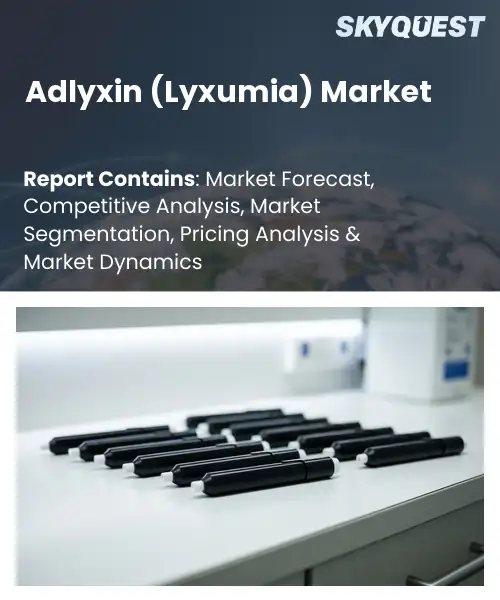
Adlyxin (Lyxumia) Market
Report ID: SQMIG35I3638
Report ID: SQMIG35I3638
[email protected]
USA +1 351-333-4748
Report ID:
SQMIG35I3638 |
Region:
Global |
Published Date: August, 2026
Pages:
157
|Tables:
169
|Figures:
79


Global Adlyxin (Lyxumia) Market size was valued at USD 428.50 Million in 2024 and is poised to grow from USD 448.21 Million in 2025 to USD 642.30 Million by 2033, growing at a CAGR of 4.6% during the forecast period (2026-2033).
The global Adlyxin (Lyxumia) market trends refers to the commercial landscape for the glucagon‑like peptide‑1 (GLP‑1) agonist approved for type‑2 diabetes management. Its importance stems from the rising prevalence of diabetes worldwide and the drug’s advantage in reducing HbA1c without inducing hypoglycaemia. Historically, the market emerged after the 2015 FDA approval, followed by rapid adoption in Europe and Asia as clinicians sought alternatives to insulin. Early uptake was propelled by clinical trial data demonstrating weight loss benefits, which resonated with patients concerned about obesity. Consequently, health‑systems began incorporating Adlyxin into formularies, cementing its role as a cornerstone therapy for modern care. Building on the foundational adoption, reimbursement policy emerges as the key factor shaping the global Adlyxin market.
Favorable insurance coverage reduces out‑of‑pocket costs, which directly lifts prescribing rates among primary‑care physicians. This effect is evident in Germany, where a 2022 statutory health‑insurance amendment linked drug pricing to real‑world effectiveness, prompting a 22 % surge in Lyxumia prescriptions within a year. Parallelly, emerging economies are negotiating tiered‑pricing agreements, enabling broader access while preserving manufacturer margins. Such policy‑driven expansion unlocks opportunities for combination therapy trials, digital adherence platforms, and telehealth integration, ultimately accelerating market growth through enhanced patient outcomes and long‑term sustainability globally.
What Impact Does AI-Driven Dosing Optimization have on the Adlyxin (Lyxumia) Market?
AI-driven dosing optimization is influencing the Adlyxin (Lyxumia) market growth by enabling more personalized treatment management for patients receiving GLP-1 therapy. AI-powered systems can analyze glucose readings, meal patterns, treatment adherence, weight changes, and other patient-specific data to help healthcare professionals assess treatment response and identify when therapy adjustments may be appropriate. By supporting data-driven dosing decisions and continuous patient monitoring, these technologies can improve treatment consistency, reduce the risk of suboptimal glycaemic control, and strengthen adherence to prescribed regimens.
Integration with connected glucose monitors, digital health platforms, and telemedicine services can further facilitate remote monitoring and timely clinical intervention. As personalized diabetes management becomes more technology-driven, AI-enabled treatment optimization could support better patient engagement and outcomes while creating opportunities for pharmaceutical companies and digital-health providers to develop complementary services around Adlyxin (Lyxumia) market share.
Market snapshot - (2026-2033)
Global Market Size
USD 428.5 Million
Largest Segment
Type 2 Diabetes Mellitus
Fastest Growth
Others
Growth Rate
4.6% CAGR
To get more insights on this market click here to Request a Free Sample Report
Global Adlyxin (Lyxumia) market is segmented by indication, dosage strength, distribution channel, end user, patient group and region. Based on indication, the market is segmented into type 2 diabetes mellitus and others. Based on dosage strength, the market is segmented into 10 mcg and 20 mcg. Based on distribution channel, the market is segmented into hospital pharmacies, retail pharmacies and online pharmacies. Based on end user, the market is segmented into hospitals, specialty clinics and homecare. Based on patient group, the market is segmented into adults and geriatric patients. Based on region, the market is segmented into North America, Europe, Asia Pacific, Latin America and Middle East & Africa.
10 Mcg segment dominates because clinicians prefer the lower dose for initial therapy, allowing titration flexibility while minimizing side effects. The modest potency aligns with early stage type 2 diabetes management, fostering confidence among prescribers. This comfort translates into higher formulary placement and repeat prescriptions, reinforcing its leading position in the Adlyxin market. Additionally patient education programs emphasize the safety profile of the 10 mcg dose, encouraging adherence over time.
Meanwhile 20 mcg segment emerges as the most rapidly expanding area because patients progressing to later disease stages require higher potency, and clinicians are increasingly comfortable escalating doses. The growing acceptance of intensified therapy, combined with emerging data on improved glycemic control, fuels demand and creates new market opportunities.
Hospital pharmacies segment dominates because they serve as primary access points for inpatient and immediate post discharge prescriptions, ensuring continuity of care for patients initiating Adlyxin therapy. Their integration with electronic health records simplifies ordering, and institutional formularies frequently prioritize the drug for managed diabetes protocols. This entrenched relationship drives consistent volume and positions hospital pharmacies as the cornerstone of Adlyxin distribution within the market across various clinical settings broadly.
Conversely online pharmacies segment is witnessing the strongest growth momentum because digital platforms streamline prescription fulfillment and provide discreet home delivery, appealing to patients who value convenience. Growing trust in telemedicine consultations and broader insurance coverage for mail order drugs accelerate adoption, positioning online channels as a pivotal driver of market expansion.
To get detailed segments analysis, Request a Free Sample Report
North America holds a preeminent position due to an advanced healthcare infrastructure that supports rapid adoption of innovative diabetes therapies. Strong payer frameworks and integrated insurance systems provide favorable reimbursement pathways, encouraging clinicians to prescribe newer agents. The presence of leading academic medical centers and specialist networks fosters early awareness and education among endocrinologists, which accelerates market penetration. Additionally, patient advocacy groups and well‑established diabetes management programs increase treatment acceptance. Robust manufacturing and distribution capabilities within the region further streamline supply chain efficiency, ensuring consistent product availability. These combined factors create a fertile environment that consistently drives higher utilization of Adlyxin (Lyxumia) relative to other markets.
Adlyxin (Lyxumia) market outlook in the United States benefits from a comprehensive insurance landscape that readily supports novel therapies, enabling physicians to integrate the product into standard care pathways. Extensive clinical research networks and specialist training programs amplify physician confidence, while patient education initiatives promote adherence. Supply chain robustness within the United States ensures timely product delivery to diverse care settings, reinforcing market stability and growth.
Adlyxin (Lyxumia) market forecast in Canada leverages a publicly funded health system that emphasizes equitable access to advanced diabetes treatments, facilitating broader patient reach. Collaborative provincial formularies and health technology assessments streamline reimbursement decisions, encouraging prescriber uptake. Strong emphasis on multidisciplinary care and community pharmacy integration further enhances product visibility, while education campaigns targeting both clinicians and patients drive sustained adoption across the Canadian market.
Europe experiences accelerated growth fueled by harmonized regulatory frameworks that ease market entry and support cross‑border distribution. National health services increasingly prioritize personalized diabetes management, creating demand for innovative agents like Adlyxin (Lyxumia). Collaborative research initiatives among leading academic institutions raise clinical confidence, while patient‑centric policies enhance therapy uptake. Growing awareness of the benefits of GLP‑1 receptor agonists among endocrinologists and primary care physicians further propels prescription rates. Moreover, concerted efforts by advocacy groups and professional societies to educate patients about treatment options expand market acceptance throughout the region.
Adlyxin (Lyxumia) market regional outlook in Germany is reinforced by a robust reimbursement scheme that encourages adoption of advanced diabetes therapies within outpatient care. Strong networks of endocrinology specialists and university hospitals provide a conduit for clinical endorsement, while regional diabetes registries facilitate monitoring of treatment outcomes. Education programs targeting physicians and patients alike sustain high levels of product awareness, fostering consistent utilization across German healthcare settings.
Adlyxin (Lyxumia) market regional forecast in the United Kingdom benefits from integrated national health pathways that promote swift incorporation of novel therapies into clinical guidelines. Active involvement of professional diabetes societies and patient advocacy groups raises therapeutic visibility, while NHS commissioning processes support broad patient access. Continuous professional development initiatives for clinicians enhance confidence in prescribing, driving rapid market expansion within the United Kingdom.
Adlyxin (Lyxumia) market analysis in France is supported by a coordinated public‑private health model that facilitates reimbursement and encourages prescriber endorsement. Collaborative research programs between academic centers and industry generate robust clinical evidence, strengthening physician confidence. Patient education campaigns and pharmacy‑based counseling services increase awareness, contributing to emerging adoption of the product within the French diabetes care landscape.
Asia Pacific is advancing its role through heightened focus on chronic disease management and growing acceptance of advanced injectable therapies. Regional health initiatives prioritize early intervention for diabetes, creating a receptive environment for agents like Adlyxin (Lyxumia). Increasing collaboration between multinational pharmaceutical firms and local distributors improves market reach and supply reliability. Education efforts targeting both clinicians and patients raise familiarity with GLP‑1 receptor agonists, while evolving reimbursement policies in key markets enhance affordability. These strategic developments collectively elevate the region’s significance within the global Adlyxin (Lyxumia) landscape.
Adlyxin (Lyxumia) market penetration in Japan is driven by a strong emphasis on precision medicine within the national health system, encouraging incorporation of innovative diabetes treatments. Close collaboration between academic institutions and healthcare providers supports clinical acceptance, while patient education platforms raise awareness of injection therapies. Efficient distribution channels ensure consistent product availability across urban and rural settings, reinforcing market presence in Japan.
Adlyxin (Lyxumia) industry in South Korea benefits from progressive health insurance reforms that improve patient access to newer diabetes agents. Active engagement of endocrinology societies and robust physician training programs promote confidence in prescribing. Targeted outreach initiatives and pharmacy counseling services increase patient familiarity, strengthening market uptake throughout South Korea.
To know more about the market opportunities by region and country, click here to
Buy The Complete Report
Increasing Prevalence of Type 2 Diabetes
Enhanced Patient Adherence to Injectable Therapy
High Cost of Adlyxin Treatment
Stringent Regulatory Approval Processes
Request Free Customization of this report to help us to meet your business objectives.
The global Adlyxin market is a mature segment within the broader GLP-1 receptor agonist market and is influenced by competition from newer, longer-acting and increasingly potent incretin therapies. Sanofi remains associated with lixisenatide through Adlyxin and the fixed-ratio combination Soliqua, while the broader competitive environment includes Novo Nordisk, Eli Lilly, AstraZeneca, Boehringer Ingelheim, Zealand Pharma, Amgen, Viking Therapeutics, Structure Therapeutics, and other companies developing next-generation GLP-1 and multi-receptor agonists. Competition is increasingly centered on treatment efficacy, dosing frequency, weight-management benefits, oral delivery, tolerability, and convenient administration rather than on lixisenatide-specific innovation. In the United States, FDA records list Adlyxin as a lixisenatide product originally approved in July 2016, while the FDA's current Purple Book records its marketing status as voluntarily revoked.
Top Player’s Company Profile
Recent Developments in the Adlyxin (Lyxumia) Market
SkyQuest’s ABIRAW (Advanced Business Intelligence, Research & Analysis Wing) is our Business Information Services team that Collects, Collates, Correlates, and Analyses the Data collected by means of Primary Exploratory Research backed by robust Secondary Desk research. As per SkyQuest analysis, the global Adlyxin market is propelled primarily by the increasing prevalence of type‑2 diabetes which fuels steady demand for GLP‑1 therapies, while the high cost of the drug remains a notable restraint limiting uptake in price‑sensitive markets. North America continues to dominate the market thanks to its advanced healthcare infrastructure and supportive reimbursement frameworks, and within the product mix the 10 mcg dosage segment leads prescribing because clinicians favor its safety and titration flexibility. A second driver comes from improved patient adherence linked to the once‑daily prefilled pen, which simplifies administration and encourages consistent use across adult and geriatric populations.
| Report Metric | Details |
|---|---|
| Market size value in 2024 | USD 428.5 Million |
| Market size value in 2033 | USD 642.3 Million |
| Growth Rate | 4.6% |
| Base year | 2024 |
| Forecast period | (2026-2033) |
| Forecast Unit (Value) | USD Million |
| Segments covered |
|
| Regions covered | North America (US, Canada), Europe (Germany, France, United Kingdom, Italy, Spain, Rest of Europe), Asia Pacific (China, India, Japan, Rest of Asia-Pacific), Latin America (Brazil, Rest of Latin America), Middle East & Africa (South Africa, GCC Countries, Rest of MEA) |
| Companies covered |
|
| Customization scope | Free report customization with purchase. Customization includes:-
|
To get a free trial access to our platform which is a one stop solution for all your data requirements for quicker decision making. This platform allows you to compare markets, competitors who are prominent in the market, and mega trends that are influencing the dynamics in the market. Also, get access to detailed SkyQuest exclusive matrix.
Table Of Content
Executive Summary
Market overview
Parent Market Analysis
Market overview
Market size
KEY MARKET INSIGHTS
COVID IMPACT
MARKET DYNAMICS & OUTLOOK
Market Size by Region
KEY COMPANY PROFILES
Methodology
For the Adlyxin (Lyxumia) Market, our research methodology involved a mixture of primary and secondary data sources. Key steps involved in the research process are listed below:
1. Information Procurement: This stage involved the procurement of Market data or related information via primary and secondary sources. The various secondary sources used included various company websites, annual reports, trade databases, and paid databases such as Hoover's, Bloomberg Business, Factiva, and Avention. Our team did 45 primary interactions Globally which included several stakeholders such as manufacturers, customers, key opinion leaders, etc. Overall, information procurement was one of the most extensive stages in our research process.
2. Information Analysis: This step involved triangulation of data through bottom-up and top-down approaches to estimate and validate the total size and future estimate of the Adlyxin (Lyxumia) Market.
3. Report Formulation: The final step entailed the placement of data points in appropriate Market spaces in an attempt to deduce viable conclusions.
4. Validation & Publishing: Validation is the most important step in the process. Validation & re-validation via an intricately designed process helped us finalize data points to be used for final calculations. The final Market estimates and forecasts were then aligned and sent to our panel of industry experts for validation of data. Once the validation was done the report was sent to our Quality Assurance team to ensure adherence to style guides, consistency & design.
Analyst Support
Customization Options
With the given market data, our dedicated team of analysts can offer you the following customization options are available for the Adlyxin (Lyxumia) Market:
Product Analysis: Product matrix, which offers a detailed comparison of the product portfolio of companies.
Regional Analysis: Further analysis of the Adlyxin (Lyxumia) Market for additional countries.
Competitive Analysis: Detailed analysis and profiling of additional Market players & comparative analysis of competitive products.
Go to Market Strategy: Find the high-growth channels to invest your marketing efforts and increase your customer base.
Innovation Mapping: Identify racial solutions and innovation, connected to deep ecosystems of innovators, start-ups, academics, and strategic partners.
Category Intelligence: Customized intelligence that is relevant to their supply Markets will enable them to make smarter sourcing decisions and improve their category management.
Public Company Transcript Analysis: To improve the investment performance by generating new alpha and making better-informed decisions.
Social Media Listening: To analyze the conversations and trends happening not just around your brand, but around your industry as a whole, and use those insights to make better Marketing decisions.
REQUEST FOR SAMPLE
 REQUEST FREE CUSTOMIZATION
Global Adlyxin (Lyxumia) Market size was valued at USD 428.5 Million in 2024 and is poised to grow from USD 448.21 Million in 2025 to USD 642.3 Million by 2033, growing at a CAGR of 4.6% during the forecast period (2026-2033).
Competition in the global Adlyxin market is intensifying as Sanofi, Novo Nordisk, and AstraZeneca accelerate GLP‑1 innovations. Sanofi’s 2020 acquisition of Principia Biopharma bolsters its pipeline, while Novo Nordisk’s partnership with Eli Lilly to co‑develop oral GLP‑1 agents expands market reach. AstraZeneca leverages AI‑driven formulation technology to improve dosing convenience, driving rapid product differentiation. 'Sanofi S.A.', 'Novo Nordisk A/S', 'Eli Lilly and Company', 'AstraZeneca plc', 'Pfizer Inc.', 'Amgen Inc.', 'Boehringer Ingelheim International GmbH', 'Merck & Co., Inc.', 'Zealand Pharma A/S', 'Hanmi Pharmaceutical Co., Ltd.', 'Sciwind Biosciences Co., Ltd.', 'Viking Therapeutics, Inc.', 'Structure Therapeutics Inc.', 'Innovent Biologics, Inc.', 'Gan & Lee Pharmaceuticals Co., Ltd.', 'Jiangsu Hengrui Pharmaceuticals Co., Ltd.', 'Huadong Medicine Co., Ltd.', 'United Laboratories International Holdings Limited', 'Peptron Inc.', 'Carmot Therapeutics, Inc.'
Integrated Digital Therapy: Healthcare providers are increasingly pairing Adlyxin with digital health ecosystems that offer real‑time glucose analytics, automated injection reminders, and AI‑generated dosing recommendations. These platforms enable clinicians to monitor adherence remotely, adjust therapy based on longitudinal data, and engage patients through personalized education modules. The seamless integration of medication with connected services enhances treatment outcomes, reduces clinic visits, and positions Adlyxin as a central component of a broader, technology‑driven diabetes management strategy. It also supports payer initiatives focused on value‑based contracts by providing measurable performance metrics.
Why does North America Dominate the Global Adlyxin (Lyxumia) Market? |@12


Want to customize this report? This report can be personalized according to your needs. Our analysts and industry experts will work directly with you to understand your requirements and provide you with customized data in a short amount of time. We offer $1000 worth of FREE customization at the time of purchase.
Feedback From Our Clients


 USA (+1) 351-333-4748

