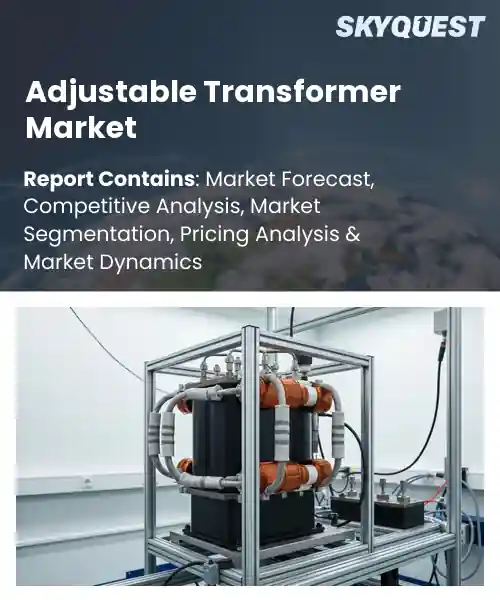
Adjustable Transformer Market
Report ID: SQMIG20D2492
Report ID: SQMIG20D2492
[email protected]
USA +1 351-333-4748
Report ID:
SQMIG20D2492 |
Region:
Global |
Published Date: February, 2026
Pages:
157
|Tables:
170
|Figures:
79


Global Adjustable Transformer Market size was valued at USD 66.40 Billion in 2024 and is poised to grow from USD 71.25 Billion in 2025 to USD 125.19 Billion by 2033, growing at a CAGR of 7.3% during the forecast period (2026-2033).
The adjustable transformer market is about equipment that changes output voltage so that the quality of power is the same across distribution systems. The main factor driving this market is the increasing demand for precise voltage regulation as distribution grids incorporate both variable power generation and sensitive electrical loads. The history of this market includes the transition from manual tap, oil-filled transformers to sophisticated on-load tap changers and digitally controlled regulators driven by industrial electrification and a greater demand for power quality. Why this matters is that reliable control of voltage prevents the failure of equipment, reduces energy loss, and allows for the use of renewable energy sources.
A decisive key trend driving the global adjustable transformer sector is the convergence of digital controls, communications and analytics, which creates measurable operational benefits and new commercial models. When utilities deploy remotely monitored, tap-changing transformers they can perform predictive maintenance, minimize outages and defer costly substation upgrades, so investment economics improve and procurement cycles accelerate. In practice this dynamic plays out where high rooftop PV penetration forces distribution operators to use adjustable transformers to stabilize voltage, and where industrial firms reduce motor failures by regulating inrush conditions; vendors gain service revenue and retrofit opportunities expand across mature and emerging grids.
How is IoT Improving Performance Monitoring in the Adjustable Transformer Market?
IoT is improving performance monitoring in the adjustable transformer market by delivering continuous, device level telemetry and smarter analytics. Key aspects are sensor based measurement of oil condition and temperature, tap changer position feedback, and nonintrusive thermal and vibration sensing. The current state shows widespread retrofits and new designs that combine edge processing with cloud analytics to enable remote diagnostics and condition based maintenance. In a market coping with aging assets and rising demand for flexible voltage control, these capabilities make monitoring more predictive and actionable. Real world instances include on load tap changer monitoring and touchless oil and thermal sensing that reduce surprise failures and support better maintenance planning.
Market snapshot - (2026-2033)
Global Market Size
USD 66.4 Billion
Largest Segment
Distribution Transformer
Fastest Growth
Specialty Transformer
Growth Rate
7.3% CAGR
To get more insights on this market click here to Request a Free Sample Report
Global adjustable transformer market is segmented by transformer type, cooling type, insulation type, phase, application, end user and region. Based on transformer type, the market is segmented into distribution transformer, power transformer, and specialty transformer. Based on cooling type, the market is segmented into air-cooled and oil-cooled. Based on insulation type, the market is segmented into dry and liquid immersed. Based on phase, the market is segmented into single phase and three phase. Based on application, the market is segmented into utility, industrial, commercial & residential, and data centers. Based on end user, the market is segmented into power utilities, industrial, commercial and residential. Based on region, the market is segmented into North America, Europe, Asia Pacific, Latin America and Middle East & Africa.
Based on the global adjustable transformer market forecast, distribution transformer segment dominates because these units are central to delivering adjustable voltage control at the last mile grid level, meeting variable load requirements and enabling localized voltage optimization. The enormous deployment of this solution over existing networks provides high levels of interoperability with retrofit technology so they are widely adopted by electric utilities and system integration professionals. Reliability focus and demand for reduced losses cause manufacturers to prioritize adjustable features in distribution models, reinforcing their leadership in the adjustable transformer market.
However, specialty transformers are emerging as the most rapidly expanding subsegment, driven by demand for customized designs for renewables integration, EV fast charging, and unconventional load profiles. Advancements in modular building and new materials can accelerate prototyping and support specific markets by drawing investors, creating new product lines, diversifying markets, and creating high-margin businesses.
Dry segment dominates because dry insulation enables safer, low maintenance adjustable transformer designs that suit dense infrastructure. With their non-flammable properties, dry insulated adjustable transformers present lesser hazards than castings and thus simplify permitting. Also, manufacturers are incorporating adjustable winding configurations and monitoring capability in dry enclosures. The easy installation process, compatibility with modular systems and fewer complexities associated with handling oil make dry insulated adjustable transformers highly favoured by both facility operators and designers.
However, Liquid Immersed is emerging as the fastest growing subsegment, propelled by optimized oil cooling enabling higher power and improved overload handling. New developments and improvements are being made with respect to the use of fluids and thermal systems in energy generation and systems, increased demand for both large-capacity generators/ transformers plus improved support to the electrical grid in its various configurations.
To get detailed segments analysis, Request a Free Sample Report
As per the global adjustable transformer market analysis, Asia Pacific leads the global adjustable transformer market due to a combination of expansive manufacturing ecosystems, concentrated demand from power intensive industries, and sustained emphasis on grid modernization. The early adoption of flexible solutions is fueled by major electronics and manufacturing clusters located in prime markets. Rapid expansion of flexible products can be accomplished in tandem with highly effective local supply chains thereby creating an environment for cost-effective scaled production. Policymakers are placing an emphasis on energy efficiency along with the inclusion and use of distributed power generation systems as the impetus for the adoption of flexible solutions throughout the utility and commercial sectors.
Adjustable transformer market in Japan is characterized by high technical standards, strong integration with precision manufacturing, and close collaboration between utilities, OEMs, and research institutions. Demand is driven by requirements for stable power in advanced industrial clusters and semiconductor fabrication facilities. Suppliers are focusing on customization, reliability, and compact design to satisfy limited space and stringent quality requirements; they also have a well-established service network that is focused on maintenance, retrofits, and integration of systems.
Adjustable transformer market in South Korea benefits from a strong electronics and heavy industry base, with close ties between manufacturers and research hubs to advance controls and power management. Rapid deployment emphasizes the key components that define product offerings in terms of their compact footprint and integration with renewable sources. This capability is enabled by a pool of qualified engineering professionals who are equipped with critical technical skills.
Rapid expansion in North America is driven by utility modernization priorities, strong demand from industrial automation and large commercial deployments, and accelerating electrification across transportation and distributed generation. Collaboration among technology companies, system integrators, and the aftermarket service and retrofit ecosystem will assist the market in delivering intelligent control capabilities and remote monitoring. A strong aftermarket and service ecosystem will be instrumental for retrofits/upgrades to existing infrastructure. Having a strong vendor base developed around modular design and interoperability will assist the market to expand. Utility procurement practices and regulatory incentives promote implementing reliable and efficient solutions and working closely with academic research facilities and emerging technology start-ups will accelerate advances in power electronics and control strategies.
Adjustable transformer market share in United States is propelled by widespread grid modernization programs, presence of large utilities, and demand from hyperscale data centers and manufacturing sectors. The focus of procurement is based on how technology will work together, be monitored from outside the building, and allow for retrofits that can be done modularly. The ability for utility companies and technology vendors to work closely with one another has created a variety of vendor options, allowing for a faster rate of adoption of new technologies.
Adjustable transformer market in Canada is shaped by a focus on reliable power delivery across remote and urban regions, integration with hydro and renewable resources, and demand from resource intensive industries. Ruggedized designs with flexible ways of controlling them have become the most important consideration to suppliers when developing and designing equipment to support long distribution networks and variable generation methods. Close collaboration between utilities and technology suppliers provides for opportunities to support the retrofitting of existing systems.
Europe is reinforcing its role in the adjustable transformer market through a concerted focus on energy efficiency, grid digitization, and harmonized technical standards that promote interoperability. Adoption of adaptable voltage management is being driven by strong industrial demand from manufacturing hubs; while ambitious renewable integration programs create a need for flexible distribution equipment, along with advanced control features. Collaborative research and development (R&D) initiatives and public/private partnerships support smart transformer technologies and digital diagnostic development. There is an emphasis on retrofit/upgrade programs for aging infrastructure, leading to significant aftermarket activity; therefore, an established engineering services sector offers complete lifecycle support. Manufacturers focus on sustainability; material efficiency; and regional production to comply with regulatory requirements and customer preferences.
Adjustable transformer market in Germany is driven by strong industrial demand from manufacturing and automotive sectors, with emphasis on energy efficiency and reliable power delivery. Controls and materials will occur when close relationships are established among equipment manufacturers, utility companies, and research institutes. An established network of engineering services exists to provide support for retrofitting, complex system integration, and full lifecycle management of industrial applications.
Adjustable transformer market trends in the United Kingdom is influenced by urban infrastructure upgrades, digitalization initiatives, and strong demand from commercial sectors. Compact design and advanced control features compatible with dense urban/DAQ environments and offering flexibility features for the overall network were highlighted as the most important supplier development criteria. A focus on retrofit programs and aftermarket diagnostics services will enhance operational efficiencies and improve the resiliency of network operations and planning.
Adjustable transformer market in France is supported by national initiatives for renewable integration and modernization of distribution networks, with emphasis on flexibility and energy efficiency. Suppliers deliver modular, scalable, and customized systems designed for deployment in urban areas with the ability to easily integrate to existing storage or smart control systems; testing programs developed through the collaborative efforts of utilities, R&D facilities, and manufacturers. Strong aftermarket support and certification systems provide users with an assurance of reliability, making it easier to adopt similar products into other networked opportunities moving forward.
To know more about the market opportunities by region and country, click here to
Buy The Complete Report
Increasing Demand for Grid Flexibility
Expansion of Renewable Energy Integration
High Upfront Costs and Investment
Regulatory Fragmentation Across Regions
Request Free Customization of this report to help us to meet your business objectives.
Competition in the global adjustable transformer market outlook centers on rapid solid state transformer commercialization, strategic acquisitions, and corporate venturing. Companies are looking to make further acquisitions such as the acquisition of SPX Transformer Solutions by Prolec GE. Companies can also make venture investments and form partnerships such as ABB's purchase of a minority interest in DG Matrix. Deep Tech spinoffs are also moving the lab-validation process for SSTs and are targeting EV charging and grid edge contracts using field deployable technology.
SkyQuest’s ABIRAW (Advanced Business Intelligence, Research & Analysis Wing) is our Business Information Services team that Collects, Collates, Correlates, and Analyses the Data collected by means of Primary Exploratory Research backed by robust Secondary Desk research.
As per SkyQuest analysis, one key driver of the global adjustable transformer industry is the rising need for grid flexibility and precise voltage regulation to integrate variable renewables and support sensitive loads, driving demand for adjustable transformers. Several factors, such as high capital costs and complex procurement processes, have been cited as barriers to adoption. The highest adoption rates are in Asia and the Pacific regions, based on the size of the manufacturing base, industrial growth and development, and advancements made through grid modernization. A second driver is the convergence of digital controls and IoT enabled monitoring that enables predictive maintenance, remote operation and new service models, improving asset economics and accelerating retrofit opportunities.
| Report Metric | Details |
|---|---|
| Market size value in 2024 | USD 66.4 Billion |
| Market size value in 2033 | USD 125.19 Billion |
| Growth Rate | 7.3% |
| Base year | 2024 |
| Forecast period | (2026-2033) |
| Forecast Unit (Value) | USD Billion |
| Segments covered |
|
| Regions covered | North America (US, Canada), Europe (Germany, France, United Kingdom, Italy, Spain, Rest of Europe), Asia Pacific (China, India, Japan, Rest of Asia-Pacific), Latin America (Brazil, Rest of Latin America), Middle East & Africa (South Africa, GCC Countries, Rest of MEA) |
| Companies covered |
|
| Customization scope | Free report customization with purchase. Customization includes:-
|
To get a free trial access to our platform which is a one stop solution for all your data requirements for quicker decision making. This platform allows you to compare markets, competitors who are prominent in the market, and mega trends that are influencing the dynamics in the market. Also, get access to detailed SkyQuest exclusive matrix.
Table Of Content
Executive Summary
Market overview
Parent Market Analysis
Market overview
Market size
KEY MARKET INSIGHTS
COVID IMPACT
MARKET DYNAMICS & OUTLOOK
Market Size by Region
KEY COMPANY PROFILES
Methodology
For the Adjustable Transformer Market, our research methodology involved a mixture of primary and secondary data sources. Key steps involved in the research process are listed below:
1. Information Procurement: This stage involved the procurement of Market data or related information via primary and secondary sources. The various secondary sources used included various company websites, annual reports, trade databases, and paid databases such as Hoover's, Bloomberg Business, Factiva, and Avention. Our team did 45 primary interactions Globally which included several stakeholders such as manufacturers, customers, key opinion leaders, etc. Overall, information procurement was one of the most extensive stages in our research process.
2. Information Analysis: This step involved triangulation of data through bottom-up and top-down approaches to estimate and validate the total size and future estimate of the Adjustable Transformer Market.
3. Report Formulation: The final step entailed the placement of data points in appropriate Market spaces in an attempt to deduce viable conclusions.
4. Validation & Publishing: Validation is the most important step in the process. Validation & re-validation via an intricately designed process helped us finalize data points to be used for final calculations. The final Market estimates and forecasts were then aligned and sent to our panel of industry experts for validation of data. Once the validation was done the report was sent to our Quality Assurance team to ensure adherence to style guides, consistency & design.
Analyst Support
Customization Options
With the given market data, our dedicated team of analysts can offer you the following customization options are available for the Adjustable Transformer Market:
Product Analysis: Product matrix, which offers a detailed comparison of the product portfolio of companies.
Regional Analysis: Further analysis of the Adjustable Transformer Market for additional countries.
Competitive Analysis: Detailed analysis and profiling of additional Market players & comparative analysis of competitive products.
Go to Market Strategy: Find the high-growth channels to invest your marketing efforts and increase your customer base.
Innovation Mapping: Identify racial solutions and innovation, connected to deep ecosystems of innovators, start-ups, academics, and strategic partners.
Category Intelligence: Customized intelligence that is relevant to their supply Markets will enable them to make smarter sourcing decisions and improve their category management.
Public Company Transcript Analysis: To improve the investment performance by generating new alpha and making better-informed decisions.
Social Media Listening: To analyze the conversations and trends happening not just around your brand, but around your industry as a whole, and use those insights to make better Marketing decisions.
REQUEST FOR SAMPLE
 REQUEST FREE CUSTOMIZATION
Global Adjustable Transformer Market size was valued at USD 66.4 Billion in 2024 and is poised to grow from USD 71.25 Billion in 2025 to USD 125.19 Billion by 2033, growing at a CAGR of 7.3% during the forecast period (2026-2033).
Competition in the global adjustable transformer market centers on rapid solid state transformer commercialization, strategic acquisitions, and corporate venturing. Incumbents pursue deals such as Prolec GE acquiring SPX Transformer Solutions. Corporates also deploy venture investments and partnerships exemplified by ABB’s minority stake in DG Matrix. Deep tech spinoffs are moving lab validated SSTs toward field deployments to capture EV charging and grid edge contracts. 'Siemens Energy', 'GE Co.', 'ABB Ltd.', 'Toshiba Corp.', 'Mitsubishi Electric Corporation', 'Schneider Electric', 'Hyundai Heavy Industries Co. Ltd.', 'Hitachi Energy Ltd.', 'Carroll & Meynell', 'Automatic Electric', 'Bharat Heavy Electricals Limited', 'Staco Energy', 'Fuji Electric Co., Ltd.', 'WEG', 'LS Electric Co., Ltd.', 'SGB-SMIT Group', 'ISE, Inc', 'Voltamp Transformers Ltd', 'TBEA Co. Ltd', 'Hyosung Heavy Industries'
Rapid increase in variable generation from renewables has elevated the need for adaptable voltage regulation and dynamic load management, making adjustable transformers essential to modern power systems. Utilities and grid operators seek solutions that provide smoother integration of intermittent resources, improved power quality, and reduced reliance on manual tap changes. This demand encourages investment in devices that enable real time adjustments, support distribution automation, and enhance network resilience, thereby expanding procurement and deployment of adjustable transformer technologies across transmission and distribution networks seeking greater operational flexibility and reliability.
Smart Grid Integration: Adjustable transformers are increasingly pivotal to grid architectures as operators prioritize flexibility and resilience. Their ability to respond to variable distributed generation and power flows supports voltage stability and facilitates integration of renewable resources. Integration with advanced grid control systems and communications protocols enables dynamic voltage regulation, congestion management, and improved asset coordination across feeders. This trend drives demand for interoperable designs, enhanced monitoring capabilities, and partnerships transformer makers, system integrators, and grid operators focused on deployment and operational visibility.
As per the global adjustable transformer market analysis, Asia Pacific leads the global adjustable transformer market due to a combination of expansive manufacturing ecosystems, concentrated demand from power intensive industries, and sustained emphasis on grid modernization.


Want to customize this report? This report can be personalized according to your needs. Our analysts and industry experts will work directly with you to understand your requirements and provide you with customized data in a short amount of time. We offer $1000 worth of FREE customization at the time of purchase.
Feedback From Our Clients


 USA (+1) 351-333-4748

