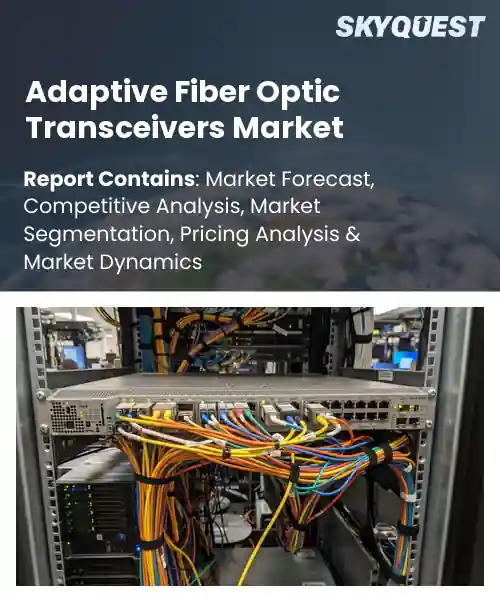
Adaptive Fiber Optic Transceivers Market
Report ID: SQMIG45H2318
Report ID: SQMIG45H2318
[email protected]
USA +1 351-333-4748
Report ID:
SQMIG45H2318 |
Region:
Global |
Published Date: August, 2026
Pages:
157
|Tables:
120
|Figures:
77


Global Adaptive Fiber Optic Transceivers Market size was valued at USD 2.61 Billion in 2024 and is poised to grow from USD 3.01 Billion in 2025 to USD 9.48 Billion by 2033, growing at a CAGR of 15.4% during the forecast period (2026-2033).
Adaptive fiber optic transceivers convert electrical signals into light and automatically adjust wavelength, data rate, and reach to suit network conditions, delivering high‑capacity links. The market has become a cornerstone of data‑center interconnects, telecom backbones, and enterprise campuses because it simplifies inventory while meeting soaring bandwidth needs. Its relevance surged with cloud computing, 5G rollout, and hyperscale data‑center growth, compelling operators to replace rigid, fixed‑rate modules with flexible alternatives. Early adopters in the late 2010s used static transceivers; the 2020 launch of programmable DSP chips enabled speed upgrades without hardware changes, shifting the market from niche to mainstream global infrastructure. The dominant growth catalyst now stems from the convergence of artificial‑intelligence workloads and edge‑computing deployments, both of which require ultra‑low latency and adaptable bandwidth. As AI models expand, hyperscale operators deploy transceivers that switch between 100 Gbps and 400 Gbps modes, avoiding over‑provisioning while preserving inference performance. Telecom firms launching 5G‑enabled edge sites use adaptive modules to match backhaul capacity with traffic bursts, converting idle links into revenue streams. This cause‑and‑effect pressure pushes vendors toward silicon‑photonic integration, cutting power use and cost, and opening opportunities in autonomous vehicles and smart‑factory IoT. The flexible hardware and network ecosystem therefore promises growth to 2030.
How is AI-driven automation influencing the Adaptive fiber optic transceivers market?
AI‑driven automation is reshaping adaptive fiber optic transceivers by embedding intelligent control loops that continuously tune signal parameters for optimal performance. Machine‑learning algorithms analyze traffic patterns and environmental conditions, allowing transceivers to adjust wavelength allocation and power levels without manual intervention. This reduces latency, improves reliability, and shortens deployment cycles as operators can roll out upgrades remotely. Vendors are integrating AI modules directly into silicon photonics, enabling real‑time diagnostics and predictive maintenance. The trend is accelerating as data centers and telecom networks demand higher bandwidth and tighter energy budgets, making self‑optimizing transceivers a strategic advantage.Optics.org, July 2026, highlighted a new AI‑enabled adaptive transceiver released by a leading optics supplier, demonstrating how automated tuning cuts provisioning time and supports the market’s rapid expansion.
Market snapshot - (2026-2033)
Global Market Size
USD 2.61 Billion
Largest Segment
SFP
Fastest Growth
QSFP-DD
Growth Rate
15.4% CAGR
To get more insights on this market click here to Request a Free Sample Report
Global adaptive fiber optic transceivers market is segmented by form factor, data rate, transmission distance, application and region. Based on form factor, the market is segmented into SFP, SFP+, QSFP, QSFP-DD and CFP. Based on data rate, the market is segmented into Up to 10 Gbps, 25–100 Gbps and Above 100 Gbps. Based on transmission distance, the market is segmented into Short Range, Medium Range and Long Range. Based on application, the market is segmented into Data Centers, Telecommunications, Enterprise Networks and Industrial Networks. Based on region, the market is segmented into North America, Europe, Asia Pacific, Latin America and Middle East & Africa.
SFP+ segment dominates because its compact size and cost efficiency align perfectly with the escalating demand for high‑density ports in modern data center racks. The form factor’s hot‑plug capability simplifies deployment, while its compatibility with existing optical modules reduces inventory complexity. These attributes drive operators to prefer SFP+ for scalable interconnects, cementing its leading position in the adaptive fiber optic transceivers market. Furthermore, its mature ecosystem of vendors ensures reliable supply and continuous performance improvements.
Meanwhile, QSFP-DD segment emerges as the most rapidly expanding form factor as network architects target petabit‑scale architectures that demand higher lane counts. Its ability to support multiple wavelengths and greater bandwidth per module fuels adoption for next‑generation aggregation and hyperscale deployments, propelling market expansion and new design opportunities.
25–100 Gbps segment dominates because it strikes a balance between performance and affordability, meeting the majority of current bandwidth requirements for enterprise and telecom backbones. This range leverages mature modulation schemes and readily available silicon photonics, enabling manufacturers to produce cost‑effective transceivers at scale. The optimal trade‑off drives widespread adoption, making it the cornerstone of today's adaptive fiber optic transceiver deployments across diverse network topologies and service provider ecosystems and long‑term upgrade paths.
On the other hand, Above 100 Gbps segment is witnessing the strongest growth momentum as hyperscale data centers and 5G core networks push for terabit‑level throughput. Advances in coherent detection and integrated photonic chips are lowering cost barriers, encouraging early adopters to deploy ultra‑high‑speed links. This surge fuels broader market expansion and catalyzes new application scenarios.
To get detailed segments analysis, Request a Free Sample Report
Asia Pacific leads the adaptive fiber optic transceivers market due to a confluence of high technology adoption, robust telecommunications infrastructure, and intensive investment in next‑generation networking. The region benefits from a dense concentration of research institutions and manufacturers that accelerate product innovation and drive cost efficiencies. Government policies encouraging digital transformation and high‑speed connectivity create a fertile environment for widespread deployment across data centers, enterprise networks, and emerging 5G ecosystems. Customer demand for flexible, energy‑efficient transceiver solutions further reinforces market momentum, while collaborative ecosystems among OEMs, component suppliers, and service providers enable rapid scaling. These dynamics collectively position Asia Pacific as the primary engine of growth and technological leadership in the adaptive transceiver space. The synergistic blend of manufacturing depth and market demand sustains a competitive advantage that outpaces other regions.
Adaptive Fiber Optic Transceivers Market in Japan is propelled by a strong focus on high‑performance networking for advanced manufacturing and financial services. Local players benefit from close collaboration with chipset designers, fostering integration of novel modulation techniques. Government incentives for smart city projects amplify deployment in urban infrastructure, while demand from data‑center operators reinforces volume growth. The ecosystem emphasis on reliability and low latency aligns with Japan precision‑driven industry standards.
Adaptive Fiber Optic Transceivers Market in South Korea thrives on a vibrant ecosystem that merges strong semiconductor expertise with aggressive broadband rollout. Leading domestic firms leverage advanced materials research to enhance transceiver bandwidth and power efficiency. Public‑private initiatives accelerate the adoption of high‑capacity links in smart manufacturing and autonomous vehicle trials. The focus on open standards and cross‑border collaboration positions South Korea as a catalyst for next‑generation optical networking solutions.
North America experiences rapid expansion of the adaptive fiber optic transceivers market driven by a confluence of high‑value data traffic, widespread cloud adoption, and aggressive network modernization by service providers. The United States and Canada host a dense concentration of technology innovators who prioritize modular, software‑controlled transceiver architectures that enable flexible capacity scaling. Strong investment in edge computing and artificial intelligence workloads fuels demand for low‑latency, high‑throughput optical links. Collaborative frameworks between telecom operators, equipment manufacturers, and research institutions accelerate the integration of emerging modulation formats. Additionally, regulatory encouragement for open‑access infrastructure and sustainability goals underpins the shift toward energy‑efficient transceiver solutions, cementing the region’s leadership in market momentum.
Adaptive Fiber Optic Transceivers Market in United States is shaped by data‑center proliferation and an ecosystem of silicon‑photonic innovators. Enterprises prioritize dynamic bandwidth provisioning to support cloud services, high‑frequency trading, and immersive media delivery. Strategic partnerships between carriers and component vendors accelerate rollout of reconfigurable optical transport networks. Government initiatives encouraging resilient broadband and the emphasis on low‑power solutions further reinforce market depth and technological advancement across multiple industry verticals.
Adaptive Fiber Optic Transceivers Market in Canada benefits from a collaborative research landscape and focus on digital connectivity across northern and urban regions. Providers seek scalable transceiver designs to meet the bandwidth needs of education, tele‑health, and resource‑intensive mining operations. Partnerships between universities, government labs, and equipment manufacturers accelerate prototyping of energy‑saving optical modules. The policy emphasis on climate‑responsible networking drives adoption of adaptive solutions that align with sustainability objectives.
Europe is strengthening its position in the adaptive fiber optic transceivers market through a strategic blend of standards leadership, deep research collaboration, and sustainability‑driven design. The region’s commitment to open‑interface specifications facilitates interoperability and accelerates vendor adoption across a wide array of telecom operators and enterprise users. Major research programs integrate photonic integration with silicon platforms, driving performance gains while reducing power consumption. Strong policy frameworks that prioritize green networking encourage the development of energy‑efficient transceiver modules. Coupled with a mature manufacturing base and a focus on secure, high‑capacity links for critical infrastructure, Europe leverages its technical expertise and regulatory influence to reinforce its competitive edge globally.
Adaptive Fiber Optic Transceivers Market in Germany is propelled by a backbone that demands reliable optical links for automation, automotive and rail. German manufacturers work with research institutes to embed modulation and photonic circuits into transceiver designs. Government initiatives supporting Industry four zero encourage adoption of flexible optical components. The focus on energy efficiency and quality standards cements Germany holding a position as an innovator in adaptive optical networking solutions.
Adaptive Fiber Optic Transceivers Market in United Kingdom is fueled by a telecom sector and strong academic‑industry partnerships focused on photonic integration. Operators seek reconfigurable transceiver platforms to support dense wavelength division multiplexing across metropolitan and regional networks. Research hubs collaborate with manufacturers to embed machine‑learning driven performance tuning, enhancing link agility. Sustainability programs prioritize low‑power designs, positioning the United Kingdom as a hub for innovative, energy‑efficient optical networking solutions.
Adaptive Fiber Optic Transceivers Market in France benefits from a strong emphasis on research excellence and government digital infrastructure programs. French carriers adopt adaptive transceiver modules to improve capacity and resilience of backbone networks. Collaboration between universities and optical component firms drives integration of silicon photonics with error‑correction techniques. The drive toward greener networking encourages development of low‑power transceivers, reinforcing France reputation as a pioneer in sustainable optical communication solutions.
To know more about the market opportunities by region and country, click here to
Buy The Complete Report
Increasing Data Center Demand
Advancements In Photonic Integration
High Initial Capital Expenditure
Complex Interoperability Standards
Request Free Customization of this report to help us to meet your business objectives.
The adaptive fiber optic transceiver market is shaped by intense competition as vendors accelerate M&A, forge strategic partnerships with cloud service providers, and push rapid tech innovation such as AI‑driven signal optimization; Innolight’s recent alliance with a leading U.S. cloud operator and Eoptolink’s acquisition of a silicon photonics design firm exemplify how players are securing market share while addressing bandwidth demands and cost pressures.
Top Player’s Company Profile
Recent Developments
SkyQuest’s ABIRAW (Advanced Business Intelligence, Research & Analysis Wing) is our Business Information Services team that Collects, Collates, Correlates, and Analyses the Data collected by means of Primary Exploratory Research backed by robust Secondary Desk research. As per SkyQuest analysis, the surging demand from hyperscale data centers is a key driver pushing adoption of adaptive fiber optic transceivers, and breakthroughs in photonic integration serve as a second driver by cutting power use and enabling denser link packing. High upfront capital expenditure remains the main restraint, causing some operators to delay upgrades. Asia Pacific dominates the market thanks to strong manufacturing bases and aggressive 5G and cloud investments, while the SFP+ form factor leads in volume because of its compact size and cost efficiency for data‑center racks. Together these forces shape a market projected to grow at roughly fifteen percent annually through 2033.
| Report Metric | Details |
|---|---|
| Market size value in 2024 | USD 2.61 Billion |
| Market size value in 2033 | USD 9.48 Billion |
| Growth Rate | 15.4% |
| Base year | 2024 |
| Forecast period | (2026-2033) |
| Forecast Unit (Value) | USD Billion |
| Segments covered |
|
| Regions covered | North America (US, Canada), Europe (Germany, France, United Kingdom, Italy, Spain, Rest of Europe), Asia Pacific (China, India, Japan, Rest of Asia-Pacific), Latin America (Brazil, Rest of Latin America), Middle East & Africa (South Africa, GCC Countries, Rest of MEA) |
| Companies covered |
|
| Customization scope | Free report customization with purchase. Customization includes:-
|
To get a free trial access to our platform which is a one stop solution for all your data requirements for quicker decision making. This platform allows you to compare markets, competitors who are prominent in the market, and mega trends that are influencing the dynamics in the market. Also, get access to detailed SkyQuest exclusive matrix.
Table Of Content
Executive Summary
Market overview
Parent Market Analysis
Market overview
Market size
KEY MARKET INSIGHTS
COVID IMPACT
MARKET DYNAMICS & OUTLOOK
Market Size by Region
KEY COMPANY PROFILES
Methodology
For the Adaptive Fiber Optic Transceivers Market, our research methodology involved a mixture of primary and secondary data sources. Key steps involved in the research process are listed below:
1. Information Procurement: This stage involved the procurement of Market data or related information via primary and secondary sources. The various secondary sources used included various company websites, annual reports, trade databases, and paid databases such as Hoover's, Bloomberg Business, Factiva, and Avention. Our team did 45 primary interactions Globally which included several stakeholders such as manufacturers, customers, key opinion leaders, etc. Overall, information procurement was one of the most extensive stages in our research process.
2. Information Analysis: This step involved triangulation of data through bottom-up and top-down approaches to estimate and validate the total size and future estimate of the Adaptive Fiber Optic Transceivers Market.
3. Report Formulation: The final step entailed the placement of data points in appropriate Market spaces in an attempt to deduce viable conclusions.
4. Validation & Publishing: Validation is the most important step in the process. Validation & re-validation via an intricately designed process helped us finalize data points to be used for final calculations. The final Market estimates and forecasts were then aligned and sent to our panel of industry experts for validation of data. Once the validation was done the report was sent to our Quality Assurance team to ensure adherence to style guides, consistency & design.
Analyst Support
Customization Options
With the given market data, our dedicated team of analysts can offer you the following customization options are available for the Adaptive Fiber Optic Transceivers Market:
Product Analysis: Product matrix, which offers a detailed comparison of the product portfolio of companies.
Regional Analysis: Further analysis of the Adaptive Fiber Optic Transceivers Market for additional countries.
Competitive Analysis: Detailed analysis and profiling of additional Market players & comparative analysis of competitive products.
Go to Market Strategy: Find the high-growth channels to invest your marketing efforts and increase your customer base.
Innovation Mapping: Identify racial solutions and innovation, connected to deep ecosystems of innovators, start-ups, academics, and strategic partners.
Category Intelligence: Customized intelligence that is relevant to their supply Markets will enable them to make smarter sourcing decisions and improve their category management.
Public Company Transcript Analysis: To improve the investment performance by generating new alpha and making better-informed decisions.
Social Media Listening: To analyze the conversations and trends happening not just around your brand, but around your industry as a whole, and use those insights to make better Marketing decisions.
REQUEST FOR SAMPLE
 REQUEST FREE CUSTOMIZATION


Want to customize this report? This report can be personalized according to your needs. Our analysts and industry experts will work directly with you to understand your requirements and provide you with customized data in a short amount of time. We offer $1000 worth of FREE customization at the time of purchase.
Feedback From Our Clients


 USA (+1) 351-333-4748

