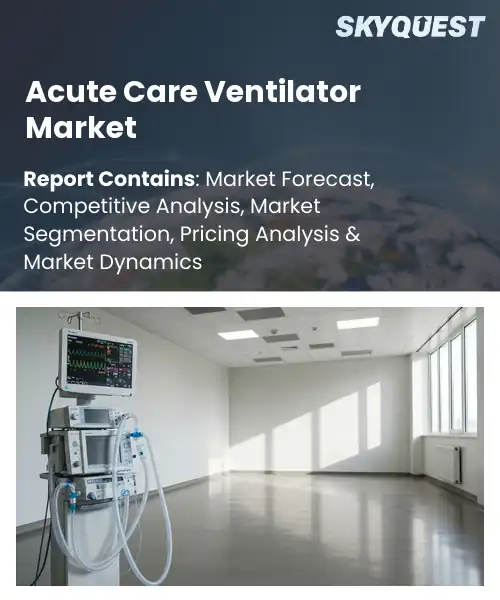
Acute Care Ventilator Market
Report ID: SQMIG35A4149
Report ID: SQMIG35A4149
[email protected]
USA +1 351-333-4748
Report ID:
SQMIG35A4149 |
Region:
Global |
Published Date: July, 2026
Pages:
157
|Tables:
119
|Figures:
77


Global Acute Care Ventilator Market size was valued at USD 2.81 Billion in 2024 and is poised to grow from USD 2.96 Billion in 2025 to USD 4.48 Billion by 2033, growing at a CAGR of 5.31% during the forecast period (2026-2033).
Acute care ventilators are complex respiratory support devices that are used in intensive care units, emergency departments and operating rooms to support patients with critical respiratory dysfunction. The market is an essential component of modern critical care, because of its direct impact on mortality outcomes and the allocation of hospital resources. The demand has always been high, peaked at the time of the 2009 H1N1 pandemic, plateaued, and then spiked again at the time of the COVID-19 pandemic, revealing supply chain vulnerabilities and prompting significant purchasing efforts. Manufacturers ramped up production and added digital monitoring while regulators fast-tracked them, shifting market dynamics and turning ventilators into essential hospital infrastructure across the globe today.
Connectivity and analytics are transforming the ventilator market by creating machines as networked health-information nodes. Clinicians can now remotely monitor parameters, tweak settings on the fly, and receive algorithmic alerts that warn of impending failure, reducing ICU stays and cutting costs. European hospitals that moved to cloud platforms experienced a significant drop in ventilator-associated pneumonia by pooling data from different wards. This means bigger contracts for manufacturers of interoperable software and greater efficiency for providers. This feedback loop increases demand for smart ventilators and drives continuous innovation across the sector. Emerging markets are also investing a lot to find resilient respiratory solutions.
How is AI-driven Automation Reshaping The Acute Care Ventilator Market?
AI-driven automation is transforming acute-care ventilators into smart platforms that track patient breathing patterns in real-time and adjust support without human intervention. Machine‐learning algorithms analyze waveform data to predict deteriorations and raise alarms to enable clinicians to focus on critical decisions. Integrated cloud services enable remote monitoring, hospital-wide data aggregation, and fast software updates that improve safety and performance. Manufacturers integrate predictive maintenance tools to signal wear and tear on components prior to failure, lowering downtime and service costs. The result is a more responsive, efficient care environment where technology complements human expertise and helps hospitals manage the rising demand for respiratory support.
Market snapshot - (2026-2033)
Global Market Size
USD 2.81 Billion
Largest Segment
Invasive Ventilators
Fastest Growth
Non-Invasive Ventilators
Growth Rate
5.31% CAGR
To get more insights on this market click here to Request a Free Sample Report
Global acute care ventilator market is segmented by product type, modality, patient demographics, end user and region. Based on product type, the market is segmented into Invasive Ventilators, Non-Invasive Ventilators and High-Frequency Ventilators. Based on modality, the market is segmented into Standalone Ventilators and Portable Ventilators. Based on patient demographics, the market is segmented into Adult Patients, Pediatric Patients, Neonatal Patients and Infant Patients. Based on end user, the market is segmented into Hospitals, Intensive Care Units, Emergency Medical Services, Ambulatory Care Centers and Others. Based on region, the market is segmented into North America, Europe, Asia Pacific, Latin America and Middle East & Africa.
Invasive ventilators segment is holding a dominant position as it directly caters to the critical respiratory support requirements of severely ill patients in intensive care settings providing exact control over tidal volume and pressure. It is effective in the management of acute respiratory distress, trauma, and postoperative complications and is used by clinicians because it works. Its robustness, large clinical data and integration with hospital monitoring systems further consolidate its preference. It is the mainstay of acute care ventilation solutions.
The fastest growing segment is ventilators, as they provide ultra small tidal volumes at very high frequency, thus reducing ventilator-induced lung injury, and are attractive to neonatal and pediatric specialists. Ongoing research, miniaturization of devices and increasing focus on lung-protective ventilation are likely to create new opportunities in the market, which is driving the adoption of the market.
Standalone ventilators are the most prevalent type of ventilators in the market, thanks to their comprehensive and integrated respiratory support that can be directly installed within fixed clinical infrastructures, ensuring uninterrupted power supply and full feature sets. Integration with sophisticated monitoring platforms enables clinicians to modify ventilation parameters in real time, helping with the management of complex cases such as severe ARDS and multi-organ failure. Reliability, comprehensive alarm systems and extensive clinical validation underpin their central role in the acute care setting.
Portable ventilators are witnessing the strongest growth momentum on the back of their lightweight design and battery operation enabling for quick deployment in pre‑hospital settings and during inter‑facility transfers. As intuitive user interfaces and wireless connectivity get better, their usefulness is expanding beyond emergencies and drawing in ambulatory care providers, creating new service models that are driving market growth.
To get detailed segments analysis, Request a Free Sample Report
North America remains at the forefront, due to sophisticated clinical ecosystems, big spending on medical innovation and a regulatory environment that accelerates product introductions. "The area has a deep pool of research institutions and top original equipment manufacturers that continue to upgrade technology. Reimbursement models align well with high-value care driving hospitals to adopt advanced ventilator solutions. And integrated supply chains and solid training programs allow new devices to be quickly introduced to a wide network of acute care facilities, further cementing market leadership.
The acute care ventilator market in the United States is driven by a high concentration of teaching hospitals and a culture of rapid technology adoption. Strong industry-research institute cooperation speeds up product development, and supportive policy incentives favor broad clinical application. The large hospital terrain opens doors for a range of use cases, from ICU and emergency response to healthcare, fostering a resilient demand environment which drives the market forward.
Acute Care Ventilator Market in Canada is driven by a universal health system that promotes cost effective, evidence based solutions. The provincial health authorities are focused on getting the most value for money spent and advocate for the use of technologies that have been proven to be effective, as part of a procurement strategy that ensures fiscal responsibility. Incremental improvements are driven through collaborative research initiatives between hospitals and manufacturers with a focus on patient safety and rigorous assessment before deployment. This structured approach helps grow the market consistently across the nation’s acute care facilities.
Europe experiences rapid expansion driven by harmonized regulatory standards, strong public health commitments, and a growing emphasis on patient outcomes across member states. Collaborative research programs foster cross‑border innovation, while reimbursement models increasingly reward advanced respiratory support. Health systems are modernizing infrastructure, integrating digital monitoring and AI‑assisted management, which fuels demand for next‑generation ventilators. Additionally, strategic government investments and public‑private partnerships accelerate adoption in both established and emerging clinical settings, positioning Europe as a dynamic growth arena.
Acute Care Ventilator Market in Germany benefits from a legacy of engineering excellence and stringent quality certifications that instill confidence among clinicians. Hospital networks prioritize interoperable solutions that align with robust digital health frameworks, encouraging upgrades to sophisticated ventilator platforms. Strong collaboration between manufacturers and research hospitals drives continual refinement of device performance, while reimbursement policies support adoption of high‑efficacy technologies across intensive care environments.
Acute Care Ventilator Market in the United Kingdom is propelled by swift integration within national health service initiatives that champion modernization of critical care equipment. Emphasis on scalable, data‑rich ventilators aligns with broader digital health strategies, facilitating real‑time patient monitoring. Rapid procurement pathways and focused clinical guidelines accelerate uptake, while ongoing training programs ensure staff proficiency, reinforcing the market’s fast‑moving trajectory.
Acute Care Ventilator Market in France is emerging as a focal point for expansion, supported by governmental incentives that encourage adoption of innovative respiratory devices. Hospital groups are increasingly exploring portable and hybrid ventilator solutions to enhance care continuity beyond traditional settings. Collaborative efforts between academic centers and industry aim to tailor technologies to local clinical practices, fostering a fertile environment for market development.
Asia Pacific is strengthening its position through a blend of demographic pressures, governmental health agendas, and accelerated technology transfer. An aging population combined with rising prevalence of respiratory conditions fuels heightened demand for reliable ventilatory support. National strategies emphasize domestic manufacturing capabilities and the integration of smart features, positioning the region as a hub for cost‑effective yet advanced solutions. Partnerships between global OEMs and local firms expedite knowledge sharing, while expanding hospital infrastructure across emerging economies broadens market reach and consolidates regional influence.
Acute Care Ventilator Market in Japan is driven by a demographic shift toward a larger elderly cohort that necessitates sophisticated respiratory care. Domestic manufacturers focus on miniaturization and precision engineering, delivering devices that align with high clinical standards. Hospital systems emphasize seamless integration with electronic health records, enabling comprehensive patient monitoring. Governmental support for innovative health technologies further bolsters market momentum, fostering a climate of continual advancement.
Acute Care Ventilator Market in South Korea advances through aggressive adoption of smart medical technologies and strong policy backing for health tech development. Manufacturers prioritize connectivity and AI‑enabled functionalities that cater to fast‑paced clinical environments. Hospitals invest in state‑of‑the‑art intensive care units, encouraging rapid turnover of legacy equipment. Collaborative research initiatives between universities and industry accelerate the translation of cutting‑edge innovations into market‑ready ventilator solutions.
To know more about the market opportunities by region and country, click here to
Buy The Complete Report
Rising Demand for Respiratory Support
Technological Advancements Enhancing Portability
Stringent Regulatory Approval Processes
High Capital Expenditure Requirements
Request Free Customization of this report to help us to meet your business objectives.
The acute‑care ventilator market is intensely competitive, with manufacturers accelerating product differentiation through single‑use designs, AI‑driven monitoring, and rapid regulatory approvals; firms are pursuing strategic partnerships with hospital networks and leveraging M&A to broaden their device portfolios, exemplified by recent capital infusions that enable faster market entry and scale‑up of innovative ventilator technologies.
SkyQuest’s ABIRAW (Advanced Business Intelligence, Research & Analysis Wing) is our Business Information Services team that Collects, Collates, Correlates, and Analyses the Data collected by means of Primary Exploratory Research backed by robust Secondary Desk research.
As per SkyQuest analysis, the global acute care ventilator market is driven primarily by rising demand for respiratory support as aging populations and acute illnesses increase hospital inventories. A second driver is rapid technological advancement that makes ventilators lighter, AI‑enabled and cloud‑connected, boosting portability and clinical efficiency. Stringent regulatory approval processes act as a restraint, adding time and cost for new product launches. North America remains the dominating region due to strong research ecosystems and well‑aligned reimbursement, while invasive ventilators dominate the product‑type segment due to their proven efficacy in critical care.
| Report Metric | Details |
|---|---|
| Market size value in 2024 | USD 2.81 Billion |
| Market size value in 2033 | USD 4.48 Billion |
| Growth Rate | 5.31% |
| Base year | 2024 |
| Forecast period | (2026-2033) |
| Forecast Unit (Value) | USD Billion |
| Segments covered |
|
| Regions covered | North America (US, Canada), Europe (Germany, France, United Kingdom, Italy, Spain, Rest of Europe), Asia Pacific (China, India, Japan, Rest of Asia-Pacific), Latin America (Brazil, Rest of Latin America), Middle East & Africa (South Africa, GCC Countries, Rest of MEA) |
| Companies covered |
|
| Customization scope | Free report customization with purchase. Customization includes:-
|
To get a free trial access to our platform which is a one stop solution for all your data requirements for quicker decision making. This platform allows you to compare markets, competitors who are prominent in the market, and mega trends that are influencing the dynamics in the market. Also, get access to detailed SkyQuest exclusive matrix.
Table Of Content
Executive Summary
Market overview
Parent Market Analysis
Market overview
Market size
KEY MARKET INSIGHTS
COVID IMPACT
MARKET DYNAMICS & OUTLOOK
Market Size by Region
KEY COMPANY PROFILES
Methodology
For the Acute Care Ventilator Market, our research methodology involved a mixture of primary and secondary data sources. Key steps involved in the research process are listed below:
1. Information Procurement: This stage involved the procurement of Market data or related information via primary and secondary sources. The various secondary sources used included various company websites, annual reports, trade databases, and paid databases such as Hoover's, Bloomberg Business, Factiva, and Avention. Our team did 45 primary interactions Globally which included several stakeholders such as manufacturers, customers, key opinion leaders, etc. Overall, information procurement was one of the most extensive stages in our research process.
2. Information Analysis: This step involved triangulation of data through bottom-up and top-down approaches to estimate and validate the total size and future estimate of the Acute Care Ventilator Market.
3. Report Formulation: The final step entailed the placement of data points in appropriate Market spaces in an attempt to deduce viable conclusions.
4. Validation & Publishing: Validation is the most important step in the process. Validation & re-validation via an intricately designed process helped us finalize data points to be used for final calculations. The final Market estimates and forecasts were then aligned and sent to our panel of industry experts for validation of data. Once the validation was done the report was sent to our Quality Assurance team to ensure adherence to style guides, consistency & design.
Analyst Support
Customization Options
With the given market data, our dedicated team of analysts can offer you the following customization options are available for the Acute Care Ventilator Market:
Product Analysis: Product matrix, which offers a detailed comparison of the product portfolio of companies.
Regional Analysis: Further analysis of the Acute Care Ventilator Market for additional countries.
Competitive Analysis: Detailed analysis and profiling of additional Market players & comparative analysis of competitive products.
Go to Market Strategy: Find the high-growth channels to invest your marketing efforts and increase your customer base.
Innovation Mapping: Identify racial solutions and innovation, connected to deep ecosystems of innovators, start-ups, academics, and strategic partners.
Category Intelligence: Customized intelligence that is relevant to their supply Markets will enable them to make smarter sourcing decisions and improve their category management.
Public Company Transcript Analysis: To improve the investment performance by generating new alpha and making better-informed decisions.
Social Media Listening: To analyze the conversations and trends happening not just around your brand, but around your industry as a whole, and use those insights to make better Marketing decisions.
REQUEST FOR SAMPLE
 REQUEST FREE CUSTOMIZATION
Global Acute Care Ventilator Market size was valued at USD 2.81 Billion in 2024 and is poised to grow from USD 2.96 Billion in 2025 to USD 4.48 Billion by 2033, growing at a CAGR of 5.31% during the forecast period (2026-2033).
The acute‑care ventilator market is intensely competitive, with manufacturers accelerating product differentiation through single‑use designs, AI‑driven monitoring, and rapid regulatory approvals; firms are pursuing strategic partnerships with hospital networks and leveraging M&A to broaden their device portfolios, exemplified by recent capital infusions that enable faster market entry and scale‑up of innovative ventilator technologies. 'Getinge AB', 'Drägerwerk AG & Co. KGaA', 'Koninklijke Philips N.V.', 'Medtronic plc', 'GE HealthCare Technologies Inc.', 'Hamilton Medical AG', 'Air Liquide S.A.', 'ResMed Inc.', 'Fisher & Paykel Healthcare Corporation Limited', 'Smiths Group plc', 'Asahi Kasei Corporation', 'Nihon Kohden Corporation', 'WEINMANN Emergency Medical Technology GmbH + Co. KG', 'Skanray Technologies Ltd.', 'Mindray Medical International Limited', 'Lowenstein Medical Technology GmbH + Co. KG', 'Airon Mindray Medical', 'Bunnell Incorporated', 'Tecme S.A.', 'ACUTRONIC Medical Systems AG'
The growing incidence of acute respiratory conditions, coupled with an expanding elderly population, drives hospitals to increase their inventory of acute care ventilators. Facilities are compelled to ensure rapid response capabilities during surges, prompting procurement of versatile devices that can support diverse patient needs. This heightened readiness stimulates manufacturers to expand production lines and innovate product features, reinforcing market expansion as providers prioritize reliable and scalable respiratory support solutions and to meet evolving clinical protocols, hospitals also seek integrated monitoring and data analytics capabilities.
Integrated Telehealth Solutions: Healthcare providers are increasingly adopting telehealth platforms that integrate directly with acute care ventilators, enabling clinicians to monitor ventilation parameters remotely and adjust settings in real time. This connectivity reduces bedside exposure, supports decision‑making, and extends expertise to underserved hospitals. Seamless data exchange also feeds predictive analytics, allowing early identification of patient deterioration. As reimbursement models evolve to reward virtual oversight, manufacturers are embedding secure communication protocols and user‑friendly interfaces, making remote ventilator management a cornerstone of acute care strategies.
Why does North America Dominate the Global Acute Care Ventilator Market? |@12


Want to customize this report? This report can be personalized according to your needs. Our analysts and industry experts will work directly with you to understand your requirements and provide you with customized data in a short amount of time. We offer $1000 worth of FREE customization at the time of purchase.
Feedback From Our Clients


 USA (+1) 351-333-4748

