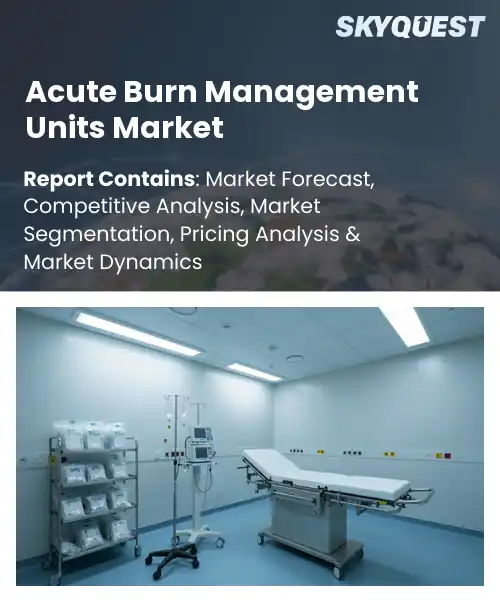
Acute Burn Management Units Market
Report ID: SQMIG35B2289
Report ID: SQMIG35B2289
[email protected]
USA +1 351-333-4748
Report ID:
SQMIG35B2289 |
Region:
Global |
Published Date: February, 2026
Pages:
157
|Tables:
87
|Figures:
76


Global Acute Burn Management Units Market size was valued at USD 1.3 Billion in 2024 and is poised to grow from USD 1.4 Billion in 2025 to USD 2.47 Billion by 2033, growing at a CAGR of 7.4% during the forecast period (2026-2033).
The global acute burn management units market growth is driven by the rising incidence of severe burns combined with improvements in trauma care that increase survival and therefore require specialist inpatient services. This market covers hospitals, dedicated burn centers, modular intensive care units and the consumables and devices that support acute management such as advanced dressings and skin substitutes. It matters because timely specialist intervention reduces mortality, limits scarring and shortens rehabilitation, which in turn lowers long term socioeconomic burdens. Over the last two decades the field shifted from general surgical wards to multidisciplinary burn units, exemplified by investments in high volume centers in India after major industrial fires.
A decisive growth factor is technological innovation in wound care and critical care infrastructure because better therapies reduce morbidity and justify capital investment by hospitals and governments. For example adoption of bioengineered skin substitutes and advanced dressings lowers graft failure and shortens intensive care stays, prompting tertiary centers in developed markets to expand dedicated burn unit capacity. Telehealth and mobile triage provide quick access to specialist input for remote accidents, permitting quicker transfers to and through greater volume through specialized units. Additionally, due to industrial accidents, there has been both an increase in public funding and clinician capacity building through training programs resulting in creating an opportunity for suppliers worldwide.
How is AI Improving Patient Outcomes in the Acute Burn Management Units Market?
The use of AI technology when providing care to individuals with burns, has significantly changed the outcomes for patients with burn injuries through improved diagnosis, treatment plans, monitoring, and workflow. Specific areas of improvement include automated imaging for assessing depth and total body surface area of burns as well as predictive models that identify wounds that are unlikely to heal. Furthermore, AI-assisted decision support systems will aid clinicians in making decisions on dressing strategies and grafting strategies. Current moves within the marketplace are away from subjective assessments of burns towards standardized AI assisted tools that will increase the speed of triage and decrease variability among clinicians. Providers time and again report more effective surgical care plans and improved consistency in post-operative care based on use of telemedicine and imaging combined.
Spectral AI in May 2025 reported leadership and regulatory progress tied to its DeepView AI platform, and this development highlights how rapid AI driven diagnostics can support acute burn units by improving triage accuracy and operational efficiency, which helps drive market adoption and better patient outcomes.
Market snapshot - 2026-2033
Global Market Size
USD 1.3 Billion
Largest Segment
Burn Dressings
Fastest Growth
Burn Dressings
Growth Rate
7.4% CAGR
To get more insights on this market click here to Request a Free Sample Report
Global acute burn management units market is segmented by product types, treatment methods, end users and region. Based on product types, the market is segmented into burn dressings and burn ointments. Based on treatment methods, the market is segmented into topical treatments and surgical interventions. Based on end users, the market is segmented into hospitals and home care settings. Based on region, the market is segmented into North America, Europe, Asia Pacific, Latin America and Middle East & Africa.
Based on the global acute burn management units market forecast, burn dressings segment dominates because burn dressings form the primary interface between the wound and clinical care in acute burn units, providing moisture balance, barrier protection, and simplified monitoring that align with treatment protocols. As they’re adaptable for many types of wounds, they can be changed less often, provide a lower chance of infection, and create smoother nursing work processes. Therefore allowing quicker wound stabilization as well as consistent use across different specialties in the burn team.
However, burn ointments are witnessing the strongest growth as advanced bioactive formulations and antimicrobial blends enhance topical effectiveness and patient comfort. Clinicians are adopting these products in greater numbers because of their ease of use at the bedside, improved pain control, and compatibility with the latest in wound care products. Thus, allowing for more treatment options for patients on an outpatient basis as well as new formulations and indications in the treatment of acute burns.
Topical treatments segment dominates because topical therapies serve as the immediate, non-invasive response within acute burn units, delivering antimicrobial action and analgesia that align with emergency care protocols. These therapies can be used for both superficial and partial thickness injuries, helping to reduce the need for immediate procedures and enabling bedside reassessment of wounds. They also support conservative healing, which collectively allows faster patient triage, reduces stabilization time, and ensures consistency with multidisciplinary treatment approaches.
However, surgical interventions are emerging as the fastest growing area due to advances in grafting techniques, regenerative therapies, and operating room technologies that improve outcomes for deep burns. Increasing procedural sophistication, enhanced reconstructive options, and expanding surgical capacity drive demand for specialized operative care, creating pathways for device innovation and integrated surgical burn unit service models.
To get detailed segments analysis, Request a Free Sample Report
Based on the global acute burn management units market analysis, North America dominates due to a combination of advanced clinical infrastructure, concentrated centers of excellence, and a mature ecosystem that supports rapid adoption of specialized care models. Patients' complex needs are met when comprehensive trauma systems and rehabilitation services are integrated with acute burn units. These care standards are enhanced by a high volume of clinical research, partnerships between academic hospitals and companies/institutions, and continued investment in workforce training for clinical staff. Availability of state-of-the-art wound care technologies as well as multidisciplinary groups that provide services to patients that belong to specialized treatment centers is a result of the payment systems and hospital-level incentives for payment of these services to the hospital.
Acute burn management units market in United States is defined by a concentration of specialized burn centers, integrated trauma care pathways, a mature ecosystem of academic and private hospitals, and strong clinical research activity. Case management relies on high clinician expertise and established referral networks to support it. Investment in multidisciplinary teams, rehabilitation services, and advanced wound care technologies are all part of delivering comprehensive care through collaborative centers that share and practice knowledge across the continuum of care.
Acute burn management units market in Canada reflects coordinated provincial health systems, regional burn units, and emphasis on equitable access to specialized care. Telemedicine and outreach programs support remote and rural patient management while urban centers provide advanced surgical and rehabilitative services. Clinical training and interprovincial referral networks strengthen capacity. Public funding and collaborative research promote protocol standardization and adoption of innovative wound care and scar management across care settings.
The rapid expansion in Europe is driven by concerted efforts to modernize specialized infrastructure, harmonize clinical protocols, and strengthen regional referral systems that concentrate expertise. The focus of public healthcare is on integrated treatment procedures that incorporate sudden surgical treatments along with detailed physical rehabilitation, leading to the need for additional funding for various medical teams as well as for better technologies to heal body wounds. The transfer of knowledge and the development of clinical guidelines are supported by joint country work and the use of academic networks. The rapid usage of devices by healthcare providers will also be accelerated by collaboration with medical technology manufacturers in the U.S. and around the world.
Acute burn management units market in Germany is defined by a network of specialized centers, strong surgical expertise, and integration with trauma and emergency services. By concentrating on multidisciplinary teams and utilizing standardized clinical protocols, case management is supported. Hospitals can work alongside technology providers to facilitate the adoption of new and innovative advanced wound care solutions. Reimbursement that supports the provision of services in accordance with the intensive care pathway as well as the emphasis on rehabilitation will create improved continuity and recovery for patients suffering from burn injuries.
Acute burn management units market in United Kingdom is expanding due to investment in specialized infrastructure and adoption of advanced wound care technologies, alongside reconfigured care pathways favoring early intervention. Strengthened referral networks and collaboration between specialist centers and regional hospitals enhance continuity of care. Policy support for innovation, partnerships with medtech developers, and workforce upskilling are facilitating deployment of specialized acute burn services across metropolitan and regional healthcare settings.
Acute burn management units market in France is emerging through modernization of specialized centers and expansion of rehabilitation services. The implementation of standardised clinical protocols and enhanced regional referral pathways will increase acute care capacity through a collaboration between public hospitals, research institutions and private sector partners to facilitate the adoption of advanced technology for wound care. The emphasis on the patient-centeredness of recovery and scar management, combined with workforce training initiatives, is contributing to improved service quality in both urban and rural facilities.
Asia Pacific is strengthening its position through coordinated investment in specialized acute burn infrastructure, rapid technology adoption, and growing collaboration between healthcare providers and domestic medtech industries. Emerging centers of excellence are improving clinical capacity and integrating multidisciplinary rehabilitation into patient pathways. There are also training programs in place that elevate the workforce’s ability to provide care and service. Cross border research collaborations and regulatory harmonization efforts enable the rapid adoption of new wound care technology in the clinical setting. The region is increasingly recognized as a global leader in the acute burn management unit market, due to a combination of public-private partnerships, an increased focus on patient outcomes (functional recovery) and long term outcomes; thus, supporting the ongoing development of local manufacture and supply chain improvements that reduce barriers to new technology introduction and referrals to specialty centers of excellence through policy and clinician education efforts.
Acute burn management units market in Japan is driven by advanced clinical expertise, strong domestic medtech innovation, and network of centers offering specialized surgical and reconstructive services. Increased focus on clinical research, advanced unified wound care technologies, and multidiscipline rehabilitation have created inclusive patient pathways. Integration of emergency medical services, as well as professional training programs, enhances the acute management of patients. Partnerships formed between hospitals and device manufacturers expedite the introduction of therapies into clinical practice.
Acute burn management units market in South Korea features adoption of innovative therapies, strong hospital and technology firm collaboration, and growth of specialized centers of excellence. Strengthening the clinical capability through advances in surgical reconstructive techniques, regenerative medicine and advanced wound management devices. The use of integrated training programs and referral systems will assist with the efficient management of patients needing care and treatment. Knowledge sharing facilitated by international collaboration and participation in clinical programs supports the transfer of evidence-based practices through regional care networks.
To know more about the market opportunities by region and country, click here to
Buy The Complete Report
Increasing Demand For Specialized Care
Clinicians and patients are increasingly leaning towards the creation of dedicated acute burn management ("ABM") Units, resulting in an increased need for facility specialization. The global acute burn management units market trend is an impetus for facilities to invest in infrastructure, clinician training, and use multidisciplinary approaches to promote improved patient outcomes and experiences and will provide an impetus for healthcare providers to prioritize the establishment and enhancement of ABM Units, leading to the acquisition of advanced technology and adoption of standardized protocols to create ongoing market momentum by increasing the availability of services and increasing perceived value of comprehensive ABM services throughout healthcare systems.
Advancements In Burn Treatment Technologies
Ongoing advancements in wound care material and surgical technique, along with supportive devices, continually improve the effectiveness and appeal of acute burn management units, creating an incentive for healthcare organizations to enhance their services by providing innovative solutions. By enhancing clinical confidence within a specialized care setting through improved grafting techniques, biomaterials, and monitoring devices, healthcare organizations are encouraged to invest in the development of burn units and training for their staff. Technological improvements help to create greater capabilities for treatment, leading to improved patient outcomes and stronger value propositions for dedicated burn units, promoting continued market expansion as a result of increased clinical standards, along with heightened institutional emphasis on burn care.
High Treatment Costs and Reimbursement
Health care providers lack financially viable options for investing in or expanding specialized burn treatment units due to the high cost of specialty equipment, consumables and staff, coupled with the long length of stay in a multi-disciplinary unit, typically for 30 days, or more, post-injury. The high cost of using specialty equipment, consumables and staff restricts many Providers from investing in or expanding their units. Also, providers face limited reimbursement policies and complicated funding processes, resulting in little financial incentive to invest, and uncertain opportunities to recover costs, particularly if resource constrained. This economic pressure discourages new entrants and slows capital allocation for facility upgrades, resulting in slower market penetration of acute burn management units and constrained overall industry expansion.
Limited Specialized Workforce Availability
As clinicians, nurses, and allied health professionals specializing in burn care are in short supply, there is also a limited amount of expertise available in acute care. Training is costly and time-consuming, as well as requiring long-term commitment from healthcare organizations. There are several competing sectors for the availability of resources, and this hampers the ability to train new specialty providers for unit operations and expansions. Finally, the limited number of specialty providers increases reliance on generalists within the team. The result is an inability to deliver quality services to the units and to provide an adequate number of providers to meet the needs of the market.
Request Free Customization of this report to help us to meet your business objectives.
The competitive landscape of the global acute burn management units market outlook is characterized by the presence of multinational wound-care and medical technology firms focusing on advanced dressings, biologic skin substitutes, and negative pressure wound therapy solutions. Big companies like Smith+Nephew, Mölnlycke Health Care, ConvaTec Group, 3M, and Coloplast strive for innovation by inventing new products, forming partnerships, and expanding their facilities. Their focus on R&D aimed at developing both advanced wound dressings and antimicrobial products will help improve the effectiveness of clinical treatments, while also increasing the number of available locations around the world for patients who require burn care.
SkyQuest’s ABIRAW (Advanced Business Intelligence, Research & Analysis Wing) is our Business Information Services team that Collects, Collates, Correlates, and Analyses the Data collected by means of Primary Exploratory Research backed by robust Secondary Desk research.
As per SkyQuest analysis, the global acute burn management units sector is driven primarily by a rising incidence of severe burns combined with improvements in trauma care that increase survival and demand for specialist services, while adoption of technological innovations in wound care and critical care infrastructure acts as a second major growth driver by enabling better outcomes and justifying investment. Growth is constrained by high treatment costs and uncertain reimbursement that limit facility expansion in resource constrained settings. North America remains the dominating region due to advanced clinical infrastructure and concentrated centers of excellence, and the burn dressings segment is the dominating product category given its central role in wound stabilization and nursing workflows.
| Report Metric | Details |
|---|---|
| Market size value in 2024 | USD 1.3 Billion |
| Market size value in 2033 | USD 2.47 Billion |
| Growth Rate | 7.4% |
| Base year | 2024 |
| Forecast period | 2026-2033 |
| Forecast Unit (Value) | USD Billion |
| Segments covered |
|
| Regions covered | North America (US, Canada), Europe (Germany, France, United Kingdom, Italy, Spain, Rest of Europe), Asia Pacific (China, India, Japan, Rest of Asia-Pacific), Latin America (Brazil, Rest of Latin America), Middle East & Africa (South Africa, GCC Countries, Rest of MEA) |
| Companies covered |
|
| Customization scope | Free report customization with purchase. Customization includes:-
|
To get a free trial access to our platform which is a one stop solution for all your data requirements for quicker decision making. This platform allows you to compare markets, competitors who are prominent in the market, and mega trends that are influencing the dynamics in the market. Also, get access to detailed SkyQuest exclusive matrix.
Table Of Content
Executive Summary
Market overview
Parent Market Analysis
Market overview
Market size
KEY MARKET INSIGHTS
COVID IMPACT
MARKET DYNAMICS & OUTLOOK
Market Size by Region
KEY COMPANY PROFILES
Methodology
For the Acute Burn Management Units Market, our research methodology involved a mixture of primary and secondary data sources. Key steps involved in the research process are listed below:
1. Information Procurement: This stage involved the procurement of Market data or related information via primary and secondary sources. The various secondary sources used included various company websites, annual reports, trade databases, and paid databases such as Hoover's, Bloomberg Business, Factiva, and Avention. Our team did 45 primary interactions Globally which included several stakeholders such as manufacturers, customers, key opinion leaders, etc. Overall, information procurement was one of the most extensive stages in our research process.
2. Information Analysis: This step involved triangulation of data through bottom-up and top-down approaches to estimate and validate the total size and future estimate of the Acute Burn Management Units Market.
3. Report Formulation: The final step entailed the placement of data points in appropriate Market spaces in an attempt to deduce viable conclusions.
4. Validation & Publishing: Validation is the most important step in the process. Validation & re-validation via an intricately designed process helped us finalize data points to be used for final calculations. The final Market estimates and forecasts were then aligned and sent to our panel of industry experts for validation of data. Once the validation was done the report was sent to our Quality Assurance team to ensure adherence to style guides, consistency & design.
Analyst Support
Customization Options
With the given market data, our dedicated team of analysts can offer you the following customization options are available for the Acute Burn Management Units Market:
Product Analysis: Product matrix, which offers a detailed comparison of the product portfolio of companies.
Regional Analysis: Further analysis of the Acute Burn Management Units Market for additional countries.
Competitive Analysis: Detailed analysis and profiling of additional Market players & comparative analysis of competitive products.
Go to Market Strategy: Find the high-growth channels to invest your marketing efforts and increase your customer base.
Innovation Mapping: Identify racial solutions and innovation, connected to deep ecosystems of innovators, start-ups, academics, and strategic partners.
Category Intelligence: Customized intelligence that is relevant to their supply Markets will enable them to make smarter sourcing decisions and improve their category management.
Public Company Transcript Analysis: To improve the investment performance by generating new alpha and making better-informed decisions.
Social Media Listening: To analyze the conversations and trends happening not just around your brand, but around your industry as a whole, and use those insights to make better Marketing decisions.
REQUEST FOR SAMPLE
 REQUEST FREE CUSTOMIZATION
Global Acute Burn Management Units Market size was valued at USD 1.3 Billion in 2024 and is poised to grow from USD 1.4 Billion in 2025 to USD 2.47 Billion by 2033, growing at a CAGR of 7.4% during the forecast period (2026-2033).
Do you want me to research and verify two real startups (founded 2019 or later) and then generate the Competitive Landscape section using the latest available data? 'Integra LifeSciences', 'Smith & Nephew', 'Vericel Corporation', 'ConvaTec Group PLC', 'Coloplast', 'Derma Sciences, Inc.', 'Medline Industries, Inc.', 'Urgo Medical', 'BioTherapeutics, Inc.', 'Molnlycke Health Care', '3M Health Care', 'AdvaCare Pharma', 'BD (Becton, Dickinson and Company)', 'Medtronic', 'Hillrom', 'Zimmer Biomet', 'Suprathel', 'Misonix', 'Avita Medical', 'B. Braun Melsungen AG'
The growing preference for dedicated acute burn management units among clinicians and patients increases demand for specialized facilities, which supports market expansion by encouraging investment in infrastructure, training, and multidisciplinary care models focused on improved outcomes and patient experience. This shift prompts healthcare providers to prioritize establishment and enhancement of burn units, fostering procurement of advanced equipment and adoption of standardized protocols, thereby creating sustained market momentum through increasing service availability and perceived value of comprehensive burn care delivery across healthcare systems.
Telemedicine And Remote Care: Integration of telemedicine is reshaping burn unit workflows by enabling remote triage, follow-up, and multidisciplinary consultations that bridge geographic gaps. Virtual platforms support continuity of care, enhance patient adherence to wound management protocols, and facilitate caregiver training. Adoption reduces unnecessary transfers and allows specialized teams to extend expertise to community facilities, improving early intervention. Stakeholders increasingly invest in interoperable systems and telehealth training to streamline referrals and support long-term rehabilitation, emphasizing patient convenience, infection control, and efficient allocation of resources.
Based on the global acute burn management units market analysis, North America dominates due to a combination of advanced clinical infrastructure, concentrated centers of excellence, and a mature ecosystem that supports rapid adoption of specialized care models.


Want to customize this report? This report can be personalized according to your needs. Our analysts and industry experts will work directly with you to understand your requirements and provide you with customized data in a short amount of time. We offer $1000 worth of FREE customization at the time of purchase.
Feedback From Our Clients


 USA (+1) 351-333-4748

