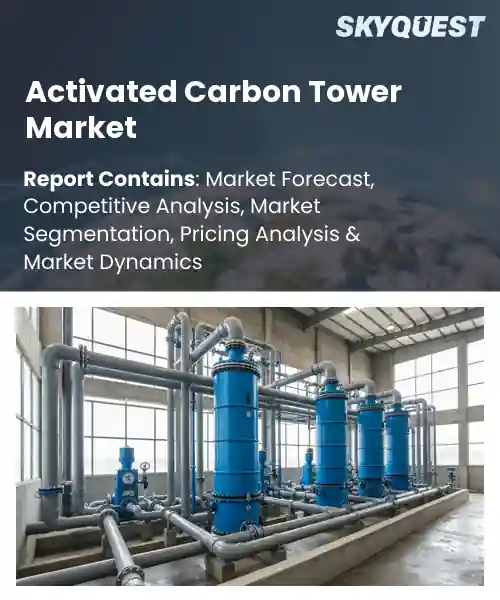
Activated Carbon Tower Market
Report ID: SQMIG20I2708
Report ID: SQMIG20I2708
[email protected]
USA +1 351-333-4748
Report ID:
SQMIG20I2708 |
Region:
Global |
Published Date: February, 2026
Pages:
157
|Tables:
118
|Figures:
77


Global Activated Carbon Tower Market size was valued at USD 1.40 Billion in 2024 and is poised to grow from USD 1.50 Billion in 2025 to USD 2.68 Billion by 2033, growing at a CAGR of 7.5% during the forecast period (2026-2033).
Growing demand for air and water pollution control, rising industrial emissions, stricter environmental regulations, increasing adoption of advanced filtration technologies, and emphasis on sustainable industrial operations are driving sales of activated carbon towers.
The combination of stricter environmental regulations with increasing industrial emissions has become the primary reason that activated carbon towers receive widespread adoption because regulators require facilities to implement effective systems which will remove volatile organic compounds and odors and trace organic pollutants through adsorption technology. The introduction of modular tower designs together with better adsorption media and on-site thermal regeneration systems allows carbon media to maintain their performance for an extended period while decreasing total operational expenses. The total cost of ownership reduction made chemical plants and municipal utilities, and wastewater treatment facilities adopt the technology.
On the contrary, high initial installation costs, operational complexity in maintaining adsorption systems, fluctuating prices of activated carbon materials, and disposal challenges associated with spent carbon media are anticipated to slow down the penetration of the activated carbon tower market in the long run.
How is AI Improving Performance Monitoring of Activated Carbon Towers?
AI is improving performance monitoring in the activated carbon tower market by combining smart sensors, real-time data, and machine learning. Some operators are changing their schedule-based maintenance to condition-based monitoring. The benefits of this are reduced downtime, improved system efficiency, and compliance with regulations. The application of this technology is seen in IoT-based carbon towers that send information to analytics platforms and cloud-based models that provide recommendations on the best type of carbon and the time to regenerate.
Market snapshot - (2026-2033)
Global Market Size
USD 1.4 Billion
Largest Segment
Granular Activated Carbon
Fastest Growth
Powdered Activated Carbon
Growth Rate
7.5% CAGR
To get more insights on this market click here to Request a Free Sample Report
The global activated carbon tower market is segmented by media type, product configuration, application area, end user and region. Based on media type, the market is segmented into granular activated carbon, powdered activated carbon, and extruded activated carbon. Based on product configuration, the market is segmented into fixed bed towers, fluidized bed towers, and moving bed towers. Based on application area, the market is segmented into water treatment, air treatment, industrial processes, and others. Based on end user, the market is segmented into municipal sector, industrial sector, and residential sector. Based on region, the market is segmented into North America, Europe, Asia Pacific, Latin America, and Middle East & Africa.
The granular activated carbon segment is forecasted to account for the a prominent chunk of the global activated carbon tower market share going forward. The particle size distribution and structural strength of the material are helping it gain dominance over the others. Its ability to provide stable bed packing and hydraulic properties that can sustain efficient mass transfer during continuous operation in the towers is another factor that is helping this section gain dominance. The material's strong affinity across a wide range of contaminants, established regeneration pathways, and manageable handling lower operational complexity and lifecycle costs, making it the preferred choice for long-term treatment applications and driving widespread adoption within the activated carbon tower market.
However, powdered activated carbon is emerging as the fastest growing segment as per this activated carbon tower market growth. Availability of flexible dosing options, rapid adsorption kinetics, and suitability for retrofit or intermittent treatment scenarios are creating new opportunities via this segment. Its injectable form enables quick operational responses to episodic contamination and tightening regulatory pressures, reducing capital barriers, and enabling new service models that expand market opportunities across diverse treatment contexts.
The fluidized bed towers segment is estimated to spearhead the global activated carbon tower market revenue generation in the long run. The ability of this fluidization regime to enhance contact efficiency between carbon media and polluted streams is helping it maintain its high share going forward. The combination of better material handling capabilities and improved media distribution systems enables operational flow optimization while reducing material waste. The system design provides multiple operational modes which enable efficient treatment of diverse materials in high demand applications.
The moving bed towers segment experiences its highest growth rates because its continuous media circulation system together with its in situ regeneration process work to decrease operational downtime while increasing media usage efficiency. Industrial operators who prioritize resilient systems with cost-effective operational lifecycles have started to adopt the solution because it enables them to handle processes with higher intensity while creating fresh possibilities for process improvement and market development.
To get detailed segments analysis, Request a Free Sample Report
High industrialization, imposition of strict environmental regulations, and concentrated manufacturing activity are driving sustained sales of activated carbon tower across Asia Pacific. Innovative research & development efforts as well as partnerships between equipment manufacturers and service providers will promote the use of technology. The use of advanced adsorbent formulas and modular tower designs will provide the required flexibility to accommodate the diverse end uses. However, strong aftermarket support and local engineering expertise are necessary for reliability and lifecycle management. High urbanization has boosted the adoption of better water treatment solutions, which also uplifts the sales of activated carbon towers. Utilities, petrochemical producers, and water technology companies lead activated carbon tower adoption in China, Japan, India, and South Korea.
Advanced engineering capabilities, stringent environmental enforcement, and strong demand from municipal and industrial water treatment programs are shaping sales of activated carbon tower in Japan. Domestic manufacturers prioritize high quality materials and precise fabrication and integrated service offerings to meet the needs of both retrofit and new build projects. Adoption of activated carbon towers featuring performance optimized adsorbents and compact designs is expected to be high in the country.
The presence of concentrated industrial clusters, regulatory frameworks, and integration between manufacturers and utilities are shaping activated carbon tower adoption in the country. Majority of activated carbon tower demand in South Korea is slated to stem from petrochemical, electronics, and municipal sectors. Local engineering firms provide complete project execution services together with ongoing operational assistance, as their partnerships with research institutions enable them to enhance performance through customized solutions.
High infrastructure renewal needs and diversified industrial demand that favors adsorption-based treatment are supporting widespread activated carbon tower adoption in North America. Collaborative partnerships among equipment manufacturers, engineering firms, and service providers help accelerate project construction and deliver better aftermarket support. The emphasis on resilience and operational reliability, a growing number of modular and scalable systems as well as a mature contracting environment are all boosting revenue generation for activated carbon tower vendors. Easy availability of financing options and pilot scale demonstrations are supplementing the rapid deployment of activated carbon towers across the region through 2033 and beyond.
Increase in municipal and industrial remediation activity and stringent environmental oversight are shaping activated carbon tower adoption in the United States. The combination of strong engineering capabilities and maintenance support systems enables both retrofit projects and new installations to succeed while public procurement routes create opportunities for demonstration initiatives and widespread technology implementation in water treatment and air purification and industrial uses.
Evolving regulatory frameworks and a mix of municipal and resource sector demand are shaping activated carbon tower sales in Canada. Local suppliers provide modular systems that require minimal upkeep and operate in different environmental conditions, which they back through their service networks and engineering partnerships that support system upgrades and testing and environmental management performance assessments.
The imposition of strict environmental standards, advanced engineering capability, and strategic focus on sustainable supply chains are creating new business scope for activated carbon tower providers in Europe. The emphasis is shifting to high-performance adsorbents, energy-efficient design, and lifecycle management service offerings to meet the needs of their customers in various industries and cities. International collaborations among technology developers, research organizations, and utilities are driving innovation and rapid commercialization of modular and retrofitted technology. Adoption of circular economy practices are also expected to uplift the sales of activated carbon tower across European countries in the long run.
Robust industrial base and rigorous environmental compliance requirements are influencing the demand for activated carbon towers in Germany. Domestic manufacturers emphasize energy efficient tower designs, and high-quality adsorbent materials tailored to complex industrial streams. Well established service networks enable maintenance and retrofit programs which comply with operational standards and emission control requirements.
Emphasis on strict environmental oversight, advanced engineering services, and deployment across municipal and industrial applications govern activated carbon tower demand in the country. Preference for flexible, modular systems and performance optimized adsorbents is high in the United Kingdom. The partnership between technology companies and consulting firms and utility companies enables customized project delivery together with strong maintenance solutions which support existing infrastructure upgrades and new construction projects.
Launch of new policies focused on environmental protection and extensive deployment across municipal and industrial treatment applications are boosting activated carbon tower sales in France. Suppliers provide system designs which can be modified according to their needs while their systems also enable clients to recycle adsorbent materials through their circular resource strategies. Equipment manufacturers and engineering consultancies and research laboratories work together to develop new products while existing service networks provide maintenance and retrofit services going forward.
To know more about the market opportunities by region and country, click here to
Buy The Complete Report
Rising Demand from Water Treatment
Industrial Emission Control Applications
High Operating and Maintenance Costs
Availability Of Alternative Technologies
Request Free Customization of this report to help us to meet your business objectives.
Competition in the global activated carbon tower market is sharpening as regulatory pressure on PFAS and rising demand for carbon removal force material and system innovation; firms are pursuing technology licensing, industrial partnerships and targeted manufacturing alliances to gain share, for example a major sorbent manufacturing tie-up with Johnson Matthey and recent pivoting by a modular DAC developer away from cooling tower retrofits.
SkyQuest’s ABIRAW (Advanced Business Intelligence, Research & Analysis Wing) is our Business Information Services team that Collects, Collates, Correlates, and Analyses the Data collected by means of Primary Exploratory Research backed by robust Secondary Desk research.
As per SkyQuest analysis, rising industrial emissions and stricter environmental regulations are anticipated to drive the demand for activated carbon towers going forward. However, high installation costs and difficulties associated with the replacement and disposal of carbon media are expected to hinder the growth of activated carbon towers in the future. North America is expected to lead the growth of the global activated carbon tower market due to the presence of stringent environmental compliance policies and advanced water and air treatment infrastructures. Integration of IoT-enabled monitoring systems and development of advanced carbon regeneration technologies are anticipated to be key trends driving the activated carbon tower sector in the long run.
| Report Metric | Details |
|---|---|
| Market size value in 2024 | USD 1.4 Billion |
| Market size value in 2033 | USD 2.68 Billion |
| Growth Rate | 7.5% |
| Base year | 2024 |
| Forecast period | (2026-2033) |
| Forecast Unit (Value) | USD Billion |
| Segments covered |
|
| Regions covered | North America (US, Canada), Europe (Germany, France, United Kingdom, Italy, Spain, Rest of Europe), Asia Pacific (China, India, Japan, Rest of Asia-Pacific), Latin America (Brazil, Rest of Latin America), Middle East & Africa (South Africa, GCC Countries, Rest of MEA) |
| Companies covered |
|
| Customization scope | Free report customization with purchase. Customization includes:-
|
To get a free trial access to our platform which is a one stop solution for all your data requirements for quicker decision making. This platform allows you to compare markets, competitors who are prominent in the market, and mega trends that are influencing the dynamics in the market. Also, get access to detailed SkyQuest exclusive matrix.
Table Of Content
Executive Summary
Market overview
Parent Market Analysis
Market overview
Market size
KEY MARKET INSIGHTS
COVID IMPACT
MARKET DYNAMICS & OUTLOOK
Market Size by Region
KEY COMPANY PROFILES
Methodology
For the Activated Carbon Tower Market, our research methodology involved a mixture of primary and secondary data sources. Key steps involved in the research process are listed below:
1. Information Procurement: This stage involved the procurement of Market data or related information via primary and secondary sources. The various secondary sources used included various company websites, annual reports, trade databases, and paid databases such as Hoover's, Bloomberg Business, Factiva, and Avention. Our team did 45 primary interactions Globally which included several stakeholders such as manufacturers, customers, key opinion leaders, etc. Overall, information procurement was one of the most extensive stages in our research process.
2. Information Analysis: This step involved triangulation of data through bottom-up and top-down approaches to estimate and validate the total size and future estimate of the Activated Carbon Tower Market.
3. Report Formulation: The final step entailed the placement of data points in appropriate Market spaces in an attempt to deduce viable conclusions.
4. Validation & Publishing: Validation is the most important step in the process. Validation & re-validation via an intricately designed process helped us finalize data points to be used for final calculations. The final Market estimates and forecasts were then aligned and sent to our panel of industry experts for validation of data. Once the validation was done the report was sent to our Quality Assurance team to ensure adherence to style guides, consistency & design.
Analyst Support
Customization Options
With the given market data, our dedicated team of analysts can offer you the following customization options are available for the Activated Carbon Tower Market:
Product Analysis: Product matrix, which offers a detailed comparison of the product portfolio of companies.
Regional Analysis: Further analysis of the Activated Carbon Tower Market for additional countries.
Competitive Analysis: Detailed analysis and profiling of additional Market players & comparative analysis of competitive products.
Go to Market Strategy: Find the high-growth channels to invest your marketing efforts and increase your customer base.
Innovation Mapping: Identify racial solutions and innovation, connected to deep ecosystems of innovators, start-ups, academics, and strategic partners.
Category Intelligence: Customized intelligence that is relevant to their supply Markets will enable them to make smarter sourcing decisions and improve their category management.
Public Company Transcript Analysis: To improve the investment performance by generating new alpha and making better-informed decisions.
Social Media Listening: To analyze the conversations and trends happening not just around your brand, but around your industry as a whole, and use those insights to make better Marketing decisions.
REQUEST FOR SAMPLE
 REQUEST FREE CUSTOMIZATION
Global Activated Carbon Tower Market size was valued at USD 1.4 Billion in 2024 and is poised to grow from USD 1.5 Billion in 2025 to USD 2.68 Billion by 2033, growing at a CAGR of 7.5% during the forecast period (2026-2033).
Competition in the global activated carbon tower market is sharpening as regulatory pressure on PFAS and rising demand for carbon removal force material and system innovation; firms are pursuing technology licensing, industrial partnerships and targeted manufacturing alliances to gain share, for example a major sorbent manufacturing tie-up with Johnson Matthey and recent pivoting by a modular DAC developer away from cooling tower retrofits. 'Calgon Carbon Corporation', 'Cabot Norit Activated Carbon', 'CarboTech AC GmbH', 'Kuraray Co., Ltd.', 'ADA Carbon Solutions', 'Haycarb PLC', 'Ingevity Corporation', 'Activated Carbon Solutions', 'Chemviron Carbon Ltd.', 'Carbon Resources LLC', 'Osaka Gas Chemicals Co., Ltd.', 'Donau Carbon GmbH', 'Carbon Activated Corporation', 'Puragen Activated Carbons', 'Norit Americas Inc.', 'Kureha Corporation', 'Silcarbon Aktivkohle GmbH', 'JACOBI Carbons Group', 'Evoqua Water Technologies', 'Global Environmental Solutions'
Activated carbon towers are increasingly selected by municipal and industrial water treatment operators for their proven ability to remove organic contaminants, taste, odor, and trace pollutants, and this preference supports market expansion by driving procurement, replacement cycles, and system upgrades. Their adaptability to diverse feed waters and compatibility with existing treatment trains reduce integration barriers, while perceived operational reliability encourages investments. The cumulative effect is stronger adoption across sectors seeking robust adsorption-based polishing steps, which translates into sustained demand for tower systems and associated services.
Industrial Emissions Compliance Drive: Stricter environmental regulations and corporate sustainability commitments are pushing industrial users toward adsorption based solutions; activated carbon towers are positioned as reliable systems for volatile organic compound and odor control. Demand emphasizes modular designs for easier integration, site specific media selection, and low disruption retrofits. Vendors are differentiating through service contracts, performance guarantees, and lifecycle consulting, while engineering firms collaborate to adapt tower footprints to complex plant constraints. This shift favors suppliers offering turnkey capabilities and demonstrable emissions reduction strategies.
Why does Asia Pacific Dominate the Global Activated Carbon Tower Market? |@12


Want to customize this report? This report can be personalized according to your needs. Our analysts and industry experts will work directly with you to understand your requirements and provide you with customized data in a short amount of time. We offer $1000 worth of FREE customization at the time of purchase.
Feedback From Our Clients


 USA (+1) 351-333-4748

