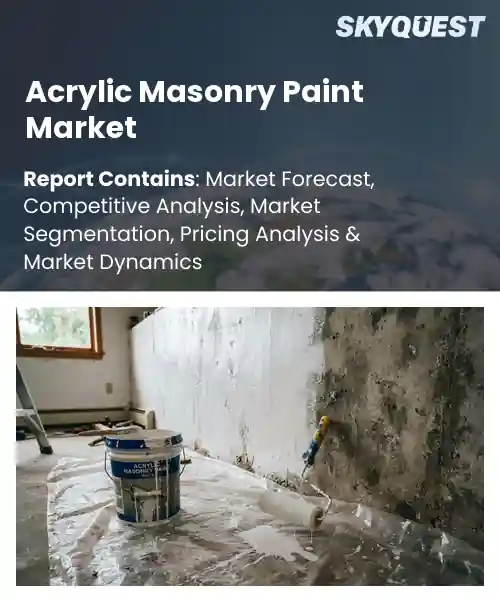
Acrylic Masonry Paint Market
Report ID: SQMIG15E4284
Report ID: SQMIG15E4284
[email protected]
USA +1 351-333-4748
Report ID:
SQMIG15E4284 |
Region:
Global |
Published Date: August, 2026
Pages:
157
|Tables:
143
|Figures:
78


Global Acrylic Masonry Paint Market size was valued at USD 12.48 Billion in 2024 and is poised to grow from USD 13.22 Billion in 2025 to USD 20.91 Billion by 2033, growing at a CAGR of 5.9% during the forecast period (2026-2033).
The global acrylic masonry paint market has become a pivotal segment of the coatings industry, driven primarily by rising demand for durable, weather‑resistant finishes on residential and commercial structures. In the early 2000s manufacturers relied on solvent‑based products, but stricter environmental rules and consumer preference shifted the industry toward water‑borne acrylic systems that deliver low VOC emissions and better breathability. As urbanization accelerated across Asia and Latin America, developers needed solutions able to withstand temperature swings. Consequently the market moved from a niche supply chain to an arena, illustrated by significant global sales of brands such as Dulux and Asian Paints. The emphasis on energy efficiency in building envelopes pushes architects to choose coatings that reflect radiation while maintaining wall breathability. Acrylic mixes enriched with infrared‑reflective pigments reduce interior cooling loads, leading developers in hot regions such as the Middle East to specify these paints for cheaper climate control. This demand drives manufacturers to fund research that delivers high‑performance blends compatible with sustainable substrates, which in turn broadens market adoption. Suppliers that provide documented performance data and certification assistance therefore secure a strategic competitive advantage and gain access to significant export large opportunities in global green‑building projects across emerging economies today.
How is AI-driven automation influencing product formulation in the acrylic masonry paint market?
AI driven automation is reshaping how formulators create acrylic masonry paint by replacing manual trial and error with data powered prediction. Machine learning models evaluate pigment stability, binder adhesion and weather resistance in virtual labs, allowing chemists to test dozens of recipes in minutes. This accelerates the rollout of low VOC, high durability coatings that meet stricter environmental rules and consumer expectations. Companies such as Sherwin Williams and AkzoNobel have integrated these tools to fine tune resin blends and optimize color fastness, while smaller innovators use cloud platforms to scale rapid prototyping. The result is a faster, more cost effective path from concept to market.PPG announced its AI formulation platform in March 2024, enabling rapid virtual testing of binder ratios and pigment blends that cuts development cycles and improves product consistency, thereby driving faster market entry and supporting growth in the acrylic masonry paint segment.
Market snapshot - (2026-2033)
Global Market Size
USD 12.48 Billion
Largest Segment
Exterior Masonry Paint
Fastest Growth
Elastomeric Masonry Paint
Growth Rate
5.9% CAGR
To get more insights on this market click here to Request a Free Sample Report
Global acrylic masonry paint market is segmented by paint type, finish, application, distribution channel, end user and region. Based on paint type, the market is segmented into Interior Masonry Paint, Exterior Masonry Paint and Elastomeric Masonry Paint. Based on finish, the market is segmented into Matte, Satin and Gloss. Based on application, the market is segmented into Residential Buildings, Commercial Buildings and Industrial Structures. Based on distribution channel, the market is segmented into Paint Stores, Home Improvement Stores and Online Retail. Based on end user, the market is segmented into Professional Contractors and DIY Consumers. Based on region, the market is segmented into North America, Europe, Asia Pacific, Latin America and Middle East & Africa.
Exterior masonry paint segment dominates because it delivers superior weather resistance and color retention that architects and builders prioritize for durable facades. The formulation’s acrylic binder resists UV degradation, reducing maintenance cycles, which drives specification in new construction and retrofit projects. Its proven performance aligns with sustainability goals, encouraging its selection over alternatives and cementing its leadership in the acrylic masonry paint market for residential and commercial applications throughout the.
However, interior masonry paint segment is witnessing the strongest growth momentum as designers seek low VOC easy clean finishes for modern living spaces. Its compatibility with diverse interior substrates and the rising trend of personalized home décor stimulate broader adoption, expanding market depth and opening new channels for product innovation.
Paint stores segment dominates because they serve as primary touchpoints where professional contractors evaluate product performance through hands on testing and expert consultation. Physical inventory allows immediate access to a wide palette, facilitating quick decision making for large scale projects. The established trust built over decades reinforces loyalty, while store staff provide technical guidance that aligns with project specifications, securing their pivotal role in market transactions for both residential and commercial.
Meanwhile, online retail segment emerges as the key high growth area as consumers favor digital convenience and instant product information. E commerce sites offer virtual color tools and rapid delivery, drawing DIY enthusiasts and small contractors. This transition expands market reach, quickens adoption, and drives innovative packaging and subscription options.
To get detailed segments analysis, Request a Free Sample Report
The region benefits from a confluence of high construction activity, strong governmental emphasis on sustainable building practices, and advanced manufacturing capabilities. Consumer preferences increasingly favor durable, low‑maintenance finishes that align with green building standards, prompting manufacturers to invest in research and development of high‑performance acrylic formulations. Robust distribution networks and a culture of rapid adoption of innovative coating technologies further reinforce market leadership. Additionally, the presence of major architectural projects and urban redevelopment initiatives drives consistent demand, establishing Asia Pacific as the central hub for acrylic masonry paint evolution.
Japan Acrylic Masonry Paint Market
Acrylic Masonry Paint Market in Japan thrives on a tradition of meticulous craftsmanship and a regulatory environment that prioritises environmental stewardship. Local producers emphasize premium product quality, integrating advanced resin technologies that meet strict emission guidelines. Consumer demand leans towards finishes that combine aesthetic versatility with long‑term durability, encouraging continuous innovation. Market participants benefit from strong collaboration with construction firms and architects, fostering tailored solutions for both residential renovations and expansive commercial projects.
South Korea Acrylic Masonry Paint Market
Acrylic Masonry Paint Market in South Korea is propelled by rapid urbanisation and a growing emphasis on smart‑city infrastructure. Domestic manufacturers focus on high‑efficiency production processes that deliver products with superior weather resistance and colour stability. The market responds to a sophisticated consumer base that values both functional performance and modern design trends. Strategic partnerships with multinational distributors expand market reach, while government incentives for energy‑efficient building materials reinforce adoption of acrylic masonry solutions.
Europe’s expansion is anchored in stringent environmental regulations that compel the shift toward low‑VOC, water‑based coatings. A mature construction sector coupled with a strong retrofit culture fuels demand for high‑quality, long‑lasting finishes. Manufacturers leverage advanced polymer science to deliver products that meet demanding performance criteria while aligning with sustainability goals. The region’s emphasis on heritage preservation and modern architectural aesthetics creates a dual market for restoration and new‑build applications. Collaborative research initiatives across key markets further accelerate product innovation, positioning Europe as a leader in premium acrylic masonry paint solutions.
Germany Acrylic Masonry Paint Market
Acrylic Masonry Paint Market in Germany is characterised by a deep commitment to engineering excellence and stringent quality standards. Producers prioritise formulations that deliver exceptional adhesion and resistance to harsh climatic conditions, aligning with the nation’s focus on energy‑efficient building envelopes. The market benefits from strong integration with the architectural and construction sectors, facilitating the development of specialised product lines for both historic renovation and contemporary construction projects. Collaborative industry clusters support continuous improvement and adoption of cutting‑edge technologies.
United Kingdom Acrylic Masonry Paint Market
Acrylic Masonry Paint Market in United Kingdom experiences accelerated growth driven by a vibrant refurbishment sector and increasing demand for sustainable building solutions. Consumers and specifiers alike seek products that combine aesthetic flexibility with robust protective attributes, prompting manufacturers to enhance colour palettes and performance characteristics. Regulatory pressures encourage the transition to low‑emission coatings, while the prevalence of mixed‑use developments creates opportunities for tailored applications. Industry bodies foster knowledge exchange, supporting rapid diffusion of innovative acrylic technologies.
France Acrylic Masonry Paint Market
Acrylic Masonry Paint Market in France is emerging as a dynamic segment within a broader push for environmentally conscious construction. Market players emphasize eco‑friendly formulations that comply with rigorous national standards, appealing to architects focused on modern design and energy efficiency. The growing popularity of renovation projects in historic districts drives demand for finishes that respect heritage aesthetics while providing superior durability. Collaborative efforts between research institutes and manufacturers accelerate the introduction of advanced acrylic systems.
North America consolidates its position through a blend of technological advancement, expansive construction pipelines, and a consumer base that values performance and sustainability. Industry leaders invest heavily in research to create acrylic blends with enhanced weather resistance and low‑odor attributes, aligning with stringent environmental guidelines. The market benefits from a robust supply chain that facilitates rapid product rollout across diverse climatic zones. Strong emphasis on contractor education and certification programs ensures consistent application quality, while strategic alliances with building material distributors broaden market penetration.
United States Acrylic Masonry Paint Market
Acrylic Masonry Paint Market in United States leverages extensive residential and commercial building activity to drive product adoption. Manufacturers focus on high‑performance formulations that address diverse climatic challenges, ensuring durability across both arid and humid environments. Emphasis on low‑VOC content aligns with evolving regulatory landscapes, while marketing initiatives highlight the aesthetic versatility of acrylic finishes. Collaborative projects with leading construction firms and architects foster the development of specialised solutions for large‑scale infrastructure and emerging green building certifications.
Canada Acrylic Masonry Paint Market
Acrylic Masonry Paint Market in Canada reflects a strong commitment to cold‑climate performance and environmentally responsible manufacturing. Product development prioritises freeze‑thaw resilience and superior adhesion on a variety of substrate types common in northern construction. Government incentives for sustainable building practices encourage the uptake of low‑emission acrylic systems. Partnerships between paint producers and regional distributors enable tailored solutions that meet the specific needs of residential renovation and new‑build projects across the country.
To know more about the market opportunities by region and country, click here to
Buy The Complete Report
Increasing Urban Construction Activities
Growing Preference for Eco Friendly Solutions
High Initial Cost of Acrylic Paint
Limited Availability of Skilled Applicators
Request Free Customization of this report to help us to meet your business objectives.
The acrylic masonry paint market is shaped by intense rivalry among global leaders such as Sherwin‑Williams, PPG Industries, Asian Paints and Jotun, each leveraging M&A, strategic partnerships and technology breakthroughs; PPG’s 2020 acquisition of AkzoNobel’s decorative‑coatings unit, Asian Paints’ collaboration with BASF on bio‑based pigments, and Jotun’s rollout of nano‑enhanced low‑VOC acrylic masonry paint illustrate how competitive pressure drives product innovation, portfolio expansion and geographic reach.
Top Player’s Company Profile
Recent Developments
SkyQuest’s ABIRAW (Advanced Business Intelligence, Research & Analysis Wing) is our Business Information Services team that Collects, Collates, Correlates, and Analyses the Data collected by means of Primary Exploratory Research backed by robust Secondary Desk research. As per SkyQuest analysis, rapid urban construction activity is propelling demand for acrylic masonry paints as developers seek durable, low‑maintenance finishes, while the rising preference for eco‑friendly, low‑VOC formulations adds a second boost by aligning products with green‑building certifications. Manufacturers are also using AI‑driven formulation to speed development and improve performance. The market is chiefly led by the exterior masonry paint segment, whose weather‑resistant properties make it the top choice for new façades and retrofits. Asia Pacific dominates globally, fueled by high building volumes and strong governmental sustainability pushes. However, the premium price of acrylic systems acts as a restraint, slowing adoption in cost‑sensitive projects until economies of scale reduce costs.
| Report Metric | Details |
|---|---|
| Market size value in 2024 | USD 12.48 Billion |
| Market size value in 2033 | USD 20.91 Billion |
| Growth Rate | 5.9% |
| Base year | 2024 |
| Forecast period | (2026-2033) |
| Forecast Unit (Value) | USD Billion |
| Segments covered |
|
| Regions covered | North America (US, Canada), Europe (Germany, France, United Kingdom, Italy, Spain, Rest of Europe), Asia Pacific (China, India, Japan, Rest of Asia-Pacific), Latin America (Brazil, Rest of Latin America), Middle East & Africa (South Africa, GCC Countries, Rest of MEA) |
| Companies covered |
|
| Customization scope | Free report customization with purchase. Customization includes:-
|
To get a free trial access to our platform which is a one stop solution for all your data requirements for quicker decision making. This platform allows you to compare markets, competitors who are prominent in the market, and mega trends that are influencing the dynamics in the market. Also, get access to detailed SkyQuest exclusive matrix.
Table Of Content
Executive Summary
Market overview
Parent Market Analysis
Market overview
Market size
KEY MARKET INSIGHTS
COVID IMPACT
MARKET DYNAMICS & OUTLOOK
Market Size by Region
KEY COMPANY PROFILES
Methodology
For the Acrylic Masonry Paint Market, our research methodology involved a mixture of primary and secondary data sources. Key steps involved in the research process are listed below:
1. Information Procurement: This stage involved the procurement of Market data or related information via primary and secondary sources. The various secondary sources used included various company websites, annual reports, trade databases, and paid databases such as Hoover's, Bloomberg Business, Factiva, and Avention. Our team did 45 primary interactions Globally which included several stakeholders such as manufacturers, customers, key opinion leaders, etc. Overall, information procurement was one of the most extensive stages in our research process.
2. Information Analysis: This step involved triangulation of data through bottom-up and top-down approaches to estimate and validate the total size and future estimate of the Acrylic Masonry Paint Market.
3. Report Formulation: The final step entailed the placement of data points in appropriate Market spaces in an attempt to deduce viable conclusions.
4. Validation & Publishing: Validation is the most important step in the process. Validation & re-validation via an intricately designed process helped us finalize data points to be used for final calculations. The final Market estimates and forecasts were then aligned and sent to our panel of industry experts for validation of data. Once the validation was done the report was sent to our Quality Assurance team to ensure adherence to style guides, consistency & design.
Analyst Support
Customization Options
With the given market data, our dedicated team of analysts can offer you the following customization options are available for the Acrylic Masonry Paint Market:
Product Analysis: Product matrix, which offers a detailed comparison of the product portfolio of companies.
Regional Analysis: Further analysis of the Acrylic Masonry Paint Market for additional countries.
Competitive Analysis: Detailed analysis and profiling of additional Market players & comparative analysis of competitive products.
Go to Market Strategy: Find the high-growth channels to invest your marketing efforts and increase your customer base.
Innovation Mapping: Identify racial solutions and innovation, connected to deep ecosystems of innovators, start-ups, academics, and strategic partners.
Category Intelligence: Customized intelligence that is relevant to their supply Markets will enable them to make smarter sourcing decisions and improve their category management.
Public Company Transcript Analysis: To improve the investment performance by generating new alpha and making better-informed decisions.
Social Media Listening: To analyze the conversations and trends happening not just around your brand, but around your industry as a whole, and use those insights to make better Marketing decisions.
REQUEST FOR SAMPLE
 REQUEST FREE CUSTOMIZATION


Want to customize this report? This report can be personalized according to your needs. Our analysts and industry experts will work directly with you to understand your requirements and provide you with customized data in a short amount of time. We offer $1000 worth of FREE customization at the time of purchase.
Feedback From Our Clients


 USA (+1) 351-333-4748

