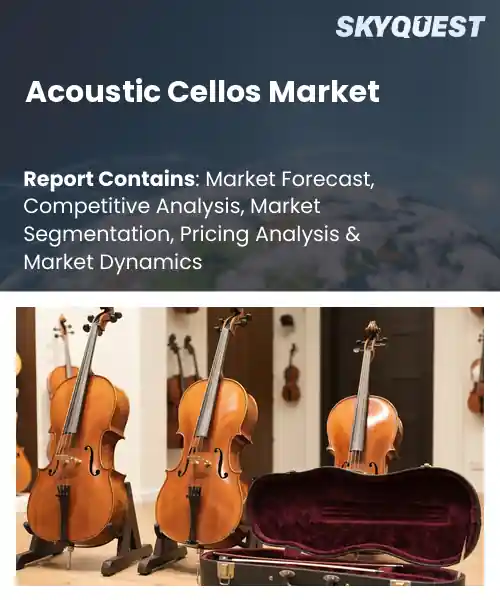
Acoustic Cellos Market
Report ID: SQMIG25J2278
Report ID: SQMIG25J2278
[email protected]
USA +1 351-333-4748
Report ID:
SQMIG25J2278 |
Region:
Global |
Published Date: July, 2026
Pages:
157
|Tables:
151
|Figures:
78


Global Acoustic Cellos Market size was valued at USD 194.20 Million in 2024 and is poised to grow from USD 201.58 Million in 2025 to USD 271.66 Million by 2033, growing at a CAGR of 3.8% during the forecast period (2026-2033).
The next crucial factor influencing the global acoustic cellos market share is increasing focus towards education. Institutes now focus on education that helps in developing listening skills and team work. University programs and conservatories have budgets for acoustic cellos for their curricula. Manufacturers have to scale up capacity and provide lines of instruments for students and professionals. This investment cascade fuels additional services like maintenance workshops and streaming platforms providing instructional content, creating revenue streams beyond the initial sale. For example, a conservatory could partner with a boutique maker to create a loan program, opening up access to students and generating steady demand for instrument upgrades.
How is AI-driven Customization Influencing the Acoustic Cellos Market?
AI-driven customization is transforming acoustic cellos, giving makers the ability to customize sound, shape and playability for each individual musician. Machine-learning algorithms examine a player’s technique and preferences, and recommend changes to wood thickness, bridge placement or string tension. This makes instruments respond more naturally, which improves expression and decreases the learning curve. Companies are embedding AI into design software that allows lightning-fast prototyping of custom models that previously would have taken months to build by hand. This also simplifies inventory, as manufacturers can make on-demand variants instead of large generic collections, making the acoustic cellos market growth more adaptable to niche demands.
AI-powered personalization is driving consumer interest and the industry's growth as shown by the $1.2 billion valuation of the acoustic cellos market in May 2026.
Market snapshot - (2026-2033)
Global Market Size
USD 194.2 Million
Largest Segment
Full-Size Cellos
Fastest Growth
Student Cellos
Growth Rate
3.8% CAGR
To get more insights on this market click here to Request a Free Sample Report
Global acoustic cellos market is segmented by product type, material, end user, price range, distribution channel and region. Based on product type, the market is segmented into full-size cellos, three-quarter cellos, half-size cellos, student cellos and others. Based on material, the market is segmented into solid wood, laminated wood, carbon fiber and others. Based on end user, the market is segmented into professional musicians, students, music schools, orchestras and others. Based on price range, the market is segmented into entry-level, mid-range, premium and others. Based on distribution channel, the market is segmented into musical instrument stores, online retail, direct sales and others. Based on region, the market is segmented into North America, Europe, Asia Pacific, Latin America and Middle East & Africa.
Full-size cellos segment dominates because it satisfies the tonal richness demanded by professional performers and orchestras, offering the resonance and projection essential for concert settings. Its larger body size enables deeper acoustic frequencies, which positions it as the preferred choice for high‑profile recordings and live performances. This inherent musical superiority drives sustained demand, reinforcing its central role in the acoustic cellos market trends across diverse repertoire and ensemble configurations today.
Meanwhile, three-quarter cellos segment is witnessing the strongest growth momentum because its more compact dimensions cater to musicians who require ergonomic comfort without compromising tonal quality. Rising enrollment in youth music programs and a surge in portable performance venues fuel demand, positioning this segment as a key driver of market expansion.
Carbon fiber segment dominates because its innovative composite construction delivers exceptional durability while preserving acoustic integrity, appealing to touring professionals and environmentally conscious musicians. The lightweight nature reduces fatigue during extended performances, and resistance to climate fluctuations eliminates the need for frequent maintenance. These functional advantages create a compelling value proposition, positioning carbon fiber as the preferred material for forward‑looking instrument makers within the acoustic cellos market across diverse performance contexts.
Conversely, laminated wood segment is emerging as the fastest growing because manufacturers can produce cost‑effective instruments with consistent tonal characteristics, attracting beginners and educational institutions. Advances in adhesive technologies and eco‑friendly sourcing broaden appeal, driving rapid market adoption and opening new opportunities for volume‑driven distribution channels across segments.
To get detailed segments analysis, Request a Free Sample Report
Europe over the acoustic cello market is due to its rich classical tradition, which fuels demand and spurs innovation. Conservatories have produced generations of virtuoso players who value handcrafted instruments, served by a dense network of luthiers and specialty retailers that keeps the supply chain alive with artisanal excellence. Moreover, cultural institutions regularly present cello repertoire, strengthening public awareness and stimulating private ownership. Collaborative design initiatives between manufacturers and leading musicians are driving continuous refinement of tonal qualities and ergonomics. The integration of heritage, education and craftsmanship creates a solid market ecosystem and a standard for performance that regularly leads the way, positioning Europe as the benchmark of quality and desirability for acoustic cellos worldwide. Furthermore, the cross-border collaboration among European workshops facilitates the exchange of information, and the premium branding appeals to sophisticated collectors and professional ensembles in need of provenance and tonal richness.
Acoustic cellos market outlook in Germany thrives on a historic reputation for precision engineering and an extensive network of music academies that prioritize string pedagogy. Regional luthiers blend traditional craftsmanship with modern acoustic research, delivering instruments praised for tonal clarity and structural stability. Enthusiastic support from orchestral foundations and a vibrant community of chamber groups sustains demand, while specialized boutiques provide personalized service that reinforces the country’s status as a hub for high‑quality acoustic cellos.
Acoustic cellos market forecast in the United Kingdom benefits from a rich heritage of string performance and a strong presence of elite conservatoires that nurture emerging talent. Renowned British luthiers are celebrated for meticulous hand‑work and innovative bracing patterns that enhance resonance. Partnerships with prominent ensembles and active participation in international festivals create a vibrant ecosystem, while boutique dealers offer bespoke fittings that cater to professional musicians seeking refined tonal character.
Acoustic cellos market regional outlook in France is propelled by a longstanding artistic culture and a network of prestigious music schools that champion classical repertoire. French luthiers are distinguished for elegant aesthetic finishes and acoustic designs that balance warmth with projection, appealing to both soloists and orchestral players. Collaborative projects with contemporary composers and frequent engagements in regional festivals reinforce a dynamic demand, while dedicated dealers provide tailored services that sustain the country’s reputation for refined, high‑quality acoustic cellos.
North America is witnessing rapid growth in the acoustic cello market due to cultural openness, robust educational frameworks, and shifting consumer lifestyles. Schools and universities with music programs include the study of cello, creating a pipeline of eager learners looking for instruments that combine tradition with modern playability. The expansion of the home recording and streaming community of hobbyists and semi-professional performers has created a demand for versatile, high-quality cellos that can meet many stylistic needs. Local manufacturers are leveraging advanced woodworking and collaborating with renowned artists to build brand trust. At the same time, growing networks of specialist retailers and digital marketplaces offer tailored guidance and easy access, helping to sustain market momentum and cement North America’s role as a vibrant growth frontier for acoustic cellos. The consumer interest in artisanal craftsmanship further enhances willingness to spend on premium instruments.
Acoustic cellos market regional forecast in the United States thrives on a vibrant blend of academic institutions, a thriving gig economy, and a strong culture of independent music production. Leading American workshops fuse traditional hand‑crafting with cutting‑edge materials, delivering instruments prized for durability and tonal depth. Influential artist endorsements and extensive online communities stimulate interest among students and professionals alike, while a wide range of retailers ensures tailored support that matches diverse performance contexts.
Acoustic cellos market analysis in Canada is shaped by a strong commitment to arts education and a supportive public funding environment that encourages orchestral participation. Canadian luthiers emphasize sustainable wood sourcing and refined acoustic engineering, appealing to environmentally conscious musicians. Collaborative festivals and regional maker’s fairs provide platforms for direct engagement between artisans and performers, fostering a community‑driven demand for high‑quality, locally crafted acoustic cellos. Retail channels that specialize in bespoke fittings further reinforce the market’s niche positioning.
Asia Pacific is strengthening its footprint in the acoustic cello landscape through a mix of cultural resurgence, growing creative economies and progressive manufacturing capabilities. Younger generations are increasingly drawn to classical and hybrid music genres, driving the demand for instruments that combine traditional resonance with contemporary aesthetics. Countries like Japan and South Korea have developed sophisticated woodworking techniques while maintaining artisanal traditions, producing cellos that are renowned for their precision and tonal depth. Government-supported arts initiatives and increased cross-border collaboration between musicians, educators and makers are creating a thriving ecosystem. “This combination of innovation, tradition and market buzz makes the region an emerging destination for world-class acoustic cellos. More participation in international competitions also emphasizes regional craftsmanship and enhances the global perception of Asian-made acoustic cellos.
Acoustic cellos market penetration in Japan merges centuries‑old craftsmanship with cutting‑edge material science, delivering instruments renowned for nuanced tonal balance and impeccable finish. Japanese luthiers often collaborate with leading conservatory instructors, ensuring that design refinements directly address evolving performance techniques. A strong culture of meticulous attention to detail, combined with a burgeoning community of chamber ensembles, fuels sustained demand. High‑end boutique retailers provide personalized consultation, reinforcing Japan’s reputation as a source of premium acoustic cellos worldwide.
Acoustic cellos industry in South Korea is driven by an energetic blend of traditional music education and a rapidly modernizing cultural scene. Korean craftsmen integrate precision engineering with time‑honored wood selection methods, producing cellos celebrated for bright projection and responsive playability. Government incentives for arts development and a surge in youth participation in orchestras amplify market vitality. Specialized music stores offer customized fitting services, while collaborations with international artists elevate the profile of Korean‑made acoustic cellos on the world stage.
To know more about the market opportunities by region and country, click here to
Buy The Complete Report
Rising Appreciation For Acoustic Authenticity
Enhanced Digital Integration With Acoustic Design
High Production Costs Limit Accessibility
Scarcity Of Skilled Luthiers Constraints Supply
Request Free Customization of this report to help us to meet your business objectives.
The acoustic cello market is shaped by intense rivalry among traditional manufacturers and emerging tech‑focused entrants, with competition driving rapid product differentiation and channel expansion. Companies are leveraging strategic partnerships, such as Sirius’s seed‑fund alliance with Market One Capital, and heavy tech innovation investments, illustrated by Suno’s $250 million AI music funding, to enhance digital integration and broaden consumer reach.
Top Player’s Company Profile
Recent Developments in the Acoustic Cellos Market
SkyQuest’s ABIRAW (Advanced Business Intelligence, Research & Analysis Wing) is our Business Information Services team that Collects, Collates, Correlates, and Analyses the Data collected by means of Primary Exploratory Research backed by robust Secondary Desk research. As per SkyQuest analysis, the global acoustic cellos market is propelled primarily by a rising appreciation for acoustic authenticity, which pushes manufacturers to expand handcrafted lines and appeals to professional and educational users; a second important catalyst is the enhanced digital integration that adds sensors and connectivity, offering real‑time feedback while preserving natural tone. Europe dominates the market thanks to its deep classical heritage and dense network of luthiers, and within the product mix the full‑size cello segment leads because of its superior tonal richness for concert settings. However, high production costs limit accessibility, especially for students and hobbyists, restraining broader adoption.
| Report Metric | Details |
|---|---|
| Market size value in 2024 | USD 194.2 Million |
| Market size value in 2033 | USD 271.66 Million |
| Growth Rate | 3.8% |
| Base year | 2024 |
| Forecast period | (2026-2033) |
| Forecast Unit (Value) | USD Million |
| Segments covered |
|
| Regions covered | North America (US, Canada), Europe (Germany, France, United Kingdom, Italy, Spain, Rest of Europe), Asia Pacific (China, India, Japan, Rest of Asia-Pacific), Latin America (Brazil, Rest of Latin America), Middle East & Africa (South Africa, GCC Countries, Rest of MEA) |
| Companies covered |
|
| Customization scope | Free report customization with purchase. Customization includes:-
|
To get a free trial access to our platform which is a one stop solution for all your data requirements for quicker decision making. This platform allows you to compare markets, competitors who are prominent in the market, and mega trends that are influencing the dynamics in the market. Also, get access to detailed SkyQuest exclusive matrix.
Table Of Content
Executive Summary
Market overview
Parent Market Analysis
Market overview
Market size
KEY MARKET INSIGHTS
COVID IMPACT
MARKET DYNAMICS & OUTLOOK
Market Size by Region
KEY COMPANY PROFILES
Methodology
For the Acoustic Cellos Market, our research methodology involved a mixture of primary and secondary data sources. Key steps involved in the research process are listed below:
1. Information Procurement: This stage involved the procurement of Market data or related information via primary and secondary sources. The various secondary sources used included various company websites, annual reports, trade databases, and paid databases such as Hoover's, Bloomberg Business, Factiva, and Avention. Our team did 45 primary interactions Globally which included several stakeholders such as manufacturers, customers, key opinion leaders, etc. Overall, information procurement was one of the most extensive stages in our research process.
2. Information Analysis: This step involved triangulation of data through bottom-up and top-down approaches to estimate and validate the total size and future estimate of the Acoustic Cellos Market.
3. Report Formulation: The final step entailed the placement of data points in appropriate Market spaces in an attempt to deduce viable conclusions.
4. Validation & Publishing: Validation is the most important step in the process. Validation & re-validation via an intricately designed process helped us finalize data points to be used for final calculations. The final Market estimates and forecasts were then aligned and sent to our panel of industry experts for validation of data. Once the validation was done the report was sent to our Quality Assurance team to ensure adherence to style guides, consistency & design.
Analyst Support
Customization Options
With the given market data, our dedicated team of analysts can offer you the following customization options are available for the Acoustic Cellos Market:
Product Analysis: Product matrix, which offers a detailed comparison of the product portfolio of companies.
Regional Analysis: Further analysis of the Acoustic Cellos Market for additional countries.
Competitive Analysis: Detailed analysis and profiling of additional Market players & comparative analysis of competitive products.
Go to Market Strategy: Find the high-growth channels to invest your marketing efforts and increase your customer base.
Innovation Mapping: Identify racial solutions and innovation, connected to deep ecosystems of innovators, start-ups, academics, and strategic partners.
Category Intelligence: Customized intelligence that is relevant to their supply Markets will enable them to make smarter sourcing decisions and improve their category management.
Public Company Transcript Analysis: To improve the investment performance by generating new alpha and making better-informed decisions.
Social Media Listening: To analyze the conversations and trends happening not just around your brand, but around your industry as a whole, and use those insights to make better Marketing decisions.
REQUEST FOR SAMPLE
 REQUEST FREE CUSTOMIZATION
Global Acoustic Cellos Market size was valued at USD 194.2 Million in 2024 and is poised to grow from USD 201.58 Million in 2025 to USD 271.66 Million by 2033, growing at a CAGR of 3.8% during the forecast period (2026-2033).
The acoustic cello market is shaped by intense rivalry among traditional manufacturers and emerging tech‑focused entrants, with competition driving rapid product differentiation and channel expansion. Companies are leveraging strategic partnerships, such as Sirius’s seed‑fund alliance with Market One Capital, and heavy tech innovation investments, illustrated by Suno’s $250 million AI music funding, to enhance digital integration and broaden consumer reach. 'Yamaha Corporation', 'Cremona Strings', 'Stentor Music Co. Ltd.', 'Eastman Strings', 'GEWA music GmbH', 'Karl Höfner GmbH & Co. KG', 'Bridge Violins', 'NS Design', 'Luis & Clark, Inc.', 'Jay Haide', 'Johannes Köstler GmbH', 'StringWorks', 'Scott Cao Violins', 'Shen Musical Instruments', 'D Z Strad Violin Shop', 'Musilia', 'Cecilio Musical Instruments', 'Corilon Violins', 'Gliga Instrumente', 'Thomann GmbH'
Consumers increasingly value the warm, resonant qualities of acoustic cellos, favoring instruments that deliver unamplified sound richness. This preference drives manufacturers to prioritize acoustic designs, expand product lines, and enhance craftsmanship, thereby stimulating market activity. The desire for genuine tonal expression also encourages musicians to seek instruments that improve performance dynamics, leading to higher demand across professional, educational, and hobbyist segments, which collectively propels market growth. Additionally, the cultural emphasis on authenticity in live performances reinforces this trend, prompting venues and educators to adopt acoustic cellos more frequently.
Sustainable Materials Adoption: Manufacturers are increasingly sourcing eco‑friendly tonewoods and recycled composites to meet rising consumer demand for sustainability. This shift reduces environmental impact and appeals to environmentally conscious musicians, schools, and performance venues. Suppliers are developing certification programs and transparent supply chains, enabling buyers to verify provenance. The emphasis on low‑VOC finishes and biodegradable packaging further differentiates brands, fostering loyalty among players who value responsible sourcing. As regulations tighten around forest exploitation, sustainable material strategies are becoming a core competitive advantage.
Why does Europe Dominate the Global Acoustic Cellos Market? |@12


Want to customize this report? This report can be personalized according to your needs. Our analysts and industry experts will work directly with you to understand your requirements and provide you with customized data in a short amount of time. We offer $1000 worth of FREE customization at the time of purchase.
Feedback From Our Clients


 USA (+1) 351-333-4748

