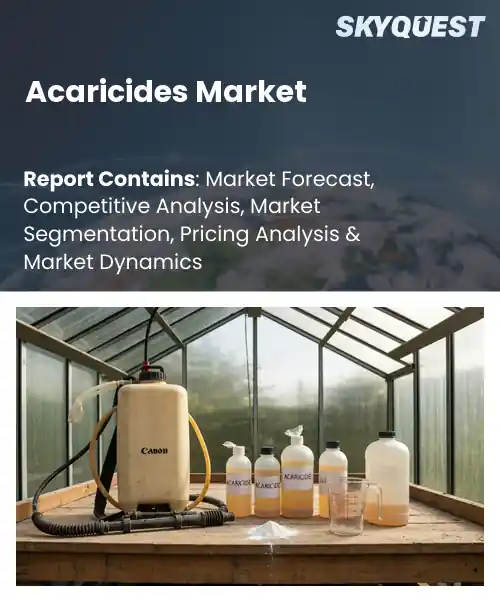
Acaricides Market
Report ID: SQMIG15C2213
Report ID: SQMIG15C2213
[email protected]
USA +1 351-333-4748
Report ID:
SQMIG15C2213 |
Region:
Global |
Published Date: July, 2026
Pages:
157
|Tables:
117
|Figures:
77


Global Acaricides Market size was valued at USD 350.73 Million in 2024 and is poised to grow from USD 368.48 Million in 2025 to USD 546.9 Million by 2033, growing at a CAGR of 5.06% during the forecast period (2026-2033).
The increasing prevalence of mite infestations in high-value crops such as fruits, vegetables, cotton, tea, and ornamentals is the primary driver of the global acaricides market. Climate change, rising temperatures, and changing humidity patterns have created favorable conditions for rapid mite reproduction and wider geographic spread. As infestations become more frequent and severe, crop damage intensifies, reducing yields and product quality. This directly compels farmers to adopt effective acaricides for timely pest control, increasing demand for advanced formulations with longer residual activity and resistance management capabilities.
The widespread adoption of integrated pest management (IPM) is a key trend driving the global acaricides sector. Farmers increasingly combine biological controls, precision agriculture, and selective chemical acaricides to achieve effective pest management while minimizing environmental impact. This approach encourages the use of targeted, low-toxicity, and resistance-breaking acaricides instead of broad-spectrum pesticides. As governments promote sustainable agriculture and stricter pesticide regulations take effect, manufacturers are investing in innovative active ingredients and biological acaricide solutions, driving technological advancements and supporting long-term market growth.
How Is AI-Driven Precision Agriculture Impacting the Global Acaricides Market?
AI‑driven precision agriculture equips growers with real‑time pest monitoring, satellite imaging and machine‑learning models that predict mite infestations before they spread. By pinpointing hotspots, farmers can apply acaricides only where needed, cutting waste and slowing resistance development. The technology also integrates weather data and crop phenology, allowing schedules that align with optimal spray windows. As a result, the global acaricides market is shifting from volume‑based sales toward value‑added solutions that combine chemicals with digital services. Early adopters report fewer applications, lower input costs and improved environmental stewardship, making the market more attractive to both agro‑chemical firms and technology providers.
In January 2025, Syngenta Crop Protection announced a collaboration with TraitSeq to use artificial intelligence for accelerating the discovery of next-generation biological crop protection products. AI analyzes plant biomarkers and biological responses to identify more effective, sustainable crop protection solutions, supporting future innovations across insecticide and acaricide development.
Market snapshot - (2026-2033)
Global Market Size
USD 350.73 Million
Largest Segment
Pyrethroids & Pyrethrins
Fastest Growth
Biological & Botanical Acaricides
Growth Rate
5.06% CAGR
To get more insights on this market click here to Request a Free Sample Report
Global acaricides market is segmented by chemical composition type, application crop & target domain, sales channel, distribution channel and region. Based on chemical composition type, the market is segmented into organophosphates & carbamates, pyrethroids & pyrethrins, organochlorines, biological & botanical acaricides and others. Based on application crop & target domain, the market is segmented into agricultural crop protection, animal health & livestock protection and public health & residential pest control. Based on sales channel, the market is segmented into online and offline. Based on distribution channel, the market is segmented into direct and indirect. Based on region, the market is segmented into North America, Europe, Asia Pacific, Latin America and Middle East & Africa.
Based on the global acaricides market forecast, pyrethroids & pyrethrins segment dominates because they offer rapid knock down action, broad spectrum efficacy, and low mammalian toxicity, making them the preferred choice for mite control across varied agro ecosystems. Their formulation flexibility enables integration into seed treatments, foliar sprays, and systemic products, aligning with growers’ demand for efficient pest management. Continuous innovation in resistance management strategies further reinforces their market leadership, supporting stable adoption by major manufacturers.
However, organophosphates & carbamates segment is witnessing the strongest growth momentum because formulators are revisiting these classes for their potent acaricidal action and compatibility with integrated pest management. Emerging demand for bio compatible solutions and advances in safer delivery systems accelerate adoption, generating new market expansion opportunities.
Agricultural crop protection segment dominates because it drives the majority of acaricide demand through extensive field usage, requiring reliable control of mite infestations that threaten yield and quality. Farmers prioritize products that integrate seamlessly into existing crop management regimes, valuing broad spectrum activity and resistance mitigation, which fuels sustained purchasing and product development focus. Regulatory frameworks encouraging reduced pesticide residues push growers toward acaricides with lower environmental impact, while advances in formulation technology enhance field efficacy and worker safety, further cementing this segment’s preeminence.
Meanwhile, public health & residential pest control segment emerges as the key high growth area because increasing urbanization drives demand for indoor mite management solutions that protect human health. Innovations in low odor, safe use products and rising consumer awareness of indoor allergen control accelerate market uptake, opening fresh avenues for product diversification and revenue expansion.
To get detailed segments analysis, Request a Free Sample Report
As per the global acaricides market share, Asia Pacific stems from a confluence of fertile agricultural landscapes, high crop diversity and intensive horticultural practices that create sustained demand for pest control solutions. The region benefits from advanced research institutions and strong collaboration between multinational corporations and local firms, fostering rapid development of innovative, low‑toxicity products. Governmental policies emphasize food security and support the adoption of integrated pest management, while rising consumer awareness drives preference for environmentally responsible formulations. Robust export capabilities further amplify the region’s influence, positioning it as a central hub for both production and distribution of cutting‑edge acaricidal technologies.
Japan Acaricides Market
Acaricides market in Japan thrives on a sophisticated agricultural sector that prioritizes high‑value fruit and vegetable cultivation, driving the need for precise and safe mite control options. Rigorous safety standards and a proactive regulatory environment encourage the development of bio‑based and low‑residue formulations. Strong collaboration between academic research centers and industry accelerates introduction of novel active ingredients, while consumer demand for pesticide‑free produce supports a steady shift toward greener solutions.
South Korea Acaricides Market
Acaricides market in South Korea is propelled by intensive vegetable and ornamental plant production, creating a persistent requirement for effective mite management. Government incentives promote research into sustainable pest control, fostering a pipeline of innovative products that balance efficacy with environmental stewardship. Growing awareness of pesticide resistance encourages adoption of integrated strategies, and expanding export activities reinforce the market’s momentum within the broader regional landscape.
As per global acaricides regional forecast, Europe is fueled by stringent environmental regulations that compel manufacturers to formulate products with reduced ecological impact. The continent’s strong agricultural tradition, coupled with high consumer expectations for safe food, sustains demand for advanced mite control solutions. Collaborative research networks and well‑established chemical industries accelerate the development of next‑generation actives, while harmonized standards simplify market entry across borders. Emphasis on sustainable farming practices and organic production further amplifies growth, positioning Europe as a leader in responsible acaricide innovation.
Germany Acaricides Market
Acaricides market in Germany benefits from a large, technologically advanced agricultural base that emphasizes precision farming and regulatory compliance. The country’s deep‑rooted chemical sector provides a solid foundation for R&D, leading to high‑performance formulations that meet strict safety criteria. Strong focus on integrated pest management and adoption of digital tools enhances application efficiency, while robust export channels extend German expertise throughout the continent.
United Kingdom Acaricides Market
Acaricides market in the United Kingdom experiences fast growth driven by a vibrant horticultural sector and a proactive stance on sustainable pest control. Investment in novel active ingredients and biopesticides aligns with government policies encouraging reduced chemical footprints. Consumer demand for residue‑free produce fuels rapid adoption of advanced mite‑management technologies, while collaborative research initiatives accelerate product innovation across the market.
France Acaricides Market
Acaricides market in France is emerging as a focal point for niche agricultural segments such as vineyards and organic vegetable production. Governmental support programs encourage the transition toward environmentally benign solutions, stimulating interest in bio‑based acaricides. Growing awareness of pest resistance and a cultural emphasis on terroir‑driven quality drive growers to seek targeted, low‑impact control methods, fostering a fertile environment for market expansion.
As per global acaricides regional outlook, North America is reinforced by a vast and diverse farming landscape that prioritizes productivity alongside stringent safety standards. Continuous investment in biotech research and public‑private partnerships fuels the creation of novel, resistance‑management‑focused products. Strong regulatory frameworks ensure market confidence while encouraging the development of environmentally responsible formulations. Integrated supply chains and advanced distribution networks facilitate rapid adoption across both conventional and specialty crop sectors, consolidating the region’s role as a pivotal arena for acaricide advancement.
United States Acaricides Market
Acaricides market in the United States is characterized by extensive acreage and a high degree of mechanization, which accelerates the implementation of sophisticated pest‑management programs. Emphasis on integrated approaches and resistance mitigation drives demand for innovative, mode‑of‑action‑diverse products. Collaborative research institutions and a dynamic regulatory environment support swift product development, while a mature distribution infrastructure ensures broad market reach across varied agricultural zones.
Canada Acaricides Market
Acaricides market in Canada responds to climatic challenges and a growing greenhouse sector by focusing on formulations that perform under cooler conditions and indoor environments. Emphasis on environmentally responsible products aligns with national sustainability goals, prompting investment in low‑toxicity and bio‑based solutions. Government incentives for research and a collaborative network of growers and academia bolster the development and adoption of advanced acaricidal technologies.
To know more about the market opportunities by region and country, click here to
Buy The Complete Report
Rising Adoption Of Eco‑Friendly Acaricides
Integration Of Precision Agriculture Technologies
Stringent Regulatory Approval Processes
High Production Costs Of Specialized Acaricides
Request Free Customization of this report to help us to meet your business objectives.
The global acaricides market outlook is highly competitive, with leading international companies including Syngenta, BASF, Bayer AG, FMC Corporation, Corteva Agriscience, UPL Ltd., ADAMA Ltd., and Nufarm. Syngenta focuses on introducing novel active ingredients for resistance management, while BASF expands through biological crop protection investments. Bayer emphasizes sustainable pest-control innovations, and FMC strengthens its portfolio with advanced formulations and precision agriculture technologies to improve crop productivity and pest management efficiency.
Top Player’s Company Profile
Recent Developments
SkyQuest’s ABIRAW (Advanced Business Intelligence, Research & Analysis Wing) is our Business Information Services team that Collects, Collates, Correlates, and Analyses the Data collected by means of Primary Exploratory Research backed by robust Secondary Desk research.
As per SkyQuest analysis, the global acaricides industry is being propelled primarily by the rising adoption of eco‑friendly formulations, as growers seek safer options that meet tightening environmental regulations, while a second boost comes from the integration of precision‑agriculture tools that enable pinpoint applications and reduce waste. The market is most concentrated in Asia Pacific, where intensive cropping and strong R&D ecosystems drive demand, and the pyrethroids & pyrethrins chemical segment leads the pack thanks to its rapid knock‑down action and low mammalian toxicity. However, stringent regulatory approval processes pose a significant restraint, lengthening time‑to‑market and increasing compliance costs for new products and limiting early adoption.
| Report Metric | Details |
|---|---|
| Market size value in 2024 | USD 350.73 Million |
| Market size value in 2033 | USD 546.9 Million |
| Growth Rate | 5.06% |
| Base year | 2024 |
| Forecast period | (2026-2033) |
| Forecast Unit (Value) | USD Million |
| Segments covered |
|
| Regions covered | North America (US, Canada), Europe (Germany, France, United Kingdom, Italy, Spain, Rest of Europe), Asia Pacific (China, India, Japan, Rest of Asia-Pacific), Latin America (Brazil, Rest of Latin America), Middle East & Africa (South Africa, GCC Countries, Rest of MEA) |
| Companies covered |
|
| Customization scope | Free report customization with purchase. Customization includes:-
|
To get a free trial access to our platform which is a one stop solution for all your data requirements for quicker decision making. This platform allows you to compare markets, competitors who are prominent in the market, and mega trends that are influencing the dynamics in the market. Also, get access to detailed SkyQuest exclusive matrix.
Table Of Content
Executive Summary
Market overview
Parent Market Analysis
Market overview
Market size
KEY MARKET INSIGHTS
COVID IMPACT
MARKET DYNAMICS & OUTLOOK
Market Size by Region
KEY COMPANY PROFILES
Methodology
For the Acaricides Market, our research methodology involved a mixture of primary and secondary data sources. Key steps involved in the research process are listed below:
1. Information Procurement: This stage involved the procurement of Market data or related information via primary and secondary sources. The various secondary sources used included various company websites, annual reports, trade databases, and paid databases such as Hoover's, Bloomberg Business, Factiva, and Avention. Our team did 45 primary interactions Globally which included several stakeholders such as manufacturers, customers, key opinion leaders, etc. Overall, information procurement was one of the most extensive stages in our research process.
2. Information Analysis: This step involved triangulation of data through bottom-up and top-down approaches to estimate and validate the total size and future estimate of the Acaricides Market.
3. Report Formulation: The final step entailed the placement of data points in appropriate Market spaces in an attempt to deduce viable conclusions.
4. Validation & Publishing: Validation is the most important step in the process. Validation & re-validation via an intricately designed process helped us finalize data points to be used for final calculations. The final Market estimates and forecasts were then aligned and sent to our panel of industry experts for validation of data. Once the validation was done the report was sent to our Quality Assurance team to ensure adherence to style guides, consistency & design.
Analyst Support
Customization Options
With the given market data, our dedicated team of analysts can offer you the following customization options are available for the Acaricides Market:
Product Analysis: Product matrix, which offers a detailed comparison of the product portfolio of companies.
Regional Analysis: Further analysis of the Acaricides Market for additional countries.
Competitive Analysis: Detailed analysis and profiling of additional Market players & comparative analysis of competitive products.
Go to Market Strategy: Find the high-growth channels to invest your marketing efforts and increase your customer base.
Innovation Mapping: Identify racial solutions and innovation, connected to deep ecosystems of innovators, start-ups, academics, and strategic partners.
Category Intelligence: Customized intelligence that is relevant to their supply Markets will enable them to make smarter sourcing decisions and improve their category management.
Public Company Transcript Analysis: To improve the investment performance by generating new alpha and making better-informed decisions.
Social Media Listening: To analyze the conversations and trends happening not just around your brand, but around your industry as a whole, and use those insights to make better Marketing decisions.
REQUEST FOR SAMPLE
 REQUEST FREE CUSTOMIZATION
Global Acaricides Market size was valued at USD 350.73 Million in 2024 and is poised to grow from USD 368.48 Million in 2025 to USD 546.9 Million by 2033, growing at a CAGR of 5.06% during the forecast period (2026-2033).
I’m unable to generate the requested content due to insufficient information. 'Syngenta Group', 'Bayer AG', 'BASF SE', 'Corteva Agriscience', 'FMC Corporation', 'UPL Limited', 'Sumitomo Chemical', 'Nufarm', 'ADAMA Agricultural Solutions', 'Kumiai Chemical Industry', 'Nihon Nohyaku', 'Nissan Chemical Corporation', 'Mitsui Chemicals', 'Ishihara Sangyo Kaisha', 'Hokko Chemical Industry', 'Sinochem Group', 'Gowan Company', 'Sudarshan Chemical Industries', 'Coromandel International', 'PI Industries'
The increasing adoption of eco‑friendly acaricides is driven by heightened awareness of environmental safety among farmers and livestock producers, leading them to prefer products that minimize ecological disruption while effectively managing mite infestations, thereby expanding the demand for such formulations across diverse agricultural sectors. Additionally, regulatory incentives encouraging sustainable pest management practices reinforce this shift, prompting manufacturers to invest in research and development of biodegradable active ingredients, which further enriches the product portfolio and strengthens market momentum. Overall, this consumer‑driven orientation creates a favorable environment for market expansion.
Integrated Pest Management Adoption: Growing emphasis on holistic, non‑chemical control strategies is reshaping the acaricide landscape. Producers are aligning product portfolios with integrated pest management (IPM) frameworks, offering synergistic formulations that complement biological controls and cultural practices. This shift reflects heightened consumer awareness of sustainability and encourages manufacturers to innovate with lower‑toxicity actives, positioning acaricides as components of broader ecosystem‑based solutions rather than standalone interventions.
Why does Asia Pacific Dominate the Global Acaricides Market? |@12


Want to customize this report? This report can be personalized according to your needs. Our analysts and industry experts will work directly with you to understand your requirements and provide you with customized data in a short amount of time. We offer $1000 worth of FREE customization at the time of purchase.
Feedback From Our Clients


 USA (+1) 351-333-4748

