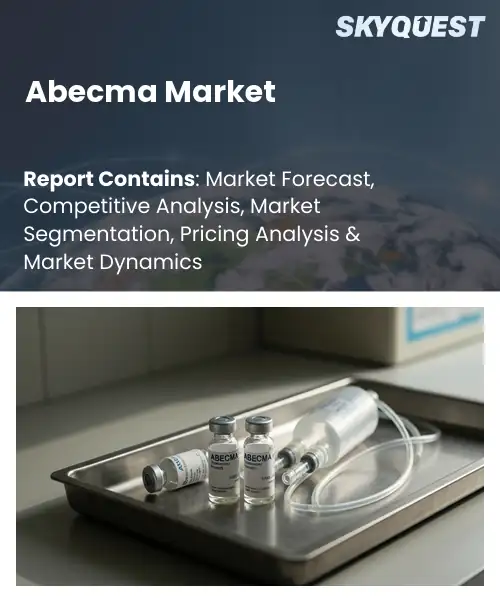
Abecma Market
Report ID: SQMIG20I2881
Report ID: SQMIG20I2881
[email protected]
USA +1 351-333-4748
Report ID:
SQMIG20I2881 |
Region:
Global |
Published Date: April, 2026
Pages:
157
|Tables:
88
|Figures:
76


Global Abecma Market size was valued at USD 1.12 Billion in 2024 and is poised to grow from USD 1.33 Billion in 2025 to USD 1.1 Billion by 2033, growing at a CAGR of 18.4% during the forecast period (2026-2033).
The Abecma market centers on the commercial deployment of idecabtagene vicleucel, an autologous BCMA-targeting CAR-T therapy indicated for relapsed and refractory multiple myeloma, and it matters because it represents a new class of personalized cellular medicines with durable responses where prior therapies failed. Its development accelerated after regulatory approvals in major jurisdictions and real-world evidence demonstrating deep response rates, prompting health systems to invest in specialized infusion centers and cold-chain logistics. Historically, the market evolved from early academic trials to commercial-scale manufacturing, illustrated by capacity expansions and partnerships, while competitors and biosimilars have begun to influence pricing dynamics and positioning.A primary factor shaping the global Abecma market is manufacturing scale and cost, because efficient autologous production reduces turnaround time and lowers per-dose expenses, which in turn persuades payers to approve reimbursement and hospitals to adopt the therapy beyond tertiary centers. As real-world cases of triple-class refractory myeloma patients achieving meaningful remissions are published, demand increases and spurs investments in decentralized manufacturing, standardized apheresis programs, and outcome-based contracting. Consequently, expanded indications into earlier lines of therapy become commercially viable, enabling partnerships between manufacturers and regional health systems and creating opportunities for pricing models tied to long-term patient outcomes and robust data.
How is AI reshaping Abecma market access strategies?
AI is reshaping Abecma market access strategies by tightening the link between evidence, patient pathways, and operations. Machine learning applied to EHR and claims data accelerates real world evidence generation that strengthens value narratives for payers. Predictive analytics improve patient identification and referral to qualified treatment centers, reducing time to therapy. AI also helps forecast demand and optimize manufacturing and logistics, easing historic supply bottlenecks for autologous cell therapies. Together these capabilities make targeted payer engagement and outcomes based contracting more practicable while helping manufacturers and providers focus resources where patient benefit is clearest.Bristol Myers Squibb March 2025, acquired 2seventy bio giving full control of Abecma, enabling tighter integration of commercialization and data analytics. Pairing that consolidation with AI driven RWE and supply chain tools can streamline reimbursement conversations and improve treatment access efficiency.
Market snapshot - (2026-2033)
Global Market Size
USD 1.12 Billion
Largest Segment
Auto & Mortgage Finance
Fastest Growth
Consumer Durable Loans & EMIs
Growth Rate
18.4% CAGR
To get more insights on this market click here to Request a Free Sample Report
Global abecma market is segmented by product category, service provider, distribution channel and region. Based on product category, the market is segmented into Consumer Durable Loans & EMIs, Personal Loans & Credit Cards and Auto & Mortgage Finance. Based on service provider, the market is segmented into Traditional Banks & NBFCs and Fintechs & BNPL (Buy Now Pay Later) Platforms. Based on distribution channel, the market is segmented into Point-of-Sale (POS) Financing and Direct-to-Consumer (Online/Mobile Apps). Based on region, the market is segmented into North America, Europe, Asia Pacific, Latin America and Middle East & Africa.
Consumer Durable Loans & EMIs segment leads because familiarity of these mechanisms with patients and hospitals reduces upfront financial friction for abecma treatment, enabling adoption where out of pocket costs would otherwise block access. Healthcare providers often integrate EMI options into billing workflows, creating predictable payment trails that satisfy institutional accounting and payer requirements, which in turn encourages treatment uptake and streamlines administrative approvals through clearer payment commitments.
However, Personal Loans & Credit Cards are emerging as the most rapidly expanding area as flexible unsecured financing appeals to patients seeking quick coverage for abecma procedures. Lenders are designing medical loan products and rewards-based credit structures that accelerate decision timelines and broaden payer mixes, thereby catalyzing access expansion and creating new funding pathways.
Traditional Banks & NBFCs segment dominates because established relationships with healthcare institutions and deeper capital pools allow underwriting of high cost, complex therapies like abecma with structured repayment frameworks. Their credibility with insurers and clinical providers reduces perceived risk, encouraging bundled financing arrangements and institutional credit facilities that stabilize cash flows for treatment centers and support wider clinician adoption through trusted, long term funding commitments.
Meanwhile, Fintechs & BNPL (Buy Now Pay Later) Platforms are the fastest growing force, leveraging digital underwriting, modular payment plans and rapid integration into hospital and pharmacy checkouts to lower barriers for abecma uptake. Their agility in tailoring oncology financing and embedding value added services expands patient reach and creates scalable channels for future market growth.
To get detailed segments analysis, Request a Free Sample Report
North America commands the global Abecma market through an ecosystem that combines concentrated clinical expertise, mature regulatory engagement, and robust private and public investment in advanced therapies. Leading academic medical centers and specialized treatment networks drive early clinical integration, while experienced contract manufacturers and established supply chains support reliable product delivery. Payer frameworks, though complex, have mechanisms to recognize specialized treatment value, enabling structured reimbursement pathways. Strong patient advocacy organizations and referral networks increase awareness and facilitate timely access. The region's capacity for translational research, coordinated multi-stakeholder initiatives, and experience with complex biologic therapies creates an environment where novel cellular treatments can progress from clinical development to routine clinical use more predictably than in many other markets. Ongoing collaboration across stakeholders sustains programmatic maturity and operational scalability.
Abecma Market in the United States benefits from concentrated clinical expertise, advanced manufacturing infrastructure, and integrated care pathways that facilitate adoption. Payers and specialty centers engage in collaborative decision making, while academic hubs contribute to knowledge generation and clinical training. Regulatory familiarity and established distribution channels enable more predictable access. Patient advocacy and referral networks support early uptake, and ongoing investment fuels programmatic expansion and collaborative refinement.
Abecma Market in Canada is shaped by a networked healthcare environment, provincial program coordination, and a focus on equitable access across geographies. Centers of excellence partner with national research institutions to adapt protocols to local delivery models. Reimbursement frameworks emphasize value-based care and multidisciplinary pathways, supporting referral consolidation. Capacity building in specialized treatment centers, clinician training, and patient support programs underpins measured growth and gradual broadening of therapy availability nationwide.
Europe is experiencing rapid expansion in the Abecma market driven by coordinated clinical networks, increasing capacity at specialized centers, and collaborative regulatory pathways that support cross-border clinical programs. Investment in regional manufacturing and distribution is reducing logistical barriers, while pan-European research consortia and academic partnerships accelerate clinical evidence generation. Diverse payer models are engaging in outcomes-based discussions, creating pathways for structured access. Patient advocacy and physician education initiatives raise awareness and referral consistency. The combined effect of infrastructure buildout, strategic public-private collaboration, and focus on scalable delivery models positions Europe as a dynamic growth region for advanced cellular therapies. Regulatory guidance that facilitates harmonized clinical development and reimbursement pilots encourages investment, while localized center accreditation programs improve treatment consistency and patient outcomes across multiple markets.
Abecma Market in Germany is anchored by academic hospitals and specialized treatment centers with a strong biotech manufacturing base supporting advanced therapy integration. Clinical leadership and technical expertise enable patient referral and standardized care pathways. Health system structures and collaborative industry relationships foster reimbursement dialogue and operational readiness. Emphasis on center accreditation, clinician training, and multidisciplinary teams underpins reliable delivery and continued clinical program development and broader regional coordination efforts.
Abecma Market in the United Kingdom is characterized by an agile regulatory environment, strong translational research hubs, and focused investment in specialized delivery networks that accelerate clinical adoption. Collaborative initiatives among academic centers, healthcare providers, and patient groups enhance referral pathways. Emphasis on scalable service models, workforce training, and integrated care protocols supports program rollout. Payer engagement and innovative access arrangements contribute to expanding clinical availability and improved patient pathways.
Abecma Market in France is emerging through targeted investments in specialized oncology centers, clinician training programs, and growing collaboration between industry and research institutions. Policy dialogues emphasize equitable access and integration of complex therapies into established care pathways. Center certification initiatives help standardize clinical practice and patient logistics. Strengthening manufacturing partnerships and coordinated referral networks supports expansion of treatment capacity and alignment of clinical protocols across the healthcare landscape nationally.
Asia Pacific is strengthening its role in the Abecma market through strategic investments in clinical capacity, localized manufacturing, and regulatory modernization that together support broader regional adoption. Governments and private stakeholders are prioritizing centers of excellence and workforce development to manage complex treatment delivery. Cross-border research collaborations and technology transfer initiatives help build technical capabilities and supply resilience. Emerging reimbursement discussions and pilot programs are promoting tailored access pathways. As infrastructure matures and stakeholder coordination improves, the region is better positioned to offer sustainable delivery models and to participate more fully in clinical development and commercial deployment of advanced cellular therapies. Focused efforts on regulatory alignment, quality standards, and public-private partnerships enhance investment attractiveness and clinical trial capacity. Regional coordination on manufacturing best practices and patient referral pathways supports scale-up of complex therapies across multiple healthcare systems.
Abecma Market in Japan benefits from advanced biomedical research institutions, strong manufacturing capabilities, and a regulatory environment tailored to innovative therapies. Collaborative networks among hospitals, industry, and academic centers support clinical translation. Emphasis on center accreditation and clinician specialization aids consistent delivery, while national healthcare frameworks engage in access discussions that consider long term value. Investment in workforce development and logistics strengthens capacity to integrate cellular therapies into clinical pathways.
Abecma Market in South Korea is advancing through concentrated government investment in biologics manufacturing, skilled clinical centers, and streamlined regulatory initiatives that support novel therapy adoption. Strong ties between industry and research hospitals accelerate translation of trials into clinical programs. Focus on training multidisciplinary teams and establishing specialized treatment centers improves operational readiness. Engagement with payers and pilot access arrangements reinforce care pathways, while technology transfer supports domestic production capacity.
To know more about the market opportunities by region and country, click here to
Buy The Complete Report
Increased Adoption Of Abecma
Expanding Reimbursement Support Globally
High Treatment Complexity and Costs
Manufacturing Capacity Constraints
Request Free Customization of this report to help us to meet your business objectives.
Competition in the global Abecma market is intensifying as autologous BCMA CAR T incumbents face pressure from allogeneic, bispecific and in vivo CAR T entrants. Competitive dynamics are driven by targeted M&A and strategic pharma partnerships such as Kite Pharma acquiring Interius and Janssen partnering with Legend Biotech for cilta cel, plus rapid tech innovation in in vivo CAR T and manufacturing scale up.
Top Player’s Company Profile
Recent Developments
SkyQuest’s ABIRAW (Advanced Business Intelligence, Research & Analysis Wing) is our Business Information Services team that Collects, Collates, Correlates, and Analyses the Data collected by means of Primary Exploratory Research backed by robust Secondary Desk research. As per SkyQuest analysis, one key driver is increased clinician adoption of Abecma and rising real-world evidence demonstrating durable responses, while one restraint is high treatment complexity and costs that limit center availability and uptake. North America dominates the market due to concentrated clinical expertise, manufacturing capacity and payer frameworks, and the consumer durable loans and EMIs segment is the leading financing channel that reduces upfront patient friction. A second driver is expanding reimbursement support globally, which together with manufacturing and logistical improvements is enabling broader access and incentivizing investment in decentralized production, outcome-based contracting and integrated care pathways across specialist and community settings.
| Report Metric | Details |
|---|---|
| Market size value in 2024 | USD 1.12 Billion |
| Market size value in 2033 | USD 1.1 Billion |
| Growth Rate | 18.4% |
| Base year | 2024 |
| Forecast period | (2026-2033) |
| Forecast Unit (Value) | USD Billion |
| Segments covered |
|
| Regions covered | North America (US, Canada), Europe (Germany, France, United Kingdom, Italy, Spain, Rest of Europe), Asia Pacific (China, India, Japan, Rest of Asia-Pacific), Latin America (Brazil, Rest of Latin America), Middle East & Africa (South Africa, GCC Countries, Rest of MEA) |
| Companies covered |
|
| Customization scope | Free report customization with purchase. Customization includes:-
|
To get a free trial access to our platform which is a one stop solution for all your data requirements for quicker decision making. This platform allows you to compare markets, competitors who are prominent in the market, and mega trends that are influencing the dynamics in the market. Also, get access to detailed SkyQuest exclusive matrix.
Table Of Content
Executive Summary
Market overview
Parent Market Analysis
Market overview
Market size
KEY MARKET INSIGHTS
COVID IMPACT
MARKET DYNAMICS & OUTLOOK
Market Size by Region
KEY COMPANY PROFILES
Methodology
For the Abecma Market, our research methodology involved a mixture of primary and secondary data sources. Key steps involved in the research process are listed below:
1. Information Procurement: This stage involved the procurement of Market data or related information via primary and secondary sources. The various secondary sources used included various company websites, annual reports, trade databases, and paid databases such as Hoover's, Bloomberg Business, Factiva, and Avention. Our team did 45 primary interactions Globally which included several stakeholders such as manufacturers, customers, key opinion leaders, etc. Overall, information procurement was one of the most extensive stages in our research process.
2. Information Analysis: This step involved triangulation of data through bottom-up and top-down approaches to estimate and validate the total size and future estimate of the Abecma Market.
3. Report Formulation: The final step entailed the placement of data points in appropriate Market spaces in an attempt to deduce viable conclusions.
4. Validation & Publishing: Validation is the most important step in the process. Validation & re-validation via an intricately designed process helped us finalize data points to be used for final calculations. The final Market estimates and forecasts were then aligned and sent to our panel of industry experts for validation of data. Once the validation was done the report was sent to our Quality Assurance team to ensure adherence to style guides, consistency & design.
Analyst Support
Customization Options
With the given market data, our dedicated team of analysts can offer you the following customization options are available for the Abecma Market:
Product Analysis: Product matrix, which offers a detailed comparison of the product portfolio of companies.
Regional Analysis: Further analysis of the Abecma Market for additional countries.
Competitive Analysis: Detailed analysis and profiling of additional Market players & comparative analysis of competitive products.
Go to Market Strategy: Find the high-growth channels to invest your marketing efforts and increase your customer base.
Innovation Mapping: Identify racial solutions and innovation, connected to deep ecosystems of innovators, start-ups, academics, and strategic partners.
Category Intelligence: Customized intelligence that is relevant to their supply Markets will enable them to make smarter sourcing decisions and improve their category management.
Public Company Transcript Analysis: To improve the investment performance by generating new alpha and making better-informed decisions.
Social Media Listening: To analyze the conversations and trends happening not just around your brand, but around your industry as a whole, and use those insights to make better Marketing decisions.
REQUEST FOR SAMPLE
 REQUEST FREE CUSTOMIZATION


Want to customize this report? This report can be personalized according to your needs. Our analysts and industry experts will work directly with you to understand your requirements and provide you with customized data in a short amount of time. We offer $1000 worth of FREE customization at the time of purchase.
Feedback From Our Clients


 USA (+1) 351-333-4748

