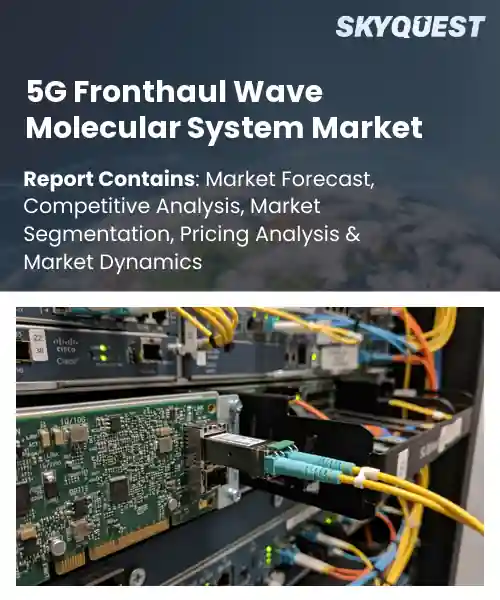
5G Fronthaul Wave Molecular System Market

Report ID: SQMIG45H2328

[email protected]
USA +1 351-333-4748

5G Fronthaul Wave Molecular System Market Size, Share, and Growth Analysis

5G Fronthaul Wave Molecular System Market

5G Fronthaul Wave Molecular System Market By Component (Hardware, Software, Services), By Deployment (Urban Networks, Suburban Networks, Rural Networks), By Application (Telecom Operators, Private 5G Networks, Data Centers), By End User, By Region - Industry Forecast 2026-2033


Report ID: SQMIG45H2328 | Region: Global | Published Date: August, 2026
Pages: 157 |Tables: 117 |Figures: 77

Format - word format excel data power point presentation

5G Fronthaul Wave Molecular System Market Insights

Global 5G Fronthaul Wave Molecular System Market size was valued at USD 1.17 Billion in 2024 and is poised to grow from USD 1.4 Billion in 2025 to USD 5.78 Billion by 2033, growing at a CAGR of 19.4% during the forecast period (2026-2033).

Beyond latency, the key growth driver for the 5G fronthaul molecular system market is the fusion of edge computing with small‑cell networks, which forces carriers to provide fronthaul that can absorb petabit traffic spikes. This pushes investment toward platforms that merge wavelength‑division multiplexing and adaptive beam‑steering, allowing bandwidth allocation to verticals such as smart factories and surgery. Samsung’s 5G Open RAN trial in South Korea used a terahertz fronthaul link to achieve fast response for robotic assembly, prompting regional operators to allocate capital for rolls. Ecosystem creates revenue from leased fronthaul capacity and speeds the deployment of latency‑critical services worldwide.

How are AI and IoT driving growth in the 5G fronthaul wave molecular system market?

AI enhances 5G fronthaul wave molecular systems by optimizing signal routing and predicting network congestion, while IoT proliferates connected devices that demand higher bandwidth and ultra‑low latency. Together they push operators to upgrade fronthaul infrastructure, integrating smart analytics and edge processing. This synergy fuels demand for more adaptable, high‑capacity wave modules that can manage massive data streams. Vendors are embedding AI‑driven orchestration tools, allowing dynamic spectrum allocation and real‑time fault detection, which reduces operational costs. Meanwhile, IoT deployments in manufacturing, logistics and smart cities generate continuous traffic, reinforcing the need for resilient, scalable fronthaul solutions that can scale with emerging use cases.In April 2026 a leading vendor unveiled an AI‑enabled fronthaul module that autonomously adjusts wave parameters based on IoT sensor inputs, boosting network efficiency and supporting rapid growth in the market.

Market snapshot - (2026-2033)

Global Market Size

USD 1.17 Billion

Largest Segment

Hardware

Fastest Growth

Services

Growth Rate

19.4% CAGR

5G Fronthaul Wave Molecular System Market ($ Bn)
Country Share for Asia Pacific Region (%)

To get more insights on this market click here to Request a Free Sample Report

5G Fronthaul Wave Molecular System Market Segments Analysis

Global 5g fronthaul wave molecular system market is segmented by component, deployment, application, end user and region. Based on component, the market is segmented into Hardware, Software and Services. Based on deployment, the market is segmented into Urban Networks, Suburban Networks and Rural Networks. Based on application, the market is segmented into Telecom Operators, Private 5G Networks and Data Centers. Based on end user, the market is segmented into Telecom Service Providers, Enterprises and Government & Defense. Based on region, the market is segmented into North America, Europe, Asia Pacific, Latin America and Middle East & Africa.

What role does hardware play in shaping the 5G fronthaul wave molecular system market?

Hardware segment dominates because it provides the essential physical infrastructure that enables the high frequency wave propagation required for 5G fronthaul. The reliability of optical modules, antenna arrays, and RF front end units directly influences network latency and capacity, making hardware the foundation of overall system performance. Continuous innovation in miniaturization and integration drives demand, as operators seek increasingly compact, power efficient solutions that can be deployed at scale globally.

Meanwhile, Software segment is witnessing growth momentum in the 5G fronthaul wave molecular system market. Advanced signal processing algorithms, AI driven network orchestration, and cloud native management platforms are unlocking levels of efficiency, prompting operators to adopt software solutions that accelerate deployment cycles and enable resource allocation across infrastructures.

how are telecom operators influencing the evolution of the 5G fronthaul wave molecular system market?

Telecom operators segment leads because they control the majority of network rollout strategies and investment decisions that shape the 5G fronthaul wave molecular system landscape. Their existing infrastructure, regulatory obligations, and need for high capacity transport drive the adoption of advanced fronthaul solutions. Continuous pressure to meet consumer demand for ultra low latency and massive bandwidth ensures that operators prioritize robust, scalable technologies, reinforcing their central role in market development.

On the other hand, Private 5G networks segment emerges as a high growth area in the 5G fronthaul wave molecular system market. Enterprises and industrial players are deploying networks to achieve reliable connectivity, prompting adoption of fronthaul solutions that support low latency and edge computing workloads, thereby expanding market opportunities.

5G Fronthaul Wave Molecular System Market By Component

To get detailed segments analysis, Request a Free Sample Report

5G Fronthaul Wave Molecular System Market Regional Insights

Why does Asia Pacific Dominate the Global 5G Fronthaul Wave Molecular System Market?

The Asia Pacific region leverages a confluence of advanced engineering capabilities, robust telecommunications infrastructure, and proactive government policies that champion next‑generation connectivity. Strong collaboration between semiconductor manufacturers, network equipment providers, and research institutions fuels continuous innovation in wave molecular technologies. Market participants benefit from a deep talent pool specialized in high‑frequency design and a culture that embraces rapid deployment of cutting‑edge solutions. Additionally, the region’s emphasis on integrated network planning and dense urban deployment creates an environment where fronthaul solutions are essential for meeting escalating data demand. Together these factors reinforce Asia Pacific’s leadership position and drive sustained momentum across the ecosystem.

Japan 5G Fronthaul Wave Molecular System Market

5G Fronthaul Wave Molecular System Market in Japan is shaped by a mature manufacturing base and a strategic focus on high‑performance networking. Leading optical component firms collaborate closely with carriers to tailor solutions that address the country’s densely populated corridors. Policy frameworks encourage investment in resilient infrastructure, while academic partnerships nurture a pipeline of technical expertise. This synergy enables Japan to deliver sophisticated fronthaul architectures that support evolving service requirements.

South Korea 5G Fronthaul Wave Molecular System Market

5G Fronthaul Wave Molecular System Market in South Korea benefits from a culture of rapid technology adoption and a strong emphasis on telecommunications excellence. Domestic equipment providers specialize in compact, high‑efficiency wave molecular designs that align with the nation’s ambitious connectivity goals. Government initiatives foster ecosystem collaboration, linking research institutes with commercial players to accelerate solution refinement. This collaborative environment positions South Korea as a pivotal contributor to regional market dynamics.

What is Driving the Rapid Expansion of 5G Fronthaul Wave Molecular System Market in North America?

North America experiences rapid expansion due to a vibrant ecosystem of innovators, substantial investment in network densification, and a regulatory environment that encourages spectrum efficiency. Leading carriers prioritize the deployment of high‑capacity fronthaul to support emerging applications such as immersive media and industrial automation. The presence of world‑class research universities and technology hubs accelerates the development of cutting‑edge wave molecular components. Furthermore, a strong emphasis on interoperability and standardization ensures seamless integration across diverse network segments, reinforcing confidence among stakeholders and spurring broader adoption across the continent.

United States 5G Fronthaul Wave Molecular System Market

5G Fronthaul Wave Molecular System Market in the United States is propelled by a dynamic blend of carrier ambition and technology entrepreneurship. Major network operators collaborate with silicon innovators to push the limits of bandwidth and latency, while venture capital fuels rapid scaling of specialized startups. Academic research centers contribute breakthroughs in wave molecular engineering, translating into commercial solutions that address the country’s expansive geographic and usage diversity. This ecosystem nurtures continuous advancement and market growth.

Canada 5G Fronthaul Wave Molecular System Market

5G Fronthaul Wave Molecular System Market in Canada reflects a strategic focus on reliable connectivity across vast and varied terrains. Canadian telecom providers partner with local research institutes to develop resilient wave molecular architectures that can operate efficiently in challenging climates. Policy support emphasizes digital inclusion, encouraging investments that extend high‑performance fronthaul into underserved regions. Collaborative efforts between industry and academia foster innovative designs tailored to the nation’s specific network demands.

How is Europe Strengthening its Position in 5G Fronthaul Wave Molecular System Market?

Europe strengthens its position through coordinated standards development, cross‑border collaboration, and a commitment to sustainable network evolution. Regional alliances among telecom operators, equipment manufacturers, and research consortia drive harmonized deployment strategies that maximize spectrum utilization. Emphasis on energy‑efficient designs aligns with broader environmental objectives, encouraging the integration of wave molecular technologies that reduce power consumption. Moreover, a strong tradition of engineering excellence and a supportive policy landscape facilitate the rollout of advanced fronthaul solutions across diverse market segments, enhancing Europe’s competitive standing.

Germany 5G Fronthaul Wave Molecular System Market

5G Fronthaul Wave Molecular System Market in Germany benefits from a robust industrial base and a focus on precision engineering. Leading optics firms collaborate with carriers to deliver high‑performance fronthaul solutions that meet stringent quality and reliability standards. Strong research institutions contribute cutting‑edge insights, fostering continuous improvement of wave molecular components. This combination of manufacturing depth and academic expertise drives Germany’s prominent role in the European market.

United Kingdom 5G Fronthaul Wave Molecular System Market

5G Fronthaul Wave Molecular System Market in the United Kingdom is characterized by a vibrant innovation ecosystem and strategic investment in digital infrastructure. Telecom operators work closely with technology incubators to prototype and commercialize advanced wave molecular designs. Government initiatives support the integration of high‑capacity fronthaul into urban and suburban networks, promoting seamless service delivery. This collaborative approach reinforces the United Kingdom’s influence within the broader European landscape.

France 5G Fronthaul Wave Molecular System Market

5G Fronthaul Wave Molecular System Market in France leverages a strong tradition of telecommunications research and a proactive regulatory framework. National carriers partner with leading research laboratories to refine wave molecular technologies that enhance network efficiency. Emphasis on sustainable deployment aligns with France’s broader environmental goals, encouraging solutions that balance performance with energy stewardship. These efforts collectively elevate France’s contribution to the European market.

5G Fronthaul Wave Molecular System Market By Geography
  • Largest
  • Fastest

To know more about the market opportunities by region and country, click here to
Buy The Complete Report

5G Fronthaul Wave Molecular System Market Dynamics

Drivers

Rising Need for Low Latency

  • The surge in applications such as autonomous vehicles, augmented reality, and industrial automation creates a compelling requirement for ultra‑low latency connections, prompting operators to prioritize fronthaul solutions that can deliver near‑real‑time data transport. This demand accelerates investment in advanced wave molecular technologies, as they enable rapid signal processing and minimal transmission delays, thereby supporting the broader rollout of 5G services and reinforcing market expansion through enhanced user experiences and new service monetization opportunities and fostering stronger partnerships across the telecom ecosystem.

Adoption of Virtualized Network Functions

  • Telecom operators are increasingly leveraging software‑defined networking and cloud‑native architectures, which require flexible and scalable fronthaul infrastructures. Wave molecular systems provide the adaptability needed to dynamically allocate bandwidth and reconfigure network topologies, aligning with the shift toward virtualized services. This alignment encourages operators to adopt these solutions, driving market growth as they seek to reduce operational complexity, improve resource utilization, and accelerate the deployment of next‑generation 5G features across diverse deployment scenarios and ensuring consistent quality of service for end‑users.

Restraints

High Capital Expenditure Requirements

  • The deployment of wave molecular fronthaul solutions often entails substantial upfront capital outlays for specialized hardware, installation, and integration activities. Such high expenditure can deter smaller operators or those with limited budgetary flexibility, leading to delayed adoption or preference for less costly legacy alternatives. Consequently, the market experiences slower penetration rates as financial constraints inhibit widespread rollout, especially in regions where investment cycles are tightly regulated or where return‑on‑investment timelines are uncertain and may affect long‑term strategic planning for network evolution.

Complex Integration With Legacy Systems

  • Integrating wave molecular fronthaul technology with existing legacy transport networks presents significant technical complexity, requiring extensive engineering effort and specialized expertise. Compatibility issues, such as differing signal formats and synchronization protocols, can lead to prolonged deployment timelines and increased risk of service disruption. These challenges discourage operators from rapidly transitioning to new solutions, thereby slowing market momentum as organizations prioritize stability and continuity over adopting innovative but potentially disruptive technologies. Furthermore, the need for comprehensive testing and validation further extends project schedules, reinforcing cautious adoption behavior among service providers.

Request Free Customization of this report to help us to meet your business objectives.

5G Fronthaul Wave Molecular System Market Competitive Landscape

The market is shaped by intense rivalry among photonics and semiconductor leaders such as II‑VI, Lumentum, Texas Instruments, Cisco and Huawei, each leveraging strategic M&A and joint‑development agreements to secure component supply chains and accelerate integration of advanced WDM and coherent‑optics technologies. Partnerships like the T‑Mobile, Intel and NASA 5G Open Innovation Lab foster ecosystem collaboration, while innovators such as Lanaotek’s semi‑active WDM solution illustrate how breakthrough product designs are being deployed to differentiate network performance and cost efficiency.

  • Arkenstone Defense: Established in 2026, their main objective is to enable Silicon Valley startups to access the U.S. defense market through tailored 5G and secure communications solutions. Recent development: launched with a $35 million seed round aimed at building a portfolio of defense‑grade 5G fronthaul technologies and accelerating go‑to‑market efforts.
  • Agave: Established in 2026, their main objective is to develop next‑generation 5G infrastructure platforms that combine edge computing and AI for high‑capacity fronthaul networks. Recent development: secured $15 million in funding to expand its R&D facilities, accelerate product prototyping of AI‑driven fronthaul management tools, and pursue strategic alliances with major telecom operators.

Top Player’s Company Profile

  • Huawei Technologies Co., Ltd.
  • Nokia Corporation
  • Telefonaktiebolaget LM Ericsson
  • ZTE Corporation
  • Cisco Systems, Inc.
  • Ciena Corporation
  • Infinera Corporation
  • Fujitsu Limited
  • NEC Corporation
  • Juniper Networks, Inc.
  • Ribbon Communications Inc.
  • Adtran Holdings, Inc.
  • CommScope Holding Company, Inc.
  • Corning Incorporated
  • Lumentum Holdings Inc.
  • Coherent Corp.
  • VIAVI Solutions Inc.
  • Broadcom Inc.
  • Marvell Technology, Inc.
  • Keysight Technologies, Inc.

Recent Developments

  • Cisco Systems and Fujitsu collaborated in July 2025 on an integrated 5G fronthaul optical transport solution that combines Cisco’s 800G wavelength‑division multiplexing platform with Fujitsu’s advanced photonic integrated circuits, delivering significantly reduced latency, enhanced spectral efficiency and simplified network orchestration for dense urban and enterprise deployments across multiple service providers and vertical industries.
  • Nokia and ZTE announced a joint venture to develop AI‑driven dynamic beamforming modules for 5G fronthaul, targeting suburban and metro scenarios, leveraging Nokia’s radio access expertise and ZTE’s silicon photonics, promising improved link robustness and energy efficiency for carriers aiming to reduce operational expenditures while scaling capacity in emerging smart‑city deployments.
  • Huawei Technologies launched its next‑generation Cloud‑Native Fronthaul Packet Engine in January 2025, supporting up to 400G per wavelength and seamless integration with Open RAN, enabling operators to virtualize the fronthaul layer and accelerate service rollout with lower CAPEX while providing end‑to‑end security features and programmable APIs that simplify network slicing for diverse vertical services.

5G Fronthaul Wave Molecular System Key Market Trends

5G Fronthaul Wave Molecular System Market SkyQuest Analysis

SkyQuest’s ABIRAW (Advanced Business Intelligence, Research & Analysis Wing) is our Business Information Services team that Collects, Collates, Correlates, and Analyses the Data collected by means of Primary Exploratory Research backed by robust Secondary Desk research. As per SkyQuest analysis the global 5G fronthaul wave molecular system market is projected to surge to $5.78 billion by 2033, driven primarily by the rising need for ultra‑low latency in applications such as autonomous vehicles and smart factories. A second strong catalyst is the widespread adoption of virtualized network functions, which pushes carriers to seek flexible, software‑enabled fronthaul platforms. High capital‑expenditure requirements remain the main restraint, slowing uptake among smaller operators and in regions with tighter budget cycles. Asia Pacific dominates the market thanks to its dense urban deployments and strong manufacturing base, while the hardware segment commands the largest share as the essential foundation of wave‑based transport solutions.

Report Metric Details
Market size value in 2024 USD 1.17 Billion
Market size value in 2033 USD 5.78 Billion
Growth Rate 19.4%
Base year 2024
Forecast period (2026-2033)
Forecast Unit (Value) USD Billion
Segments covered
  • Component
    • Hardware
      • Optical Transceivers
      • WDM Equipment
      • Fronthaul Gateways
    • Software
    • Services
  • Deployment
    • Urban Networks
    • Suburban Networks
    • Rural Networks
  • Application
    • Telecom Operators
    • Private 5G Networks
    • Data Centers
  • End User
    • Telecom Service Providers
    • Enterprises
    • Government & Defense
Regions covered North America (US, Canada), Europe (Germany, France, United Kingdom, Italy, Spain, Rest of Europe), Asia Pacific (China, India, Japan, Rest of Asia-Pacific), Latin America (Brazil, Rest of Latin America), Middle East & Africa (South Africa, GCC Countries, Rest of MEA)
Companies covered
  • Huawei Technologies Co., Ltd.
  • Nokia Corporation
  • Telefonaktiebolaget LM Ericsson
  • ZTE Corporation
  • Cisco Systems, Inc.
  • Ciena Corporation
  • Infinera Corporation
  • Fujitsu Limited
  • NEC Corporation
  • Juniper Networks, Inc.
  • Ribbon Communications Inc.
  • Adtran Holdings, Inc.
  • CommScope Holding Company, Inc.
  • Corning Incorporated
  • Lumentum Holdings Inc.
  • Coherent Corp.
  • VIAVI Solutions Inc.
  • Broadcom Inc.
  • Marvell Technology, Inc.
  • Keysight Technologies, Inc.
Customization scope

Free report customization with purchase. Customization includes:-

  • Segments by type, application, etc
  • Company profile
  • Market dynamics & outlook
  • Region

To get a free trial access to our platform which is a one stop solution for all your data requirements for quicker decision making. This platform allows you to compare markets, competitors who are prominent in the market, and mega trends that are influencing the dynamics in the market. Also, get access to detailed SkyQuest exclusive matrix.

Table Of Content

Executive Summary

Market overview

  • Exhibit: Executive Summary – Chart on Market Overview
  • Exhibit: Executive Summary – Data Table on Market Overview
  • Exhibit: Executive Summary – Chart on 5G Fronthaul Wave Molecular System Market Characteristics
  • Exhibit: Executive Summary – Chart on Market by Geography
  • Exhibit: Executive Summary – Chart on Market Segmentation
  • Exhibit: Executive Summary – Chart on Incremental Growth
  • Exhibit: Executive Summary – Data Table on Incremental Growth
  • Exhibit: Executive Summary – Chart on Vendor Market Positioning

Parent Market Analysis

Market overview

Market size

  • Market Dynamics
    • Exhibit: Impact analysis of DROC, 2021
      • Drivers
      • Opportunities
      • Restraints
      • Challenges
  • SWOT Analysis

KEY MARKET INSIGHTS

  • Technology Analysis
    • (Exhibit: Data Table: Name of technology and details)
  • Pricing Analysis
    • (Exhibit: Data Table: Name of technology and pricing details)
  • Supply Chain Analysis
    • (Exhibit: Detailed Supply Chain Presentation)
  • Value Chain Analysis
    • (Exhibit: Detailed Value Chain Presentation)
  • Ecosystem Of the Market
    • Exhibit: Parent Market Ecosystem Market Analysis
    • Exhibit: Market Characteristics of Parent Market
  • IP Analysis
    • (Exhibit: Data Table: Name of product/technology, patents filed, inventor/company name, acquiring firm)
  • Trade Analysis
    • (Exhibit: Data Table: Import and Export data details)
  • Startup Analysis
    • (Exhibit: Data Table: Emerging startups details)
  • Raw Material Analysis
    • (Exhibit: Data Table: Mapping of key raw materials)
  • Innovation Matrix
    • (Exhibit: Positioning Matrix: Mapping of new and existing technologies)
  • Pipeline product Analysis
    • (Exhibit: Data Table: Name of companies and pipeline products, regional mapping)
  • Macroeconomic Indicators

COVID IMPACT

  • Introduction
  • Impact On Economy—scenario Assessment
    • Exhibit: Data on GDP - Year-over-year growth 2016-2022 (%)
  • Revised Market Size
    • Exhibit: Data Table on 5G Fronthaul Wave Molecular System Market size and forecast 2021-2027 ($ million)
  • Impact Of COVID On Key Segments
    • Exhibit: Data Table on Segment Market size and forecast 2021-2027 ($ million)
  • COVID Strategies By Company
    • Exhibit: Analysis on key strategies adopted by companies

MARKET DYNAMICS & OUTLOOK

  • Market Dynamics
    • Exhibit: Impact analysis of DROC, 2021
      • Drivers
      • Opportunities
      • Restraints
      • Challenges
  • Regulatory Landscape
    • Exhibit: Data Table on regulation from different region
  • SWOT Analysis
  • Porters Analysis
    • Competitive rivalry
      • Exhibit: Competitive rivalry Impact of key factors, 2021
    • Threat of substitute products
      • Exhibit: Threat of Substitute Products Impact of key factors, 2021
    • Bargaining power of buyers
      • Exhibit: buyers bargaining power Impact of key factors, 2021
    • Threat of new entrants
      • Exhibit: Threat of new entrants Impact of key factors, 2021
    • Bargaining power of suppliers
      • Exhibit: Threat of suppliers bargaining power Impact of key factors, 2021
  • Skyquest special insights on future disruptions
    • Political Impact
    • Economic impact
    • Social Impact
    • Technical Impact
    • Environmental Impact
    • Legal Impact

Market Size by Region

  • Chart on Market share by geography 2021-2027 (%)
  • Data Table on Market share by geography 2021-2027(%)
  • North America
    • Chart on Market share by country 2021-2027 (%)
    • Data Table on Market share by country 2021-2027(%)
    • USA
      • Exhibit: Chart on Market share 2021-2027 (%)
      • Exhibit: Market size and forecast 2021-2027 ($ million)
    • Canada
      • Exhibit: Chart on Market share 2021-2027 (%)
      • Exhibit: Market size and forecast 2021-2027 ($ million)
  • Europe
    • Chart on Market share by country 2021-2027 (%)
    • Data Table on Market share by country 2021-2027(%)
    • Germany
      • Exhibit: Chart on Market share 2021-2027 (%)
      • Exhibit: Market size and forecast 2021-2027 ($ million)
    • Spain
      • Exhibit: Chart on Market share 2021-2027 (%)
      • Exhibit: Market size and forecast 2021-2027 ($ million)
    • France
      • Exhibit: Chart on Market share 2021-2027 (%)
      • Exhibit: Market size and forecast 2021-2027 ($ million)
    • UK
      • Exhibit: Chart on Market share 2021-2027 (%)
      • Exhibit: Market size and forecast 2021-2027 ($ million)
    • Rest of Europe
      • Exhibit: Chart on Market share 2021-2027 (%)
      • Exhibit: Market size and forecast 2021-2027 ($ million)
  • Asia Pacific
    • Chart on Market share by country 2021-2027 (%)
    • Data Table on Market share by country 2021-2027(%)
    • China
      • Exhibit: Chart on Market share 2021-2027 (%)
      • Exhibit: Market size and forecast 2021-2027 ($ million)
    • India
      • Exhibit: Chart on Market share 2021-2027 (%)
      • Exhibit: Market size and forecast 2021-2027 ($ million)
    • Japan
      • Exhibit: Chart on Market share 2021-2027 (%)
      • Exhibit: Market size and forecast 2021-2027 ($ million)
    • South Korea
      • Exhibit: Chart on Market share 2021-2027 (%)
      • Exhibit: Market size and forecast 2021-2027 ($ million)
    • Rest of Asia Pacific
      • Exhibit: Chart on Market share 2021-2027 (%)
      • Exhibit: Market size and forecast 2021-2027 ($ million)
  • Latin America
    • Chart on Market share by country 2021-2027 (%)
    • Data Table on Market share by country 2021-2027(%)
    • Brazil
      • Exhibit: Chart on Market share 2021-2027 (%)
      • Exhibit: Market size and forecast 2021-2027 ($ million)
    • Rest of South America
      • Exhibit: Chart on Market share 2021-2027 (%)
      • Exhibit: Market size and forecast 2021-2027 ($ million)
  • Middle East & Africa (MEA)
    • Chart on Market share by country 2021-2027 (%)
    • Data Table on Market share by country 2021-2027(%)
    • GCC Countries
      • Exhibit: Chart on Market share 2021-2027 (%)
      • Exhibit: Market size and forecast 2021-2027 ($ million)
    • South Africa
      • Exhibit: Chart on Market share 2021-2027 (%)
      • Exhibit: Market size and forecast 2021-2027 ($ million)
    • Rest of MEA
      • Exhibit: Chart on Market share 2021-2027 (%)
      • Exhibit: Market size and forecast 2021-2027 ($ million)

KEY COMPANY PROFILES

  • Competitive Landscape
    • Total number of companies covered
      • Exhibit: companies covered in the report, 2021
    • Top companies market positioning
      • Exhibit: company positioning matrix, 2021
    • Top companies market Share
      • Exhibit: Pie chart analysis on company market share, 2021(%)

Methodology

For the 5G Fronthaul Wave Molecular System Market, our research methodology involved a mixture of primary and secondary data sources. Key steps involved in the research process are listed below:

1. Information Procurement: This stage involved the procurement of Market data or related information via primary and secondary sources. The various secondary sources used included various company websites, annual reports, trade databases, and paid databases such as Hoover's, Bloomberg Business, Factiva, and Avention. Our team did 45 primary interactions Globally which included several stakeholders such as manufacturers, customers, key opinion leaders, etc. Overall, information procurement was one of the most extensive stages in our research process.

2. Information Analysis: This step involved triangulation of data through bottom-up and top-down approaches to estimate and validate the total size and future estimate of the 5G Fronthaul Wave Molecular System Market.

3. Report Formulation: The final step entailed the placement of data points in appropriate Market spaces in an attempt to deduce viable conclusions.

4. Validation & Publishing: Validation is the most important step in the process. Validation & re-validation via an intricately designed process helped us finalize data points to be used for final calculations. The final Market estimates and forecasts were then aligned and sent to our panel of industry experts for validation of data. Once the validation was done the report was sent to our Quality Assurance team to ensure adherence to style guides, consistency & design.

Analyst Support

Customization Options

With the given market data, our dedicated team of analysts can offer you the following customization options are available for the 5G Fronthaul Wave Molecular System Market:

Product Analysis: Product matrix, which offers a detailed comparison of the product portfolio of companies.

Regional Analysis: Further analysis of the 5G Fronthaul Wave Molecular System Market for additional countries.

Competitive Analysis: Detailed analysis and profiling of additional Market players & comparative analysis of competitive products.

Go to Market Strategy: Find the high-growth channels to invest your marketing efforts and increase your customer base.

Innovation Mapping: Identify racial solutions and innovation, connected to deep ecosystems of innovators, start-ups, academics, and strategic partners.

Category Intelligence: Customized intelligence that is relevant to their supply Markets will enable them to make smarter sourcing decisions and improve their category management.

Public Company Transcript Analysis: To improve the investment performance by generating new alpha and making better-informed decisions.

Social Media Listening: To analyze the conversations and trends happening not just around your brand, but around your industry as a whole, and use those insights to make better Marketing decisions.

$5,300

REQUEST FOR SAMPLE

Please verify that you're not a robot to proceed!
Want to customize this report? REQUEST FREE CUSTOMIZATION

FAQs

Global 5G Fronthaul Wave Molecular System Market size was valued at USD 1.17 Billion in 2024 and is poised to grow from USD 1.4 Billion in 2025 to USD 5.78 Billion by 2033, growing at a CAGR of 19.4% during the forecast period (2026-2033).

The market is shaped by intense rivalry among photonics and semiconductor leaders such as II‑VI, Lumentum, Texas Instruments, Cisco and Huawei, each leveraging strategic M&A and joint‑development agreements to secure component supply chains and accelerate integration of advanced WDM and coherent‑optics technologies. Partnerships like the T‑Mobile, Intel and NASA 5G Open Innovation Lab foster ecosystem collaboration, while innovators such as Lanaotek’s semi‑active WDM solution illustrate how breakthrough product designs are being deployed to differentiate network performance and cost efficiency. 'Huawei Technologies Co., Ltd.', 'Nokia Corporation', 'Telefonaktiebolaget LM Ericsson', 'ZTE Corporation', 'Cisco Systems, Inc.', 'Ciena Corporation', 'Infinera Corporation', 'Fujitsu Limited', 'NEC Corporation', 'Juniper Networks, Inc.', 'Ribbon Communications Inc.', 'Adtran Holdings, Inc.', 'CommScope Holding Company, Inc.', 'Corning Incorporated', 'Lumentum Holdings Inc.', 'Coherent Corp.', 'VIAVI Solutions Inc.', 'Broadcom Inc.', 'Marvell Technology, Inc.', 'Keysight Technologies, Inc.'

The surge in applications such as autonomous vehicles, augmented reality, and industrial automation creates a compelling requirement for ultra‑low latency connections, prompting operators to prioritize fronthaul solutions that can deliver near‑real‑time data transport. This demand accelerates investment in advanced wave molecular technologies, as they enable rapid signal processing and minimal transmission delays, thereby supporting the broader rollout of 5G services and reinforcing market expansion through enhanced user experiences and new service monetization opportunities and fostering stronger partnerships across the telecom ecosystem.

Edge‑Centric Architecture Adoption: The migration toward edge‑centric network designs is driving operators to deploy compact, low‑latency fronthaul modules that sit close to radio units. By situating wave molecular systems at the edge, carriers can reduce transport distances, improve signal integrity, and support real‑time applications such as augmented reality and autonomous vehicle communication. This shift also aligns with the broader push for decentralized cloud resources, fostering greater flexibility in network scaling and enabling service providers to react swiftly to localized traffic spikes efficiently now.

Why does Asia Pacific Dominate the Global 5G Fronthaul Wave Molecular System Market? |@12
AGC3x.webp
Aisin3x.webp
ASKA P Co. LTD3x.webp
BD3x.webp
BILL & MELIDA3x.webp
BOSCH3x.webp
CHUNGHWA TELECOM3x.webp
DAIKIN3x.webp
DEPARTMENT OF SCIENCE & TECHNOLOGY3x.webp
ETRI3x.webp
Fiti Testing3x.webp
GERRESHEIMER3x.webp
HENKEL3x.webp
HITACHI3x.webp
HOLISTIC MEDICAL CENTRE3x.webp
Institute for information industry3x.webp
JAXA3x.webp
JTI3x.webp
Khidi3x.webp
METHOD.3x.webp
Missul E&S3x.webp
MITSUBISHI3x.webp
MIZUHO3x.webp
NEC3x.webp
Nippon steel3x.webp
NOVARTIS3x.webp
Nttdata3x.webp
OSSTEM3x.webp
PALL3x.webp
Panasonic3x.webp
RECKITT3x.webp
Rohm3x.webp
RR KABEL3x.webp
SAMSUNG ELECTRONICS3x.webp
SEKISUI3x.webp
Sensata3x.webp
SENSEAIR3x.webp
Soft Bank Group3x.webp
SYSMEX3x.webp
TERUMO3x.webp
TOYOTA3x.webp
UNDP3x.webp
Unilever3x.webp
YAMAHA3x.webp
Yokogawa3x.webp

Want to customize this report? This report can be personalized according to your needs. Our analysts and industry experts will work directly with you to understand your requirements and provide you with customized data in a short amount of time. We offer $1000 worth of FREE customization at the time of purchase.

Feedback From Our Clients


