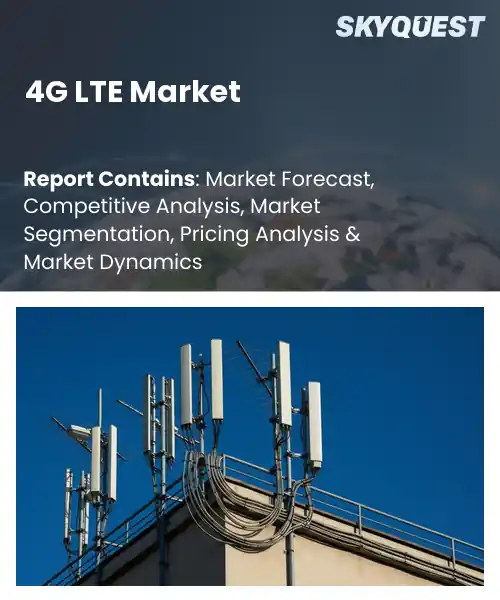
4G LTE Market
Report ID: SQMIG50C2058
Report ID: SQMIG50C2058
[email protected]
USA +1 351-333-4748
Report ID:
SQMIG50C2058 |
Region:
Global |
Published Date: February, 2026
Pages:
157
|Tables:
143
|Figures:
78


Global 4G LTE Market size was valued at USD 71.80 Billion in 2024 and is poised to grow from USD 95.13 Billion in 2025 to USD 903.79 Billion by 2033, growing at a CAGR of 32.5% during the forecast period (2026-2033).
Growing demand for high-speed mobile data, increasing smartphone penetration, rising consumption of video streaming and digital content, expansion of mobile broadband infrastructure, and advancements in network technologies are driving the demand for 4G LTE solutions and services.
The evolution of 4G LTE has provided opportunities for new business models in the ecosystem for over-the-top service providers and increased opportunities for IoT connectivity. Moreover, spectrum availability and investment in networks are significant in shaping the expansion of the ecosystem. This is because spectrum auctions provide opportunities for operators to increase capacity and accelerate expansion. Carrier aggregation and network densification technologies provide increased throughput and reduce operational costs. As a result, use cases such as fixed wireless access, large-scale video streaming, and machine-type communications for smart infrastructure are becoming increasingly viable, further creating a new business scope. Growing consumer demand for high-speed internet connectivity and the rapid shift from voice-centric to data-centric communication are expected to primarily drive 4G LTE market growth through 2033.
On the contrary, high infrastructure and spectrum acquisition costs, network congestion in densely populated areas, regulatory challenges, and the ongoing transition toward 5G networks are slated to impede 4G LTE market penetration in the future.
How is IoT Deployment Driving Demand in the Global 4G LTE Market?
IoT deployment is driving demand in the global 4G LTE market penetration by emphasizing wide coverage, reliable connectivity, and long device lifecycles. Integration of IoT with 4G enables asset tracking, smart metering, industrial monitoring, and remote sensing features for end users. This practical approach helps maintain the relevance of 4G LTE even as next-generation networks continue to expand, while giving system integrators and operators more flexibility in deployment.
Market snapshot - 2026-2033
Global Market Size
USD 71.8 Billion
Largest Segment
LTE-FDD
Fastest Growth
LTE-Advanced
Growth Rate
32.5% CAGR
To get more insights on this market click here to Request a Free Sample Report
The global 4G LTE market is segmented by LTE technology type, device type, connection plan, organization size, end user, and region. Based on LTE technology type, the market is segmented into LTE-Advanced, LTE-TDD, LTE-FDD, and other technologies. Based on device type, the market is segmented into smartphones, laptops, and tablets. Based on connection plan, the market is segmented into post-paid and pre-paid. Based on organization size, the market is segmented into small and medium enterprises (SME) and large enterprises. Based on end user, the market is segmented into private, public and government, and defense. Based on region, the market is segmented into North America, Europe, Asia Pacific, Latin America, and Middle East & Africa.
The smartphones segment is expected to spearhead the global 4G LTE market revenue generation in the long run. High adoption of smartphones drives primary traffic profiles and service expectations from 4G LTE, which helps this segment hold sway over others. The demand for streaming, social media, and app-rich user experiences from consumers is what drives operators to optimize their networks for mobile data performance. OEMs and chip providers prioritize LTE feature sets, which in turn drives operators to invest in network capacity and radio features, reinforcing the importance of smartphones as a revenue and innovation enabler.
However, laptops are turning out to be the most dynamic segment in the device-driven demand growth, driven by the increasing integration of LTE modems in laptops and the usage of mobile hotspots to increase the availability of broadband services beyond mobile phones. The increasing trend of remote working and the need to increase the usage of LTE-enabled laptops to cater to the growing need for mobile productivity is boosting the adoption of LTE in laptops.
The LTE-FDD segment is slated to account for the largest global 4G LTE market share in the future. The ability of this technology to offer a mature, stable foundation for paired spectrum deployments is helping it maintain its dominant stance in the future. Its well-understood channel characteristics, together with its wide device support, make network planning simpler, while voice and data service quality is ensured. As service providers increasingly depend on guaranteed coverage and handover performance, LTE-FDD’s familiar operation makes the deployment process simpler, thus creating a climate of confidence for further investments in radio access networks.
However, LTE-advanced is witnessing the strongest growth momentum as per this 4G LTE market forecast. The unique feature set associated with this technology allows for capacity and throughput improvements. New innovations such as carrier aggregation and enhanced MIMO drive the requirement for higher bandwidth applications and services for the enterprise. This accelerates the upgrade cycle for operators, thus increasing the chances for equipment vendors and providing a richer user experience for a variety of use cases.
To get detailed segments analysis, Request a Free Sample Report
Expansion of mobile infrastructure, large urban populations driving demand, and proactive spectrum allocation by regulators are helping cement the dominance of Asia Pacific in terms of 4G LTE demand. An emphasis on building scalable 4G networks, along with well-developed device ecosystems and strong local manufacturing, has made it possible for major equipment vendors and network operators to provide large-scale, interoperable 4G services. The high volume and different types of traffic generated in densely populated metropolitan areas have created an environment where upgrades to capacity and the development of differentiated service offerings are expedited.
Demand for dense urban coverage and high consumer expectations for reliable throughput and low latency help boost 4G LTE demand in Japan. Service providers focus on delivering high-quality networks and customer experience, with support from local vendors. Enterprises focus on industrial connectivity and service innovation. Clarity in regulations also ensures efficient utilization of spectrum resources. Optimization and customer plans have ensured high-quality networks and positioned them for mobile applications.
High operator emphasis on service differentiation and quick adoption of advanced technologies are boosting 4G LTE demand in South Korea. Clarity in regulations and competitive models is helping in wider penetration across consumers and enterprises, thus increasing the overall strength in operational improvements and service innovation. Joint efforts by providers and local vendors are driving device connectivity and service improvements.
High investments in network densification, targeted spectrum strategies, and a competitive retail environment are promoting the adoption of 4G LTE solutions in North America. Partnerships with vendors and a robust device ecosystem have ensured the timely adoption of network upgrades and ensured device compatibility with various operators. Initiatives for network reach and reliability in rural areas have also been implemented in parallel with network capacity enhancements in the same region. Coordination with the regulatory environment and the presence of an infrastructure-sharing-friendly market structure have helped reduce the challenges associated with network investments for operators. This has also allowed operators to optimize investments and ensure consistency in the customer experience for diverse geographic and demographic segments.
Operator emphasis on improving coverage, capacity optimization, and competitive service plans is shaping 4G LTE demand in the United States. The diverse device landscape and strong vendor footprint support availability and interoperability. Enterprises' need for robust connectivity and fixed wireless alternatives has driven quality and operational improvements. Policy initiatives and infrastructure programs support growth in less served markets, while competition continues to shape pricing and customer experience.
Launch of new initiatives to improve rural and remote connectivity along with urban connectivity demands are shaping 4G LTE market trends in Canada. The need to serve the enterprises and the consumers drives the demand for reliable and consistent services with good coverage and quality in different geographical areas. The regulatory environments and collaborative infrastructure approaches support the expansion of the services and network sharing, thus improving the competitiveness of the services and the reliability of the services.
Coordinated regulatory approaches, harmonized spectrum frameworks, and cooperative infrastructure policies are influencing 4G LTE adoption in Europe. Emphasis is placed on network modernization, service differentiation, and international cooperation, which encourages a sense of roaming and multi-market opportunities. A healthy vendor landscape and a wide range of available devices also support a sense of compatibility and an accelerated approach to network enhancements. Emphasis is being placed on enterprise markets, such as connected transport and industrial connectivity, which is opening up new market opportunities beyond traditional consumer markets. Initiatives aimed at rural connectivity and spectrum efficiency are also being encouraged, which supports urban capacity planning.
Growing investment in improving network quality, with emphasis on industrial applications and enterprise connectivity help drive 4G LTE demand in Germany. Government schemes and buying habits are helping to increase coverage in less connected areas. Competitive market and variety in services are helping consumers make better decisions, and enterprise solutions in manufacturing and logistics are helping to increase usage and reliability in these sectors.
Presence of competitive operators prioritizing network quality, urban capacity, and differentiated consumer plans creates new business scope for 4G LTE vendors in the country. Business needs for dependable mobile connectivity, together with regional initiatives to address connectivity gaps, drive investments. Regulations promote efficient use of available spectrum, sharing of infrastructure, innovation initiatives, and pilot projects to promote service diversification, especially for consumer and industry use.
Efforts to improve nationwide coverage, quality of service, and competitive offers are helping create new opportunities for 4G LTE companies in France. Investment is made in capacity and network management to ensure high consumer demands are met, while business connectivity is facilitated. Partnerships with vendors promote device diversity and compatibility. Policy initiatives, such as collaborative infrastructure schemes, promote further reach into regional areas. Emphasis is placed on enterprise services, thus broadening business demand while further diversifying operator revenue streams.
To know more about the market opportunities by region and country, click here to
Buy The Complete Report
Expansion Of Mobile Broadband Demand
Cost Effective Network Upgrades
Spectrum Allocation and Licensing
Rising Security and Privacy Concerns
Request Free Customization of this report to help us to meet your business objectives.
The global 4G LTE competitive landscape is defined by incumbent consolidation, Open RAN vendor expansion, and rising enterprise private network competition driven by CBRS and edge use cases. Vendors pursue concrete M&A and systems integrator deals to secure enterprise routes to market, for example Ericsson’s acquisition of Cradlepoint and targeted buys and partnerships by Open RAN players such as Mavenir and NEC to broaden radio and integration capabilities.
SkyQuest’s ABIRAW (Advanced Business Intelligence, Research & Analysis Wing) is our Business Information Services team that Collects, Collates, Correlates, and Analyses the Data collected by means of Primary Exploratory Research backed by robust Secondary Desk research.
As per SkyQuest analysis, growing demand for high-speed mobile data and increasing adoption of IoT applications are anticipated to drive the demand for 4G LTE going forward. However, high infrastructure and spectrum costs along with the rapid transition toward 5G networks are slated to slow down the adoption of 4G LTE in the future. North America is slated to spearhead the demand for 4G LTE owing to early technology adoption and the presence of advanced telecommunications infrastructure. Advancements in LTE-based IoT modules, integration of low-power connectivity solutions, and continued network optimization are anticipated to be key trends driving the 4G LTE sector across the study period.
| Report Metric | Details |
|---|---|
| Market size value in 2024 | USD 71.80 Billion |
| Market size value in 2033 | USD 903.79 Billion |
| Growth Rate | 32.5% |
| Base year | 2024 |
| Forecast period | 2026-2033 |
| Forecast Unit (Value) | USD Billion |
| Segments covered |
|
| Regions covered | North America (US, Canada), Europe (Germany, France, United Kingdom, Italy, Spain, Rest of Europe), Asia Pacific (China, India, Japan, Rest of Asia-Pacific), Latin America (Brazil, Rest of Latin America), Middle East & Africa (South Africa, GCC Countries, Rest of MEA) |
| Companies covered | |
| Customization scope | Free report customization with purchase. Customization includes:-
|
To get a free trial access to our platform which is a one stop solution for all your data requirements for quicker decision making. This platform allows you to compare markets, competitors who are prominent in the market, and mega trends that are influencing the dynamics in the market. Also, get access to detailed SkyQuest exclusive matrix.
Table Of Content
Executive Summary
Market overview
Parent Market Analysis
Market overview
Market size
KEY MARKET INSIGHTS
COVID IMPACT
MARKET DYNAMICS & OUTLOOK
Market Size by Region
KEY COMPANY PROFILES
Methodology
For the 4G LTE Market, our research methodology involved a mixture of primary and secondary data sources. Key steps involved in the research process are listed below:
1. Information Procurement: This stage involved the procurement of Market data or related information via primary and secondary sources. The various secondary sources used included various company websites, annual reports, trade databases, and paid databases such as Hoover's, Bloomberg Business, Factiva, and Avention. Our team did 45 primary interactions Globally which included several stakeholders such as manufacturers, customers, key opinion leaders, etc. Overall, information procurement was one of the most extensive stages in our research process.
2. Information Analysis: This step involved triangulation of data through bottom-up and top-down approaches to estimate and validate the total size and future estimate of the 4G LTE Market.
3. Report Formulation: The final step entailed the placement of data points in appropriate Market spaces in an attempt to deduce viable conclusions.
4. Validation & Publishing: Validation is the most important step in the process. Validation & re-validation via an intricately designed process helped us finalize data points to be used for final calculations. The final Market estimates and forecasts were then aligned and sent to our panel of industry experts for validation of data. Once the validation was done the report was sent to our Quality Assurance team to ensure adherence to style guides, consistency & design.
Analyst Support
Customization Options
With the given market data, our dedicated team of analysts can offer you the following customization options are available for the 4G LTE Market:
Product Analysis: Product matrix, which offers a detailed comparison of the product portfolio of companies.
Regional Analysis: Further analysis of the 4G LTE Market for additional countries.
Competitive Analysis: Detailed analysis and profiling of additional Market players & comparative analysis of competitive products.
Go to Market Strategy: Find the high-growth channels to invest your marketing efforts and increase your customer base.
Innovation Mapping: Identify racial solutions and innovation, connected to deep ecosystems of innovators, start-ups, academics, and strategic partners.
Category Intelligence: Customized intelligence that is relevant to their supply Markets will enable them to make smarter sourcing decisions and improve their category management.
Public Company Transcript Analysis: To improve the investment performance by generating new alpha and making better-informed decisions.
Social Media Listening: To analyze the conversations and trends happening not just around your brand, but around your industry as a whole, and use those insights to make better Marketing decisions.
REQUEST FOR SAMPLE
 REQUEST FREE CUSTOMIZATION
Global 4G Lte Market size was valued at USD 71.8 Billion in 2024 and is poised to grow from USD 95.13 Billion in 2025 to USD 903.79 Billion by 2033, growing at a CAGR of 32.5% during the forecast period (2026-2033).
Global 4G LTE competitive landscape is defined by incumbent consolidation, Open RAN vendor expansion, and rising enterprise private network competition driven by CBRS and edge use cases. Vendors pursue concrete M&A and systems integrator deals to secure enterprise routes to market, for example Ericsson’s acquisition of Cradlepoint and targeted buys and partnerships by Open RAN players such as Mavenir and NEC to broaden radio and integration capabilities. 'Verizon', 'AT&T', 'T-Mobile', 'China Mobile', 'China Telecom', 'Vodafone', 'Orange', 'Deutsche Telekom', 'NTT Docomo', 'Airtel', 'Dish Wireless', 'Telstra', 'Rogers Communications', 'TIM (Telecom Italia)', 'KDDI', 'Bouygues Telecom', 'SK Telecom', 'Swisscom', 'O2 (Telefonica UK)', 'MTN South Africa'
Expansion of widespread consumer and enterprise demand for high-speed mobile data has encouraged network operators to invest in 4G LTE infrastructure and service improvements, enabling broader coverage and improved user experiences. Continued preference for video streaming, real-time communications, and cloud services increases the need for reliable, low-latency connectivity, prompting operators to deploy and optimize LTE networks. This sustained demand supports vendor revenues, stimulates competition on quality of service, and fosters ecosystem development for devices and applications that rely on consistent broadband access.
Private Lte And Enterprise Solutions: Enterprises increasingly demand dedicated 4G LTE networks to support reliable, low-latency connectivity for industrial automation, logistics and campus environments. Private deployments enable operators and system integrators to offer managed services, customized quality of service and seamless integration with IT systems. This trend stimulates partnerships across telecommunications vendors, cloud providers and equipment manufacturers, driving tailored solutions for verticals that require predictable performance and localized control. Service differentiation and recurring revenue streams emerge as operators focus on connectivity offerings for business customers.
Expansion of mobile infrastructure, large urban populations driving demand, and proactive spectrum allocation by regulators are helping cement the dominance of Asia Pacific in terms of 4G LTE demand.


Want to customize this report? This report can be personalized according to your needs. Our analysts and industry experts will work directly with you to understand your requirements and provide you with customized data in a short amount of time. We offer $1000 worth of FREE customization at the time of purchase.
Feedback From Our Clients


 USA (+1) 351-333-4748

