3D Printing Medical Devices Market
Report ID: SQMIG35A2617
Report ID: SQMIG35A2617
[email protected]
USA +1 351-333-4748
Report ID:
SQMIG35A2617 |
Region:
Global |
Published Date: August, 2025
Pages:
176
|Tables:
89
|Figures:
71


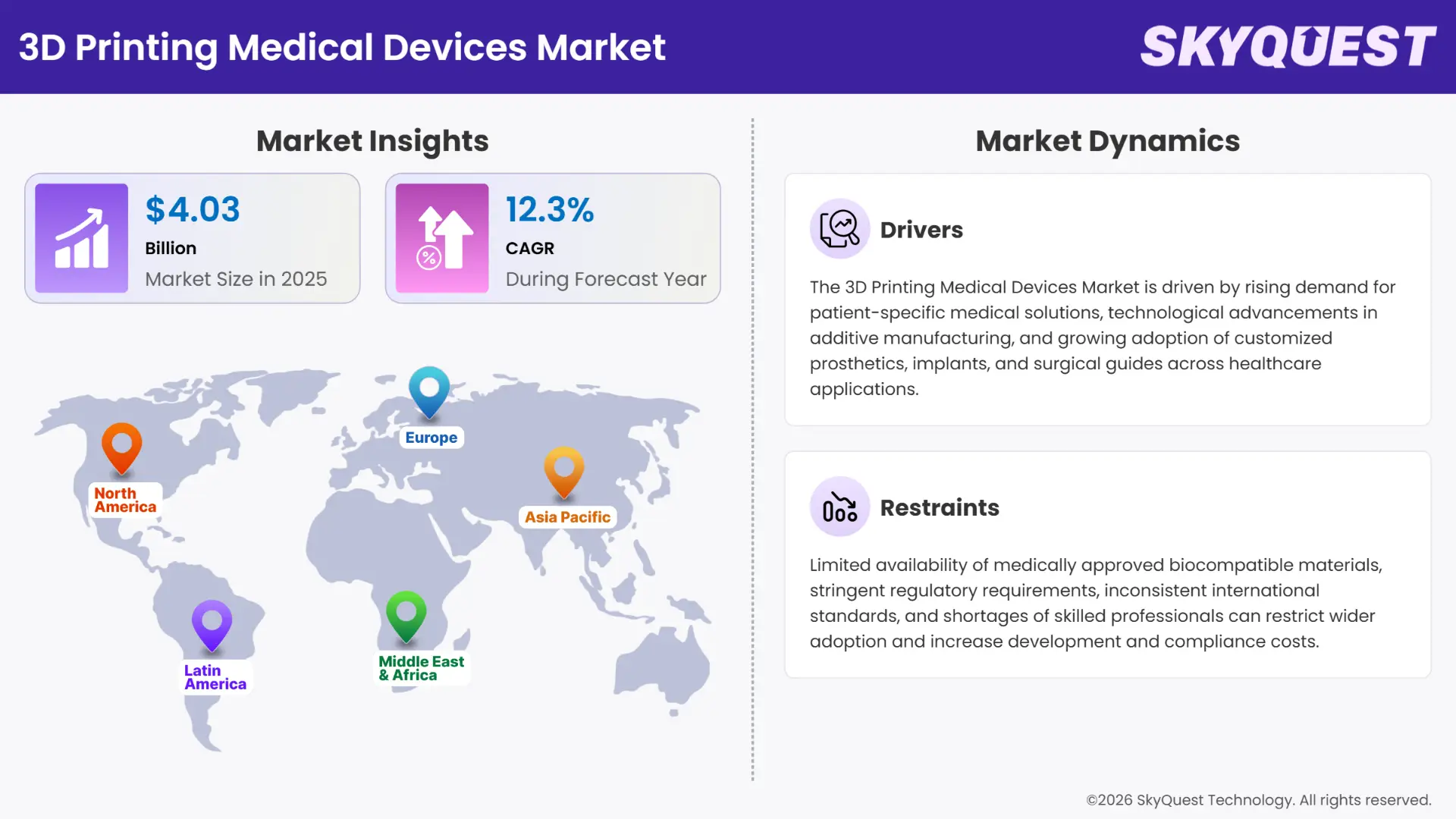
Global 3D Printing Medical Devices Market size was valued at USD 3.59 Billion in 2024 poised to grow between USD 4.03 Billion in 2025 to USD 10.2 Billion by 2033, growing at a CAGR of 12.3% in the forecast period (2026–2033).
Key Takeaways: Market Trends & Insights
The global 3D printing medical devices market is primarily driven by the growing need for personalized healthcare. Chronic diseases such as osteoarthritis, congenital deformities, and cardiovascular issues often require custom-fit implants or prosthetics that traditional manufacturing cannot offer. 3D printing enables precise, patient-specific designs by using data from imaging techniques like CT or MRI scans. This customization leads to better anatomical compatibility, reduced surgery time, and faster recovery, ultimately improving patient outcomes. As healthcare providers increasingly value individualized treatments, the demand for 3D-printed, tailor-made medical devices is accelerating across hospitals, dental clinics, and orthopedic centers worldwide.
A critical factor supporting market growth is the rapid evolution of biocompatible materials and 3D printing technologies. Innovations in materials—such as bioresorbable polymers, medical-grade titanium, and composite hydrogels—have enabled safer, more functional medical devices. Coupled with advancements in printing techniques like selective laser sintering (SLS) and stereolithography (SLA), manufacturers can now create intricate, high-precision structures suitable for complex procedures. These developments not only enhance device performance and longevity but also expand their application in orthopedics, dental, and tissue engineering. As a result, improved material and process capabilities are making 3D-printed devices more clinically viable and trusted by regulatory bodies and surgeons alike.
What are Clinical Benefits of AI-Enabled, Custom 3D-Printed Medical Devices?
Artificial Intelligence is significantly enhancing the 3D printing medical devices market by streamlining design, production, and quality control processes. Because AI can analyze complex imaging data and generate patient-specific models, it enables highly accurate, custom medical devices with minimal human intervention. This results in better-fitting implants and surgical tools, improving clinical outcomes. Additionally, AI-powered monitoring systems detect defects during printing in real time, reducing waste and ensuring consistency. A recent development includes MIT’s AI-integrated 3D-printed implant for diabetes management, which releases medication on demand—demonstrating AI’s role in creating smarter, responsive medical devices that go beyond static solutions.
To get more insights on this market click here to Request a Free Sample Report
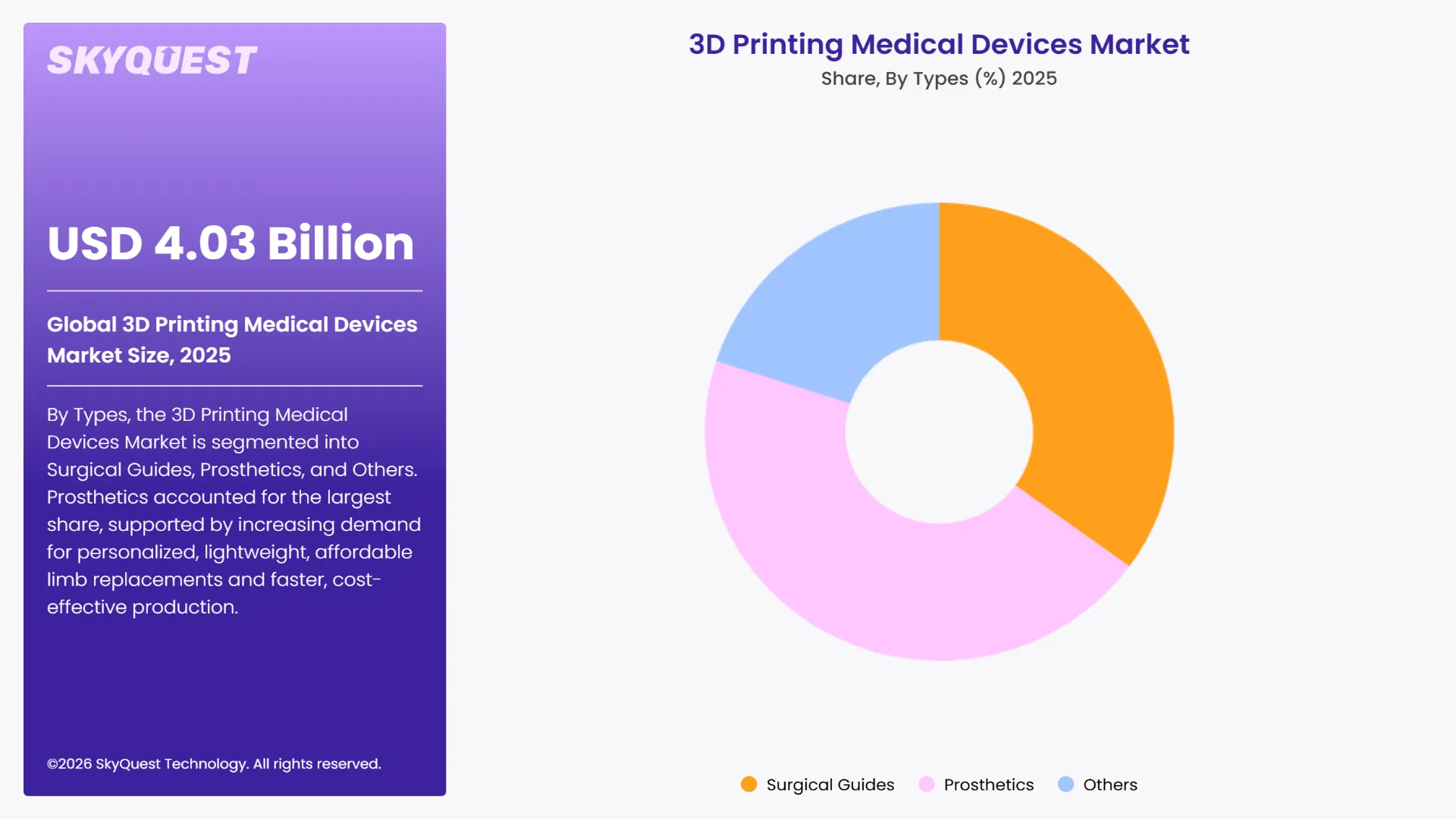
The global 3D printing medical devices market is segmented based on types, components, application, and region. In terms of types, the market is trifurcated into surgical guides, prosthetics, and others. Based on components, the market is divided into systems and materials. In terms of application, the market is grouped into wearable external devices, implants, and others. Based on region, the market is segmented into North America, Europe, Asia-Pacific, Central & South America and the Middle East & Africa.
Based on the global 3D printing medical devices market forecast, prosthetics are currently leading the industry due to increasing innovation in personalized, lightweight, and affordable limb replacements. Advanced materials and AI-integrated design allow for faster production and improved comfort. This segment dominates because 3D printing significantly reduces costs and fabrication time compared to traditional methods, making prosthetics more accessible to patients globally, especially in developing regions where conventional prosthetic options are often unaffordable or unavailable.
Surgical guides are projected to grow fastest in the global 3D printing medical devices market because they enable highly accurate, patient-specific guidance for implant placement. Personalized guides based on DICOM imaging reduce surgical time and complications. With mounting orthopedic surgeries and demand for precision, the surgical guide segment is expanding rapidly.
Material components dominate the global 3D printing medical devices market as they form the essential base for all 3D-printed medical devices. Innovations in biocompatible polymers, titanium alloys, and bioinks enable stronger, safer, and more functional devices. These materials support a range of applications from implants to surgical tools. Their dominance stems from the growing need for specialized materials that meet strict medical standards, making them indispensable to the design and functionality of 3D-printed healthcare solutions.
The system component segment is expanding most rapidly because constant innovation in multi-material, portable, and full-color 3D printers is unlocking new clinical applications. As healthcare facilities invest in advanced hardware capable of high precision and automation, demand surges for devices such as surgical instruments and anatomical models, driving system sales faster than materials or services.
To get detailed segments analysis, Request a Free Sample Report
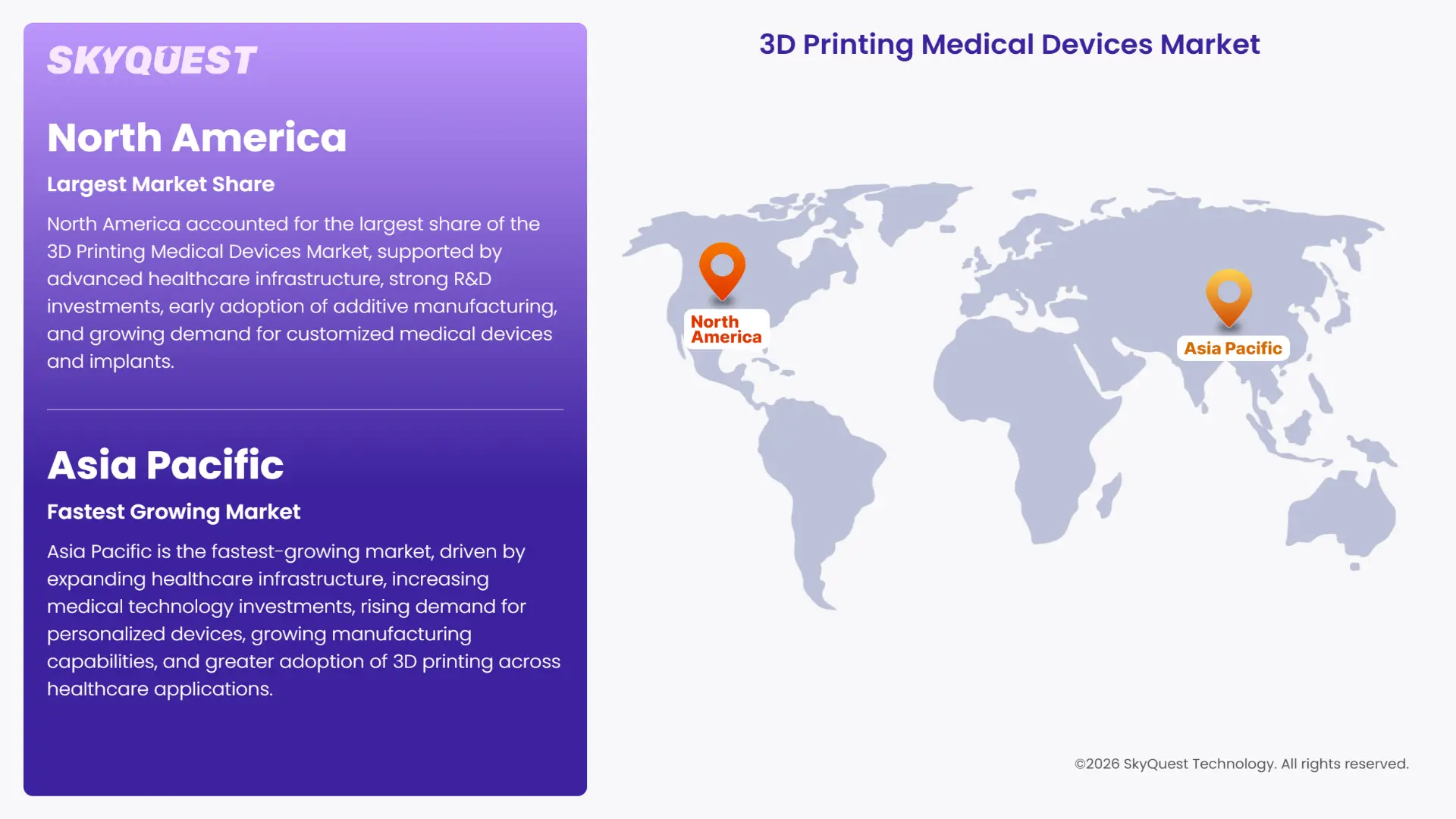
As per the global 3D printing medical devices market analysis, North America leads the industry due to advanced healthcare infrastructure, high R&D investment, and early adoption of innovative technologies. The U.S. dominates with strong regulatory support and growing clinical use of customized implants and surgical guides. Additionally, increasing collaborations between medical institutions and 3D printing companies, along with rising demand for personalized care, continues to drive growth, making North America a hub for 3D-printed medical innovation.
US 3D Printing Medical Devices Market
The United States is the primary contributor to North America’s 3D printing medical devices market, driven by robust healthcare infrastructure, high R&D spending, and early adoption of advanced technologies. The presence of major industry players, streamlined FDA approvals, and increasing clinical use of custom implants and surgical guides fuel market growth. Government and private investments in personalized healthcare and bioprinting continue to position the U.S. as a global leader in medical 3D printing innovation.
Canada 3D Printing Medical Devices Market
Canada is rapidly emerging as a key contributor to North America’s 3D printing medical devices market, supported by strong academic-industry collaborations and government-backed innovation programs. Hospitals and research centers are increasingly adopting 3D-printed models and prosthetics for surgical planning and patient-specific treatments. Growth is further driven by expanding applications in dental and orthopedic care. Canada's commitment to precision medicine and localized production is enhancing its role in advancing 3D printing adoption in healthcare.
Asia Pacific is the fastest-growing region in the global 3D printing medical devices market, driven by expanding healthcare infrastructure, rising medical tourism, and government support for digital manufacturing. Countries like China and India are leading in adoption due to large patient populations and cost-effective production. Meanwhile, Japan and South Korea are advancing innovations in bioprinting and precision implants, positioning Asia Pacific as a dynamic hub for next-generation medical 3D printing solutions.
Japan 3D Printing Medical Devices Market
Japan plays a significant role in the Asia Pacific 3D printing medical devices market, driven by its advanced healthcare system and strong investment in R&D. The country focuses on surgical guides, dental applications, and bioprinting technologies. Collaborative efforts between universities, hospitals, and tech companies support innovation, while regulatory clarity accelerates market entry. Japan’s emphasis on precision medicine and aging population needs further propels the adoption of customized, patient-specific 3D-printed medical solutions.
South Korea 3D Printing Medical Devices Market
South Korea is emerging as a key contributor to the Asia Pacific 3D printing medical devices market, supported by strong government funding, innovation hubs, and rapid tech adoption in hospitals. The country emphasizes 3D-printed dental implants, orthopedic devices, and bioprinted tissues. Collaborations between research institutions and medical manufacturers are driving clinical applications. South Korea’s focus on digital healthcare transformation and localized production strengthens its competitiveness in delivering advanced, cost-effective, and personalized medical devices.
Europe is a prominent player in the global 3D printing medical devices market, driven by strong research capabilities, supportive government funding, and growing demand for customized implants. Countries like Germany, the UK, and France are leading innovation in dental, orthopedic, and bioprinting applications. The region benefits from robust healthcare infrastructure and academic–industry collaborations. However, strict EU regulations pose compliance challenges, slightly moderating the pace of adoption despite high technological readiness.
Germany 3D Printing Medical Devices Market
Germany plays a leading role in Europe’s 3D printing medical devices market, driven by its strong engineering base, advanced manufacturing capabilities, and presence of key companies like EOS and SLM Solutions. The country emphasizes orthopedic and dental 3D-printed devices, supported by robust hospital adoption and academic research. Government initiatives and innovation hubs further support its growth, making Germany a powerhouse for precision, metal-based 3D medical device production in the global market.
UK 3D Printing Medical Devices Market
The United Kingdom is a fast-growing contributor, driven by its advanced research institutions and National Health Service (NHS) integration of 3D printing technologies. The UK supports innovation in prosthetics, implants, and anatomical models through collaborations between universities, startups, and hospitals. Government funding and regulatory support enhance market penetration. As a leader in medical 3D printing patents and point-of-care manufacturing, the UK is emerging as a hub for personalized healthcare solutions.
Italy 3D Printing Medical Devices Market
Italy’s contribution to the Europe market is growing steadily, particularly through its Mirandola Biomedical District, which fosters innovation in customized implants and surgical devices. The country is focusing on dental and orthopedic 3D printing applications, supported by university research and hospital partnerships. Local manufacturers are increasingly adopting 3D printing to meet patient-specific needs. Italy’s combination of medical manufacturing heritage and expanding digital technologies is helping it gain ground in Europe’s 3D printing healthcare landscape.
To know more about the market opportunities by region and country, click here to
Buy The Complete Report
Rising Demand for Personalized Medical Solutions
Technological Advancements in 3D Printing
Limited Material Availability and Biocompatibility
Regulatory and Standardization Challenges
Request Free Customization of this report to help us to meet your business objectives.
the global 3D printing medical devices market outlook is competitive and marked by innovation and strategic collaboration. Key international players include Stratasys, 3D Systems, Materialise, and GE Healthcare. Stratasys focuses on expanding its healthcare portfolio through partnerships, while 3D Systems invests in bioprinting R&D. Materialise enhances its software capabilities for surgical planning, and GE Healthcare integrates 3D printing with imaging technologies to offer customized medical solutions globally.
As per the global 3D printing medical devices industry analysis, the market is witnessing a surge in innovative startups focusing on personalization, speed, and regulatory readiness. These startups leverage AI, advanced biomaterials, and real-time quality control to produce surgical tools, implants, and prosthetics with improved precision. Backed by increased funding and supportive healthcare ecosystems, these emerging companies are driving down costs, accelerating design-to-surgery timelines, and fostering global adoption through niche innovations and patient-specific medical solutions.
Personalization Surge in Patient-Specific Implants
Rising Integration of Biocompatible Materials
SkyQuest’s ABIRAW (Advanced Business Intelligence, Research & Analysis Wing) is our Business Information Services team that Collects, Collates, Correlates, and Analyses the Data collected by means of Primary Exploratory Research backed by robust Secondary Desk research.
As per SkyQuest analysis, the global 3D printing medical devices industry is undergoing a transformative shift driven by personalization, advanced materials, and AI integration. Increasing demand for patient-specific treatments is encouraging the adoption of 3D-printed implants, prosthetics, and surgical tools that improve clinical outcomes and reduce recovery time. Innovations in biocompatible materials and additive manufacturing techniques are expanding the range and safety of applications.
Regional markets like North America and Asia-Pacific are leading in adoption due to strong infrastructure, research funding, and healthcare digitization. Startups and global leaders alike are investing in real-time monitoring, smart implants, and regulatory-ready solutions. As technological capabilities grow and regulatory frameworks mature, the global 3D printing medical devices market strategy is poised to become an essential part of modern medical care across the globe.
| Report Metric | Details |
|---|---|
| Market size value in 2024 | USD 3.59 Billion |
| Market size value in 2033 | USD 10.2 Billion |
| Growth Rate | 12.3% |
| Base year | 2024 |
| Forecast period | 2026–2033 |
| Forecast Unit (Value) | USD Billion |
| Segments covered |
|
| Regions covered | North America (US, Canada), Europe (Germany, France, United Kingdom, Italy, Spain, Rest of Europe), Asia Pacific (China, India, Japan, Rest of Asia-Pacific), Latin America (Brazil, Rest of Latin America), Middle East & Africa (South Africa, GCC Countries, Rest of MEA) |
| Companies covered |
|
| Customization scope | Free report customization with purchase. Customization includes:-
|
To get a free trial access to our platform which is a one stop solution for all your data requirements for quicker decision making. This platform allows you to compare markets, competitors who are prominent in the market, and mega trends that are influencing the dynamics in the market. Also, get access to detailed SkyQuest exclusive matrix.
Table Of Content
Executive Summary
Market overview
Parent Market Analysis
Market overview
Market size
KEY MARKET INSIGHTS
COVID IMPACT
MARKET DYNAMICS & OUTLOOK
Market Size by Region
KEY COMPANY PROFILES
Methodology
For the 3D Printing Medical Devices Market, our research methodology involved a mixture of primary and secondary data sources. Key steps involved in the research process are listed below:
1. Information Procurement: This stage involved the procurement of Market data or related information via primary and secondary sources. The various secondary sources used included various company websites, annual reports, trade databases, and paid databases such as Hoover's, Bloomberg Business, Factiva, and Avention. Our team did 45 primary interactions Globally which included several stakeholders such as manufacturers, customers, key opinion leaders, etc. Overall, information procurement was one of the most extensive stages in our research process.
2. Information Analysis: This step involved triangulation of data through bottom-up and top-down approaches to estimate and validate the total size and future estimate of the 3D Printing Medical Devices Market.
3. Report Formulation: The final step entailed the placement of data points in appropriate Market spaces in an attempt to deduce viable conclusions.
4. Validation & Publishing: Validation is the most important step in the process. Validation & re-validation via an intricately designed process helped us finalize data points to be used for final calculations. The final Market estimates and forecasts were then aligned and sent to our panel of industry experts for validation of data. Once the validation was done the report was sent to our Quality Assurance team to ensure adherence to style guides, consistency & design.
Analyst Support
Customization Options
With the given market data, our dedicated team of analysts can offer you the following customization options are available for the 3D Printing Medical Devices Market:
Product Analysis: Product matrix, which offers a detailed comparison of the product portfolio of companies.
Regional Analysis: Further analysis of the 3D Printing Medical Devices Market for additional countries.
Competitive Analysis: Detailed analysis and profiling of additional Market players & comparative analysis of competitive products.
Go to Market Strategy: Find the high-growth channels to invest your marketing efforts and increase your customer base.
Innovation Mapping: Identify racial solutions and innovation, connected to deep ecosystems of innovators, start-ups, academics, and strategic partners.
Category Intelligence: Customized intelligence that is relevant to their supply Markets will enable them to make smarter sourcing decisions and improve their category management.
Public Company Transcript Analysis: To improve the investment performance by generating new alpha and making better-informed decisions.
Social Media Listening: To analyze the conversations and trends happening not just around your brand, but around your industry as a whole, and use those insights to make better Marketing decisions.
REQUEST FOR SAMPLE
 REQUEST FREE CUSTOMIZATION
Global 3D Printing Medical Devices Market size was valued at USD 3.59 Billion in 2024 poised to grow between USD 4.03 Billion in 2025 to USD 10.2 Billion by 2033, growing at a CAGR of 12.3% in the forecast period (2026–2033).
Key vendors in the 3D Printing Medical Devices Market include 3D Systems Corporation, Materialise NV, Desktop Metal, Nano Dimension, Protolabs, Markforged, Organovo Holdings, Voxeljet, BICO Group, EnvisionTEC, Aspect Biosystems, GE Additive, Formlabs, Stryker, Medtronic, Johnson & Johnson, Align Technology, and Roche Holding.
The key driver of the 3D Printing Medical Devices Market is the growing demand for personalized and patient-specific medical devices, supported by 3D printing’s ability to deliver customized implants, prosthetics, surgical instruments, and anatomical models with greater precision.
The key trend in the 3D Printing Medical Devices Market is the growing demand for patient-specific implants, driven by advanced imaging and 3D printing technologies that enable better anatomical fit, faster recovery, and improved surgical outcomes.
North America accounted for the largest share of the 3D Printing Medical Devices Market, supported by advanced healthcare infrastructure, high R&D investment, early adoption of 3D printing technologies, strong industry-academic collaborations, and increasing demand for personalized medical devices.


Want to customize this report? This report can be personalized according to your needs. Our analysts and industry experts will work directly with you to understand your requirements and provide you with customized data in a short amount of time. We offer $1000 worth of FREE customization at the time of purchase.
Feedback From Our Clients


 USA (+1) 351-333-4748

