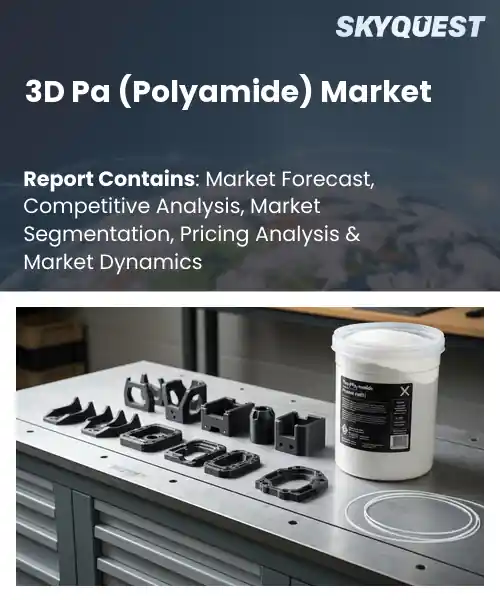
3D Pa (Polyamide) Market
Report ID: SQMIG15E3221
Report ID: SQMIG15E3221
[email protected]
USA +1 351-333-4748
Report ID:
SQMIG15E3221 |
Region:
Global |
Published Date: February, 2026
Pages:
157
|Tables:
126
|Figures:
77


Global 3D Pa (Polyamide) Market size was valued at USD 1.7 Billion in 2024 and is poised to grow from USD 1.86 Billion in 2025 to USD 3.78 Billion by 2033, growing at a CAGR of 9.3% during the forecast period (2026-2033).
Primary driver of the 3D polyamide (PA) market is the material’s balance of mechanical performance and process adaptability, which has reshaped additive manufacturing and prototyping. The market encompasses powdered and filament PA grades used by printers for functional parts, tooling, and end use components, and it matters because polyamides bridge the gap between polymer ease and metal level durability, reducing time to market and weight in sectors such as automotive. Over the past decade adoption progressed from niche prototyping to certified production runs as powder bed fusion and selective laser sintering matured, exemplified by suppliers qualifying PA12 for drone components.Building on the mechanical and process strengths described above, increasing demand for lightweight functional parts drives growth because original equipment manufacturers seek weight reduction and consolidation of assemblies. As manufacturers adopt powder bed fusion and multi jet fusion compatible PA11 and PA12 grades, they lower assembly costs and improve fuel efficiency in vehicles, which incentivizes suppliers to expand resin portfolios and certification pathways. The availability of recycled PA powders and glass and carbon filled formulations creates opportunities for sustainable production while enabling end use applications such as jigs, intake manifolds, and overmolded housings that demonstrate quantifiable lifecycle and cost benefits.
How is AI driving adoption of 3D polyamide materials in industrial additive manufacturing?
AI is accelerating adoption of 3D polyamide materials by improving material design, process control and part qualification. Key aspects include AI driven particle engineering, machine learning for print parameter optimization and real time quality monitoring. The current state sees polyamide grades like PA12 becoming the preferred choice for functional parts made with selective laser sintering and powder bed fusion. Market context favors polyamides because of strong mechanical performance and thermal resilience and because producers need faster qualification and lower scrap. Examples include AI tuned print profiles that reduce warpage, sensor fed models that detect defects during builds and generative design that leverages polyamide strength for lightweight structures.Toray February 2026, announced Toraypearl PA12 spherical powder that improves surface finish and consistency. AI driven process tuning and simulation tools shorten qualification and raise first pass quality. This combination reduces post processing and helps manufacturers qualify polyamide parts faster for aerospace and automotive production.
Market snapshot - (2026-2033)
Global Market Size
USD 1.7 Billion
Largest Segment
Standard Polyamides
Fastest Growth
Bio-based Polyamide
Growth Rate
9.3% CAGR
To get more insights on this market click here to Request a Free Sample Report
Global 3d pa (polyamide) market is segmented by polyamide types, 3d printing methods, formulations, applications and region. Based on polyamide types, the market is segmented into Standard Polyamides and Bio-based Polyamide. Based on 3d printing methods, the market is segmented into Fused Deposition Modeling (FDM), Selective Laser Sintering (SLS), Stereolithography (SLA), Binder Jetting and PolyJet Printing. Based on formulations, the market is segmented into Standard Formulations, Reinforced Formulations, Flexible Formulations, Thermal Conductive Formulations and Flame Retardant Formulations. Based on applications, the market is segmented into Consumer Goods, Aerospace, Automotive, Medical Devices, Industrial Manufacturing, Electronics, Fashion and Textiles, Architecture and Construction and Robotics. Based on region, the market is segmented into North America, Europe, Asia Pacific, Latin America and Middle East & Africa.
Reinforced Formulations segment dominates because reinforced fillers dramatically boost stiffness and load bearing capacity of polyamide parts, making them the default choice for structural aerospace components. Their compatibility with high performance printing technologies and ability to meet stringent regulatory and safety requirements drive adoption by OEMs and tier suppliers. This performance driven preference reduces downstream finishing and testing cycles and enables designers to replace metal where weight savings and part consolidation are essential.
However, Thermal Conductive Formulations are emerging as the most rapidly expanding formulation, propelled by demand for built in heat dissipation in avionics and power electronics. Novel conductive fillers and optimized print recipes produce functional thermal pathways without secondary assembly, unlocking compact electrified modules and enabling suppliers to offer integrated thermal solutions that broaden application scope and aftermarket value.
Selective Laser Sintering segment dominates because its powder bed process yields high density, isotropic polyamide parts with fine geometries and minimal support structures, matching the precision and mechanical consistency required for demanding industrial and medical applications. The long established material ecosystem and process control deliver predictable qualification pathways for designers and manufacturers, which reduces production risk and simplifies certification for end use components. This technique's scalability and repeatability encourage adoption for serial production where consistency underlies downstream assembly and performance expectations.
However, Binder Jetting is emerging as the most rapidly expanding printing method due to its high throughput and cost efficiency for polyamide production. Improvements in powder reconditioning and sintering workflows enable faster part cycles and reduced per part costs, unlocking broader adoption for short run production and accelerating industrialization of additive manufacturing for functional thermoplastic components.
To get detailed segments analysis, Request a Free Sample Report
Asia Pacific dominance in the 3D Pa (Polyamide) market is rooted in a dense manufacturing ecosystem and concentrated demand from high value industries. Established polymer producers and integrated supply chains enable efficient material sourcing and customization close to major electronics and automotive clusters. Strong industrial R&D and collaborations between manufacturers and research institutions accelerate formulation improvements and application development. Competitive production costs and specialized contract manufacturers support scale up for functional parts and prototypes. Supportive industrial policy frameworks and a skilled engineering workforce further reinforce capacity to translate material innovation into commercial applications, while testing and certification infrastructure ensures components meet strict performance and safety requirements for medical and automotive use.
3D Pa (Polyamide) Market Japan benefits from a concentration of precision engineering firms and advanced materials research that drive high quality applications. Close collaboration between OEMs and material suppliers fosters tailored formulations for demanding electronics and medical components. Established certification pathways and a culture of incremental innovation promote adoption of polyamide for durable, lightweight functional parts. Strong aftermarket and prototyping facilities support rapid iteration and validated performance for industrial customers.
3D Pa (Polyamide) Market South Korea combines strong electronics manufacturing with agile additive manufacturing clusters that prioritize lightweight functional components. Domestic material innovation and tight OEM supplier integration accelerate qualification cycles for new polyamide grades. Emphasis on throughput production and component durability supports adoption in automotive and device segments. Collaborative testbeds and industry focused research centers facilitate scale up from prototype to validated component, strengthening supply chain resilience through support.
Rapid expansion in North America is driven by concentrated demand from advanced end markets and a dynamic ecosystem of service providers and material developers. Strong industry adoption in aerospace, medical device and industrial tooling creates rigorous performance requirements that favor polyamide formulations optimized for strength and durability. Close collaboration among additive manufacturing bureaus, OEM engineering teams and academic researchers accelerates material qualification and application specific testing. Emphasis on supply chain resilience and onshoring of critical components spurs investment in local production and downstream processing. Robust venture investment in materials science and a growing network of regional manufacturing hubs provide technical services and pilot scale capabilities that help firms de risk commercialization and meet OEM quality standards.
3D Pa (Polyamide) Market United States benefits from a broad industrial base and concentration of aerospace and medical OEMs that require certified, high performance materials. Extensive additive manufacturing service networks and suppliers enable rapid qualification and scale up for functional parts. Research institutions and labs support material testing and validation, while procurement practices and onshoring priorities from large buyers sustain demand for advanced polyamide grades suited to durable, lightweight components.
3D Pa (Polyamide) Market Canada leverages specialized manufacturing clusters and a strong service bureau community that support prototyping and batch production for niche industrial applications. Collaboration between material developers and engineering firms accelerates adaptation of polyamide formulations to local regulatory and performance requirements. Emphasis on supply chain diversification and sustainable sourcing drives interest in recyclable and durable polyamide solutions, while supportive innovation programs encourage pilot projects and industry partnerships.
Europe is strengthening its role in the 3D Pa (Polyamide) market through coordinated emphasis on material performance, sustainability and industrial standardization. Regional initiatives promote recycling and circular feedstock for polyamide supply chains while harmonized certification frameworks help fast track qualification for safety critical applications. Automotive and high precision manufacturing centers are integrating additive workflows, encouraging design for additive manufacturing and lightweighting that favor polyamide adoption. Collaboration among material producers, research institutes and testing laboratories supports rigorous performance validation and end use specific formulations. Targeted public and private funding for pilot production and centers of excellence helps translate laboratory innovations into commercially reliable polyamide materials, while export oriented manufacturers collaborate across borders to build resilient supplier networks and shared testing protocols.
3D Pa (Polyamide) Market Germany is anchored by precision engineering and a dense automotive supplier landscape that demand high performance, qualified materials. Strong collaboration between industry labs and manufacturers supports stringent testing and certification for structural and thermal applications. Local material producers and specialized compounders adapt polyamide grades to meet industrial quality standards, while a machine tool and additive manufacturing sector enables seamless integration of polyamide components into production workflows.
3D Pa (Polyamide) Market United Kingdom draws on advanced research institutions and a strong design services community that promote rapid adoption of novel material solutions. Clinical and aerospace clusters drive stringent testing protocols for medical and flight critical components, shaping polyamide specifications. Service bureaus and specialist compounders enable customization for end use requirements, while industry collaborations and targeted innovation initiatives support translation of research grade materials into validated manufacturing grades.
3D Pa (Polyamide) Market France benefits from strong aerospace and luxury goods manufacturing sectors that demand high fidelity and aesthetic quality for functional polyamide parts. National research centers collaborate with material producers to develop tailored formulations and surface finishes suited to brand and performance requirements. A network of service providers facilitates prototyping and batch production, while public innovation support encourages pilot projects that bridge laboratory development and wider industrial application.
To know more about the market opportunities by region and country, click here to
Buy The Complete Report
Rising Demand For End Use Applications
Advancements In Polyamide Material Technology
High Material And Production Costs
Supply Chain And Raw Material Availability
Request Free Customization of this report to help us to meet your business objectives.
Competitive landscape in the global 3D polyamide market is driven by strategic consolidation and targeted technical partnerships, as major chemical producers secure powder and filament channels through acquisitions and co development while investing in dedicated PA production capacity, prompting rivals to pursue differentiated PA chemistries and channel agreements to protect margin and supply resilience.
Top Player’s Company Profile
Recent Developments
SkyQuest’s ABIRAW (Advanced Business Intelligence, Research & Analysis Wing) is our Business Information Services team that Collects, Collates, Correlates, and Analyses the Data collected by means of Primary Exploratory Research backed by robust Secondary Desk research. As per SkyQuest analysis, the global 3D polyamide market is driven primarily by polyamide’s balance of mechanical performance and process adaptability, enabling functional end-use parts, and further supported by rising demand for lightweight, consolidated components and sustainable recycled and bio-based grades. Growth is constrained by high material and production costs that can limit adoption and scale. Asia Pacific emerges as the dominant region due to dense manufacturing ecosystems and strong R&D, while reinforced formulations lead the market by delivering enhanced stiffness and load bearing capacity for aerospace and industrial applications. Continued material innovation and AI-enabled process optimization will accelerate qualification and broader industrial uptake.
| Report Metric | Details |
|---|---|
| Market size value in 2024 | USD 1.7 Billion |
| Market size value in 2033 | USD 3.78 Billion |
| Growth Rate | 9.3% |
| Base year | 2024 |
| Forecast period | (2026-2033) |
| Forecast Unit (Value) | USD Billion |
| Segments covered |
|
| Regions covered | North America (US, Canada), Europe (Germany, France, United Kingdom, Italy, Spain, Rest of Europe), Asia Pacific (China, India, Japan, Rest of Asia-Pacific), Latin America (Brazil, Rest of Latin America), Middle East & Africa (South Africa, GCC Countries, Rest of MEA) |
| Companies covered |
|
| Customization scope | Free report customization with purchase. Customization includes:-
|
To get a free trial access to our platform which is a one stop solution for all your data requirements for quicker decision making. This platform allows you to compare markets, competitors who are prominent in the market, and mega trends that are influencing the dynamics in the market. Also, get access to detailed SkyQuest exclusive matrix.
Table Of Content
Executive Summary
Market overview
Parent Market Analysis
Market overview
Market size
KEY MARKET INSIGHTS
COVID IMPACT
MARKET DYNAMICS & OUTLOOK
Market Size by Region
KEY COMPANY PROFILES
Methodology
For the 3D Pa (Polyamide) Market, our research methodology involved a mixture of primary and secondary data sources. Key steps involved in the research process are listed below:
1. Information Procurement: This stage involved the procurement of Market data or related information via primary and secondary sources. The various secondary sources used included various company websites, annual reports, trade databases, and paid databases such as Hoover's, Bloomberg Business, Factiva, and Avention. Our team did 45 primary interactions Globally which included several stakeholders such as manufacturers, customers, key opinion leaders, etc. Overall, information procurement was one of the most extensive stages in our research process.
2. Information Analysis: This step involved triangulation of data through bottom-up and top-down approaches to estimate and validate the total size and future estimate of the 3D Pa (Polyamide) Market.
3. Report Formulation: The final step entailed the placement of data points in appropriate Market spaces in an attempt to deduce viable conclusions.
4. Validation & Publishing: Validation is the most important step in the process. Validation & re-validation via an intricately designed process helped us finalize data points to be used for final calculations. The final Market estimates and forecasts were then aligned and sent to our panel of industry experts for validation of data. Once the validation was done the report was sent to our Quality Assurance team to ensure adherence to style guides, consistency & design.
Analyst Support
Customization Options
With the given market data, our dedicated team of analysts can offer you the following customization options are available for the 3D Pa (Polyamide) Market:
Product Analysis: Product matrix, which offers a detailed comparison of the product portfolio of companies.
Regional Analysis: Further analysis of the 3D Pa (Polyamide) Market for additional countries.
Competitive Analysis: Detailed analysis and profiling of additional Market players & comparative analysis of competitive products.
Go to Market Strategy: Find the high-growth channels to invest your marketing efforts and increase your customer base.
Innovation Mapping: Identify racial solutions and innovation, connected to deep ecosystems of innovators, start-ups, academics, and strategic partners.
Category Intelligence: Customized intelligence that is relevant to their supply Markets will enable them to make smarter sourcing decisions and improve their category management.
Public Company Transcript Analysis: To improve the investment performance by generating new alpha and making better-informed decisions.
Social Media Listening: To analyze the conversations and trends happening not just around your brand, but around your industry as a whole, and use those insights to make better Marketing decisions.
REQUEST FOR SAMPLE
 REQUEST FREE CUSTOMIZATION


Want to customize this report? This report can be personalized according to your needs. Our analysts and industry experts will work directly with you to understand your requirements and provide you with customized data in a short amount of time. We offer $1000 worth of FREE customization at the time of purchase.
Feedback From Our Clients


 USA (+1) 351-333-4748

