1-Ethynyl-1-Cyclohexanol Market
Report ID: SQMIG15E3392
Report ID: SQMIG15E3392
[email protected]
USA +1 351-333-4748
Report ID:
SQMIG15E3392 |
Region:
Global |
Published Date: March, 2026
Pages:
157
|Tables:
116
|Figures:
77


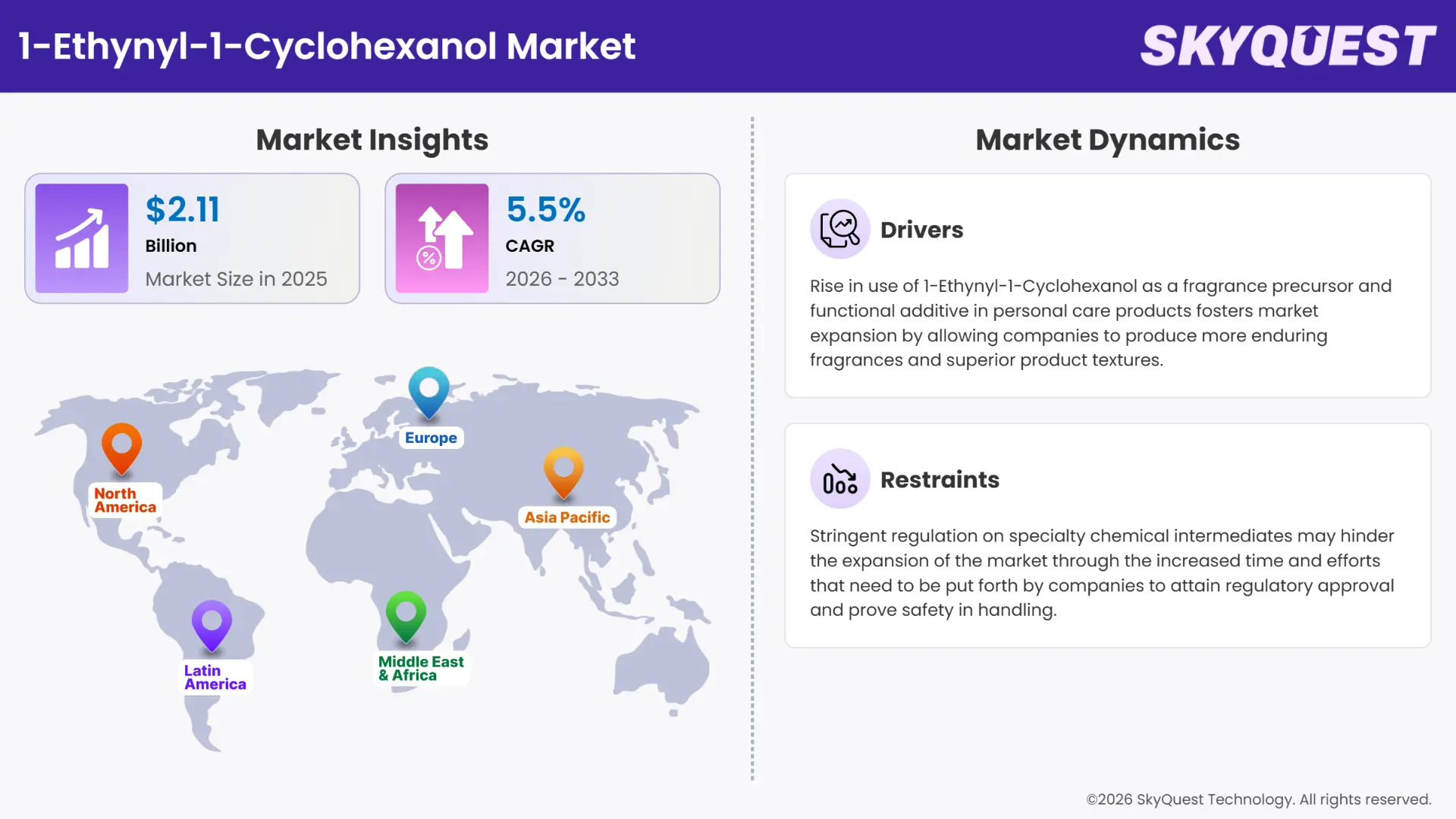
Global 1-Ethynyl-1-Cyclohexanol Market size was valued at USD 2.0 Billion in 2024 and is poised to grow from USD 2.11 Billion in 2025 to USD 3.24 Billion by 2033, growing at a CAGR of 5.5% during the forecast period (2026-2033).
Key Takeaways: Market Trends & Insights
Growing demand for specialty chemical intermediates, increasing use in pharmaceutical and agrochemical synthesis, rising focus on high-purity compounds, advancements in chemical processing technologies, and emphasis on efficient production methods are driving sales of 1-ethynyl-1-cyclohexanol.
The strong preference of end users for intermediates with high purity and customization, coupled with the growing tendency of outsourcing the manufacturing process to third-party manufacturers, will fuel 1-ethynyl-1-cyclohexanol in the coming years The improvement in catalytic reactions and flow processes will enhance the efficiency of production while decreasing cost. A surge in use of 1-ethynyl-1-cyclohexanol in pharmaceutical and agrochemical manufacturing is also expected to create new opportunities in the future. Growing demand for advanced chemical building blocks around the world coupled with increasing focus on efficient and sustainable synthesis is expected to primarily drive 1-ethynyl-1-cyclohexanol market growth.
On the contrary, high production costs, stringent regulatory requirements, volatility in raw material supply, and challenges in maintaining consistent purity levels are anticipated to slow down 1-ethynyl-1-cyclohexanol market penetration through 2033.
How is AI Enhancing Demand Forecasting in the 1-Ethynyl-1-Cyclohexanol Market?
AI technologies are revolutionizing the process of demand forecasting in the 1-ethynyl-1-cyclohexanol industry through data analysis alongside supply chain knowledge. Corporations have started incorporating data on customer demand, quality control measures, and material costs to AI platforms. Such an approach will minimize overproduction or shortage of products. The use of AI technology also enables suppliers to prioritize orders and schedule production according to demand requirements. AI makes it easier for manufacturers to manage irregular order placement and lengthy lead time issues, detect shifts in demand within the pharmaceuticals and specialty polymers sector, and plan for production capacity.
In March 2025, Eastman collaborated with Mitsubishi Chemical to scale production of 1-ethynyl-1-cyclohexanol derivatives. This improves supply visibility and provides better data for AI models, leading to more accurate forecasts and improved market efficiency.
To get more insights on this market click here to Request a Free Sample Report
Global 1-ethynyl-1-cyclohexanol market is segmented by product purity, physical form, application, end-use industry, and region. Based on product purity, the market is segmented into High purity grade and standard industrial grade. Based on physical form, the market is segmented into crystalline solid/flakes and liquid/solution. Based on application/functional use, the market is segmented into chemical intermediates, silicone rubber inhibitors, pharmaceutical synthesis, and fragrance & flavor stabilizers. Based on end-use industry, the market is segmented into specialty chemical manufacturing, pharmaceutical & biotech, and polymer & plastic additives. Based on region, the market is segmented into North America, Europe, Asia Pacific, Latin America, and Middle East & Africa.
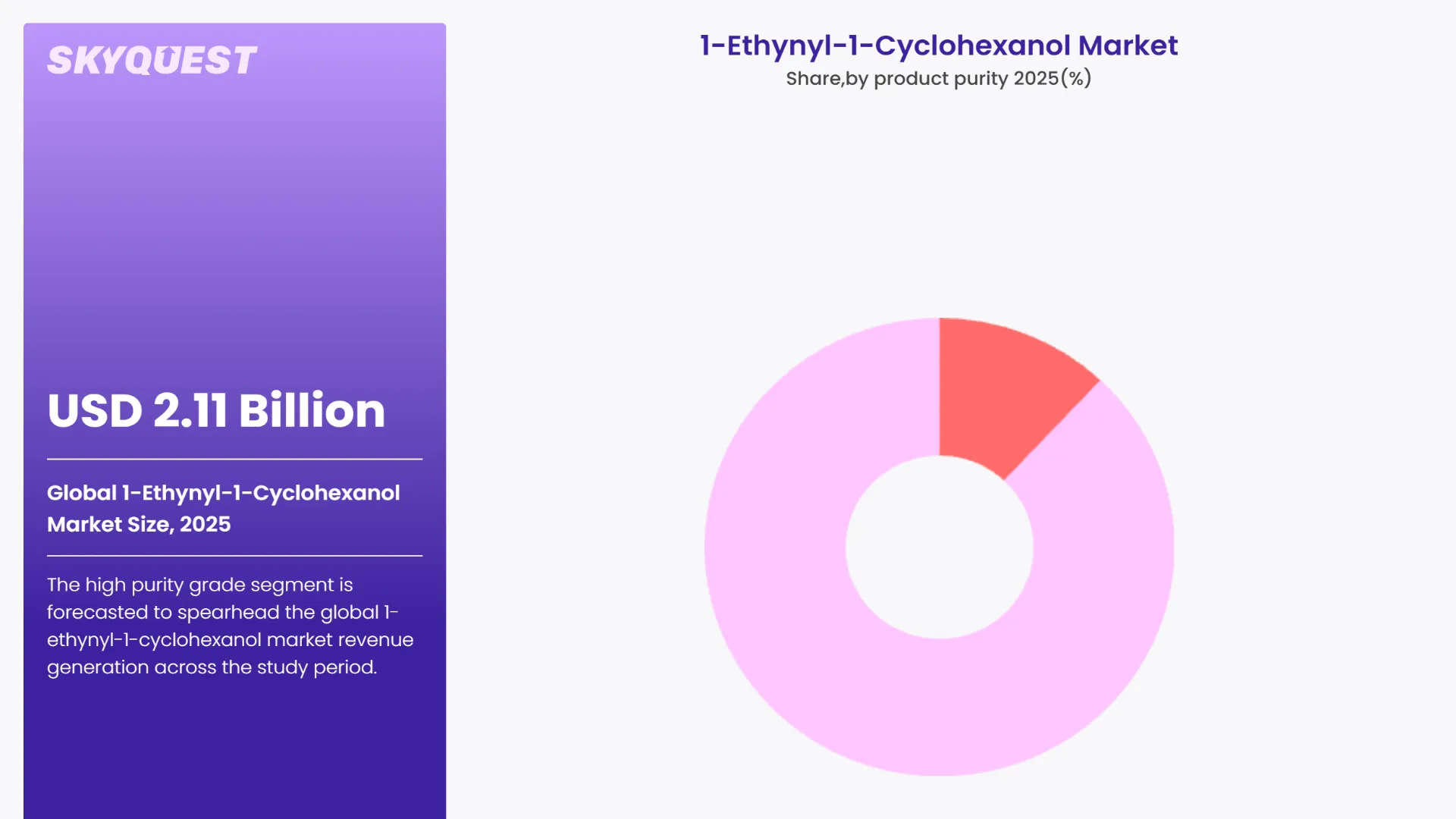
The high purity grade segment is forecasted to spearhead the global 1-ethynyl-1-cyclohexanol market revenue generation across the study period. Stringent application requirements in pharmaceutical synthesis and specialty chemical intermediates require minimal impurities and consistent performance. Higher levels of purity are preferred by the manufacturing companies because they help achieve reaction selectivity, minimize purification efforts, and comply with quality requirements set by the authorities, hence encouraging the buying companies to acquire premium quality products. This, in turn, encourages manufacturers to produce high-quality products through efficient production processes.
However, standard industrial grade is becoming the most rapidly expanding segment as per this 1-ethynyl-1-cyclohexanol industry analysis. Rising adoption in bulk chemical intermediate applications and cost sensitive formulations creates new business scope. Low cost and adequate performance capabilities make the technology more popular, thereby facilitating its use in large-scale operations and increasing demand volumes which present an opportunity for volume-based companies.
The chemical intermediates segment is forecasted to account for the highest global 1-ethynyl-1-cyclohexanol market share in the future. Use of 1-ethynyl-1-cyclohexanol as a critical building block for downstream synthesis in silicone rubber inhibitors, pharmaceutical routes, and specialty polymer additives helps this segment hold sway over others. Its essential role in multiple industry verticals ensures sustained demand from industry. This also encourages producers to concentrate on custom manufacture and guarantees steady prices by ensuring continuity in sourcing and purchasing based on quality considerations.
On the other hand, pharmaceutical synthesis will see the most growth impetus since the R&D efforts in the pharmaceutical industry and molecule construction are progressively dependent on custom intermediate chemicals, which have known stereochemistry and purity. The demand for custom intermediates in novel therapy development and strict safety measures has driven innovations in producing and controlling their quality, which results in rapid application development and value creation.
To get detailed segments analysis, Request a Free Sample Report
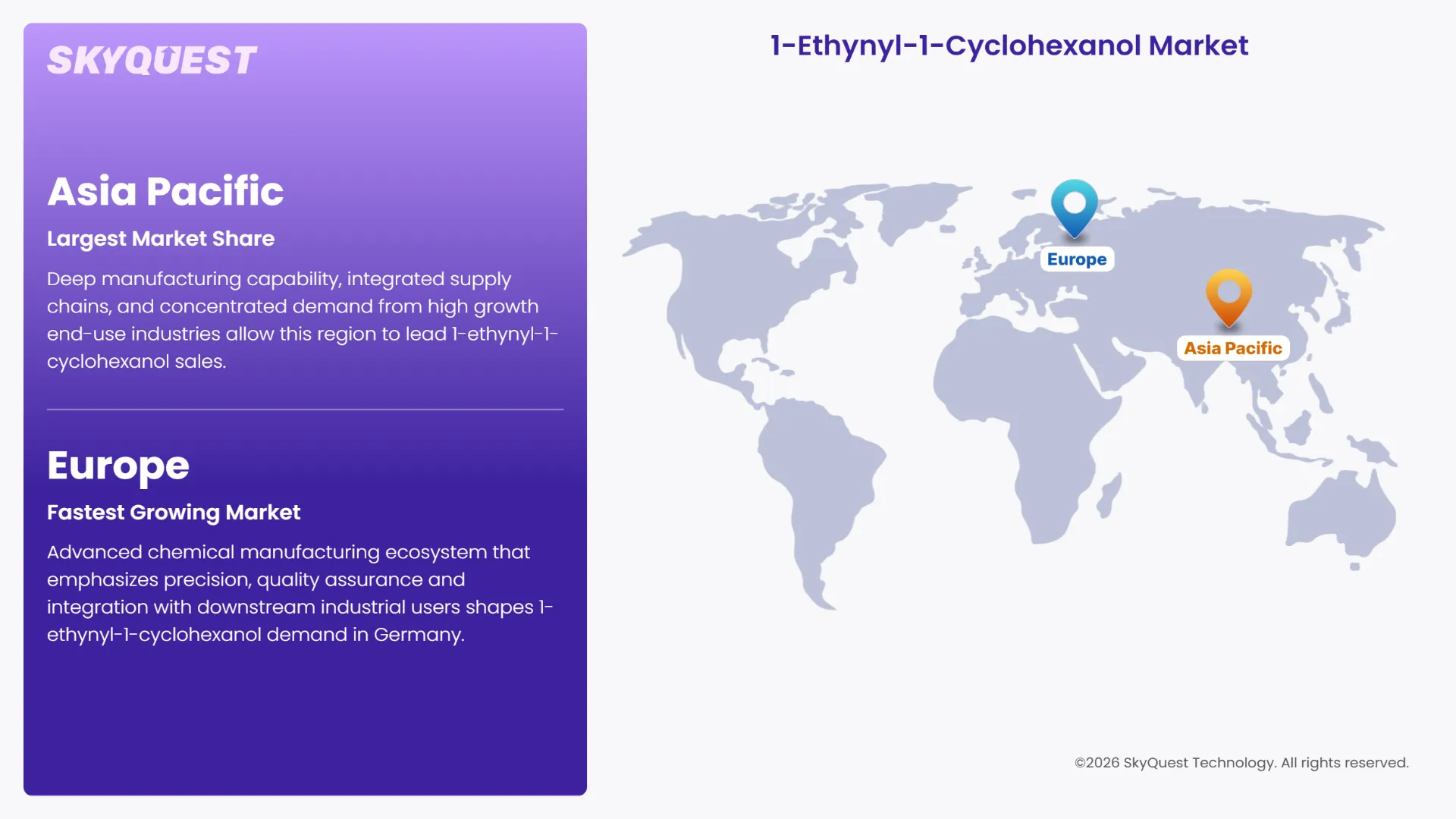
Deep manufacturing capability, integrated supply chains, and concentrated demand from high growth end-use industries allow this region to lead 1-ethynyl-1-cyclohexanol sales. Rising investments by governmental bodies and private companies in research to improve specialty chemical performance for continuous improvement to existing products also creates new business scope. Collaborations between industrial players and research institutions allow for higher levels of innovation related to process efficiencies and more sustainable production processes. The region's regulatory harmonization with the presence of major export markets and a cost-effective manufacturing base will further solidify the Asia Pacific region’s position as a leader in production and consumption of 1-ethynyl-1-cyclohexanol. Established industrial clusters in the chemical industry combined with a wide network of contract manufacturers allows for the rapid scaling of 1-ethynyl-1-cyclohexanol production operations in the region.
High technical sophistication, focus on premium applications, and stringent quality expectations are boosting demand for 1-ethynyl-1-cyclohexanol in Japan. Favorable regulatory environments facilitate ethical manufacturing processes and easy market entry for novel compounds and formulations. Advanced research centers and reputable producers of specialty chemicals work hand-in-hand to refine processes and improve performance capabilities. Close connections with precision manufacturing industries and formulators ensure consistent growth of custom grades.
Agile manufacturing networks and an innovation-oriented industrial ecosystem are helping shape 1-ethynyl-1-cyclohexanol procurement in South Korea. Excellent cooperation between international and indigenous businesses facilitates knowledge transfer and development of potential applications. Agile contract manufacturing companies offer adaptability services to local and regional customers, and process intensification strategies enable competitiveness in production.
Demanding regulatory standards, a mature industrial base for specialty chemicals, and a strong emphasis on sustainability are helping boost adoption of 1-ethynyl-1-cyclohexanol in Europe. Through investments in process safety, reduction in solvent use, and alternative feedstock strategies, the expansion of new capacities and products is being supported. Collaborative activities across borders which include R&D, industry alliances, and downstream brands will help accelerate the development of innovative value-added blends and certified sustainable products, thus enhancing the market’s credibility. Additionally, strategically located manufacturing, coupled with robust logistic networks, supports a consistent supply to both European and adjacent export markets.
Advanced chemical manufacturing ecosystem that emphasizes precision, quality assurance and integration with downstream industrial users shapes 1-ethynyl-1-cyclohexanol demand in Germany. Strict approach towards adherence to norms and constant process optimization help create high-value intermediaries for various applications. Established chemical clusters ensure efficient coordination between suppliers, contract processing companies and formulation facilities for quick adaptation of products to individual needs of end-users.
Emphasis on innovation, niche specialization, and close links to academic research are helping boost the demand for 1-ethynyl-1-cyclohexanol in the United Kingdom. Clear regulation and an active entrepreneurial environment facilitate innovation in processes as well as collaborations towards product differentiation. Agile specialized chemical manufacturers as well as software providers are cashing in on the need for custom intermediates in high-end personal care and specialty chemicals.
Strong cosmetics and fragrance manufacturing base, proactive industrial funding, and clustering of specialty chemical expertise supports steady 1-ethynyl-1-cyclohexanol demand in France. The investment in sustainable process routes, as well as collaborations between brand owners and ingredient producers, is leading to the adoption of value-added, certified ingredients. Hubs will assist with transferring technologies, scaling applications and application-driven formulation.
Targeted capacity additions, increased emphasis on supply chain resilience, and strategic investments in specialty chemical innovation helps boost adoption of 1-ethynyl-1-cyclohexanol in North America. Collaborations of manufacturers with universities and independent research organizations help develop new methods for synthesizing chemicals while introducing more environmentally friendly production methods in keeping with current customer demands for a sustainable supply chain. North America's proximity to major end-use markets, along with its efficient transportation and logistics capabilities, provide a high level of efficiency for distributing goods within the region. Furthermore, the ability of contract development and manufacturing organizations in North America to develop and manufacture products quickly for new applications and niche products allows North American chemical manufacturers to compete globally more effectively. Manufacturers are also utilizing flexible manufacturing processes and quality assurance systems to address the varying needs of their customers in the pharmaceutical, personal care and industrial markets.
Robust innovation ecosystem, significant private investment, and close ties between manufacturers and leading end users drive consistent 1-ethynyl-1-cyclohexanol demand in the United States. Effective collaborations in R&D and developed contract manufacturing ensure quick product development and market adaptation to various requirements. The need for high-grade intermediates in medicines and expensive cosmetics is the key factor behind the creation of sophisticated versions and effective quality management.
Niche production, strong environmental stewardship, and collaborative networks that link specialty producers with North American supply chains boost 1-ethynyl-1-cyclohexanol sales in Canada. Collaboration with research organizations and investments have facilitated the ability of Canadian manufacturers to cater to their local demands and exports too. Proximity of major markets and attention to sustainable manufacturing processes have ensured competitiveness for high-quality intermediates in the country.
To know more about the market opportunities by region and country, click here to
Buy The Complete Report
Rising Demand In Personal Care
Rise in use of 1-Ethynyl-1-Cyclohexanol as a fragrance precursor and functional additive in personal care products fosters market expansion by allowing companies to produce more enduring fragrances and superior product textures. The chemical characteristics of 1-Ethynyl-1-Cyclohexanol allow for formulation versatility, which minimizes the need for testing on the part of the formulator and streamlines product innovation. As personal care companies look for unique sensory experiences and greater stability in their products, there is a rising requirement for dependable precursors, leading to increased manufacturing and sourcing investments.
Improved Synthesis And Production
More efficient pathways and processes of production have made it easier for companies producing the drug to ensure stable supply while overcoming other bottlenecks in scaling up the production. New developments such as catalysis, intensified processes, and impurity management allow for the production of the same to maintain consistency in quality and tailor its production to meet varying demands by different customers. This makes the company interested in investing in partnerships that will provide raw materials for the product's production.
Stringent Regulatory Compliance Requirements
Stringent regulation on specialty chemical intermediates may hinder the expansion of the market through the increased time and efforts that need to be put forth by companies to attain regulatory approval and prove safety in handling. Regulations will involve extra efforts and expenses on testing and documentation as well as changes in production processes, adding to complexities in operation. This is especially tough for smaller players who may not be able to cope with regulatory requirements, thereby limiting suppliers and hampering 1-ethynyl-1-cyclohexanol market outlook.
Feedstock Availability And Variability
A dependence on particular sources and types of feedstocks might act as an inhibitor of the market’s growth since the fluctuations in their availability and purity pose some logistics issues that create complications in the manufacturing process. Quality changes in precursors lead to extra treatment and higher costs due to tighter quality controls, while few other sources mean less flexibility in meeting demand and scale-up of operations. Therefore, there might be difficulties for manufacturers to provide a consistent supply of the product to its formulator clients.
Request Free Customization of this report to help us to meet your business objectives.
The global 1-Ethynyl-1-Cyclohexanol competitive landscape is fragmented with specialist fine chemical manufacturers vying on regulatory compliance, secure sourcing, and sustainable synthesis. Meeting compliance requirements and developing sustainable products is also a key priority for multiple 1-ethynyl-1-cyclohexanol companies. Here are a couple of startups that could change the future of 1-ethynyl-1-cyclohexanol demand as per this 1-ethynyl-1-cyclohexanol market analysis.
SkyQuest’s ABIRAW (Advanced Business Intelligence, Research & Analysis Wing) is our Business Information Services team that Collects, Collates, Correlates, and Analyses the Data collected by means of Primary Exploratory Research backed by robust Secondary Desk research.
As per SkyQuest analysis, rising demand for specialty chemical intermediates and increasing adoption in pharmaceutical and agrochemical synthesis are anticipated to drive the demand for 1-ethynyl-1-cyclohexanol going forward. However, high production costs, stringent regulatory requirements, and raw material supply volatility are slated to slow down the adoption of 1-ethynyl-1-cyclohexanol in the future. Asia Pacific is slated to spearhead the demand for 1-ethynyl-1-cyclohexanol owing to strong presence of pharmaceutical manufacturers, advanced chemical production infrastructure, and high investment in specialty chemicals. Advancements in AI-driven demand forecasting, development of high-purity intermediates, and adoption of continuous flow synthesis technologies are anticipated to be key trends driving the 1-ethynyl-1-cyclohexanol sector across the study period.
| Report Metric | Details |
|---|---|
| Market size value in 2024 | USD 2.0 Billion |
| Market size value in 2033 | USD 3.24 Billion |
| Growth Rate | 5.5% |
| Base year | 2024 |
| Forecast period | 2026-2033 |
| Forecast Unit (Value) | USD Billion |
| Segments covered |
|
| Regions covered | North America (US, Canada), Europe (Germany, France, United Kingdom, Italy, Spain, Rest of Europe), Asia Pacific (China, India, Japan, Rest of Asia-Pacific), Latin America (Brazil, Rest of Latin America), Middle East & Africa (South Africa, GCC Countries, Rest of MEA) |
| Companies covered |
|
| Customization scope | Free report customization with purchase. Customization includes:-
|
To get a free trial access to our platform which is a one stop solution for all your data requirements for quicker decision making. This platform allows you to compare markets, competitors who are prominent in the market, and mega trends that are influencing the dynamics in the market. Also, get access to detailed SkyQuest exclusive matrix.
Table Of Content
Executive Summary
Market overview
Parent Market Analysis
Market overview
Market size
KEY MARKET INSIGHTS
COVID IMPACT
MARKET DYNAMICS & OUTLOOK
Market Size by Region
KEY COMPANY PROFILES
Methodology
For the 1-Ethynyl-1-Cyclohexanol Market, our research methodology involved a mixture of primary and secondary data sources. Key steps involved in the research process are listed below:
1. Information Procurement: This stage involved the procurement of Market data or related information via primary and secondary sources. The various secondary sources used included various company websites, annual reports, trade databases, and paid databases such as Hoover's, Bloomberg Business, Factiva, and Avention. Our team did 45 primary interactions Globally which included several stakeholders such as manufacturers, customers, key opinion leaders, etc. Overall, information procurement was one of the most extensive stages in our research process.
2. Information Analysis: This step involved triangulation of data through bottom-up and top-down approaches to estimate and validate the total size and future estimate of the 1-Ethynyl-1-Cyclohexanol Market.
3. Report Formulation: The final step entailed the placement of data points in appropriate Market spaces in an attempt to deduce viable conclusions.
4. Validation & Publishing: Validation is the most important step in the process. Validation & re-validation via an intricately designed process helped us finalize data points to be used for final calculations. The final Market estimates and forecasts were then aligned and sent to our panel of industry experts for validation of data. Once the validation was done the report was sent to our Quality Assurance team to ensure adherence to style guides, consistency & design.
Analyst Support
Customization Options
With the given market data, our dedicated team of analysts can offer you the following customization options are available for the 1-Ethynyl-1-Cyclohexanol Market:
Product Analysis: Product matrix, which offers a detailed comparison of the product portfolio of companies.
Regional Analysis: Further analysis of the 1-Ethynyl-1-Cyclohexanol Market for additional countries.
Competitive Analysis: Detailed analysis and profiling of additional Market players & comparative analysis of competitive products.
Go to Market Strategy: Find the high-growth channels to invest your marketing efforts and increase your customer base.
Innovation Mapping: Identify racial solutions and innovation, connected to deep ecosystems of innovators, start-ups, academics, and strategic partners.
Category Intelligence: Customized intelligence that is relevant to their supply Markets will enable them to make smarter sourcing decisions and improve their category management.
Public Company Transcript Analysis: To improve the investment performance by generating new alpha and making better-informed decisions.
Social Media Listening: To analyze the conversations and trends happening not just around your brand, but around your industry as a whole, and use those insights to make better Marketing decisions.
REQUEST FOR SAMPLE
 REQUEST FREE CUSTOMIZATION
Global 1-Ethynyl-1-Cyclohexanol Market size was valued at USD 2.0 Billion in 2024 and is poised to grow from USD 2.11 Billion in 2025 to USD 3.24 Billion by 2033, growing at a CAGR of 5.5% during the forecast period (2026-2033).
The global 1-Ethynyl-1-Cyclohexanol competitive landscape is fragmented with specialist fine chemical manufacturers vying on regulatory compliance, secure sourcing, and sustainable synthesis. Market drivers tied to competition include REACH and export compliance requirements and buyer preference for low carbon production methods. Real strategies visible now include acquisitions such as Eastman Chemical acquiring Taminco, capacity partnerships like BASF Petronas expansions, and process technology upgrades to reduce environmental footprint and improve traceability. 'BASF SE', 'Evonik Industries', 'Huangshan Basihui Chemical', 'Shanghai Shenyue Biotech', 'Merck KGaA', 'TCI Chemicals', 'Thermo Fisher Scientific', 'Santa Cruz Biotechnology', 'Wako Pure Chemical', 'Oakwood Chemical', 'Alfa Aesar', 'Acros Organics', 'Fluorochem Ltd.', 'J&K Scientific', 'Meryer Chemical', 'Combi-Blocks', 'Advanced Synthesis Tech', 'Zelinsky Institute', 'Sisco Research Labs', 'Glentham Life Sciences'
The expanding use of 1-Ethynyl-1-Cyclohexanol as a fragrance intermediate and functional ingredient in personal care formulations supports market growth by enabling manufacturers to create longer-lasting scents and improved product textures. Its chemical properties permit formulation flexibility, which reduces formulator trial time and facilitates new product development. As personal care brands seek differentiated sensory profiles and stability, demand for reliable intermediates grows, encouraging investment in production capacity and supplier relationships. This sustained formulation demand underpins commercial interest and spurs broader adoption across product lines.
Sustainable Consumer Formulations: Growing consumer focus on cleaner, milder product portfolios is driving formulators to favor multifunctional intermediates that enable lower concentrations, gentle sensory profiles, and biodegradability. Manufacturers emphasize greener manufacturing routes and compatibility with natural-derived ingredients to address brand sustainability narratives. This trend encourages product differentiation through perceived safety and environmental stewardship, pushing suppliers to offer documentation, supply-chain transparency, and product stewardship services that simplify adoption by personal care and household brands looking to meet shifting consumer expectations without compromising performance.
Asia Pacific Dominate the Global 1-Ethynyl-1-Cyclohexanol Market.
The Standard Industrial Grade segment currently holds the largest share of the global market due to its extensive use across specialty chemical manufacturing and industrial applications.
The compound is widely used as a chemical intermediate, silicone rubber inhibitor, pharmaceutical synthesis ingredient, and fragrance & flavor stabilizer across multiple industries.
AI is improving demand forecasting, production planning, inventory management, and supply chain visibility by analyzing customer demand patterns, material costs, and quality control data.


Want to customize this report? This report can be personalized according to your needs. Our analysts and industry experts will work directly with you to understand your requirements and provide you with customized data in a short amount of time. We offer $1000 worth of FREE customization at the time of purchase.
Feedback From Our Clients


 USA (+1) 351-333-4748

